Short version: yes, Japan is one of the easiest countries on earth to backpack solo, even on a budget, as long as you plan a bit.
Why it’s easy:
- Trains run on time, signs are usually in English + Japanese, and people are helpful even if they don’t speak much English.
- Crime rates are low, so walking with a pack at night or taking late trains usually feels safe.
- Convenience stores (7-Eleven, Lawson, FamilyMart) are everywhere and sell cheap, decent food, ATMs, and SIM top‑ups.
What can trip you up:
- Accommodation can be pricier than Southeast Asia or Latin America, so you need to be deliberate: hostels, business hotels, and overnight buses are your friends.
- Rural areas have fewer English signs and fewer trains, so you need to check schedules instead of winging it.
- Cash is still important in small towns, older restaurants, and some guesthouses, so always keep a backup stash of yen.
Backpacker‑friendly tips:
- Stay in hostels and guesthouses; they’re clean, social, and often include free tea/coffee and sometimes breakfast.
- Use IC cards (Suica, Pasmo, Icoca) for tap‑on/tap‑off travel in cities; it saves time and confusion at ticket machines.
- Use luggage lockers at stations to day‑trip with a small bag instead of hauling your full pack.
- Night buses between major cities are cheaper than the bullet train and double as a night’s accommodation.
If you’re comfortable navigating Europe by train or Southeast Asia by bus, Japan will feel organized and surprisingly forgiving, as long as you respect schedules and keep an eye on your budget.
For a first backpacking trip, 10–14 days is the sweet spot; 3–4 weeks lets you go deeper without rushing.
Rough time guidelines:
- 5–7 days (ultra‑short): Focus on 1–2 hubs. Example: Tokyo (4 nights) + Kyoto (3 nights) with a day trip or two. You’ll see the hits but spend more time on trains than I’d like.
- 10–14 days (ideal first trip): Tokyo + Kyoto/Osaka + 1–2 side areas (Hakone/Fuji, Kanazawa, Hiroshima/Miyajima, or the Japanese Alps). Enough time to mix big‑city energy with small‑town walks and hot springs.
- 3–4 weeks (backpacker pace): Add northern Honshu (Tohoku), Shikoku, Kyushu, or Okinawa. You can slow down, chase local festivals, and hike more.
Budget traveler angle:
- Fewer bases, longer stays: Changing cities every day burns money on transport and check‑in/check‑out time. Aim for 3+ nights per base.
- Rail passes only pay off if you’re doing multiple long‑distance hops in a short window; for a slower, regional trip, regular tickets and buses can be cheaper.
- Build in at least one “do nothing” day per week to wander neighborhoods, eat convenience‑store lunches, and let your budget breathe.
If you’re flying a long way, anything under a week feels rushed. If you can swing 2 weeks, you’ll actually feel Japan’s rhythm instead of just collecting sights.
Yes, you can absolutely get around Japan without a car, and for most backpackers it’s actually easier and cheaper to avoid driving.
How you’ll move:
- Trains: The backbone of your trip. Shinkansen (bullet trains) connect major cities fast; local and rapid trains cover suburbs and smaller towns. They’re clean, safe, and run often.
- Buses: Highway buses are cheaper than shinkansen for long distances and good for night travel. Local buses fill gaps in rural areas and around mountains, lakes, and onsen towns.
- Metro + trams: Tokyo, Osaka, Kyoto, Hiroshima, and others have dense metro or tram systems that make city travel simple.
- Ferries: Useful for islands (Miyajima, Naoshima, Okinawa region, and smaller local islands).
Tickets and passes:
- IC cards (Suica, Pasmo, Icoca, etc.) let you tap in/out on most trains, subways, and buses in cities and many regions. They’re ideal for backpackers who don’t want to decode every fare chart.
- Regional rail passes can be good value if you’re doing several long rides in a short time in one area (e.g., Kansai, Kyushu).
- For ultra‑budget, compare: night bus vs. rail pass vs. individual shinkansen tickets; the cheapest option changes depending on your route and pace.
When a car helps but isn’t essential:
- Deep countryside (remote onsen, tiny villages, trailheads with few buses) can be awkward by public transport, but still possible if you time buses carefully and accept some long walks.
- Hokkaido in winter and some remote hiking areas are more flexible with a car, but as a budget traveler you can still stitch together trains, buses, and the occasional taxi share with hostel mates.
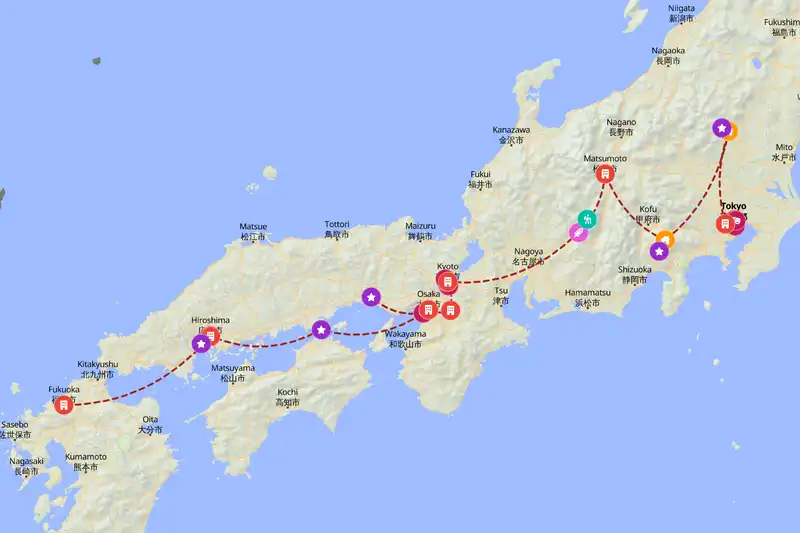
For 90% of backpacking routes—Tokyo–Kyoto–Osaka–Hiroshima–Alps–Kanazawa–Fukuoka—you’re better off without a car: fewer costs, no parking stress, and no driving rules to worry about.
For budget backpackers, “must‑visit” means places with strong character, good cheap food, and easy logistics. These are the ones that consistently deliver:
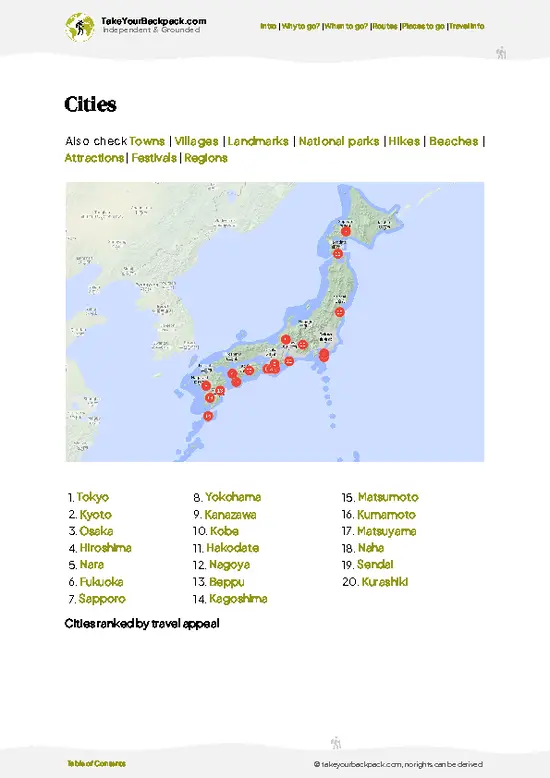
Tokyo (4–6 nights)
- Why: It’s like several cities stitched together—neon chaos, quiet shrines, weird subcultures, and tiny bars stacked in alleys.
- Budget perks: Endless cheap eats (gyudon chains, ramen counters, convenience stores), free viewpoints in some government buildings, and neighborhoods that are fun just to wander.
- Focus areas: Shinjuku, Shibuya, Asakusa, Ueno, Shimokitazawa, Kichijoji, Akihabara if you’re into anime/games.
Kyoto (3–4 nights)
- Why: Temples, old streets, and that “this is the Japan I imagined” feeling.
- Budget perks: Many shrines are free; you can walk or bus between clusters of sights instead of paying for tours.
- Focus areas: Fushimi Inari (go early or late), Arashiyama (bamboo + riverside), Higashiyama and Gion backstreets.
Osaka (2–3 nights, or as a Kyoto base)
- Why: Food city with a casual, slightly rowdier vibe than Tokyo.
- Budget perks: Street food and cheap izakaya in Dotonbori and Shinsekai; good hostel scene; easy day trips to Nara and Kobe.
Hiroshima + Miyajima (1–2 nights)
- Why: Hiroshima for history and resilience; Miyajima for the floating torii gate and island walks.
- Budget perks: You can do Hiroshima as a day trip from Osaka/Okayama if money is tight; Miyajima can be a half‑day if you move efficiently.
Japanese Alps (Kamikochi, Takayama, Matsumoto, or Nagano area) (2–4 nights)
- Why: Mountain air, rivers, and traditional towns break up the city overload.
- Budget perks: Hostel dorms, simple set meals, and free hiking trails; onsen can be a splurge but worth one or two visits.
Kanazawa (1–2 nights)
- Why: Compact city with a top‑tier garden, samurai and geisha districts, and good seafood.
- Budget perks: Walkable, so you save on transport; many sights are low‑cost or free to just wander around.
If you have extra time:
- Fukuoka / Nagasaki (Kyushu): Great food, laid‑back cities, and easy side trips.
- Shikoku (e.g., Tokushima, Kochi, or the 88‑temple route sections): Quieter, more local feel, good for hikers.
- Okinawa (if you’re chasing beaches and don’t mind the extra transport cost).
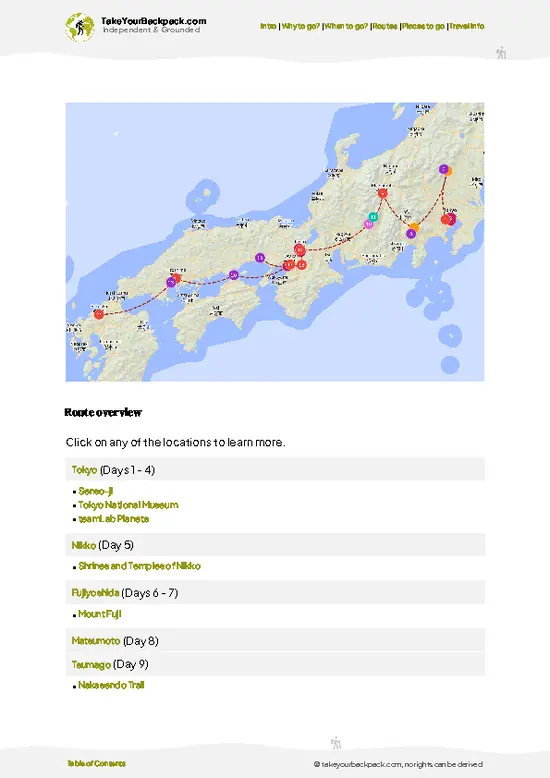
If it’s your first trip and you’re on a budget, a strong core route is: Tokyo → Alps (Takayama/Matsumoto) → Kanazawa → Kyoto/Osaka → Hiroshima/Miyajima.
If you’re short on time or cash, skip anything that eats hours of transit for a single photo or feels like a weaker version of something you’re already seeing.
Common things backpackers can skip or downsize:
- Over‑templing in Kyoto and Nara: You don’t need to see every famous temple. Pick a few with different moods (e.g., Fushimi Inari for gates, Kiyomizu‑dera for views, one Zen garden, one mossy/quiet temple) and skip the rest.
- Tokyo’s paid observation decks: The views are nice, but if money or time is tight, use free viewpoints (like certain government buildings) and enjoy street‑level neighborhoods instead.
- Overpriced theme parks (unless you’re a super‑fan): Tokyo Disneyland/DisneySea and Universal Studios Japan are fun but expensive and time‑draining. If you’re counting yen, that money goes further on local food, trains, and a good onsen.
- Rushing all the way to Hokkaido or Okinawa on a short trip: Both are great, but they’re far. On a 1–2 week itinerary, the extra flights or long trains eat days you could spend exploring closer regions. Save them for a future, slower trip.
- Hyper‑touristy animal attractions: Owl cafés, questionable animal cafés, and some over‑commercialized deer experiences can feel gimmicky and ethically murky. If you want animals, Nara’s deer for an hour or two is enough; then move on.
- Shopping districts that repeat the same chains: Once you’ve walked Shibuya/Shinjuku or Umeda/Namba, you don’t need to chase every big mall area in every city. Use that time for a neighborhood with character or a park.
Strategic cuts if you’re really squeezed:
- On a 7–10 day trip, consider skipping Hiroshima/Miyajima or the Alps and focus on Tokyo + Kyoto/Osaka + 1 nearby side trip (Nara, Hakone, or Kamakura).
- On a 5–7 day trip, skip internal flights entirely; stick to one region (Kanto around Tokyo or Kansai around Kyoto/Osaka) to avoid burning time and money on long transfers.
The rule: if a place takes more than half a day of transit each way, it needs to offer something you can’t get anywhere else on your route. If it doesn’t, cut it and go deeper where you already are.