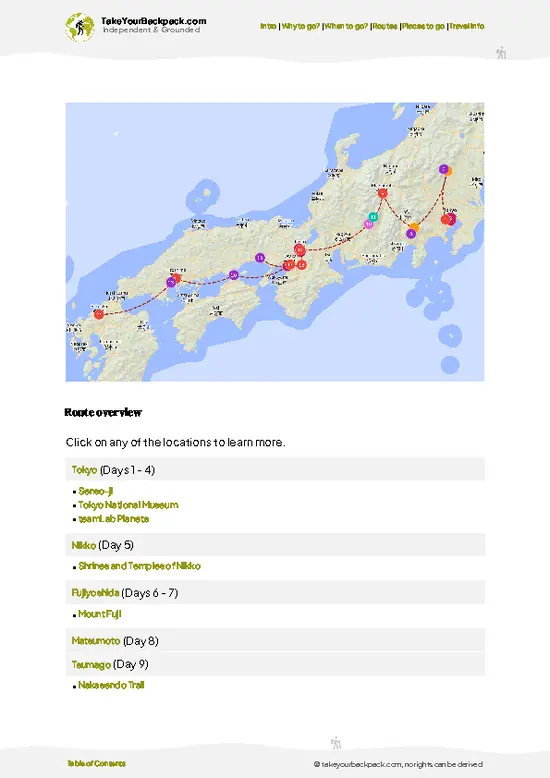
This three-week loop through Japan suits travelers who have a little time and want depth: big-city nights, a mountain post town, a contemporary art island and the food stalls of Kyushu. It moves west from Tokyo to Fukuoka at a relaxed pace, with no stop shorter than one night and only one truly long transit day. You’ll need shinkansen bullet trains, JR limited expresses, the private Tobu and Fujikyu lines, a highway bus from Shinjuku, local buses in the Kiso Valley and two short ferries, one to Naoshima and one to Miyajima.
Days 1-4: Tokyo
Four nights in
Tokyo gives jet lag a day to wear off and leaves time for the city’s quieter side. Start in Asakusa at
Senso-ji before 8am, when the Nakamise shopping street is still shuttered and you can hear the temple’s incense cauldron crackle. Walk about 25 minutes west to Ueno Park to the
Tokyo National Museum, which holds the largest collection of Japanese art anywhere; the Honkan building alone needs two to three hours. Give one afternoon to
teamLab …
read more 👉This three-week loop through Japan suits travelers who have a little time and want depth: big-city nights, a mountain post town, a contemporary art island and the food stalls of Kyushu. It moves west from Tokyo to Fukuoka at a relaxed pace, with no stop shorter than one night and only one truly long transit day. You’ll need shinkansen bullet trains, JR limited expresses, the private Tobu and Fujikyu lines, a highway bus from Shinjuku, local buses in the Kiso Valley and two short ferries, one to Naoshima and one to Miyajima.
Days 1-4: Tokyo
Four nights in Tokyo gives jet lag a day to wear off and leaves time for the city’s quieter side. Start in Asakusa at Senso-ji before 8am, when the Nakamise shopping street is still shuttered and you can hear the temple’s incense cauldron crackle. Walk about 25 minutes west to Ueno Park to the Tokyo National Museum, which holds the largest collection of Japanese art anywhere; the Honkan building alone needs two to three hours. Give one afternoon to teamLab Planets TOKYO in Toyosu, where you wade barefoot through knee-deep water inside the installations, and book a timed slot online because walk-ins sell out on weekends. Evenings belong to standing bars under the train tracks in Yurakucho, where a beer and skewers run ¥1,500 to 2,500 (US$10 to 17).Days 5-7: Nikko and Mount Fuji
Take the Tobu limited express from Asakusa to Nikko, about 2 hours for roughly ¥3,000 (US$20), and stay one night so you see the Shrines and Temples of Nikko after the tour buses leave. Toshogu is the opposite of Kyoto’s restraint: gold leaf, lacquer and hundreds of carved animals, set in cedar forest on a mountain slope. The next day is the route’s long haul. Ride back to Tokyo, then catch a highway bus from Busta Shinjuku to Lake Kawaguchi, about 2 hours, and settle into Fujiyoshida for two nights. Climb the roughly 400 steps to the Chureito Pagoda at dawn, the classic frame for Mount Fuji, and keep the second day flexible because the summit hides in cloud more often than it shows. From early July to early September you can swap that day for an overnight climb from the Yoshida Trail’s Fifth Station, 5 to 7 hours up, with an advance reservation and a mandatory trail fee.Days 8-9: Matsumoto and the Nakasendo Trail
Head inland via the Fujikyu line to Otsuki and the JR Azusa express to Matsumoto, about 2.5 to 3 hours in total. The black-walled castle here has one of the original wooden keeps in the country, and the steep ladders inside tell you more about samurai architecture than any museum panel. Next morning, continue about 1.5 hours down the Chuo line to Nagiso and stay in Tsumago, a post town where power lines are hidden and the main street still looks like the Edo period after the day visitors leave around 4pm. A minshuku with dinner and breakfast costs ¥12,000 to 18,000 (US$80 to 120) per person, and it is the splurge on this route that justifies the price. On day 10, walk the 8-kilometer stretch of the Nakasendo Trail over the pass to Magome, 2.5 to 3 hours through cedar woods and past waterwheels, then ride the bus to Nakatsugawa and the train to Nagoya for the shinkansen to Kyoto. In season, the tourist offices in both towns forward your bag for around ¥1,000 so you hike light.Days 10-13: Kyoto and Nara
Arriving in Kyoto in the afternoon leaves three full days. Go to Kinkaku-ji at opening (9am) to see the gold pavilion reflected in a still pond before the school groups arrive, then cross town to Nijo Castle, where the corridors of the shogun’s palace squeak underfoot on purpose, an early alarm against assassins. Save Fushimi Inari Taisha for late afternoon this time: walk up through the vermilion gates as the light drops, and the lanterns along the upper loop come on around dusk. Spend one day in Nara, 45 minutes away on the Kintetsu line, where Todai-ji’s bronze Buddha sits inside one of the largest wooden buildings in the world and semi-wild deer bow for crackers that sell for ¥200.Days 14-16: Osaka, Himeji-jo and Naoshima
Shift to Osaka, 15 minutes by shinkansen, for two nights of eating. The Osaka Aquarium Kaiyukan is built around a single central tank with a whale shark, and the ramp spirals down past it for eight floors; tickets cost about ¥2,700 to 3,500 depending on the date. On day 16, put your bag in a locker at Himeji station and walk 15 minutes up the main avenue to Himeji-jo, the best preserved original castle in Japan, white plaster on a hill. Continue by shinkansen to Okayama, then the JR Uno line and a 20-minute ferry to Naoshima. Sleep on the island so you have a full morning at the Chichu Art Museum, whose Monet room is lit only by daylight; book the timed ticket weeks ahead and avoid Mondays, when most museums close.Days 17-20: Hiroshima to Fukuoka
Ferry and train get you to Hiroshima by lunchtime, 40 minutes by shinkansen from Okayama. Give the Hiroshima Peace Memorial Museum two to three unhurried hours; entry is ¥200, and the personal belongings on display make it the most affecting stop in the country. Spend the second day on Miyajima at Itsukushima Shinto Shrine, a 10-minute ferry from Miyajimaguchi plus a ¥100 visitor tax, and check the tide table, since the great torii stands in water at high tide and on wet sand at low tide. Finish with two nights in Fukuoka, 65 minutes away by shinkansen. It is the easiest city on this route to just wander, with yatai food stalls along the river in Nakasu serving bowls of Hakata pork-bone ramen for ¥800 to 1,000, and an airport only 5 minutes from Hakata station on the subway.
If a friend had a spare afternoon in Fukuoka, I would send them on the 10-minute ferry from Meinohama to Nokonoshima, a small island park with seasonal flower fields facing the city skyline across the bay, and tell them to bring a picnic from a Hakata depachika.v2.webp)
 Best Backpacking