Yes, Lebanon is one of the easier countries in the Middle East to backpack on your own, because distances are short and English or French is spoken almost everywhere you’ll travel.
Most backpackers use
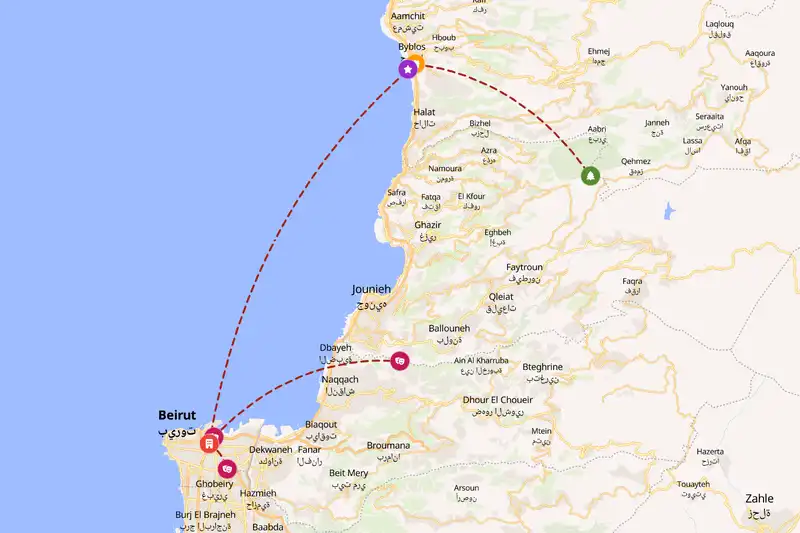
Beirut as a hub, with hostel dorms in Mar Mikhael and Hamra at roughly US$12 to 20 a night. Minibuses run along the coast to
Byblos in about an hour and to
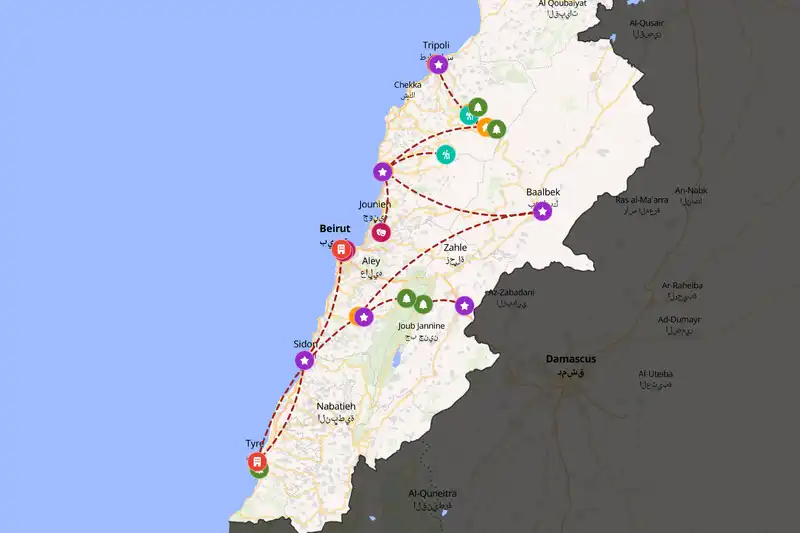
Tripoli in 1.5 to 2 hours for US$1 to 3. US dollars are accepted almost everywhere, so carry small bills. The harder part is the mountains: reaching the Cedars or the Shouf usually means a taxi at US$10 to 40. Before heading to
Tyre or the Bekaa, check your government’s current advice for the south and the border areas.
Ten days is the right amount of time for Lebanon if you want the main highlights without rushing, though five days covers one region well.
With
5 days, stay north: two nights in
Byblos with a trip to Jeita Grotto, then two nights in
Bcharre for the Qadisha Valley and the Cedars of God. With
10 days, add 3 nights in
Beirut, 2 in
Tripoli, 2 in the Shouf around Deir el Qamar and 2 at
Baalbek. With
15 days, you can include Tyre, Jezzine and Zahle too. No transfer in the country takes much more than 3 hours, so you lose very little time moving between bases.
Yes, you can travel most of Lebanon without a car, as long as you’re happy to use minibuses on the coast and hire a taxi for the final mountain stretches.
Vans from Beirut run north to
Byblos (about 1 hour) and
Tripoli (1.5 to 2 hours), and south to
Sidon (about 1 hour) and
Tyre (1.5 to 2 hours), for roughly US$1 to 4. Vans to the Bekaa reach Zahle in about 1.5 hours and
Baalbek in 2 to 2.5 hours. Vans from Tripoli climb to
Bcharre in about 1.5 hours. For the Cedars of God, the Shouf reserve or crossing from the Shouf to Anjar, a private driver costs US$40 to 100 for a full day.
The must-visits in Lebanon are the Roman temples of Baalbek, the old harbor town of Byblos, and the Qadisha Valley with the Cedars of God above it.
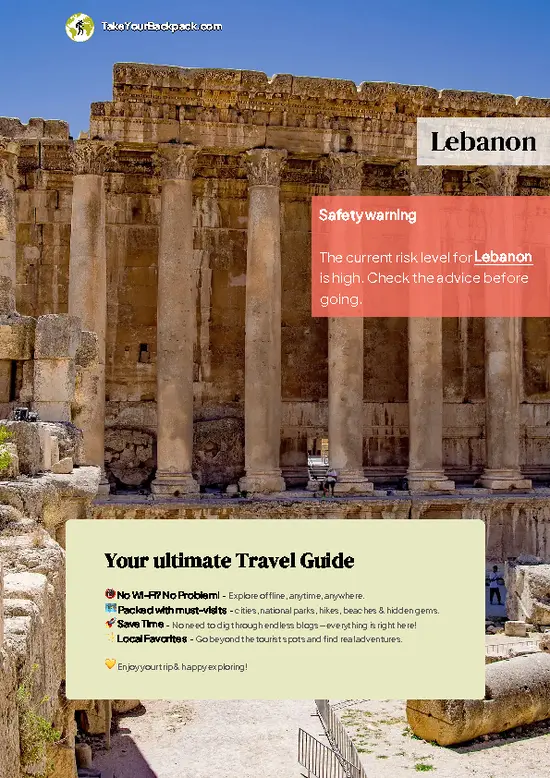
Baalbek needs a full day, 2 to 2.5 hours from Beirut, for the Temple of Bacchus and the giant quarried stones.
Byblos, an hour north of the capital, combines a Crusader castle with Bronze Age ruins and a swimmable beach. Based in
Bcharre, the Qadisha hike down to Qannoubine monastery takes 4 to 6 hours return. Add 2 to 3 days in
Beirut for the National Museum and the Corniche, and a day in
Tripoli for the Mamluk souks and the citadel.
Jeita Grotto works as a half-day stop north of Beirut.
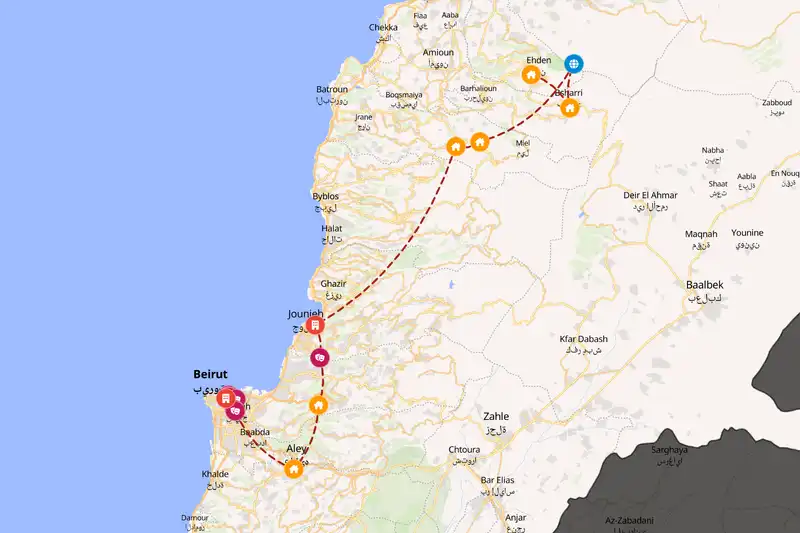
If time is short in Lebanon, skip the summer resort towns of Jounieh, Broummana and Aley, which are mostly about nightlife, hotels and traffic rather than sights.
In Beirut, the
Robert Mouawad Private Museum and the
MIM Mineral Museum are for jewelry or mineral fans only; the National Museum covers far more history in 2 hours.
Zahle is pleasant for a riverside lunch, but Baalbek and Anjar can both be done as day trips from Beirut without staying over. The far south, including
Bint Jbeil and
Marjayoun, is a long trip for little payoff on a short visit. Put the saved days toward the Qadisha Valley or an extra night in Byblos.
Yes, our itinerary-planner does exactly that. Set your trip length in days, give your interests and travel style, optionally give start- and end location and/or some mandatory stops you would like to include and the itinerary planner creates your personalized routes for Lebanon in seconds. Try it out!
Try the itinerary planner
 Best Backpacking