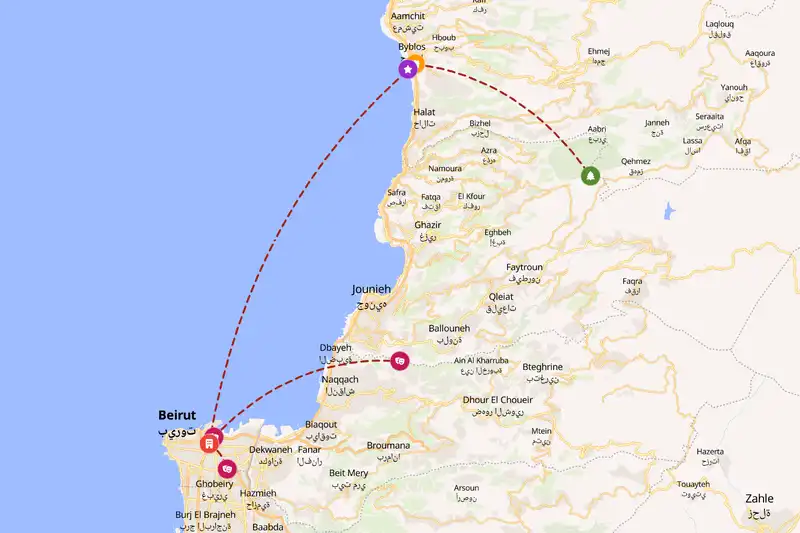
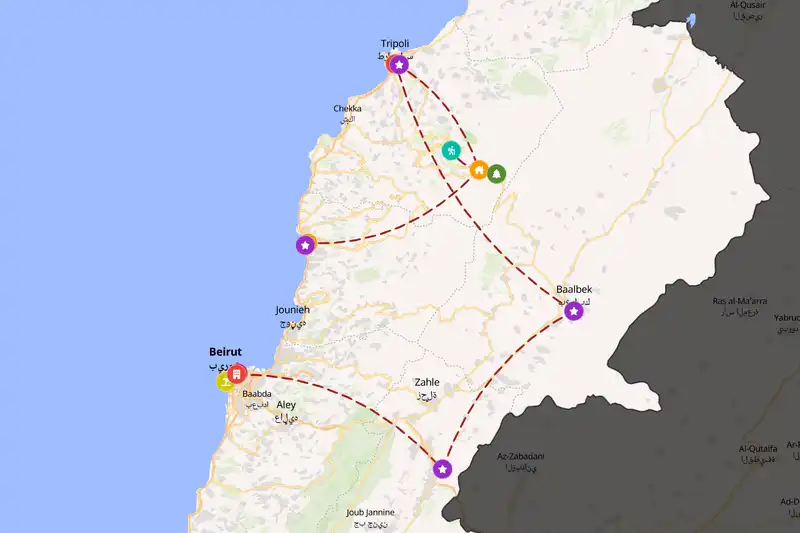
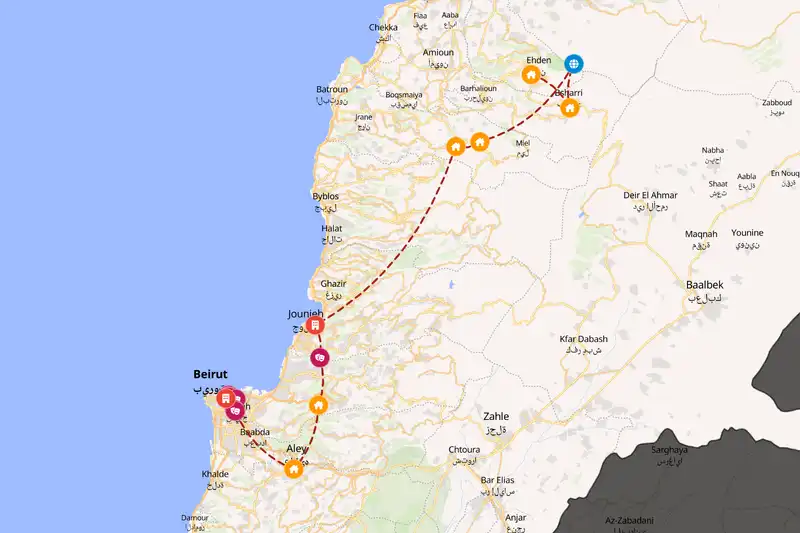
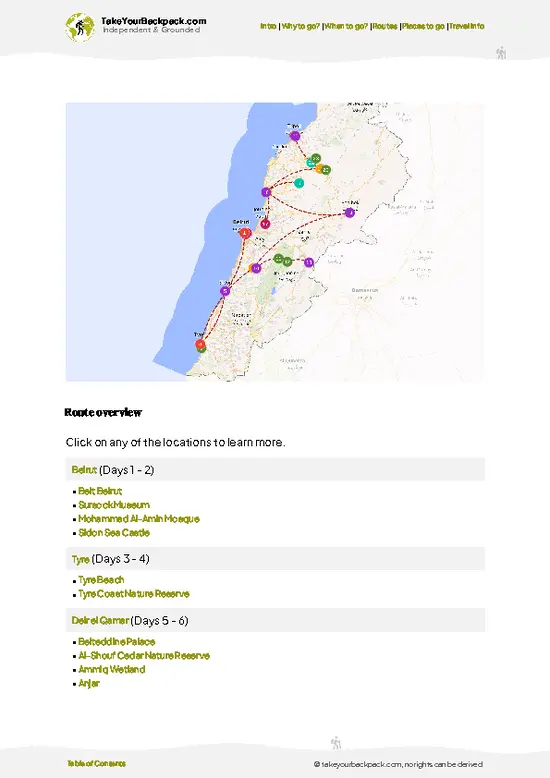
This fifteen-day route crosses Lebanon from the southern coast to the northern mountains, and it suits travelers who want the whole country rather than a sampler: Crusader sea castles, Umayyad and Roman ruins, cedar reserves, a gorge waterfall and the Mamluk souks of the north. The pace is relaxed, with bases of two or three nights and no back-to-back long travel days. Coastal buses, minibuses and shared taxis cover most legs; hire a driver for the Chouf-to-Bekaa crossing and for Baatara, where no public route works.
Days 1-2: Beirut
Read Beirut through its scars and its art.
Beit Beirut Museum occupies the yellow sandstone Barakat building on the old Green Line, where civil war snipers cut firing slits through the walls; the bullet-pocked facade has been kept on purpose. A short walk east, the
Sursock Museum shows modern Lebanese art inside a 1912 mansion that was badly damaged in the 2020 port explosion and has since been restored. Finish downtown at the
Mohammad Al-Amin Mosque, whose …
read more 👉This fifteen-day route crosses Lebanon from the southern coast to the northern mountains, and it suits travelers who want the whole country rather than a sampler: Crusader sea castles, Umayyad and Roman ruins, cedar reserves, a gorge waterfall and the Mamluk souks of the north. The pace is relaxed, with bases of two or three nights and no back-to-back long travel days. Coastal buses, minibuses and shared taxis cover most legs; hire a driver for the Chouf-to-Bekaa crossing and for Baatara, where no public route works.
Days 1-2: Beirut
Read Beirut through its scars and its art. Beit Beirut Museum occupies the yellow sandstone Barakat building on the old Green Line, where civil war snipers cut firing slits through the walls; the bullet-pocked facade has been kept on purpose. A short walk east, the Sursock Museum shows modern Lebanese art inside a 1912 mansion that was badly damaged in the 2020 port explosion and has since been restored. Finish downtown at the Mohammad Al-Amin Mosque, whose blue domes sit beside the tomb of former prime minister Rafic Hariri.Days 3-4: Sidon and Tyre
Head south by bus and break the trip in Sidon for the Saidon Sea Castle, a 13th-century Crusader fort on an islet reached by a stone causeway; an hour is enough. Then continue to Tyre for two nights. The Roman colonnaded street at Al-Mina runs straight toward the water, and the Al-Bass site holds one of the largest Roman hippodromes known. Give your second afternoon to Tyre Beach, the long sandy strip south of town, which forms part of the Tyre Coast Nature Reserve; loggerhead and green turtles nest here in summer, and the beach shacks serve grilled fish with arak.Days 5-6: Deir el Qamar and the Chouf
Ride back to Sidon and take a taxi up into the Chouf to Deir el Qamar, a town of honey-colored stone houses grouped around a fountain square and the old Fakhreddine mosque. Five kilometers away, Beiteddine Palace was built for Emir Bashir Shihab II in the early 19th century; its courtyards, inlaid ceilings and hammam are worth seeing, and the basement holds a large collection of Byzantine mosaics. On day six, a driver gets you to the Al-Shouf Cedar Nature Reserve through the Barouk or Maasser el Chouf entrance. It covers roughly 5 percent of the country, and the walk through old cedar stands along the ridge is cool even in August.Days 7-8: Across to the Bekaa
Cross the mountain with your driver and drop into the valley at the Ammiq Wetland, the largest remaining freshwater marsh in Lebanon, where storks and raptors pass through in spring and autumn. Continue to the Anjar Umayyad Ruins, an early 8th-century palace town laid out on a strict grid, then on to Baalbek for two nights. Use a full day at the Baalbek Roman Ruins (Temples of Jupiter complex. Look past the famous columns: the interior of the Temple of Bacchus is carved in astonishing detail, and the vaulted tunnels beneath the temples hold a small museum explaining how the site grew over centuries.Days 9-11: Byblos as a base
Day nine is your one long transfer, a minibus to Beirut and a coastal bus north, around four hours with connections. Settle into Byblos for three nights. Hire a driver on day ten for the Baatara Gorge Waterfall Trail near Tannourine, where meltwater plunges past three natural rock bridges into a limestone sinkhole roughly 255 meters deep; March to May is when the flow is strongest. On day eleven, visit Jeita Grotto in the morning, walking the upper gallery and boating the lower one (it closes when winter water runs high), then spend the late afternoon on the roof of Byblos Castle, built by the Crusaders in the 12th century from older Roman stone.Days 12-13: Bcharre
Move north to Bcharre, perched on the edge of the Holy Valley. On the first morning, ride up to the Cedars of God, a small grove at about 2,000 meters where some trees are thought to be over a thousand years old. Save the next day for the Qadisha Valley: trails drop past hermit caves cut into the cliffs and rock-built monasteries that sheltered Maronite patriarchs for centuries. Wear proper shoes; the climb back out is steep.Days 14-15: Ehden and Tripoli
A 30-minute taxi takes you over to Ehden, where the Horsh Ehden Nature Reserve protects a mixed forest of cedar, fir and juniper with rare orchids in early summer. From there, descend to Tripoli in time for Tripoli’s Citadel at sunset, with the whole city spread below. Spend your final morning in the Mamluk souks among soap makers and sweet shops, then allow about two hours to Beirut’s airport.
On your way south from Tripoli, stop at Mseilha Fort, a small 17th-century stronghold built right on top of a rock spur above the Nahr al-Jawz river near Batroun.
 Best Backpacking