×
Mexico🇲🇽 | 21 days itinerary

Mexico in 21 Days

By Johan Kruseman 🇳🇱 | Updated May 7, 2026
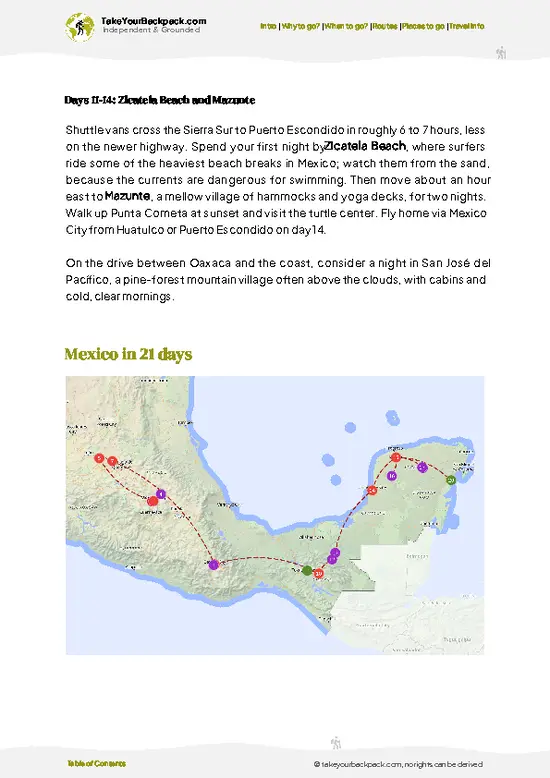
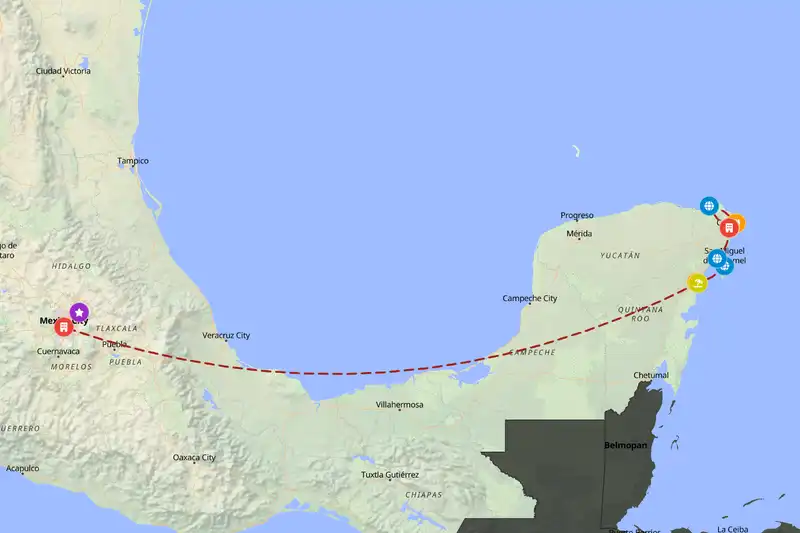
This 21-day route is for travelers who want a full-spectrum Mexico experience: megacity culture, highland towns, mountains, canyons, jungle ruins, and Caribbean coast, moving at a steady but not frantic pace using a mix of long-distance buses and a couple of strategic flights. You’ll usually stay 2-4 nights per stop, with occasional day-trip detours to keep things varied without burning out.

Days 1-4: Mexico City’s Museums and Volcano Horizons

Begin in Mexico City, giving yourself four nights to actually breathe in the capital instead of just sprinting through it. Spend a full day at the National Museum of Anthropology, then another pairing Palacio de Bellas Artes with the Museo Nacional de Arte to get a handle on how Mexican identity has been painted, sculpted, and sung over the last century. Dedicate a south-city day to the Frida Kahlo Museum and Museo Universitario Arte Contemporáneo, which together show you both the intimate and experimental sides of Mexican art. If you want a quick … read more 👉
This 21-day route is for travelers who want a full-spectrum Mexico experience: megacity culture, highland towns, mountains, canyons, jungle ruins, and Caribbean coast, moving at a steady but not frantic pace using a mix of long-distance buses and a couple of strategic flights. You’ll usually stay 2-4 nights per stop, with occasional day-trip detours to keep things varied without burning out.

Days 1-4: Mexico City’s Museums and Volcano Horizons

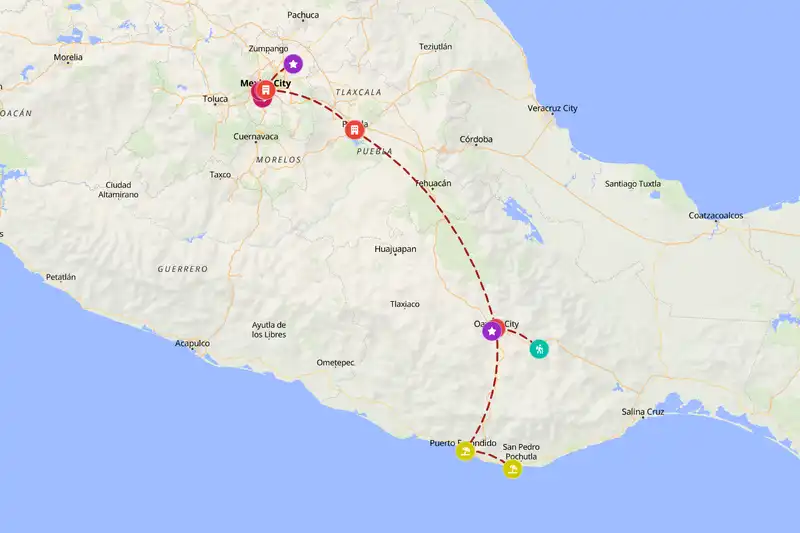
Begin in Mexico City, giving yourself four nights to actually breathe in the capital instead of just sprinting through it. Spend a full day at the National Museum of Anthropology, then another pairing Palacio de Bellas Artes with the Museo Nacional de Arte to get a handle on how Mexican identity has been painted, sculpted, and sung over the last century. Dedicate a south-city day to the Frida Kahlo Museum and Museo Universitario Arte Contemporáneo, which together show you both the intimate and experimental sides of Mexican art. If you want a quick nature reset without leaving the metro area, slip up into Desierto de los Leones for cool forest air and monastery ruins, a reminder that the mountains are always just beyond the city’s edge.

Days 5-7: Volcano Country and Lake Mystique

Leave the capital for altitude and small-town pace, heading first toward Pico de Orizaba or Iztaccíhuatl depending on your appetite for hiking and guided excursions. You don’t need to summit to feel the scale; even lower-elevation walks around these giants give you crisp air and big-sky views that reset your sense of Mexico as more than beaches and cities. Then continue to Pátzcuaro, where cobbled streets and a misty lake atmosphere slow everything down; use your time here to wander markets, take a boat out on the lake, and feel how indigenous and colonial histories overlap in daily life. This phase is about trading museum walls for open horizons and learning how much Mexico’s geography shapes its culture.

Days 8-10: Copper Canyon and Northern Drama

Head north to the Sierra Tarahumara and base yourself around Copper Canyon, one of the country’s most dramatic landscapes. Whether you arrive by bus or the famous train route, give yourself at least two full days to ride viewpoints, walk short trails, and simply sit on the edge of the canyon watching light move across the rock. If you have the energy, add a side trip to Basaseachic Falls, where the waterfall drops into a deep gorge and the hiking feels wild without requiring technical skills. This stretch is your big nature chapter, where distances are longer but the payoff is enormous and the pace on the ground is slow and contemplative.

Days 11-14: Jungle Ruins and Waterfalls in Chiapas

Fly or bus south to the Chiapas Highlands, using San Cristóbal de las Casas as your cool, high-altitude base. From here, push out to Sumidero Canyon, where boat trips between towering walls give you a totally different canyon experience than the north, lush and river-carved instead of dry and vast. Then continue toward the lowlands to explore Palenque, where temples rise out of the jungle, and pair it with a day at Cascadas de Agua Azul, whose stepped turquoise pools are perfect for a long, lazy swim after climbing ruins. This phase is all about humidity, howler monkeys in the distance, and the feeling that the forest is slowly reclaiming the stone.

Days 15-18: Oaxaca City, Mountains, and Ancient Ridges

Shift west to Oaxaca, giving yourself time to recover from jungle travel and dive into markets, mezcal, and mountain light. Spend a day at the Museo de las Culturas de Oaxaca, then another at Monte Albán, where the ridge-top setting makes every pyramid feel like a lookout over the valleys below. Use a full day to head into the Sierra Norte, hiking between villages on well-marked community trails that offer cool air, pine forests, and a very different side of Oaxaca than the city’s plazas. Evenings are for slow dinners, people-watching, and realizing how many versions of Mexico you’ve already met in just over two weeks.

Days 19-21: Caribbean Wind-Down on the Riviera Maya and Isla Holbox

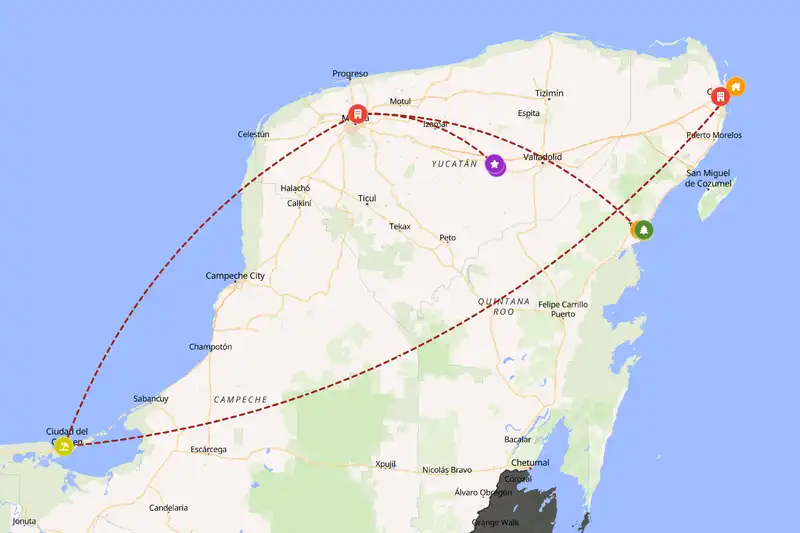
Finish with a flight east to the Yucatan Peninsula, basing yourself along the Riviera Maya for a couple of nights of easy beach access and ruin-hopping. Visit Tulum National Park for its cliffside ruins and then slide into the sea at Paradise Beach Tulum, letting your legs recover from all the canyon and mountain walking. For your final nights, escape the busier coast and head to Isla Holbox and the Isla Holbox Beaches, where sandy streets, shallow water, and long sunsets give you a soft landing before you fly out. Ending here lets you process three weeks of mountains, canyons, and ruins with your feet in warm water and no real agenda beyond deciding where to eat your last plate of ceviche.
The part of this route that lives rent-free in my head is watching the sun set over Copper Canyon one week and then, two weeks later, wading through the glassy shallows of Holbox, realizing just how huge and varied Mexico really is.
Loading the map 🌍
film
0
0
0a
Mexico City
Pixabay
film
1
1
1a
National Museum of Anthropology
film
2
2
2a
Palacio de Bellas Artes
film
3
3
3a
Frida Kahlo Museum
film
4
4
4a
Pico de Orizaba
film
5
5
5a
Iztaccíhuatl
film
6
6
6a
Pátzcuaro
film
7
7
7a
Copper Canyon
film
8
8
8a
Chiapas Highlands
Laurent M
film
9
9
9a
Sumidero Canyon
Jorge Eliecer Molina
film
10
10
10a
Palenque
Unsplash
film
11
11
11a
Cascadas de Agua Azul
Daniel Plotnik
film
12
12
12a
Oaxaca
Neha Kankar
film
13
13
13a
Museo de las Culturas de Oaxaca
film
14
14
14a
Monte Albán
Viridiana Contreras
film
15
15
15a
Sierra Norte
Elena Petrov
film
16
16
16a
Yucatan Peninsula
Abd Abo Naser
film
17
17
17a
Riviera Maya
film
18
18
18a
Tulum
film
19
19
19a
Tulum
film
20
20
20a
Isla Holbox
film
21
21
21a
Isla Holbox Beaches
Photos Are Copyrighted By Their Owners

✈️ The backpacker research shortcutMexico Travel Guide

An offline-friendly backpacking guide with optimized travel routes, ranked highlights, transport advice, and the best areas to stay.
example page 0 from our offline Travel Guide for Mexicoexample page 1 from our offline Travel Guide for Mexicoexample page 2 from our offline Travel Guide for Mexicoexample page 3 from our offline Travel Guide for Mexicoexample page 4 from our offline Travel Guide for Mexicoexample page 5 from our offline Travel Guide for Mexico
The digital guide (451 pages) contains:
147 highlights, ranked by travel appeal
Optimized 7, 14 & 21-day travel routes
Best neighborhoods to stay
How to get around
Offline-friendly for travel without Wi-Fi
👉 See all 30+ guide features

📅 Plan smarter in minutes, not weeks
Month by month travel advice
Festivals & national holidays
Budget expectations

🗺️ Go to the right places, skip the overrated ones
Honest pros & cons of destinations
Top hikes, parks & viewpoints
Lesser-known places most travelers miss
Clear “worth it vs skip it” guidance

🛏️ Travel smoothly without rookie mistakes
Best areas to stay
Transport systems explained simply
Common scams & safety advice
SIM cards, money & practical tips

🌍 Understand the country, not just visit it
Culture & traditions
52 Essential phrases & customs
Festivals worth planning around
Traveler-friendly historical context
Insights that make places more meaningful

📱 Built for real travel conditions
Fully downloadable PDF
Works completely offline
Optimized for phone use
Useful in remote areas & buses
Everything in one place
Save weeks of stressful planning
Get instant access to the full guide directly. 30-day money-back guarantee.


Sent to your inbox immediately after payment • 100% Secure Checkout
Best Backpacking Travel Advisor 2025 tourism awardBest Backpacking
Travel Advisor
2025
What others say about Take Your Backpack Guides:
⭐⭐⭐⭐⭐
Fantastic, amazing amount of information!
⭐⭐⭐⭐⭐
My goodness this is amazing, it's what I've been looking for hats off too you!
⭐⭐⭐⭐⭐
I think this is absolutely BRILLIANT
⭐⭐⭐⭐
Very complete and informative. It's still missing places, but I gotta to commend you
⭐⭐⭐⭐⭐
This is truly amazing, thank you, can't wait to explore it with my kids!
⭐⭐⭐⭐⭐
Awesome resource, thank you!
⭐⭐⭐⭐⭐
This is amazing! Can't wait to explore the ones I haven't seen
⭐⭐⭐⭐
I love this! Well done, great idea.
⭐⭐⭐⭐⭐
Thanks for taking the time to make this gem!
⭐⭐⭐⭐⭐
This might be the best website I've ever seen.
⭐⭐⭐⭐⭐
Congratulations, and thank you so much for your work; it's incredibly valuable.
⭐⭐⭐⭐
In all seriousness I think you did a great job pointing out the important spots
⭐⭐⭐⭐⭐
10/10 very good
⭐⭐⭐⭐⭐
As someone who's only just starting to visit regularly this is awesome, thank you.
⭐⭐⭐⭐
Thank you very much! I'm going to visit my dad, it's going to be very useful!
⭐⭐⭐⭐⭐
This is really cool! We'll be travelling for the first time and this definitely come in handy.
⭐⭐⭐⭐⭐
You are now our minister of culture, congratulations 👨‍💼
⭐⭐⭐⭐⭐
Just wanted to tell you that this is a pearl! Going to follow your recommendations.
⭐⭐⭐⭐⭐
This is so cool. I'll definitely be using the resource for my travels soon.
⭐⭐⭐⭐⭐
This is very impressive! Good work.
⭐⭐⭐⭐⭐
This is an amazing and informative site. Very well done!

🧭 RouteChoose Your Itinerary

Travel Mexico your way — from a quick highlights trip to a slow-paced adventure.

🙋 FAQFrequently Asked Questions

Mexico is one of the easiest countries in Latin America to backpack independently if you stay aware and use common sense. The backpacker infrastructure is strong: hostels in every major town, clear bus routes, and plenty of other travelers to link up with. Spanish helps a lot, but you can get by with basic phrases plus offline translation apps in touristy areas. Safety is very location-specific: most backpacker routes (Mexico City center, Oaxaca, Chiapas, Yucatán, Baja Sur, main colonial towns) are manageable if you stick to well-used areas, avoid wandering drunk at night, and use official taxis or ride-hailing apps. Cash is still king in markets, colectivos, and small towns, so always have some pesos on you. ATMs are common, but use those attached to banks or inside supermarkets. You do not need tours for most things: ruins, cenotes, and cities are easy to do DIY with buses and colectivos. The main challenges are long distances, heat, and occasional stomach issues, so travel with a basic first-aid kit, drink purified water, and give yourself buffer days instead of racing through the country.
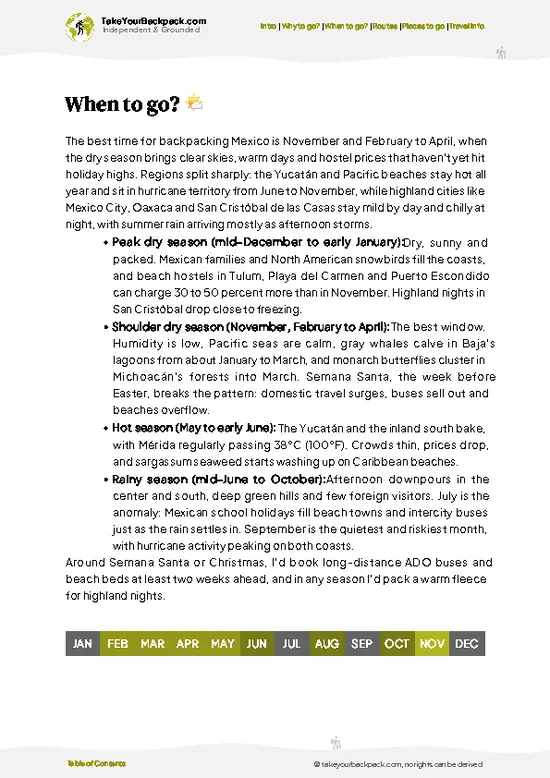
For a first backpacking trip, 3–4 weeks is a sweet spot: enough to see a few regions without burning out on buses. If you only have 1 week, focus on a single region: for example, Mexico City + Puebla, or Oaxaca + coast, or Yucatán (Mérida, Valladolid, Tulum area). With 2 weeks, you can do a classic loop like: Mexico City → Puebla → Oaxaca → Chiapas (San Cristóbal, Palenque) → Yucatán (Bacalar or Valladolid). With 1 month, you can slow down and add side trips like Hierve el Agua, smaller pueblos around Oaxaca, extra cenotes, or a Pacific surf town. Mexico is huge; trying to do Baja, the center, the south, and the Yucatán in one go just means you’ll spend half your trip on overnight buses. It’s better to treat Mexico as 2–3 separate trips over your life than to sprint through everything once. If you’re on a long-term backpacking journey (3+ months), you can easily spend 6–8 weeks just in Mexico without running out of interesting, good-value places.
You can absolutely get around Mexico without a car; most backpackers do. Long-distance buses are the backbone of travel: ADO and similar companies cover almost every city and many tourist sites, with multiple comfort levels from basic to very comfy. For shorter hops, colectivos (shared vans) and second-class buses are cheaper and more local, though less comfortable and sometimes slower. In cities, use metro systems where they exist (Mexico City’s metro is cheap and extensive) and ride-hailing apps or official taxis at night or when carrying all your gear. Trains are limited, so don’t plan around them. Domestic flights can be surprisingly cheap if booked in advance and are worth it for huge jumps like Tijuana–Mexico City or Mexico City–Cancún, especially if you’re short on time. Hitchhiking exists but is not essential and adds risk; budget travelers are usually better off with buses and colectivos. The main constraint is time: some routes are 10–14 hours by bus, so plan overnight buses or break the journey with a stopover instead of trying to do everything in one push.
For budget travelers, the must-visits are the places that mix culture, nature, and good value without forcing you into resort mode. Mexico City is non-negotiable: world-class food at street prices, museums, neighborhoods like Coyoacán and Roma, and easy day trips to Teotihuacán. Oaxaca City is a backpacker favorite for a reason: markets, mezcal, street art, and day trips to Hierve el Agua and nearby villages. San Cristóbal de las Casas in Chiapas gives you cool mountain air, strong indigenous culture, and cheap hostels, plus access to Sumidero Canyon and waterfalls like El Chiflón. For ruins, Palenque feels like a jungle adventure, while Teotihuacán is the big, accessible classic; if you’re heading to Yucatán, Chichén Itzá is historically important but often crowded and pricey, so many backpackers prefer Uxmal, Ek’ Balam, or Calakmul for a more atmospheric experience. On the coast, pick one or two zones instead of chasing every beach: on the Caribbean side, think Bacalar (lagoon, chill vibe) and maybe one beach town like Puerto Morelos or Mahahual; on the Pacific, places like Puerto Escondido, Mazunte, or Sayulita give you surf-town energy without resort prices if you choose simple accommodation and eat where locals eat. Colonial towns like Guanajuato or San Miguel de Allende are worth it if you like architecture and café life, but they’re more interesting if you already have Mexico City and Oaxaca in your plan.
If you’re short on time, skip anything that eats days without adding much beyond what you’ve already seen. You can skip trying to cross the entire country in one trip; choose either the central/southern highlands (Mexico City, Puebla, Oaxaca, Chiapas) or the Yucatán/Caribbean coast, not both, if you have under 10–12 days. Many backpackers on a budget can skip Cancún’s hotel zone and big all-inclusive resorts; they’re expensive, generic, and you can get better beaches and more character in smaller towns. If you’ve already visited one major ruin site (Teotihuacán, Palenque, or Chichén Itzá), you don’t need to see every single pyramid; pick 1–3 that fit your route and spend the saved time in markets, neighborhoods, or nature. Cruise-port towns and heavily packaged tourist experiences (like overpriced theme-park-style eco-parks) are easy to skip if money and time are tight; you can find cheaper, more authentic cenotes, waterfalls, and hikes with a bit of research and local advice. Unless you have a specific reason, you can also skip long detours to far-north border cities on a short trip; they’re logistically heavier and don’t add much for a first-time backpacker compared with the cultural and natural highlights in the center and south.

🇲🇽 MexicoExplore Mexico

Ready to build a truly unique trip? Predefined routes are perfect for first-time visitors, but there is so much more to discover. Whether you are chasing a city trip, pristine national parks, local food scenes, or quiet beaches, pick a category to design your own path.