×

Mexico🇲🇽 | best citiesWhere to Find the 10 Best cities in Mexico

Cities in Mexico are not one product with different postcards. The colonial highlands (the central plateau and the Bajío) hand you cobbled grids, 1,800 to 2,200 meters of altitude and a mild climate, with buses so frequent you stop checking schedules. The Pacific and Gulf coasts trade that for humidity, seafood and slower pacing. The south, especially Oaxaca and Chiapas, is where Indigenous languages, markets and mezcal-fueled evenings set the tone. The Yucatán is flat, hot and priced for cruise passengers. The north is industrial, car-minded and rarely on a backpacker’s radar. Prices swing hard: a hostel bed runs roughly US$10 to 25 in the interior and far more in beach-adjacent places. Independent travelers get the easiest ride in the center and south, where hostels, first-class buses and 40-peso lunches are everywhere. Crowds are the real variable. Pick your city type first, then argue about tacos.

By Johan Kruseman 🇳🇱 | Updated October 20, 2026
Explore the best towns in Mexico

Why go?Why Travelers Love These Spots

Mexico is a country built around the city as a living room. Spanish colonial planners laid out towns around a central plaza, and that grid sat on top of Aztec, Maya and Zapotec settlements that already worked the same way. The result is that most Mexican cities, big or small, hand you a walkable center with a main square, a cathedral, a market and a row of cheap places to eat, all within a few blocks. Nobody had to design this for tourists. It was just how things were done for five centuries.

Geography does the rest. Much of the interior sits on a high plateau between roughly 1,500 and 2,400 meters, so cities there have mild days and cool nights even when the coasts are sweating through their shirts. Silver mining money paid for ornate churches and mansions far from the sea, which is why … read more 👉
Mexico is a country built around the city as a living room. Spanish colonial planners laid out towns around a central plaza, and that grid sat on top of Aztec, Maya and Zapotec settlements that already worked the same way. The result is that most Mexican cities, big or small, hand you a walkable center with a main square, a cathedral, a market and a row of cheap places to eat, all within a few blocks. Nobody had to design this for tourists. It was just how things were done for five centuries.

Geography does the rest. Much of the interior sits on a high plateau between roughly 1,500 and 2,400 meters, so cities there have mild days and cool nights even when the coasts are sweating through their shirts. Silver mining money paid for ornate churches and mansions far from the sea, which is why colonial cities cluster inland, while the Pacific and Caribbean sides lean toward resort-and-ruin territory.

Before choosing Mexico for its cities, know that distances are huge. The country is about 3,200 kilometers from top to bottom, and a map that makes two stops look like neighbors can hide a 10 to 14 hour bus ride. The upside is a first-class bus network that is comfortable, frequent and cheap by North American standards, with reclining seats and the occasional film dubbed at a volume that suggests the driver is hard of hearing.

Altitude, heat and rain vary far more than newcomers expect, so packing for one climate is a gamble. Mexico City alone sits above 2,200 meters, and the first day there can feel like a mild argument with your lungs.

Finally, regional identity is strong. Food, dress, language and even the pace of a lunch change sharply between the north, the central highlands, the south and the Yucatán Peninsula. That variety is the real argument for Mexico: one passport stamp, and several quite different countries' worth of city life.
Why These Made the Cut
The list of best cities in Mexico is created based on culture, vibe, attractions, transport ease, and local charm. If you feel a city is missing in this list, please let us know.

When to go?Timing Your Visit for the Best Experience

Best months for cities in Mexico: November to April is the best window for cities in Mexico, because the rains have stopped and the central highlands sit at a comfortable 18 to 26°C by day. Nights at altitude can fall to 5 to 10°C from December through February, so the “eternal spring” brochure line comes with a jacket requirement.
Rainy season and shoulder months: From roughly June to October, the interior gets afternoon downpours that are punctual enough to set a watch by. Mornings are usually clear, and the rain tends to arrive between 3 and 6 p.m., so plan museums for the wet hours. Rainfall is heaviest in the south and on the Gulf side, where September and October can bring flooding and hurricane risk. May is the hottest month on the central plateau, with highs of 30 to 35°C, and it is … read more 👉
Best months for cities in Mexico: November to April is the best window for cities in Mexico, because the rains have stopped and the central highlands sit at a comfortable 18 to 26°C by day. Nights at altitude can fall to 5 to 10°C from December through February, so the “eternal spring” brochure line comes with a jacket requirement.
Rainy season and shoulder months: From roughly June to October, the interior gets afternoon downpours that are punctual enough to set a watch by. Mornings are usually clear, and the rain tends to arrive between 3 and 6 p.m., so plan museums for the wet hours. Rainfall is heaviest in the south and on the Gulf side, where September and October can bring flooding and hurricane risk. May is the hottest month on the central plateau, with highs of 30 to 35°C, and it is also the driest-feeling, dusty stretch before the rains. Shoulder months like October, early November and late April-May are manageable for cities, with fewer visitors and lower hotel rates, often 15 to 30 percent below peak.
Peak periods and regional differences: Prices and crowds jump around Day of the Dead (October 31 to November 2), Christmas to New Year, and Semana Santa (the week before Easter), when locals travel too and buses sell out days ahead. Book beds and long-distance tickets at least two to three weeks early for those dates. Oaxaca and Mexico City are especially packed in late October. The Yucatán is steamy year-round, with highs of 32 to 38°C from April to September, so winter is the sane season there. Northern cities swing hotter in summer (often above 38°C) and surprisingly cold in January. Mexico City itself is easiest from March to May and October to November, outside the heavier rain months.

city hoppingTips for Visiting Multiple Destinations

How many days to combine cities in Mexico: A trip linking several cities in Mexico needs 14 to 28 days, and 3 weeks is the comfortable middle. Anything shorter turns into a tour of bus stations.
Regions that cluster well: The central highlands group naturally: Mexico City sits within 3 to 5 hours by bus of most Bajío and colonial-belt stops, so they chain together without drama. The south (Oaxaca and the Chiapas highlands) pairs with the center, but the gap is real: Mexico City to Oaxaca is about 6.5 to 8 hours by bus, and Oaxaca to San Cristóbal de las Casas is 10 to 12 hours on winding roads. The Yucatán Peninsula is its own cluster, usually reached by flight (roughly 2 hours from Mexico City) or a 20-hour-plus bus that nobody remembers fondly.
Direction and pacing: Start where you land and … read more 👉
How many days to combine cities in Mexico: A trip linking several cities in Mexico needs 14 to 28 days, and 3 weeks is the comfortable middle. Anything shorter turns into a tour of bus stations.
Regions that cluster well: The central highlands group naturally: Mexico City sits within 3 to 5 hours by bus of most Bajío and colonial-belt stops, so they chain together without drama. The south (Oaxaca and the Chiapas highlands) pairs with the center, but the gap is real: Mexico City to Oaxaca is about 6.5 to 8 hours by bus, and Oaxaca to San Cristóbal de las Casas is 10 to 12 hours on winding roads. The Yucatán Peninsula is its own cluster, usually reached by flight (roughly 2 hours from Mexico City) or a 20-hour-plus bus that nobody remembers fondly.
Direction and pacing: Start where you land and work outward. A common sensible flow is Mexico City first, then the colonial highlands, then south, finishing with a short flight to the peninsula if you want heat at the end. Reverse it if you arrive in Cancún. Budget 2 to 4 nights per city in the center, and 3 to 5 in larger or more sprawling places, where a first day disappears to orientation and altitude.
Planning mistakes: The classic error is trying to fit the whole country into 10 days. The map shrinks everything, so assuming “it’s right there” leads to 12-hour travel days. Instead, choose two regions and drop the rest. Another is booking overnight buses back to back, which wrecks two days each time; mix in daytime legs and one flight when the distance exceeds about 8 hours. Travelers also forget that holiday weeks fill buses. Buy first-class tickets a day or two ahead online, and keep one empty day in the plan. Mexico tends to use it.

The ListMust-Visit cities in Mexico

1 Mexico City

Aztec ruins, anthropology museum, Xochimilco canals, Roma and Condesa

Move from Aztec temple ruins and Rivera murals to Kahlo’s blue house, canal boats and tree-lined café streets across a huge basin.

Mexico - Mexico City

2 Playa del Carmen

Quinta Avenida, cenote stream beach, al pastor, Cozumel ferry

Stroll the pedestrian avenue, swim where a cenote stream meets the sea, and eat al pastor a few blocks inland where residents do.

3 Cancún

Hotel Zone sandbar, public beaches, MUSA sculptures, Parque de las Palapas

Ride the local bus to free sand, snorkel over sculptures on the seafloor, then eat marquesitas downtown after dark among families.

4 Oaxaca

Mole, mezcal, gold-leaf church, smoky market grills

Pick your meat at a market grill, pause in a gold-leaf church, and compare artisanal mezcals with orange slices and worm salt.

mexico-city-oaxaca
© Google | Neha Kankar

5 Guanajuato

Tunnel streets, mummies, Pípila viewpoint, student guitars

Climb to a hilltop statue for rooftop views, squeeze through the Callejón del Beso, and file past naturally mummified bodies in glass cases.

6 San Miguel de Allende

Pink spires, cobblestone core, Fábrica La Aurora, rooftop terraces

Watch the pink church spires glow at dusk, browse galleries in a former textile factory, and walk everywhere on cobblestones.

7 Mérida

Laurel plaza, henequen mansions, free concerts, cochinita pibil

Walk Paseo de Montejo past old mansions, study Maya history in a modern museum, and catch free trova music in the squares at dusk.

8 Puerto Vallarta

Malecón sculptures, Zona Romántica, Los Muertos pier, jungle hills

Walk the sculpture-lined seafront at dusk, swim off the sail-shaped pier, and escape to a botanical garden in the hills.

9 Guadalajara

Orozco murals, mariachi plaza, Tlaquepaque crafts, birria

Stand beneath Orozco’s fiery murals, eat birria in a three-floor market, and hear mariachis play requests at night on the plaza.

mexico-city-guadalajara
© Google | Luis Toledano

10 Puebla

Talavera tiles, gilded chapel, mole and cemitas, volcano views

Admire a chapel buried in gold leaf, browse Talavera stalls, and eat mole and cemitas with volcanoes on the horizon.

mexico-city-puebla
© Google | Xochitl Sr

11 San Cristóbal de las Casas

Highland chill, Maya textiles, amber museum, Real de Guadalupe

Browse Maya weavings beside a baroque church, sip local coffee along a pedestrian street, and climb the stairs to a hilltop chapel.

12 Mazatlán

Centro Histórico, lighthouse climb, cliff divers, Plaza Machado

Climb the steep path to a hilltop lighthouse, watch cliff divers on the malecón, and spend evenings in restored plazas with live music.

mexico-city-mazatlan
© Google |

13 Querétaro

Pink aqueduct, arcaded plazas, pedestrian lanes, Maximilian hilltop

Photograph 74 aqueduct arches at late afternoon, cross shaded squares between baroque churches, and linger at café tables on lanes after dark.

14 Los Cabos

Land’s End arch, Cabo marina, calm coves, whale watching

Take a water taxi to the rock arch, snorkel sheltered coves, and watch for humpbacks between towns at the tip of the peninsula.

15 La Paz

Sea lion snorkeling, Balandra lagoon, five-kilometer malecón, whale sharks

Walk the waterfront at sunset, then book a boat to snorkel with sea lions or whale sharks, and swim the shallow lagoon at Balandra.

16 Campeche

Pastel walled grid, bastions and forts, Gulf sunsets, Maya jade

Circle the repainted colonial grid inside its bastions, climb hilltop forts for sea views, and catch the nightly light show at the land gate.

17 Veracruz

Spoon-tapped coffee, danzón plaza, San Juan de Ulúa, Gulf malecón

Tap your glass for milk at the old café, take a boat to a island fortress prison, and dance to danzón at night.

18 Ensenada

Fish tacos, marine geyser, Baja wine, Hussong’s cantina

Follow battered fish tacos from harbor stalls to the blowhole at La Bufadora, then taste Baja wine and finish at the 1892 cantina.

19 Tijuana

Avenida Revolución, Caesar salad, food-truck court, border wall murals

Follow the Revolución strip into craft beer arcades and gastro-park trucks, then end at the mural-covered wall where it meets the Pacific.

20 Zacatecas

Pink quarry stone, silver mine train, cable car to La Bufa, mask museum

Ride a small train into a silver mine, glide by cable car over rooftops to a hilltop at sunset, and admire thousands of masks.

21 Chihuahua

Pancho Villa house, baroque cathedral, Art Nouveau mansion, cabrito

Trace the Revolution through Villa’s bullet-scarred car, then see a cathedral, a carved-wood mansion and a colonial aqueduct before a roast kid dinner.

22 Aguascalientes

Flat walkable center, Day of the Dead museums, Posada engravings, Mercado Terán lunches

Walk a flat, compact center from the cathedral plaza to skull-filled museums, then finish with a market lunch of local sweets and produce.

23 Chetumal

Bayfront promenade, Maya cosmos museum, Belize border hub, Calderitas seafood

Spend a night or two walking the bay at dusk, studying Maya stelae and jade, and eating fresh fish at palapa restaurants nearby.

24 Durango

Baroque facade, Western film sets, cable car, marimba plaza

Ride the cable car to a hilltop view, browse the Mexican film museum, and join families on the plaza at dusk.

25 Hermosillo

Sonoran carne asada, Cerro de la Campana, coyotas, state capital grid

Climb the hilltop at late afternoon, then work through grilled beef, coyotas and market snacks in a tidy northern capital.

26 Manzanillo

Sailfish port, La Audiencia cove, local combis, palm tuba

Swim in a sheltered horseshoe cove, walk the sailfish malecón at dusk, and eat fresh fish and palm drink in a working port.

27 Villahermosa

Olmec colossal heads, jungle sculpture park, Grijalva River, Yumká

Follow a shaded jungle trail past giant Olmec heads and caged jaguars, then ride tram and boat through savanna and wetland zones.

28 Xalapa

Olmec heads museum, cloud forest garden, hill cafés, coffee

Stand before seven colossal basalt heads, walk cloud forest trails, and retreat to cobbled lane cafés when the drizzle starts.

29 Rosarito

Boulevard taco crawl, Titanic film studios, beach pier, old hotel murals

Eat fish tacos along the main boulevard, walk the wide beach at sunset, and tour the studio built for the Titanic shoot.

30 Tecate

Brewery malt smell, Kumeyaay mountain, panaderías, border plaza

Tour the brewery in town, buy warm bread near the center, and sit in the shaded plaza as evening music starts.

31 Ciudad Juárez

1668 adobe mission, Revolution museum, border avenue, Mercado Cuauhtémoc

Step into a 1668 adobe mission, follow Villa’s 1911 story in the old customs house, and eat cheap tacos among boots and crafts.

32 Saltillo

Churrigueresque cathedral, desert museum, pan de pulque, sarape market

Spend a morning among dinosaur fossils and desert plants, then wander a calm colonial center to a cathedral and market of sarapes and sweets.

33 Culiacán

Riverside paths, Tamazula and Humaya, botanical garden, aguachile, Mercado Garmendia

Stroll the two rivers at dusk, visit a large botanical garden, and order aguachile and fresh seafood at the old central market.

34 Los Mochis

Copper Canyon rail gateway, chilorio tortillas, tropical garden, Topolobampo shrimp

Use a day or two for tortillas stuffed with chilorio, a shaded garden, and shrimp by the bay before the canyon train.

35 Nogales

Border fence, Sonoran hot dogs, leather and silver shops, on-foot crossing

Cross on foot, browse leather and pottery along Avenida Obregón, and eat bacon-wrapped hot dogs at stands before heading south.

36 Torreón

Cristo de las Noas, hilltop cable car, Revolution museum, cotton heritage

Ride the cable car up Cerro de las Noas to the giant statue, then trace the 1914 battle and the cotton story in two small museums.

37 Tuxtla Gutiérrez

Sumidero Canyon boats, jaguar zoo, marimba park, Chiapas capital

Cruise between canyon walls rising about 1,000 meters, see jaguars and quetzals at the zoo, and hear marimbas under the trees.

Think you know Mexico?

Prove you’re a true local — uncover 27 lesser-known cities in Mexico that locals tend to keep to themselves.
Loading the map 🌍

Expert viewInsights from Locals and Experts

How many cities to visit: Three to five cities is the number I would advise for a trip of two to four weeks. Mexico rewards staying put: each place needs two or three nights just to find the good market stall, the neighborhood you like and the bus ticket office that actually opens. Beyond five, you spend more hours on buses than on streets, and the cities start to blur into one long plaza with different church facades.
Choosing between kinds of cities: Match the kind of city to your travel style. If food, museums and nightlife drive you, pick one big capital-scale city and give it four or more nights, because the museum list alone takes days. If you want walkable beauty and cheap comfort, the colonial highland towns are the easiest introduction and the kindest to first-timers. For culture, … read more 👉
How many cities to visit: Three to five cities is the number I would advise for a trip of two to four weeks. Mexico rewards staying put: each place needs two or three nights just to find the good market stall, the neighborhood you like and the bus ticket office that actually opens. Beyond five, you spend more hours on buses than on streets, and the cities start to blur into one long plaza with different church facades.
Choosing between kinds of cities: Match the kind of city to your travel style. If food, museums and nightlife drive you, pick one big capital-scale city and give it four or more nights, because the museum list alone takes days. If you want walkable beauty and cheap comfort, the colonial highland towns are the easiest introduction and the kindest to first-timers. For culture, crafts and regional cooking, choose the southern cities, where markets and Indigenous traditions shape daily life. Beach-adjacent and Yucatán cities suit a short heat-and-history stretch but cost more and draw the heaviest tourist traffic. Northern cities suit specific business or border reasons, not a typical backpacking loop.
What it costs: A realistic budget in the interior is US$35 to 60 a day (about 650 to 1,100 pesos): a hostel dorm at US$10 to 25, street and market meals at US$2 to 6, and a few museum entries. Mid-range travelers who want private rooms and sit-down dinners should plan on US$70 to 110. The Yucatán and big-ticket tourist zones push those numbers up by 30 to 50 percent. Museums and archaeological sites usually charge 100 to 600 pesos (US$5 to 30), and the most famous sites sit at the top of that range. Guides at major sites commonly cost 500 to 1,200 pesos for a small group, and they are worth paying at places where signage is thin. First-class buses run roughly US$8 to 25 for 3 to 8 hours, and local rides in cities cost 6 to 15 pesos (under US$1) on metros and buses. Per city visit, expect US$100 to 200 for three nights including a couple of paid sights, more in the capital or the peninsula.
Crowds, honestly: Crowds are heaviest at the famous plazas on weekends and around holidays. The fix is easy: go early. Most cathedrals and markets are far calmer before 9 a.m., and the light is better anyway. Lines at top museums can run an hour at midday, so buy tickets online where offered. Prices also climb in historic centers, where a tourist-facing menu costs double what the same dish costs three blocks away. Walk those three blocks.
Safety and cultural considerations: Most traveler-heavy city centers are used to visitors, and petty theft is the common problem, not violence. Keep phones out of sight on crowded metros, use registered taxis or rideshare apps at night rather than hailing from the street, and avoid walking dark stretches after late dinners. Check your government’s travel advisory by state before routing, since conditions differ sharply across the country. Withdraw cash from ATMs inside banks during the day.

On the cultural side, greet with a “buenos días” before asking for anything; skipping it reads as rude. Tipping 10 to 15 percent in sit-down restaurants is standard. Dress is relaxed, but cover shoulders and knees in churches. Ask before photographing people, particularly in Indigenous markets. At altitude, go easy on mezcal the first night; I would drink water and eat early. A little Spanish and patience turn most of Mexico’s cities from hard work into easy, rewarding days.

✈️ The backpacker research shortcutMexico Travel Guide

An offline-friendly backpacking guide with optimized travel routes, ranked highlights, transport advice, and the best areas to stay.
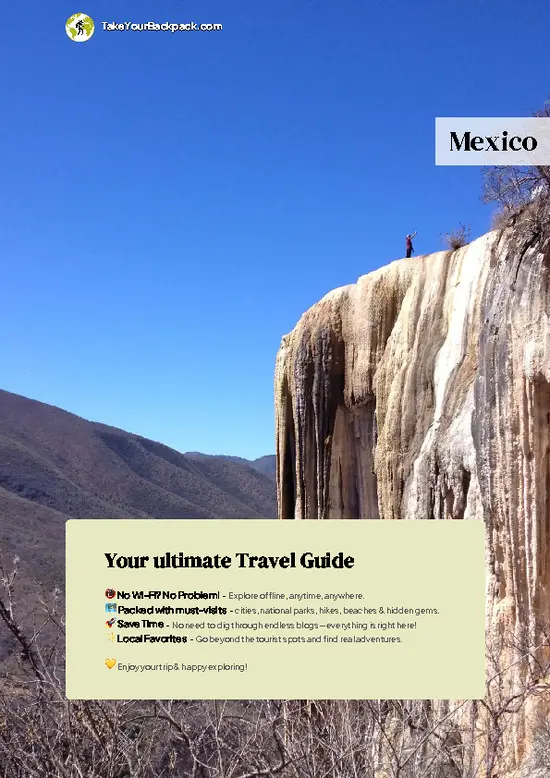
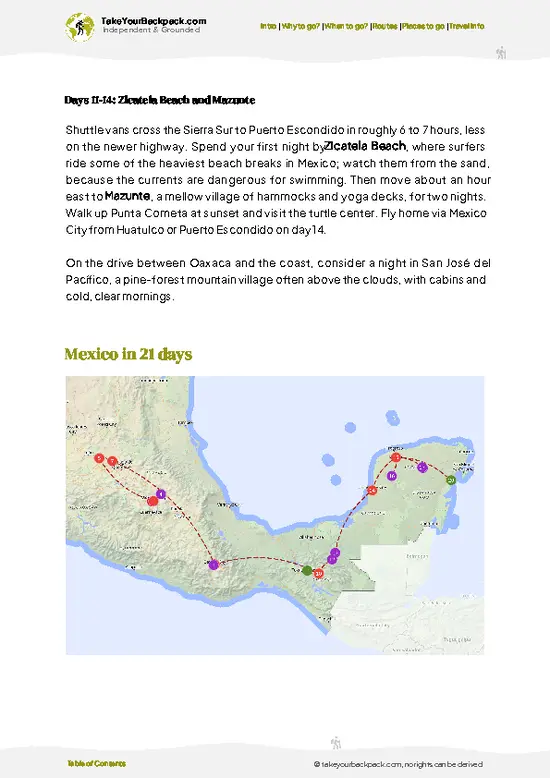
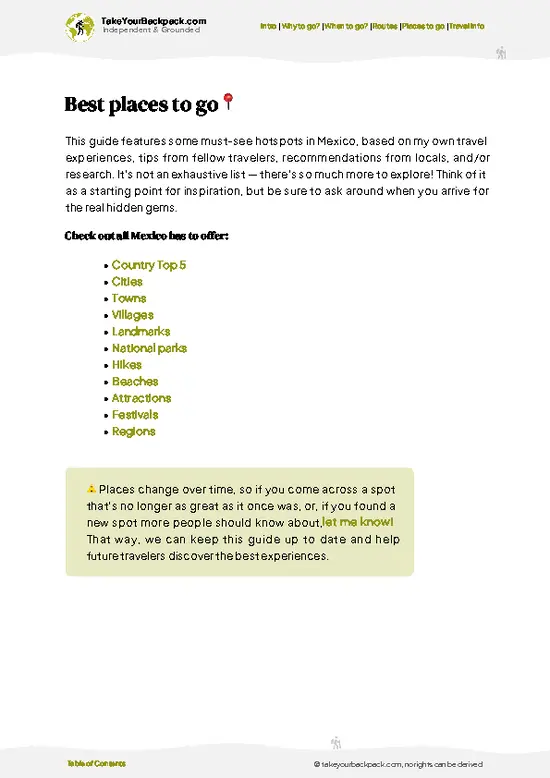
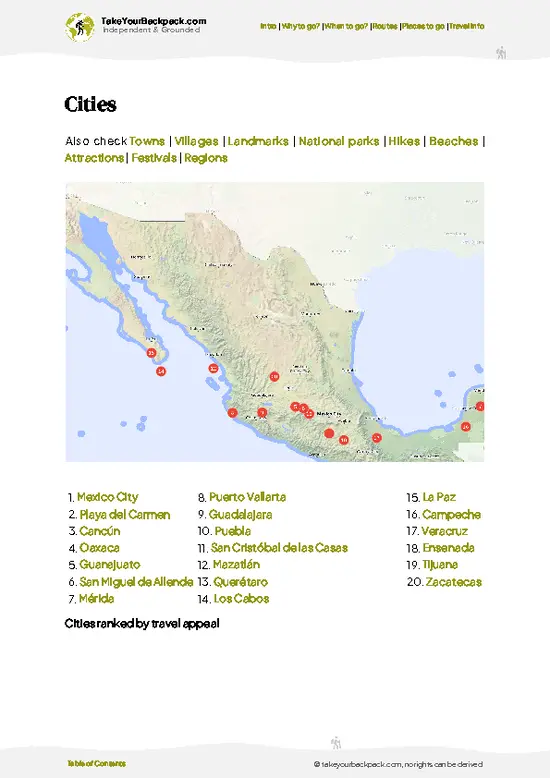
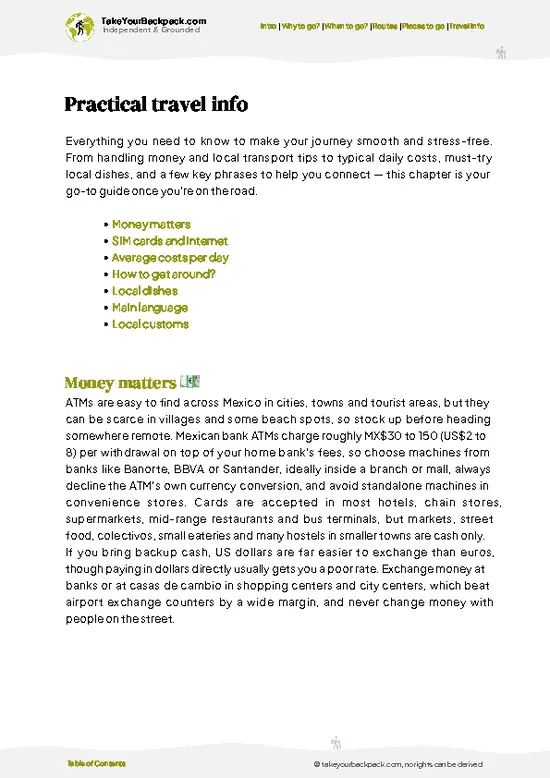
example page 0 from our offline Travel Guide for Mexico
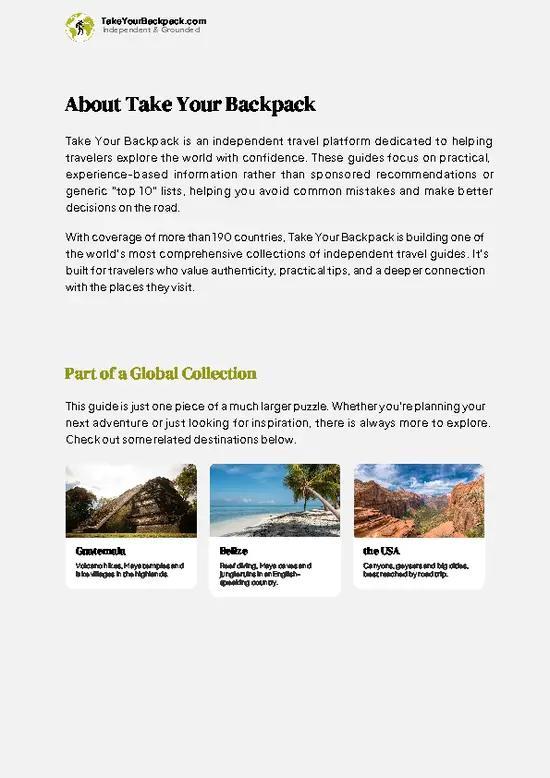
example page 1 from our offline Travel Guide for Mexico
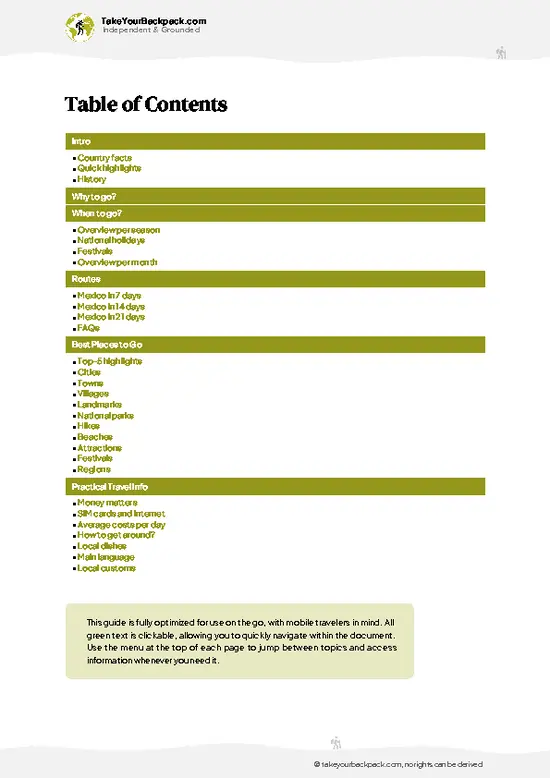
example page 2 from our offline Travel Guide for Mexico
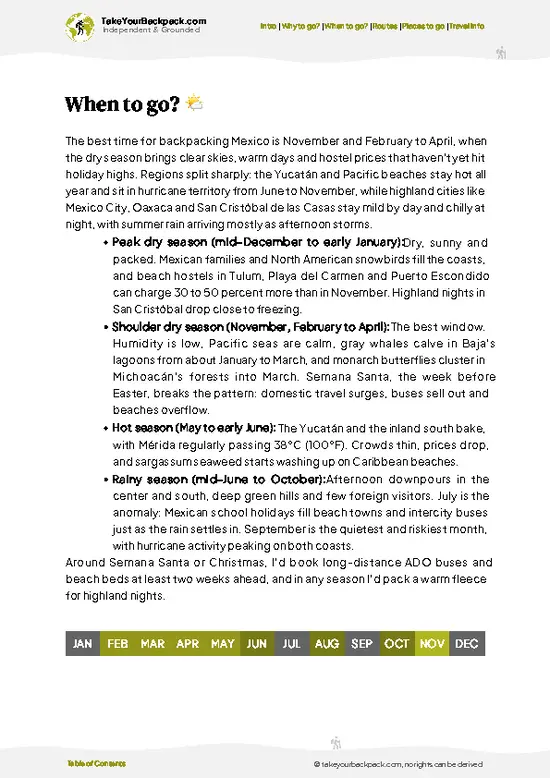
example page 3 from our offline Travel Guide for Mexico
example page 4 from our offline Travel Guide for Mexico
example page 5 from our offline Travel Guide for Mexico
example page 6 from our offline Travel Guide for Mexico
example page 7 from our offline Travel Guide for Mexico
The digital guide (402 pages) contains:
✅ 138 highlights, ranked by travel appeal
✅ Optimized 7, 14 & 21-day travel routes
✅ Cities, national parks, landmarks, beaches
✅ How to get around
✅ Offline-friendly for travel without Wi-Fi
👉 Click to see all 30+ guide features

📅 Plan smarter in minutes, not weeks
✅ Month by month travel advice
✅ Festivals & national holidays
✅ Budget expectations

🗺️ Go to the right places, skip the overrated ones
✅ Honest pros & cons of destinations
✅ Top hikes, parks & viewpoints
✅ Lesser-known places most travelers miss
✅ Clear “worth it vs skip it” guidance

🛏️ Travel smoothly without rookie mistakes
✅ Best areas to stay
✅ Transport systems explained simply
✅ Common scams & safety advice
✅ SIM cards, money & practical tips

🌍 Understand the country, not just visit it
✅ Culture & traditions
✅ 52 Essential phrases & customs
✅ Festivals worth planning around
✅ Traveler-friendly historical context
✅ Insights that make places more meaningful

📱 Built for real travel conditions
✅ Fully downloadable PDF
✅ Works completely offline
✅ Optimized for phone use
✅ Useful in remote areas & buses
✅ Everything in one place
Stop searching, start planning
Get instant access to your full guide. 30‑day money-back guarantee.
+ Add another guide for just

By proceeding you agree to our terms.
Sent to your inbox immediately after payment • 100% Secure Checkout
Best Backpacking Travel Advisor 2025 tourism awardBest Backpacking
Travel Advisor
2025
What others say about Take Your Backpack Guides:
⭐⭐⭐⭐⭐
Fantastic, amazing amount of information!
⭐⭐⭐⭐⭐
My goodness this is amazing, it's what I've been looking for hats off too you!
⭐⭐⭐⭐⭐
I think this is absolutely BRILLIANT
⭐⭐⭐⭐
Very complete and informative. It's still missing places, but I gotta to commend you
⭐⭐⭐⭐⭐
This is truly amazing, thank you, can't wait to explore it with my kids!
⭐⭐⭐⭐⭐
Awesome resource, thank you!
⭐⭐⭐⭐⭐
This is amazing! Can't wait to explore the ones I haven't seen
⭐⭐⭐⭐
I love this! Well done, great idea.
⭐⭐⭐⭐⭐
Thanks for taking the time to make this gem!
⭐⭐⭐⭐⭐
This might be the best website I've ever seen.
⭐⭐⭐⭐⭐
Congratulations, and thank you so much for your work; it's incredibly valuable.
⭐⭐⭐⭐
In all seriousness I think you did a great job pointing out the important spots
⭐⭐⭐⭐⭐
10/10 very good
⭐⭐⭐⭐⭐
As someone who's only just starting to visit regularly this is awesome, thank you.
⭐⭐⭐⭐
Thank you very much! I'm going to visit my dad, it's going to be very useful!
⭐⭐⭐⭐⭐
This is really cool! We'll be travelling for the first time and this definitely come in handy.
⭐⭐⭐⭐⭐
You are now our minister of culture, congratulations 👨‍💼
⭐⭐⭐⭐⭐
Just wanted to tell you that this is a pearl! Going to follow your recommendations.
⭐⭐⭐⭐⭐
This is so cool. I'll definitely be using the resource for my travels soon.
⭐⭐⭐⭐⭐
This is very impressive! Good work.
⭐⭐⭐⭐⭐
This is an amazing and informative site. Very well done!

🛏️ Where to stay?Top Places to Consider Staying

Mexico has one of the deepest hostel scenes in Latin America, with dorm beds typically running MXN 250 to 500 (about US$13 to 28) and private rooms in guesthouses from roughly MXN 700 (US$38). In Mexico City, the Centro Histórico puts you steps from the main museums and is the cheapest, though some blocks empty out after dark, while Roma and Condesa cost a bit more but give you leafy, walkable streets, good bars and a safer feel at night. Elsewhere, San Cristóbal de las Casas and central Oaxaca offer quiet, cheap stays within walking distance of everything, and Playa del Carmen and Tulum pack in party hostels near the beach at noticeably higher prices.

If you enjoy meeting fellow travelers, consider … read more 👉
Mexico has one of the deepest hostel scenes in Latin America, with dorm beds typically running MXN 250 to 500 (about US$13 to 28) and private rooms in guesthouses from roughly MXN 700 (US$38). In Mexico City, the Centro Histórico puts you steps from the main museums and is the cheapest, though some blocks empty out after dark, while Roma and Condesa cost a bit more but give you leafy, walkable streets, good bars and a safer feel at night. Elsewhere, San Cristóbal de las Casas and central Oaxaca offer quiet, cheap stays within walking distance of everything, and Playa del Carmen and Tulum pack in party hostels near the beach at noticeably higher prices.

If you enjoy meeting fellow travelers, consider choosing hostels with high ratings for atmosphere. On the other hand, if you prefer having your own space, a hotel might be a better option.

MexicoMore Places Across Mexico

👋 Meet the founderWho’s Behind Take Your Backpack?

Johan, backpacker and founder of TakeYourBackpackHi, I’m Johan (Netherlands 🇳🇱), the creator of TakeYourBackpack. Over the past 3 decades, I’ve backpacked through 90+ countries across six continents, gaining extensive experience with independent travel, long-term trips, and overland routes.

This site is built on a combination of firsthand travel experience and carefully curated insights from other backpackers. Many guides are based on places I’ve personally visited, while others bring together tips, observations, and practical advice shared by trusted travelers I’ve met along the way.

The goal is to provide realistic, experience-driven guidance — not generic itineraries — so you can explore destinations with better context, clearer expectations, and more confidence.