×

Netherlands🇳🇱 | best townsYour Guide to the 10 Best towns in The Netherlands

Towns in the Netherlands are small, dense and built around water, which means almost every one has a walkable historic core, a canal or harbor, and a train station within 10 minutes of the center. The differences come from region. The Randstad in the west is packed with well-preserved merchant towns that are easy to reach but expensive and crowded in season. The north and east are quieter and cheaper, with fewer visitors because trains thin out. The south has hillier, Burgundian-flavored towns with a distinct food culture. For independent travel, rail access and bed prices decide which kind suits you.

By Johan Kruseman 🇳🇱 | Updated October 18, 2026
Explore the best villages in The Netherlands

Why go?Key Factors That Shape the Experience

The Netherlands suits town travel because its settlements grew out of water management and trade rather than castles or fortresses on hills. Land was reclaimed and drained, so towns formed around dams, locks and harbors, which explains the canal grids, the leaning gabled merchant houses and the compact layouts. The Golden Age wealth of the 1600s funded town halls, weigh houses and almshouses that survive in surprising numbers, and a strong tradition of municipal preservation keeps the cores largely car-free or car-light.

Infrastructure is the second reason. The country is flat, small and covered by one of the densest rail networks in Europe, with frequent trains and a nationwide cycling network, so reaching a town rarely costs more than an hour. That makes it ideal for independent travelers … read more 👉
The Netherlands suits town travel because its settlements grew out of water management and trade rather than castles or fortresses on hills. Land was reclaimed and drained, so towns formed around dams, locks and harbors, which explains the canal grids, the leaning gabled merchant houses and the compact layouts. The Golden Age wealth of the 1600s funded town halls, weigh houses and almshouses that survive in surprising numbers, and a strong tradition of municipal preservation keeps the cores largely car-free or car-light.

Infrastructure is the second reason. The country is flat, small and covered by one of the densest rail networks in Europe, with frequent trains and a nationwide cycling network, so reaching a town rarely costs more than an hour. That makes it ideal for independent travelers who dislike long transfers.

Before choosing the Netherlands, know three things. Prices are high by European standards, especially for beds. Popular towns near Amsterdam get day-trip crowds from late morning to late afternoon. And the landscape is flat and the weather changeable, so the appeal is architecture, waterways and cafe life rather than dramatic scenery. Most places accept cards, and cash is often refused, so plan around contactless payment.
Evaluating the Top Choices
The list of best towns in The Netherlands is created based on charm, local culture, atmosphere, hidden gems, and visitor appeal. If you feel a town is missing in this list, please let us know.

When to go?Timing Your Visit for the Best Experience

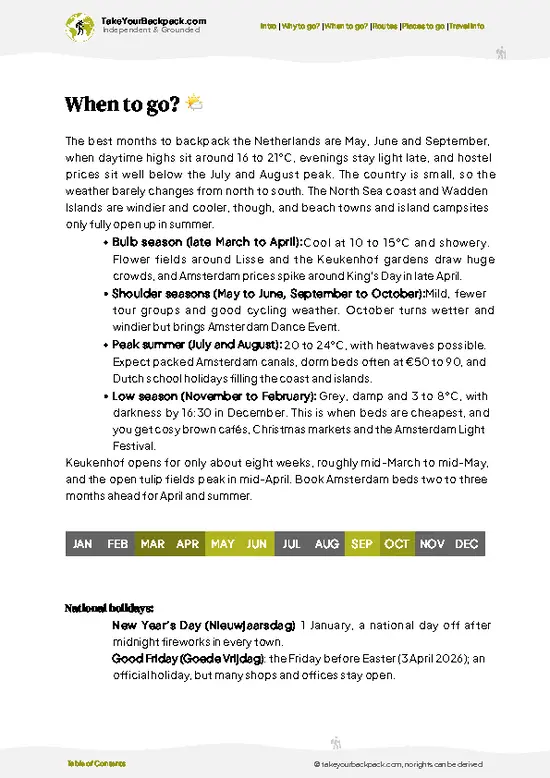
Best months and why: The best months for towns in the Netherlands are May, June and September, when daytime highs sit around 16 to 22°C, daylight lasts until 9 or 10 pm in early summer, and terraces, markets and boat operations are fully running. The country is flat and open to the North Sea, so wind and rain can arrive in any month, and annual rainfall is spread fairly evenly at roughly 700 to 850 mm.
Shoulder seasons and peaks: April brings spring bulb fields in the west, mainly the belt between Haarlem and Leiden, from about mid-April to early May, and with them heavy visitor numbers and higher bed prices. July and August reach 20 to 25°C with occasional heat spikes above 30°C, and they are the most expensive and crowded months in the Randstad. Rooms can cost 20 to 40 percent more than in … read more 👉
Best months and why: The best months for towns in the Netherlands are May, June and September, when daytime highs sit around 16 to 22°C, daylight lasts until 9 or 10 pm in early summer, and terraces, markets and boat operations are fully running. The country is flat and open to the North Sea, so wind and rain can arrive in any month, and annual rainfall is spread fairly evenly at roughly 700 to 850 mm.
Shoulder seasons and peaks: April brings spring bulb fields in the west, mainly the belt between Haarlem and Leiden, from about mid-April to early May, and with them heavy visitor numbers and higher bed prices. July and August reach 20 to 25°C with occasional heat spikes above 30°C, and they are the most expensive and crowded months in the Randstad. Rooms can cost 20 to 40 percent more than in shoulder months. King’s Day on April 27 fills the western towns and lifts prices sharply.
Winter and regional differences: November to February is cold and gray, with highs of 3 to 7°C, short days from about 4:30 pm in midwinter, and the lowest prices. Some seasonal boat tours and small attractions close or run reduced hours. Christmas markets and lights make December good for atmosphere. The coast and the north feel windier and cooler year-round, while the south in Limburg is slightly milder and sunnier in spring.

town hoppingHow to Combine towns Into One Trip

How many days to allow: A trip combining several towns in the Netherlands needs 7 to 10 days, since the country is small enough that distance is rarely the limit; pacing is. Most towns need half a day to a full day, and the compact historic centers take 2 to 4 hours to see properly.
Grouping regions and direction: Cluster by region. The western Randstad (around Amsterdam, Haarlem, Leiden, Delft and Utrecht) links by frequent trains of 15 to 45 minutes between stops. The north and northeast and the east (Gelderland and Overijssel) connect through hubs such as Zwolle, Amersfoort and Arnhem, with trips of about 1 to 2 hours from the west. The south (Brabant and Limburg) is 1.5 to 2.5 hours from Amsterdam by train. A sensible direction runs west to east, then south, or the reverse, so you make … read more 👉
How many days to allow: A trip combining several towns in the Netherlands needs 7 to 10 days, since the country is small enough that distance is rarely the limit; pacing is. Most towns need half a day to a full day, and the compact historic centers take 2 to 4 hours to see properly.
Grouping regions and direction: Cluster by region. The western Randstad (around Amsterdam, Haarlem, Leiden, Delft and Utrecht) links by frequent trains of 15 to 45 minutes between stops. The north and northeast and the east (Gelderland and Overijssel) connect through hubs such as Zwolle, Amersfoort and Arnhem, with trips of about 1 to 2 hours from the west. The south (Brabant and Limburg) is 1.5 to 2.5 hours from Amsterdam by train. A sensible direction runs west to east, then south, or the reverse, so you make one long crossing rather than several returns to the capital.
Planning mistakes: The first mistake is basing everywhere in Amsterdam and day-tripping out, which pays the highest bed prices and wastes evenings, when small towns are at their quietest and best. Stay in a mid-sized town and use the trains instead. The second is cramming more than two towns into a day, leaving little time beyond the station and main square. The third is ignoring the rural bus links in the north and east, where services thin out after early evening and on Sundays, so check the last departure on the 9292 journey planner before committing.

The ListTop towns of The Netherlands

1 Middelburg

Stadhuis statues, Lange Jan, Zeeuws Museum, Kuiperspoort

Climb the abbey tower for the canal ring, then explore the Zeeuws Museum and the miniature model of Walcheren.

2 Valkenburg

Castle ruins, marl caves, coal mine, Cauberg

Go underground in the caves and the coal mine, then climb to the castle ruins and the Cauberg hill above town.

3 Volendam

Dike promenade, fish stands, Hotel Spaander, Markermeer

Follow the dike promenade past fish stands and the harbor, then step into the museum and Hotel Spaander.

netherlands-city-volendam
© Google | Gulhan Eren

4 Edam

Cheese weigh house, drawbridges, Damplein, canal loop

Time a visit for a Thursday or Saturday, then follow the canals past drawbridges to the Kaaswaag and the carillon tower.

netherlands-city-edam
© Google |

5 Gouda

Stadhuis square, Kaaswaag, Roode Leeuw mill, Sint-Janskerk

Cross a compact center on foot to find a Gothic town hall, a cheese weigh house and a working windmill.

netherlands-city-gouda
© Google |

6 Enkhuizen

Zuiderzee Museum, Drommedaris, Oude Haven, ice arena

Spend a full day moving between the open-air museum, the harbor towers and the fort, with the ferry timetable setting your pace.

netherlands-city-enkhuizen
© Google | Gerlof Hoogeveen

7 Kampen

Bovenkerk, Cellebroerspoort, IJsselkade, Nieuwe Toren

Stroll the IJsselkade and pass through the Cellebroerspoort gate, then visit the Bovenkerk and the city museum on a half-day trip from Zwolle.

netherlands-city-kampen
© Google | Felix

8 Zierikzee

Monstertoren, Noordhavenpoort, Nieuwe Haven, maritime museum

Circle the harbor to read merchant marks and wall anchors on the brick, then visit the maritime museum and the unfinished church tower.

9 Veere

Scottish Houses, Veerse Meer, Grote Kerk, Veerse Dam

Rent a boat or paddleboard on the calm lake, then stroll past the town hall and the Scottish Houses to the dam.

netherlands-city-veere
© Google |

10 Naarden

Star-shaped bastions, moats, Comenius mausoleum, Grote Kerk

Walk the full ring of bastions and moats, then visit the fortress museum and the mausoleum of Comenius.

netherlands-city-naarden
© Google |

11 Sneek

Waterpoort, Frisian boats, Saturday market, Kleine Kerkstraat

Pass beneath the brick Waterpoort, browse the Saturday market and take a boat out onto the canals and lakes.

netherlands-city-sneek
© Google |

12 Ootmarsum

Gallery lanes, Kunstroute, Springendal, village cafés

Wander the old center’s lanes between galleries and bakeries, then walk or cycle out along the Springendal valley.

13 Thorn

White-washed houses, abbey church, herb garden, Maas cycling

Walk lanes of white-coated brick houses to the abbey church, then cycle the Maas bank for a change of pace.

netherlands-city-thorn
© Google |

14 Urk

Fish stands, lighthouse, fishermen’s monument, former island

Eat fish at the harbor stands, climb toward the lighthouse and read the town’s seafaring history in the old lanes and museum.

netherlands-city-urk
© Google |

15 Doesburg

IJssel ramparts, mustard tasting, Martinikerk tower, Waterstraat

Walk the earthen ramparts above the IJssel, then taste local mustard and browse Waterstraat before climbing the Martinikerk tower.

16 Gorinchem

Dalempoort, bastion walk, market stalls, Sint-Janskerk

Circle the old fortifications on foot, then browse the Grote Markt stalls and the harbor before stepping into the town museum.

17 Monnickendam

Smoked fish, Speeltoren, Markermeer dike, Waag

Taste smoked fish on the harbor, listen for the carillon and walk the dike path out to the Markermeer.

18 Oudewater

Heksenwaag, Hollandse IJssel, Sint-Michaëlskerk, old streets

Step onto the historic scales where accused witches were weighed, then wander the old streets to the river and the church.

netherlands-city-oudewater
© Google | Martin Lamboo

19 Woudrichem

Bastion ramparts, Gevangenpoort, smoked fish, harbor ferry

Walk the quiet bastions and the prison gate, taste smoked fish at the harbor and watch the ferry cross the river.

20 Hulst

Star ramparts, basilica, fortress museum, Stadsmolen

Follow the ramparts around the old fortress, then pick out the basilica spire and the windmill from the Grote Markt.

netherlands-city-hulst
© Google | Herman Verspecht

21 Woerden

Castle, Old Rhine canals, Saturday market, Petruskerk

Visit the castle that once guarded Holland’s border, then follow the old town canals and browse the Saturday market on the Markt.

netherlands-city-woerden
© Google | Martin Lamboo

22 Oisterwijk

De Lind terraces, heath pools, Kristalbad, forest trails

Trade the Lind’s terraces and bakery for forest paths, heath pools and the Voorste Stroom stream on foot or by bike.

netherlands-city-oisterwijk
© Google |

23 Gulpen

Gulpener brewery, Geul valley, vineyards, rental bikes

Rent a bike for the Geul valley hills, tour the brewery and finish with a tasting or a walk among the vines.

Think you know The Netherlands?

Prove you’re a true local — uncover 13 lesser-known towns in The Netherlands that locals tend to keep to themselves.
Loading the map 🌍

Expert viewInsights from Locals and Experts

How many towns to visit: I advise four to six towns on a trip of a week or more. The towns are small and the cores look similar in structure (canal, church, market square), so past six the impressions blur and you spend more time on trains than in streets. Four to six lets you vary the type and still have an unhurried morning in each.
Choosing by travel style: Match the kind of town to how you travel. If you want architecture and museums, pick the Golden Age merchant towns of the west, where entries mostly cost €10 to 20 each. If you want quiet and low prices, pick the eastern and northern towns, where cafes and beds cost noticeably less and crowds are rare. If you care about food and drink, the southern towns have the strongest regional food scene, with fruit pastries, beer and long lunches. … read more 👉
How many towns to visit: I advise four to six towns on a trip of a week or more. The towns are small and the cores look similar in structure (canal, church, market square), so past six the impressions blur and you spend more time on trains than in streets. Four to six lets you vary the type and still have an unhurried morning in each.
Choosing by travel style: Match the kind of town to how you travel. If you want architecture and museums, pick the Golden Age merchant towns of the west, where entries mostly cost €10 to 20 each. If you want quiet and low prices, pick the eastern and northern towns, where cafes and beds cost noticeably less and crowds are rare. If you care about food and drink, the southern towns have the strongest regional food scene, with fruit pastries, beer and long lunches. Mix one busy and one quiet town in a trip, because the contrast makes both better.
What it costs: Expect €70 to 110 a day on a tight independent budget: dorm beds run €30 to 60 in the west and €25 to 45 elsewhere, a supermarket meal or snack bar lunch costs €6 to 12, and a sit-down dinner €18 to 30. Trains are the biggest variable, at roughly €5 to 20 per hop; a day of heavy hopping can reach €40 to 50, so check an off-peak discount card or a pass if you plan more than four hops. Prices are high because the Netherlands has high labor costs and a tight housing market, so book beds early in spring and summer, when the cheapest rooms disappear first. A canal cruise runs about €15 to 20, a church tower climb €3 to 8, and a guided walk €10 to 20, but most towns are rewarding on foot for free.
Safety and culture: The Netherlands is very safe, and the main risk is bicycle traffic. Red-tinted paths are for bikes, and riders move fast and rarely brake, so step off them quickly, and look both ways before crossing. Pickpocketing happens around busy stations and tourist squares, so carry your phone in an inside pocket. Lock rented bikes with two locks, as theft is common, and expect to pay a €50 to 100 deposit on rentals. Culturally, directness is normal and not rude, tipping is modest (rounding up or 5 to 10 percent), and cards are preferred, with some places refusing foreign credit cards and cash. Many windows lack curtains; do not photograph into private homes. Shops close early on Sundays and many close Monday mornings in small towns, so buy supplies on Saturday.

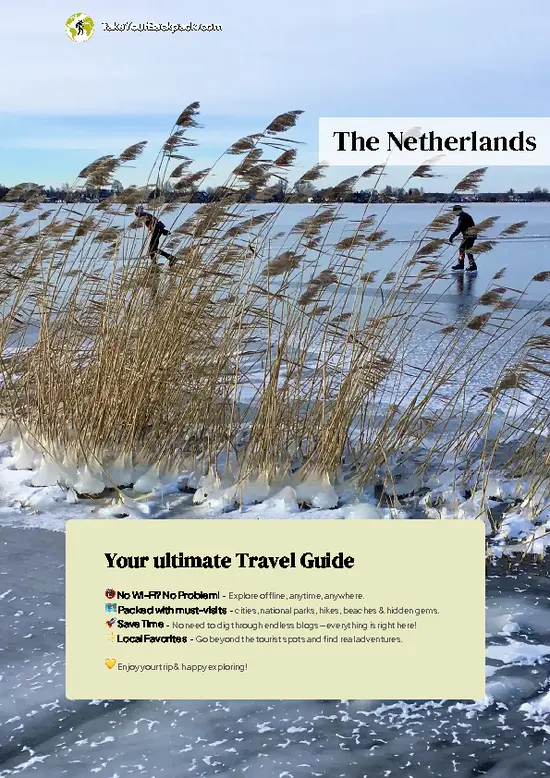
✈️ The backpacker research shortcutThe Netherlands Travel Guide

An offline-friendly backpacking guide with optimized travel routes, ranked highlights, transport advice, and the best areas to stay.
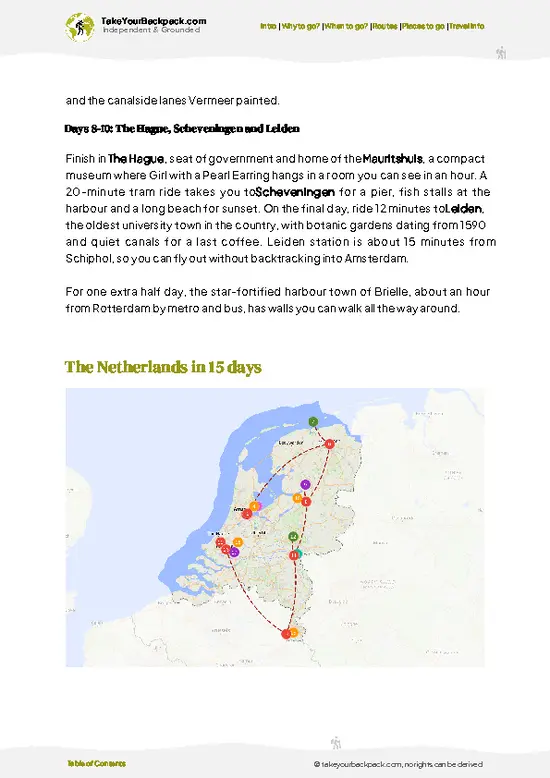
example page 0 from our offline Travel Guide for Netherlands
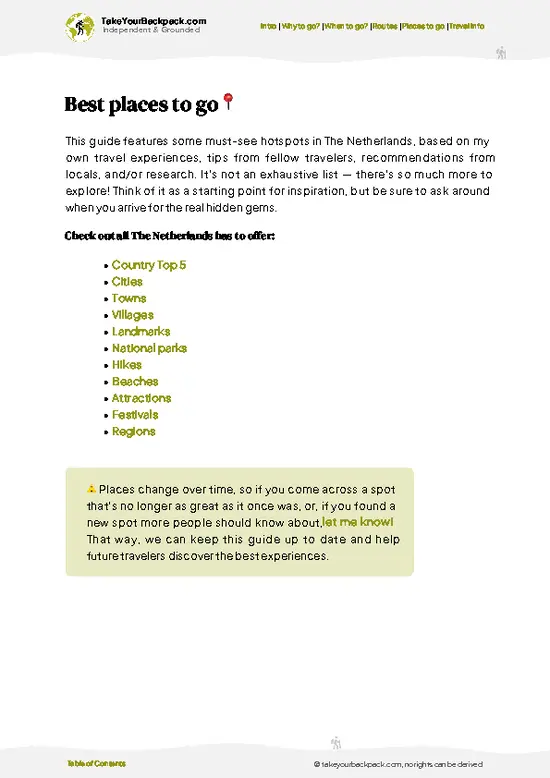
example page 1 from our offline Travel Guide for Netherlands
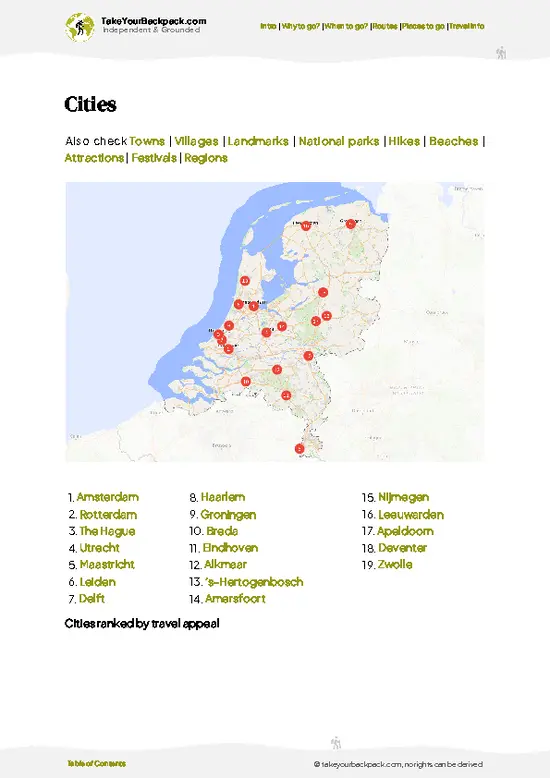
example page 2 from our offline Travel Guide for Netherlands
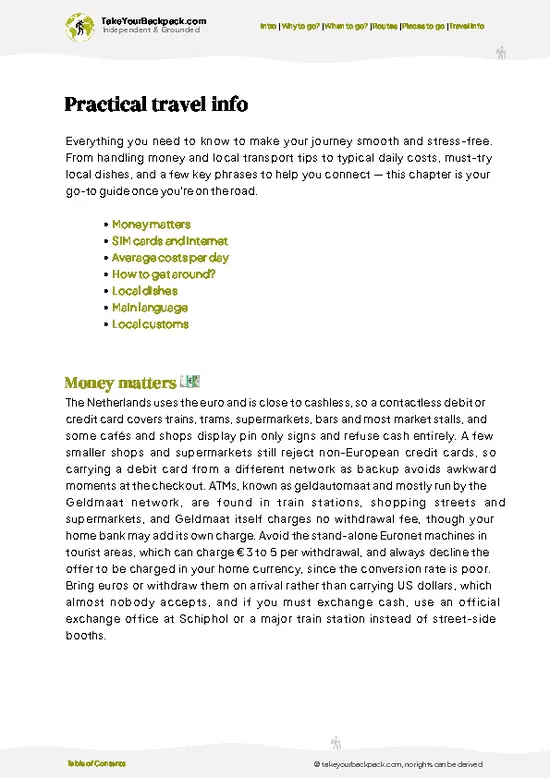
example page 3 from our offline Travel Guide for Netherlands
example page 4 from our offline Travel Guide for Netherlands
example page 5 from our offline Travel Guide for Netherlands
example page 6 from our offline Travel Guide for Netherlands
example page 7 from our offline Travel Guide for Netherlands
The digital guide (373 pages) contains:
✅ 127 highlights, ranked by travel appeal
✅ Optimized 5, 10 & 15-day travel routes
✅ Cities, national parks, landmarks, beaches
✅ How to get around
✅ Offline-friendly for travel without Wi-Fi
👉 Click to see all 30+ guide features

📅 Plan smarter in minutes, not weeks
✅ Month by month travel advice
✅ Festivals & national holidays
✅ Budget expectations

🗺️ Go to the right places, skip the overrated ones
✅ Honest pros & cons of destinations
✅ Top hikes, parks & viewpoints
✅ Lesser-known places most travelers miss
✅ Clear “worth it vs skip it” guidance

🛏️ Travel smoothly without rookie mistakes
✅ Best areas to stay
✅ Transport systems explained simply
✅ Common scams & safety advice
✅ SIM cards, money & practical tips

🌍 Understand the country, not just visit it
✅ Culture & traditions
✅ 52 Essential phrases & customs
✅ Festivals worth planning around
✅ Traveler-friendly historical context
✅ Insights that make places more meaningful

📱 Built for real travel conditions
✅ Fully downloadable PDF
✅ Works completely offline
✅ Optimized for phone use
✅ Useful in remote areas & buses
✅ Everything in one place
Stop searching, start planning
Get instant access to your full guide. 30‑day money-back guarantee.
+ Add another guide for just

By proceeding you agree to our terms.
Sent to your inbox immediately after payment • 100% Secure Checkout
Best Backpacking Travel Advisor 2025 tourism awardBest Backpacking
Travel Advisor
2025
What others say about Take Your Backpack Guides:
⭐⭐⭐⭐⭐
Fantastic, amazing amount of information!
⭐⭐⭐⭐⭐
My goodness this is amazing, it's what I've been looking for hats off too you!
⭐⭐⭐⭐⭐
I think this is absolutely BRILLIANT
⭐⭐⭐⭐
Very complete and informative. It's still missing places, but I gotta to commend you
⭐⭐⭐⭐⭐
This is truly amazing, thank you, can't wait to explore it with my kids!
⭐⭐⭐⭐⭐
Awesome resource, thank you!
⭐⭐⭐⭐⭐
This is amazing! Can't wait to explore the ones I haven't seen
⭐⭐⭐⭐
I love this! Well done, great idea.
⭐⭐⭐⭐⭐
Thanks for taking the time to make this gem!
⭐⭐⭐⭐⭐
This might be the best website I've ever seen.
⭐⭐⭐⭐⭐
Congratulations, and thank you so much for your work; it's incredibly valuable.
⭐⭐⭐⭐
In all seriousness I think you did a great job pointing out the important spots
⭐⭐⭐⭐⭐
10/10 very good
⭐⭐⭐⭐⭐
As someone who's only just starting to visit regularly this is awesome, thank you.
⭐⭐⭐⭐
Thank you very much! I'm going to visit my dad, it's going to be very useful!
⭐⭐⭐⭐⭐
This is really cool! We'll be travelling for the first time and this definitely come in handy.
⭐⭐⭐⭐⭐
You are now our minister of culture, congratulations 👨‍💼
⭐⭐⭐⭐⭐
Just wanted to tell you that this is a pearl! Going to follow your recommendations.
⭐⭐⭐⭐⭐
This is so cool. I'll definitely be using the resource for my travels soon.
⭐⭐⭐⭐⭐
This is very impressive! Good work.
⭐⭐⭐⭐⭐
This is an amazing and informative site. Very well done!

🛏️ Where to stay?Top Places to Consider Staying

Budget accommodation in the Netherlands is easy to find, with hostel dorms in Amsterdam typically running €30 to €70 a night in summer and noticeably less in Rotterdam, Utrecht and smaller cities like Haarlem. In Amsterdam, Centrum puts you within walking distance of the canal ring and the busiest nightlife but is loud, pricey and crowded around De Wallen, while De Pijp and Oud-West offer good bars, cafés and safe, livelier-but-local streets a 10 to 20 minute tram ride out, and Oost and Amsterdam-Noord are quieter and cheaper at the cost of a longer commute. Rotterdam’s Centrum and Witte de Withkwartier give you nightlife and architecture on foot at lower prices, and Utrecht’s compact Binnenstad … read more 👉
Budget accommodation in the Netherlands is easy to find, with hostel dorms in Amsterdam typically running €30 to €70 a night in summer and noticeably less in Rotterdam, Utrecht and smaller cities like Haarlem. In Amsterdam, Centrum puts you within walking distance of the canal ring and the busiest nightlife but is loud, pricey and crowded around De Wallen, while De Pijp and Oud-West offer good bars, cafés and safe, livelier-but-local streets a 10 to 20 minute tram ride out, and Oost and Amsterdam-Noord are quieter and cheaper at the cost of a longer commute. Rotterdam’s Centrum and Witte de Withkwartier give you nightlife and architecture on foot at lower prices, and Utrecht’s compact Binnenstad keeps everything walkable and calm, with Amsterdam about 30 minutes away by train.

If you enjoy meeting fellow travelers, consider choosing hostels with high ratings for atmosphere. On the other hand, if you prefer having your own space, a hotel might be a better option.

The NetherlandsMore Places Across The Netherlands

👋 Meet the founderWho’s Behind Take Your Backpack?

Johan, backpacker and founder of TakeYourBackpackHi, I’m Johan (Netherlands 🇳🇱), the creator of TakeYourBackpack. Over the past 3 decades, I’ve backpacked through 90+ countries across six continents, gaining extensive experience with independent travel, long-term trips, and overland routes.

This site is built on a combination of firsthand travel experience and carefully curated insights from other backpackers. Many guides are based on places I’ve personally visited, while others bring together tips, observations, and practical advice shared by trusted travelers I’ve met along the way.

The goal is to provide realistic, experience-driven guidance — not generic itineraries — so you can explore destinations with better context, clearer expectations, and more confidence.