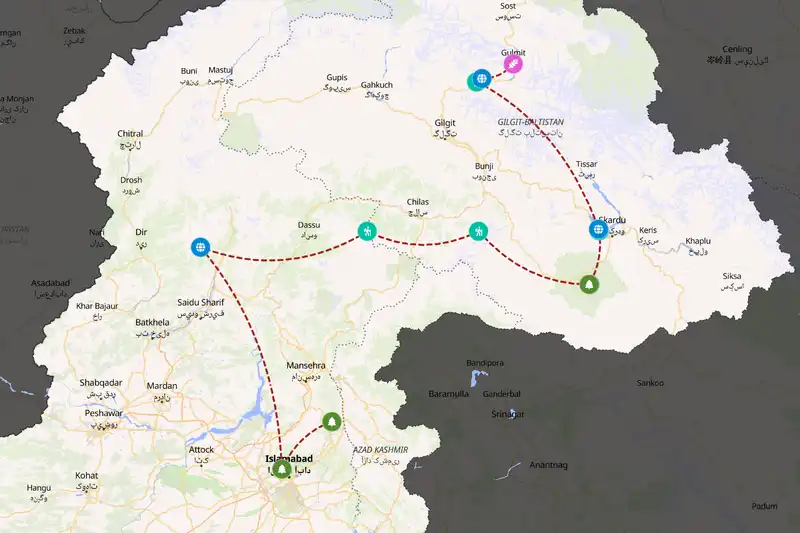
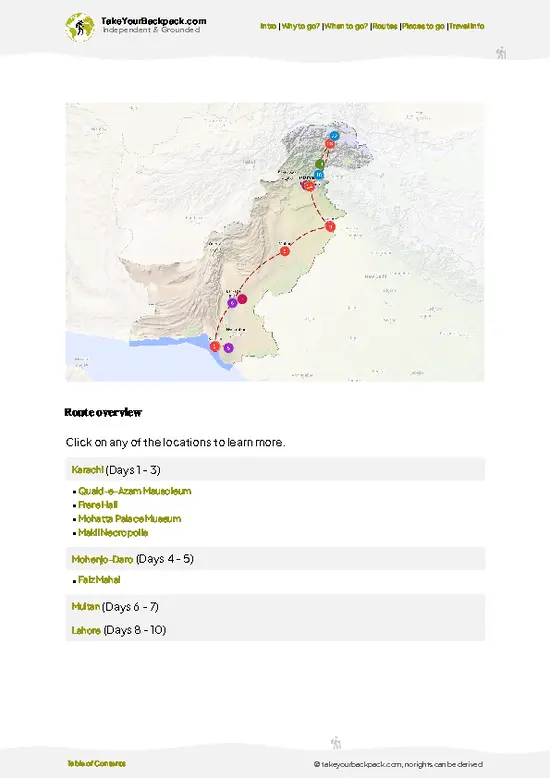
This three-week route is for travelers who want the whole spine of Pakistan, from the Arabian Sea to the Karakoram, with ruins, shrines and Mughal cities on the way. The pace is steady with built-in rest days. Expect a mix of comfort and grit: air-conditioned coaches on the motorways, one long train ride across Sindh and Punjab, minibuses and shared jeeps in the mountains, and one domestic flight home from Gilgit. Plan it for September into early October, when the Babusar Pass is still open and the southern plains have cooled from their June peak, though Sindh still reaches 35 to 40°C.
Days 1-3: Karachi and Makli
Fly into
Karachi and let the country’s biggest city show you its formal side first. The white marble
Quaid-e-Azam Mausoleum holds Jinnah’s tomb, and the changing of the guard is worth timing your visit around. Nearby, colonial
Frere Hall has a ceiling mural by the painter Sadequain, while the pink-stone
Mohatta Palace Museum in Clifton, built in 1927, shows rotating exhibitions …
read more 👉This three-week route is for travelers who want the whole spine of Pakistan, from the Arabian Sea to the Karakoram, with ruins, shrines and Mughal cities on the way. The pace is steady with built-in rest days. Expect a mix of comfort and grit: air-conditioned coaches on the motorways, one long train ride across Sindh and Punjab, minibuses and shared jeeps in the mountains, and one domestic flight home from Gilgit. Plan it for September into early October, when the Babusar Pass is still open and the southern plains have cooled from their June peak, though Sindh still reaches 35 to 40°C.
Days 1-3: Karachi and Makli
Fly into Karachi and let the country’s biggest city show you its formal side first. The white marble Quaid-e-Azam Mausoleum holds Jinnah’s tomb, and the changing of the guard is worth timing your visit around. Nearby, colonial Frere Hall has a ceiling mural by the painter Sadequain, while the pink-stone Mohatta Palace Museum in Clifton, built in 1927, shows rotating exhibitions on Sindhi art and history. Eat dinner on Burns Road, where nihari and rabri have been served since Partition. On day 3, ride 1.5 to 2 hours east to Makli, Thatta, a UNESCO necropolis with hundreds of thousands of graves spread across a dusty ridge, its carved sandstone tombs dating from the 14th to the 18th century.Days 4-7: Mohenjo-Daro, Faiz Mahal and Multan
Take a coach 6 to 8 hours north to Larkana, the town that serves as your base for Mohenjo-Daro, about 28 km away. Arrive the day before so you can reach the 4,500-year-old Indus city at opening time, before the heat climbs. Walk the grid streets, the Great Bath and the stupa mound, then finish in the small site museum. On day 6, drive about 2 hours to Khairpur for Faiz Mahal, the yellow-stone palace of the Talpur Mirs, then catch an afternoon train from nearby Rohri to Multan, a 6 to 8-hour ride. Spend day 7 slowly: the blue-tiled shrine of Shah Rukn-e-Alam dominates the skyline, and the old bazaars around it sell sohan halwa by the kilo.Days 8-10: Lahore
A 4 to 5-hour coach brings you to Lahore. This time, start with context at the Lahore Museum, where the Fasting Buddha from Gandhara and the Zamzama cannon outside set the scene for everything you will see further north. Give a full day to the Walled City of Lahore, entering at Delhi Gate and threading through the cloth and spice lanes to Wazir Khan Mosque. Save the last day for the Lahore Fort, including its tiled Picture Wall, and the red sandstone courtyard of the Badshahi Mosque Complex next door. Stay for the evening call to prayer, when the mosque lights come on.Days 11-12: Islamabad and Taxila
Coach 4 to 5 hours up the M-2 to Islamabad, a breather after the intensity of the plains. The petal-shaped Pakistan Monument and Museum sits on a hill in Shakarparian, and the Lok Virsa Museum next to it covers the crafts, music and costumes of every province. On day 12, take a ride-hailing car about 1 hour to the Taxila Museum, which holds one of the best Gandharan sculpture collections anywhere, with the excavated city of Sirkap a short drive away.Days 13-15: Kaghan Valley and the Babusar Pass
Head north by minibus or hired car to Naran in the Kaghan Valley, 6 to 8 hours via Abbottabad and Balakot. Rest the next day with a 45-minute jeep ride up to Saiful Muluk National Park, where the lake sits at about 3,200 meters below Malika Parbat. Day 15 is the big one: cross the Babusar Pass at 4,173 meters, drop to the Indus at Chilas and continue to Gilgit, 7 to 9 hours in total. Sleep there to break the journey.Days 16-19: Karimabad and the Hunza Valley
A short 2.5 to 3-hour coaster ride lands you in Karimabad, where poplars and apricot orchards line the terraces. Tour Baltit Fort, then follow the old irrigation channel that runs along the hillside above town for a flat walk with views across the valley. Use one day to explore deeper into the Hunza Valley, driving north to Attabad Lake, the turquoise lake formed by a 2010 landslide, and stopping in the village of Ganish on the way back. On day 19, return to Gilgit for an early flight the next morning.Days 20-21: Islamabad and the Margalla Hills
The 1-hour flight to Islamabad skirts Nanga Parbat if the sky is clear. If the flight is cancelled, this final night becomes your buffer. Otherwise, spend your last afternoon on Trail 5 in Margalla Hills National Park, then drive up to the Daman-e-Koh viewpoint for a final look over the city grid before flying out.
If you have an extra day in Multan, ride 2.5 to 3 hours south to Uch Sharif, where the half-ruined tiled tomb of Bibi Jawindi stands alone above the fields.

 Best Backpacking