×

Pakistan🇵🇰 | best regionsEssential 12 regions to Explore in Pakistan

Pakistan packs five distinct travel worlds into one passport stamp, and the gaps between them are huge. In the far north, the Karakoram, Hindu Kush and Himalaya deliver glaciers, jeep tracks and guesthouses that cost US$10 to 25 a night, with crowds mostly limited to July and August. Down the Indus, the Punjab plains trade peaks for Mughal-era forts, shrines and street food, with the densest transport links and the lowest prices. Sindh brings desert heat, Sufi festivals and ancient ruins, while Balochistan stays remote and needs far more planning. Independent travel works best where roads are paved, buses run daily and homestays are common, and that describes the north and the cities. Pick by altitude, season and appetite for rough roads, then go explore. Pakistan rewards the traveler who moves, asks and says yes to tea.

By Johan Kruseman 🇳🇱 | Updated October 18, 2026
Explore the best cities in Pakistan

Why go?What Makes Them Special

Pakistan sits where three great mountain ranges collide, and that geology shapes everything about how you travel here. The Karakoram holds four of the world’s 14 peaks above 8,000 meters, the Indus carves a lowland spine through the whole country, and the valleys between them stayed isolated enough to keep their own languages, from Shina and Balti to Khowar and Wakhi. That is why regions here feel like different countries rather than variations on one theme.

History stacks on top. The land has hosted Gandharan Buddhists, Indus Valley cities, Mughal emperors and Silk Road caravans, so archaeology and mountains often sit within a day’s drive of each other. The Karakoram Highway, a paved road that climbs to the Khunjerab Pass at 4,693 meters, links the north to China and makes long-distance … read more 👉
Pakistan sits where three great mountain ranges collide, and that geology shapes everything about how you travel here. The Karakoram holds four of the world’s 14 peaks above 8,000 meters, the Indus carves a lowland spine through the whole country, and the valleys between them stayed isolated enough to keep their own languages, from Shina and Balti to Khowar and Wakhi. That is why regions here feel like different countries rather than variations on one theme.

History stacks on top. The land has hosted Gandharan Buddhists, Indus Valley cities, Mughal emperors and Silk Road caravans, so archaeology and mountains often sit within a day’s drive of each other. The Karakoram Highway, a paved road that climbs to the Khunjerab Pass at 4,693 meters, links the north to China and makes long-distance overland travel realistic.

Before you commit, know the practical shape of it. Hospitality is a real feature: expect invitations to tea, to meals, sometimes to stay. Distances are slow, since mountain roads wash out, landslides close sections of highway and 200 kilometers can swallow a full day. Security conditions vary sharply by province, and some border and tribal areas are restricted or need permits, so check current government advisories close to departure. Most visitors need an e-visa, applied for online ahead of time. Dress modestly, and expect women travelers to find segregated spaces and plenty of staring in some areas, yet also warm, helpful families. Mobile signal disappears in the high valleys, so download maps and carry cash, because ATMs thin out fast beyond the main towns. Come curious, flexible and willing to adjust plans.
How the List Was Created
The list of best regions in Pakistan is created based on landscapes, local culture, attractions, vibes, and overall appeal. If you feel a region is missing in this list, please let us know.

When to go?Optimal Periods for Travel

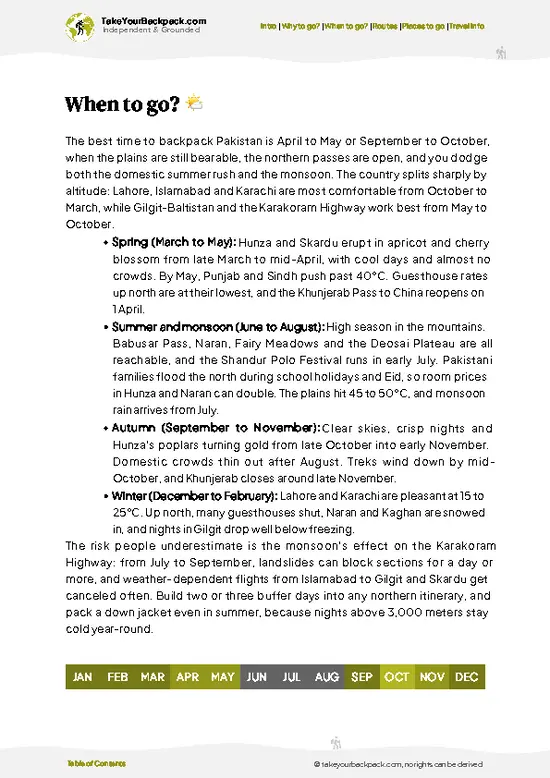
Best months and the weather behind them: The best window for Pakistan’s regions is May to September for the mountains and October to March for the plains and south, because each side swaps places between scorching and pleasant. In the north, valley days in June to August reach 20 to 30°C, nights at altitude drop near freezing, and high passes like Khunjerab only open roughly May to November. Snow shuts many roads and guesthouses from December to March.
Shoulder seasons and peak crowds: April to May and September to October are the sharpest shoulder periods in the north. Apricot and cherry blossom arrives in spring, while autumn brings golden poplars, clear air and 10 to 20°C days. Peak domestic tourism hits June to August and around Eid holidays, when hotel prices in popular valleys can rise … read more 👉
Best months and the weather behind them: The best window for Pakistan’s regions is May to September for the mountains and October to March for the plains and south, because each side swaps places between scorching and pleasant. In the north, valley days in June to August reach 20 to 30°C, nights at altitude drop near freezing, and high passes like Khunjerab only open roughly May to November. Snow shuts many roads and guesthouses from December to March.
Shoulder seasons and peak crowds: April to May and September to October are the sharpest shoulder periods in the north. Apricot and cherry blossom arrives in spring, while autumn brings golden poplars, clear air and 10 to 20°C days. Peak domestic tourism hits June to August and around Eid holidays, when hotel prices in popular valleys can rise 30 to 50 percent and roads clog with Pakistani families. Book ahead then, or avoid those weeks.
Heat, monsoon and the south: In Punjab and Sindh, April to June brings 38 to 48°C, which makes sightseeing miserable. The monsoon runs roughly July to September, with heaviest rain across Punjab, Sindh and the lower hills, and with it come landslides and flooding that disrupt northern roads. November to February is the comfortable season on the plains, with days around 15 to 25°C and chilly mornings. Balochistan’s lowlands follow the same pattern, though its highlands turn bitterly cold in winter.
Planning around closures: Ramadan shifts daytime food access, since many restaurants close until sunset, and the dates move about 11 days earlier each year. Winter travel to the high north is only practical if you accept road closures and limited services, but the prices are lowest and the silence is total.

region hoppingSuggested Travel Strategies

How Many Days a Multi-Region Trip Needs: A trip that links several regions of Pakistan needs 14 to 21 days, and 18 to 25 if you want slack for weather. Distances look short on the map and run long on the road, so plan around travel time, not kilometers.
Which Regions Group Together and Which Way to Go: Cluster by road corridor. The Karakoram Highway ties the northern mountain areas into one north-south line, with Islamabad and Rawalpindi as the gateway at the bottom. The cultural plains of Punjab and the Lahore area sit a few hours from Islamabad by motorway, so they pair easily with the capital. Sindh and Balochistan sit far to the south and west, and they work best as a separate leg or a separate trip.
Travel from the plains toward the mountains in summer, then finish with the cool lowlands. … read more 👉
How Many Days a Multi-Region Trip Needs: A trip that links several regions of Pakistan needs 14 to 21 days, and 18 to 25 if you want slack for weather. Distances look short on the map and run long on the road, so plan around travel time, not kilometers.
Which Regions Group Together and Which Way to Go: Cluster by road corridor. The Karakoram Highway ties the northern mountain areas into one north-south line, with Islamabad and Rawalpindi as the gateway at the bottom. The cultural plains of Punjab and the Lahore area sit a few hours from Islamabad by motorway, so they pair easily with the capital. Sindh and Balochistan sit far to the south and west, and they work best as a separate leg or a separate trip.
Travel from the plains toward the mountains in summer, then finish with the cool lowlands. In spring or autumn the direction matters less. Start in Lahore or Islamabad, climb the Karakoram Highway, then fly or ride back down.
Time Per Stop and Between Regions: Give each mountain region 4 to 6 days, since valley roads are slow and acclimatization pays off. Give Punjab’s cities 2 to 4 days. Islamabad to Gilgit by road runs 14 to 18 hours on the Karakoram Highway, often split over two days, and Lahore to Islamabad takes 4 to 5 hours by motorway. Flights between Islamabad and Gilgit or Skardu take about an hour and often cancel for weather, so keep a buffer day.
Planning Mistakes to Skip: The common error is stacking too many regions into two weeks. Pick two or three and let each breathe. Another is booking tight onward flights or buses after a mountain leg, when landslides and road closures can strand you for a day or two. Leave a 1 to 2 day cushion before any international departure. Travelers also forget that overnight buses on long mountain stretches cost a full day of energy, so book daytime seats where the road is scenic and climbing, and save night buses for flat motorway runs.

The ListHighly Recommended regions of Pakistan

1 Hunza Valley

Terraced orchards, Karakoram views, stone forts

Drive switchback roads above orchard terraces toward Karakoram peaks, passing centuries-old forts and stone-walled villages along the way.

2 Baltistan

Cold desert, K2 approach, Balti forts

Cross cold-desert plains and river valleys toward K2 base camp routes, passing Balti forts and centuries-old irrigation systems.

3 Swat Valley

River valley, orchards, ski resort

Move between orchard-lined river towns and a hillside ski resort in a valley long known for its farming and forestry.

4 Neelum Valley

Border river, orchards, quiet villages

Follow the Neelum River past orchards and timber houses in a narrow valley that runs close to the line of control.

5 Kaghan Valley

Alpine lakes, pine slopes, glacier streams

Hike past glacier-fed streams and pine ridgelines toward alpine lakes that sit below some of the range's accessible high passes.

6 Azad Kashmir

Pine forests, river valleys, border villages

Wander through terraced hillsides and pine forests where the Jhelum and Neelum rivers carve routes past small mountain settlements.

pakistan-region-azad-kashmir
© Google |

7 Chitral

Hindu Kush peaks, polo grounds, isolated valleys

Reach a remote valley ringed by high peaks, where old polo traditions and Kalash culture persist far from main tourist routes.

pakistan-region-chitral
© Google |

8 Kumrat Valley

Dense forest, waterfalls, unpaved trails

Trek through dense forest tracks and waterfall crossings in a valley still reached mostly by jeep and foot rather than paved road.

9 Naltar Valley

Ski slopes, alpine meadows, wooden huts

Ski or hike across open meadows framed by pine slopes and scattered wooden huts, a short detour from the main Hunza road.

10 Shandur Pass

High pass, polo festival, treeless plateau

Cross a windswept plateau known for its high-altitude polo festival, where Chitral and Gilgit-Baltistan roads briefly meet.

11 Shounter Valley

Wildflower meadows, alpine lake, rough track

Push along a rough track into wildflower meadows leading to a glacial lake, reached only during a short summer window.

pakistan-region-shounter-valley
© Google |

12 Ziarat

Juniper forest, hill station, colonial remnants

Walk through one of the world's oldest juniper forests around a former colonial hill station set high in the Balochistan mountains.

Loading the map 🌍

Expert viewPro Tips for Exploring the Best

How Many Regions to Visit: Two or three regions is the number I advise for a typical two-to-three-week trip. Roads in Pakistan are slow, mountain passes close without warning, and a day lost to a landslide is normal. Fewer regions means more time on the trail, in the tea shop, and in someone’s home when an invitation arrives, and invitations do arrive, often with chai and a plate of rice before you have finished saying thank you.
Choosing a Kind of Region for Your Style: Trekkers and photographers should put the high mountain areas first: expect jeep rides on gravel shelves above gray glacial rivers, then a campsite where peaks glow pink at dusk. History and food lovers should lean toward the plains, where you get crowded old-city lanes, grilled meat smoking at roadside stalls, and shrines … read more 👉
How Many Regions to Visit: Two or three regions is the number I advise for a typical two-to-three-week trip. Roads in Pakistan are slow, mountain passes close without warning, and a day lost to a landslide is normal. Fewer regions means more time on the trail, in the tea shop, and in someone’s home when an invitation arrives, and invitations do arrive, often with chai and a plate of rice before you have finished saying thank you.
Choosing a Kind of Region for Your Style: Trekkers and photographers should put the high mountain areas first: expect jeep rides on gravel shelves above gray glacial rivers, then a campsite where peaks glow pink at dusk. History and food lovers should lean toward the plains, where you get crowded old-city lanes, grilled meat smoking at roadside stalls, and shrines humming with drums on Thursday nights. Travelers short on time or nerve can start with the easier, better-served areas near the capital and add a remote leg once they have a feel for the country. The far south and west reward experienced travelers with space and silence, but they demand more planning and local advice.
What It Costs: Budget about US$25 to 45 a day on a backpacker setup: guesthouse dorms or basic rooms at US$6 to 15, local meals at US$2 to 5, and shared vans or buses for most moves. Mid-range comfort runs US$50 to 90 a day. Add up the extras per visit. Trekking permits, park fees and local guide costs vary by area, so expect US$15 to 40 a day for a guide or porter on remote routes and a few dollars for park or site entry. Jeep hire for a mountain valley often runs US$60 to 120 a day, split among passengers it becomes tolerable, and you get the view from the front seat. Foreigners usually pay more than locals at sites, still a small amount by international standards. Carry cash in rupees, since cards and ATMs thin out fast beyond the cities, and withdraw before you leave a big town.
Safety and Cultural Considerations: Check current government travel advisories before choosing any region, because security conditions differ sharply from one province to the next and some border areas are off limits or need a no-objection certificate. Register your plans with your guesthouse, travel in daylight, and keep a local SIM, which gives you real-time road and weather updates. Mountain danger is often natural: landslides, flooding in monsoon months, altitude sickness above 3,000 meters, and river crossings that kill more travelers than crime does. Buy insurance that covers trekking and evacuation.
Dress modestly everywhere. Men should avoid shorts; women should carry a light scarf and wear loose long sleeves, which also makes daily life smoother. Ask before photographing women. In the north, a head covering is not demanded, but in conservative areas it earns warmth and smoother conversations. Ramadan changes daily rhythm: restaurants may close until sunset, so carry snacks and eat out of sight in daytime. Use your right hand for eating and greetings, and remove shoes at mosques and many homes. Alcohol is largely unavailable, so plan for tea, fresh juice and lassi instead. One small observation: a guide or driver known by your guesthouse is worth more than any discount, because they handle checkpoints, translate, and know which bridge is out.

✈️ The backpacker research shortcutPakistan Travel Guide

An offline-friendly backpacking guide with optimized travel routes, ranked highlights, transport advice, and the best areas to stay.
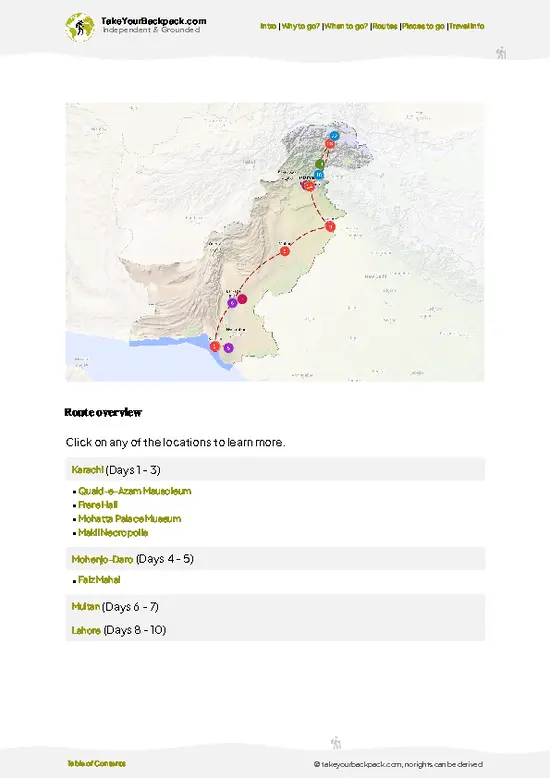
example page 0 from our offline Travel Guide for Pakistan
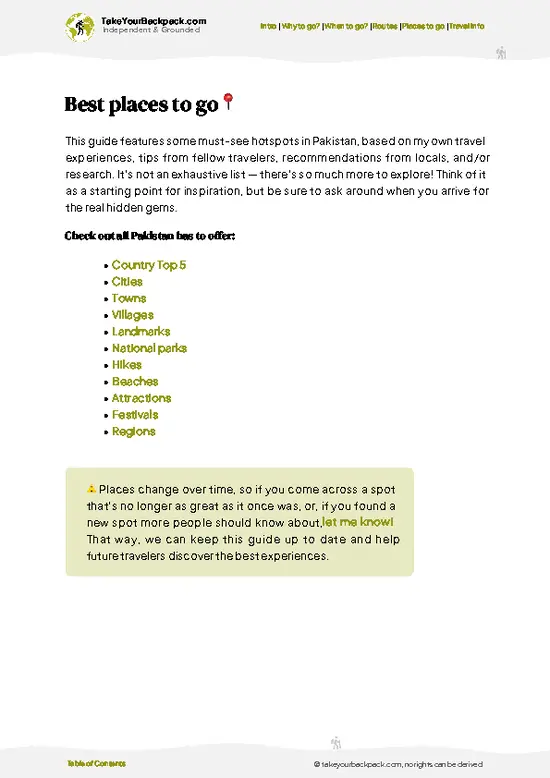
example page 1 from our offline Travel Guide for Pakistan
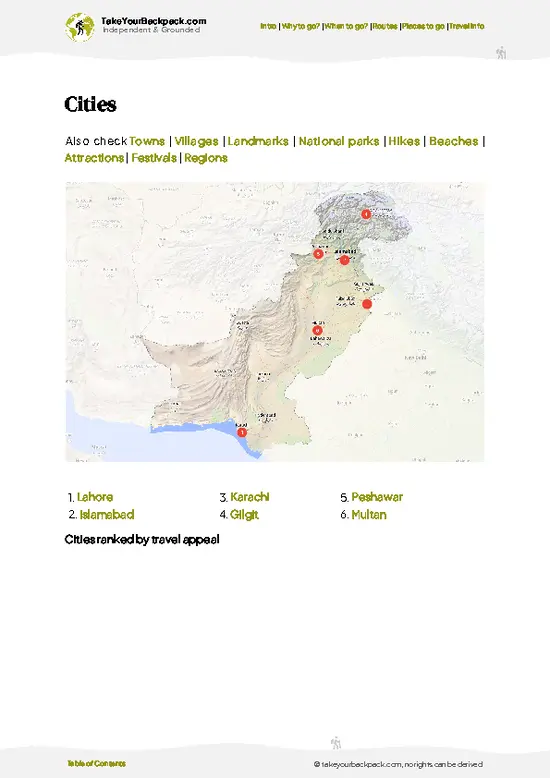
example page 2 from our offline Travel Guide for Pakistan
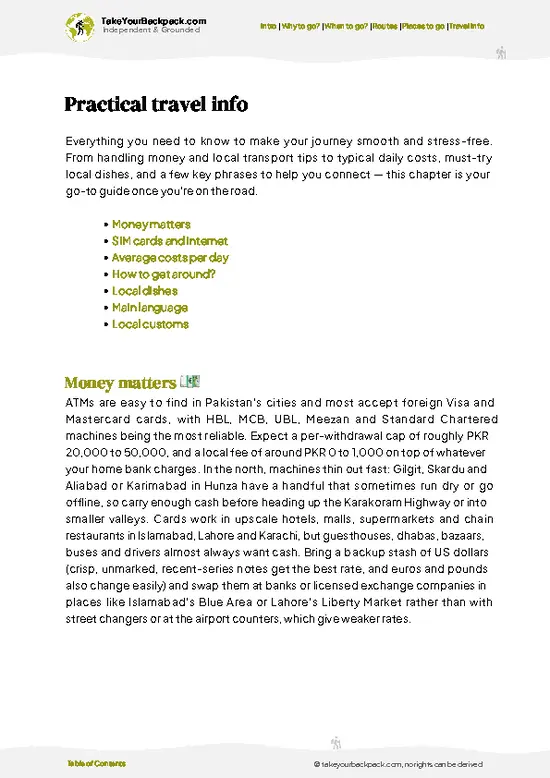
example page 3 from our offline Travel Guide for Pakistan
example page 4 from our offline Travel Guide for Pakistan
example page 5 from our offline Travel Guide for Pakistan
example page 6 from our offline Travel Guide for Pakistan
example page 7 from our offline Travel Guide for Pakistan
The digital guide (290 pages) contains:
✅ 97 highlights, ranked by travel appeal
✅ Optimized 7, 14 & 21-day travel routes
✅ Cities, national parks, landmarks, beaches
✅ How to get around
✅ Offline-friendly for travel without Wi-Fi
👉 Click to see all 30+ guide features

📅 Plan smarter in minutes, not weeks
✅ Month by month travel advice
✅ Festivals & national holidays
✅ Budget expectations

🗺️ Go to the right places, skip the overrated ones
✅ Honest pros & cons of destinations
✅ Top hikes, parks & viewpoints
✅ Lesser-known places most travelers miss
✅ Clear “worth it vs skip it” guidance

🛏️ Travel smoothly without rookie mistakes
✅ Best areas to stay
✅ Transport systems explained simply
✅ Common scams & safety advice
✅ SIM cards, money & practical tips

🌍 Understand the country, not just visit it
✅ Culture & traditions
✅ 52 Essential phrases & customs
✅ Festivals worth planning around
✅ Traveler-friendly historical context
✅ Insights that make places more meaningful

📱 Built for real travel conditions
✅ Fully downloadable PDF
✅ Works completely offline
✅ Optimized for phone use
✅ Useful in remote areas & buses
✅ Everything in one place
Stop searching, start planning
Get instant access to your full guide. 30‑day money-back guarantee.
+ Add another guide for just

By proceeding you agree to our terms.
Sent to your inbox immediately after payment • 100% Secure Checkout
Best Backpacking Travel Advisor 2025 tourism awardBest Backpacking
Travel Advisor
2025
What others say about Take Your Backpack Guides:
⭐⭐⭐⭐⭐
Fantastic, amazing amount of information!
⭐⭐⭐⭐⭐
My goodness this is amazing, it's what I've been looking for hats off too you!
⭐⭐⭐⭐⭐
I think this is absolutely BRILLIANT
⭐⭐⭐⭐
Very complete and informative. It's still missing places, but I gotta to commend you
⭐⭐⭐⭐⭐
This is truly amazing, thank you, can't wait to explore it with my kids!
⭐⭐⭐⭐⭐
Awesome resource, thank you!
⭐⭐⭐⭐⭐
This is amazing! Can't wait to explore the ones I haven't seen
⭐⭐⭐⭐
I love this! Well done, great idea.
⭐⭐⭐⭐⭐
Thanks for taking the time to make this gem!
⭐⭐⭐⭐⭐
This might be the best website I've ever seen.
⭐⭐⭐⭐⭐
Congratulations, and thank you so much for your work; it's incredibly valuable.
⭐⭐⭐⭐
In all seriousness I think you did a great job pointing out the important spots
⭐⭐⭐⭐⭐
10/10 very good
⭐⭐⭐⭐⭐
As someone who's only just starting to visit regularly this is awesome, thank you.
⭐⭐⭐⭐
Thank you very much! I'm going to visit my dad, it's going to be very useful!
⭐⭐⭐⭐⭐
This is really cool! We'll be travelling for the first time and this definitely come in handy.
⭐⭐⭐⭐⭐
You are now our minister of culture, congratulations 👨‍💼
⭐⭐⭐⭐⭐
Just wanted to tell you that this is a pearl! Going to follow your recommendations.
⭐⭐⭐⭐⭐
This is so cool. I'll definitely be using the resource for my travels soon.
⭐⭐⭐⭐⭐
This is very impressive! Good work.
⭐⭐⭐⭐⭐
This is an amazing and informative site. Very well done!

🛏️ Where to stay?Best Places to Stay in Pakistan

But dedicated backpacker hostels in Pakistan are scarce, so most budget travelers sleep in family-run guesthouses at roughly Rs 3,000 to 7,000 (US$11 to 25) a night, with a small hostel scene in Lahore, Islamabad and the north. In Lahore, the area around Mall Road puts you close to the Walled City and Lahore Fort but is noisy and congested, while Gulberg is calmer and has the cafés and evening life, at the cost of long rides to the old town; in Islamabad, the leafy F-6 and F-7 sectors are safe, quiet and near the markets, but nightlife is close to nonexistent. Up north, Karimabad in Hunza has the densest cluster of cheap guesthouses with walkable valley views and a sociable traveler crowd, though … read more 👉
But dedicated backpacker hostels in Pakistan are scarce, so most budget travelers sleep in family-run guesthouses at roughly Rs 3,000 to 7,000 (US$11 to 25) a night, with a small hostel scene in Lahore, Islamabad and the north. In Lahore, the area around Mall Road puts you close to the Walled City and Lahore Fort but is noisy and congested, while Gulberg is calmer and has the cafés and evening life, at the cost of long rides to the old town; in Islamabad, the leafy F-6 and F-7 sectors are safe, quiet and near the markets, but nightlife is close to nonexistent. Up north, Karimabad in Hunza has the densest cluster of cheap guesthouses with walkable valley views and a sociable traveler crowd, though many places close or cut back between November and March.

If you enjoy meeting fellow travelers, consider choosing hostels with high ratings for atmosphere. On the other hand, if you prefer having your own space, a hotel might be a better option.

PakistanExplore Pakistan

👋 Meet the founderWho’s Behind Take Your Backpack?

Johan, backpacker and founder of TakeYourBackpackHi, I’m Johan (Netherlands 🇳🇱), the creator of TakeYourBackpack. Over the past 3 decades, I’ve backpacked through 90+ countries across six continents, gaining extensive experience with independent travel, long-term trips, and overland routes.

This site is built on a combination of firsthand travel experience and carefully curated insights from other backpackers. Many guides are based on places I’ve personally visited, while others bring together tips, observations, and practical advice shared by trusted travelers I’ve met along the way.

The goal is to provide realistic, experience-driven guidance — not generic itineraries — so you can explore destinations with better context, clearer expectations, and more confidence.