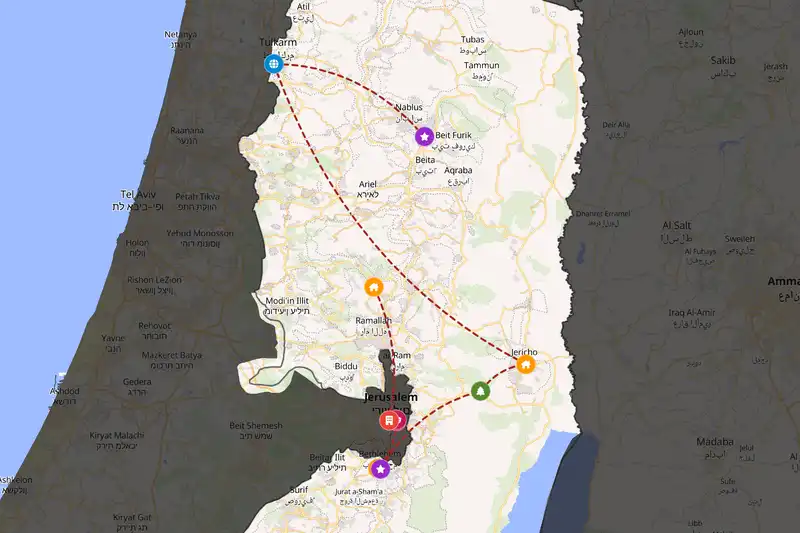
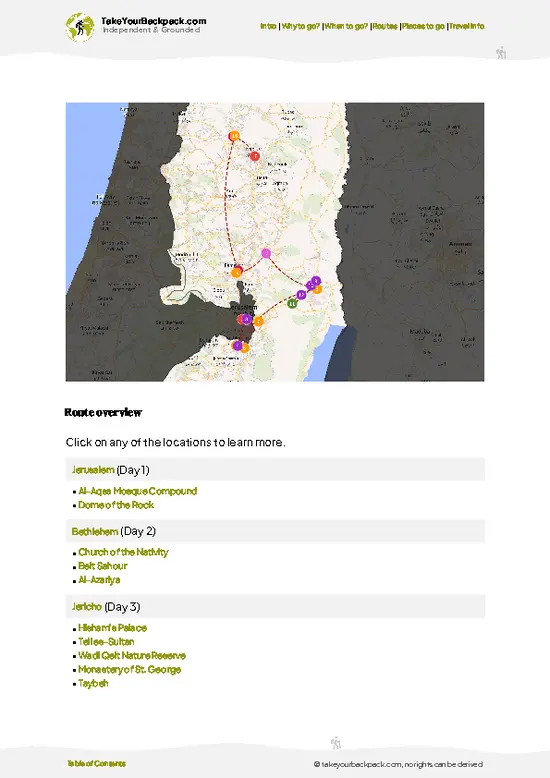
This 5-day route is for travelers who want the full arc of Palestine in one trip: the holy sites of Jerusalem and Bethlehem, the desert drop to Jericho, a canyon hike, a hilltop brewery village and the stone cities of the north. The pace is steady, with one overnight stop per day but short distances between them (rarely more than 90 minutes on the road). You will use Arab buses out of East Jerusalem, yellow service taxis between West Bank towns and a private taxi or two for the Wadi Qelt trailhead and the climb to Taybeh.
Day 1: Jerusalem
Start in
Jerusalem and spend the day inside the Old City walls, sleeping in a guesthouse near Damascus Gate so you can be first in line the next morning if the compound’s schedule shifts. The
Al-Aqsa Mosque Compound opens to non-Muslims only through the Mughrabi Gate, in a morning window (and sometimes a short midday one) from Sunday to Thursday, so plan the rest of the day around it. Once you are on the plaza, take your time with the
Dome of the Rock: …
read more 👉This 5-day route is for travelers who want the full arc of Palestine in one trip: the holy sites of Jerusalem and Bethlehem, the desert drop to Jericho, a canyon hike, a hilltop brewery village and the stone cities of the north. The pace is steady, with one overnight stop per day but short distances between them (rarely more than 90 minutes on the road). You will use Arab buses out of East Jerusalem, yellow service taxis between West Bank towns and a private taxi or two for the Wadi Qelt trailhead and the climb to Taybeh.
Day 1: Jerusalem
Start in Jerusalem and spend the day inside the Old City walls, sleeping in a guesthouse near Damascus Gate so you can be first in line the next morning if the compound’s schedule shifts. The Al-Aqsa Mosque Compound opens to non-Muslims only through the Mughrabi Gate, in a morning window (and sometimes a short midday one) from Sunday to Thursday, so plan the rest of the day around it. Once you are on the plaza, take your time with the Dome of the Rock: its interior is closed to non-Muslim visitors, but the exterior is the main event anyway, an octagon wrapped in blue and green Ottoman-era tilework under a gold dome that has topped this site since the late 7th century. Cover your shoulders and knees, and leave any religious items at your guesthouse. Spend the afternoon walking the Muslim Quarter’s covered lanes, where spice stalls and juice presses squeeze into vaulted Mamluk-era streets.Days 2-3: Bethlehem, Beit Sahour and the road down to Jericho
The Arab bus from the Damascus Gate station gets you to Bethlehem in 30 to 45 minutes. Drop your bag, then go to the Church of the Nativity before tour groups arrive. Look down through the floor hatches at the Byzantine mosaics, then up at the restored Crusader-era wall mosaics, which were cleaned of centuries of soot during the restoration. In the afternoon, take a short taxi ride to Beit Sahour, the Christian town on the eastern slope, where the Shepherds’ Field sites sit above terraces that fall away toward the desert. Spend the night in Bethlehem, eating along Star Street once the day-trippers have gone back to Jerusalem.
On Day 3, take a service taxi east along the winding Wadi Nar road, which climbs to Al-Azariya, the biblical Bethany. Walk down the narrow, worn stone steps into the Tomb of Lazarus, a 15-minute stop that most visitors skip. From there it is a long descent of roughly 30 minutes to Jericho, about 250 meters below sea level, where the air turns thick and warm and date palms replace the olive trees. Head to Hisham’s Palace in the afternoon to see the 8th-century Umayyad floor mosaic, one of the largest in the world, and its Tree of Life panel with lions hunting gazelles. Finish at Tell es-Sultan, the excavated mound of the ancient city, where a cable car rises to the Monastery of Temptation on the cliffs above. Sleep in Jericho.Day 4: Wadi Qelt, Taybeh and Ramallah
Start at dawn, because the canyon is a furnace by late morning for much of the year. Have a taxi drop you at an upper access point of the Wadi Qelt Nature Reserve and walk down the gorge along the old aqueduct channel to the Monastery of St. George, a Greek Orthodox complex built into the cliff face, then continue down toward Jericho. Carry at least 3 liters of water per person. After lunch, hire a taxi up the hills to Taybeh, a Christian village known for its family-run brewery, which has made beer here since the 1990s. Take the brewery tour, wander the ruins of the Byzantine-era church of al-Khader at the edge of the village, then continue 20 to 30 minutes west to Ramallah for the night. After a day of monasteries and desert, its café terraces and late-night shawarma counters make a welcome change.Day 5: Ramallah, Sebastia and Nablus
Visit the Yasser Arafat Museum as soon as it opens. It sits beside his mausoleum in the Muqata’a compound and covers Palestinian political history in more depth than any other museum in the West Bank, including the rooms where Arafat lived during the siege of the compound. Then take a service taxi north. Get out before Nablus and take a local taxi to Sebastia, a small village of olive groves and Ottoman houses about 12 kilometers northwest of the city. At the Sebastia Archaeological Site and Roman Ruins, a colonnaded Roman street, a theater cut into the hillside and the foundations of Herod’s temple to Augustus spread across the slopes, with very few other visitors. End in Nablus, whose old city is full of soap workshops where bars of olive-oil soap are stacked in tall drying towers. Eat a plate of hot kunafa at the counter before you head out.
Before leaving Nablus, I would send a friend to Hammam al-Shifa, the Ottoman bathhouse in the old city, for a steam and a scrub after five days of dust and stone stairs.
 Best Backpacking