×
Russia🇷🇺 | 21 days itinerary

A Complete 21-Day Plan for Russia

By Johan Kruseman 🇳🇱 | Updated May 9, 2026
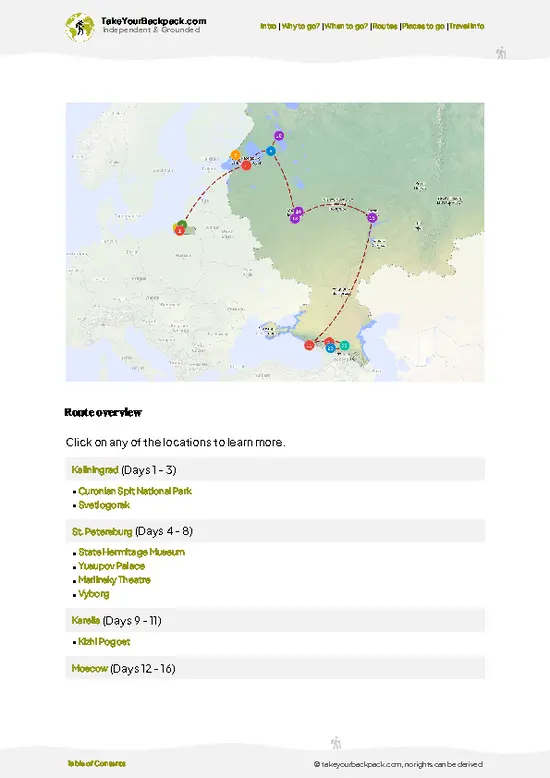
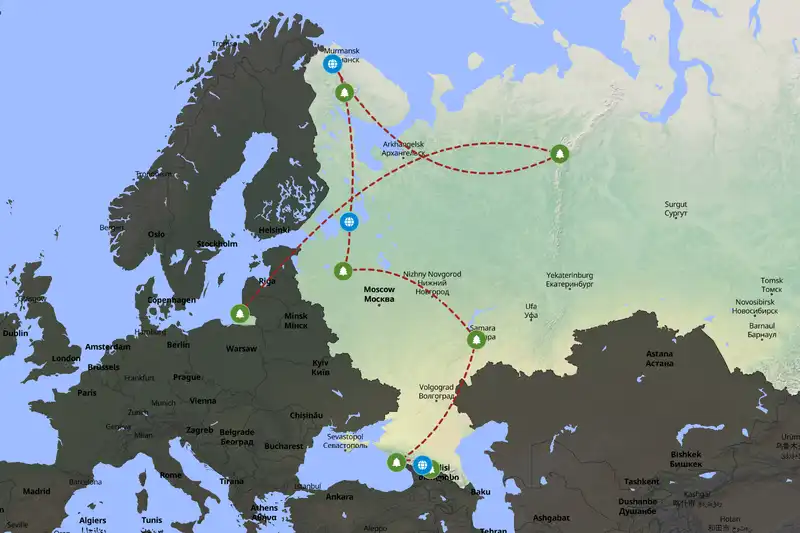
This 21-day itinerary is for travelers who want a broader sweep of European Russia: big capitals, medieval towns, and a taste of the Volga and Kazan, using fast trains, overnight rail, and a couple of regional hops while still keeping a humane pace. You’ll move more than on the 14-day route, but with enough two- and three-night stops that you can unpack your bag and actually feel each place.

Days 1-5: Moscow - Icons, art, and metro-deep dives

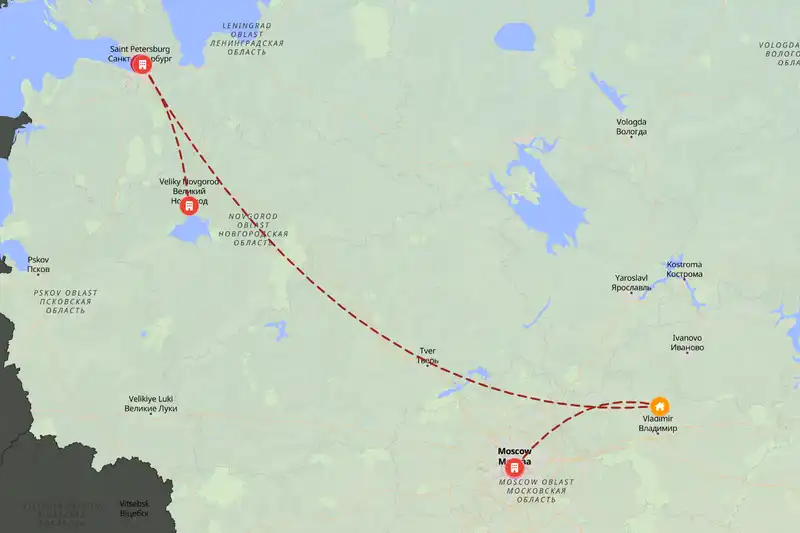
Start in Moscow and give yourself time to actually breathe between the heavy-hitter sights. Anchor your first days around Red Square & Saint Basil’s Cathedral, the Kremlin and Red Square ensemble, the Moscow Kremlin, and the Kremlin Armoury Museum, spacing them out so you’re not overdosing on palaces in one go. Use another day for the Tretyakov Gallery and the Pushkin State Museum of Fine Arts, then ride the Moscow Metro as a sightseeing loop, hopping off at the most ornate stations. When the city intensity peaks, decompress in Gorky Park and, if you … read more 👉
This 21-day itinerary is for travelers who want a broader sweep of European Russia: big capitals, medieval towns, and a taste of the Volga and Kazan, using fast trains, overnight rail, and a couple of regional hops while still keeping a humane pace. You’ll move more than on the 14-day route, but with enough two- and three-night stops that you can unpack your bag and actually feel each place.

Days 1-5: Moscow - Icons, art, and metro-deep dives

Start in Moscow and give yourself time to actually breathe between the heavy-hitter sights. Anchor your first days around Red Square & Saint Basil’s Cathedral, the Kremlin and Red Square ensemble, the Moscow Kremlin, and the Kremlin Armoury Museum, spacing them out so you’re not overdosing on palaces in one go. Use another day for the Tretyakov Gallery and the Pushkin State Museum of Fine Arts, then ride the Moscow Metro as a sightseeing loop, hopping off at the most ornate stations. When the city intensity peaks, decompress in Gorky Park and, if you want a quick nature escape, wander the trails of Losiny Ostrov National Park to remember that Moscow is ringed by real forest.

Days 6-8: Golden Ring and medieval layers - Sergiev Posad, Suzdal, and Yaroslavl

Head out by train to the spiritual heartland at the Trinity Sergius Lavra in Sergiev Posad (visited as a day stop en route), where blue-and-gold domes and chanting monks give you a very different kind of Russian power. Continue to Suzdal for two nights, soaking up the Suzdal Kremlin & Museum Complex and the low-rise, wooden-house charm that feels like a time warp. Then move on to Yaroslavl, one of the most characterful Volga cities, where you can stroll the riverfront, explore churches and merchant houses, and get a feel for a regional capital that’s important without being overwhelming.

Days 9-13: St. Petersburg and Vyborg - Imperial facades and Nordic edges

Take a daytime train to St. Petersburg and give yourself several days to go deep rather than wide. Split your museum energy between the State Hermitage Museum and the Russian Museum, then add the Fabergé Museum for a focused hit of imperial bling. Walk the Peter and Paul Fortress to trace the city’s origins, and spend an evening at the Mariinsky Theatre if you want to see ballet or opera in a house that still feels like a working institution, not a museum. Take a side trip to Vyborg for a day or overnight to feel the Finnish-Swedish side of Russia’s story in its castle, cobbled streets, and waterfront views.

Days 14-17: Veliky Novgorod and Pskov - Old Rus’ and fortress walls

Ride the train to Veliky Novgorod, one of the oldest cities in Russia and a place where the early medieval story gets very real, very fast. Spend time inside its kremlin, churches, and riverside walks, then continue to Pskov, another historically loaded city with thick fortress walls and a more low-key, lived-in feel. This phase slows the pace and shifts the focus from imperial grandeur to the earlier, rougher layers of Russian history, giving you context for everything you saw in the capitals.

Days 18-21: Kazan and the Volga - Crossroads of cultures

Finish with a train or overnight rail to Kazan, where Europe and Asia feel like they’re sharing the same street. Spend your last days exploring the Kazan Kremlin, mosques and churches standing side by side, and the riverfront that reminds you how central the Volga has always been. The city’s mix of Tatar and Russian culture, food, and architecture is a perfect counterpoint to Moscow and St. Petersburg, and it sends you home with a more layered picture of what “Russia” actually means.

The moment that hooked me on this route was standing on Yaroslavl’s river embankment at sunset, realizing how the Volga quietly ties together so many of the places I’d just crossed.
Loading the map 🌍
film
0
0
0a
Moscow
Pixabay
film
1
1
1a
Red Square & Saint Basil’s Cathedral
film
2
2
2a
Kremlin and Red Square
Pixabay
film
3
3
3a
Moscow Kremlin
film
4
4
4a
Trinity Sergius Lavra in Sergiev Posad
Raffaello Mcr
film
5
5
5a
St. Petersburg
Pixabay
film
6
6
6a
State Hermitage Museum
Pixabay
film
7
7
7a
Russian Museum
film
8
8
8a
Mariinsky Theatre
film
9
9
9a
Vyborg
film
10
10
10a
Veliky Novgorod
film
11
11
11a
Kazan Kremlin

✈️ The backpacker research shortcutRussia Travel Guide

An offline-friendly backpacking guide with optimized travel routes, ranked highlights, transport advice, and the best areas to stay.
example page 0 from our offline Travel Guide for Russiaexample page 1 from our offline Travel Guide for Russiaexample page 2 from our offline Travel Guide for Russiaexample page 3 from our offline Travel Guide for Russiaexample page 4 from our offline Travel Guide for Russiaexample page 5 from our offline Travel Guide for Russia
The digital guide (369 pages) contains:
115 highlights, ranked by travel appeal
Optimized 14, 21 & 30-day travel routes
Best neighborhoods to stay
How to get around
Offline-friendly for travel without Wi-Fi
👉 See all 30+ guide features

📅 Plan smarter in minutes, not weeks
Month by month travel advice
Festivals & national holidays
Budget expectations

🗺️ Go to the right places, skip the overrated ones
Honest pros & cons of destinations
Top hikes, parks & viewpoints
Lesser-known places most travelers miss
Clear “worth it vs skip it” guidance

🛏️ Travel smoothly without rookie mistakes
Best areas to stay
Transport systems explained simply
Common scams & safety advice
SIM cards, money & practical tips

🌍 Understand the country, not just visit it
Culture & traditions
52 Essential phrases & customs
Festivals worth planning around
Traveler-friendly historical context
Insights that make places more meaningful

📱 Built for real travel conditions
Fully downloadable PDF
Works completely offline
Optimized for phone use
Useful in remote areas & buses
Everything in one place
Save weeks of stressful planning
Get instant access to the full guide directly. 30-day money-back guarantee.


Sent to your inbox immediately after payment • 100% Secure Checkout
Best Backpacking Travel Advisor 2025 tourism awardBest Backpacking
Travel Advisor
2025
What others say about Take Your Backpack Guides:
⭐⭐⭐⭐⭐
Fantastic, amazing amount of information!
⭐⭐⭐⭐⭐
My goodness this is amazing, it's what I've been looking for hats off too you!
⭐⭐⭐⭐⭐
I think this is absolutely BRILLIANT
⭐⭐⭐⭐
Very complete and informative. It's still missing places, but I gotta to commend you
⭐⭐⭐⭐⭐
This is truly amazing, thank you, can't wait to explore it with my kids!
⭐⭐⭐⭐⭐
Awesome resource, thank you!
⭐⭐⭐⭐⭐
This is amazing! Can't wait to explore the ones I haven't seen
⭐⭐⭐⭐
I love this! Well done, great idea.
⭐⭐⭐⭐⭐
Thanks for taking the time to make this gem!
⭐⭐⭐⭐⭐
This might be the best website I've ever seen.
⭐⭐⭐⭐⭐
Congratulations, and thank you so much for your work; it's incredibly valuable.
⭐⭐⭐⭐
In all seriousness I think you did a great job pointing out the important spots
⭐⭐⭐⭐⭐
10/10 very good
⭐⭐⭐⭐⭐
As someone who's only just starting to visit regularly this is awesome, thank you.
⭐⭐⭐⭐
Thank you very much! I'm going to visit my dad, it's going to be very useful!
⭐⭐⭐⭐⭐
This is really cool! We'll be travelling for the first time and this definitely come in handy.
⭐⭐⭐⭐⭐
You are now our minister of culture, congratulations 👨‍💼
⭐⭐⭐⭐⭐
Just wanted to tell you that this is a pearl! Going to follow your recommendations.
⭐⭐⭐⭐⭐
This is so cool. I'll definitely be using the resource for my travels soon.
⭐⭐⭐⭐⭐
This is very impressive! Good work.
⭐⭐⭐⭐⭐
This is an amazing and informative site. Very well done!

🧭 RouteOther Route Options

Travel Russia your way — from a quick highlights trip to a slow-paced adventure.

🙋 FAQFAQ: Backpacking Russia

Short version: Russia is doable to backpack independently if you’re organized and comfortable with some friction. It’s not “show up and wing it” easy like Southeast Asia, but it rewards effort in a big way.

Language is the main hurdle. Outside Moscow and St. Petersburg, English drops off fast, so offline translation apps, a Cyrillic alphabet cheat sheet, and screenshots of key phrases are worth their weight in gold. Learning to read place names in Cyrillic makes train stations, metro maps, and menus much less intimidating.

Visa rules and registration can be the other headache. You usually need a visa in advance, plus proof of accommodation. Once inside the country, hotels and hostels typically handle registration for you; double-check this when booking and keep your registration slips together with your passport. For budget travelers, booking at least the first few nights in registered hostels is the simplest way to stay legal.

On the ground, the infrastructure is actually very backpacker-friendly: extensive rail network, cheap long-distance trains, overnight sleepers that double as accommodation, and plenty of hostels in major cities and along classic routes like the Trans-Siberian. Supermarkets and stolovaya-style canteens keep food costs low, and you can eat well on a backpacker budget if you avoid fancy sit-down restaurants.

Safety-wise, Russia is generally fine for common-sense travelers: watch your valuables in crowded metros, avoid drunk groups late at night, and keep a low profile at political events. In smaller towns, people are often curious and helpful once they realize you’re a traveler, even if you share only five words of common language.

If you like structure, plan your long-distance trains and major city stays in advance. If you like flexibility, you can still improvise within regions, but don’t expect last-minute cheap tickets on the most popular train routes in peak season. Independent backpacking here is more like a slow, strategic chess game than a spontaneous card trick, but that’s half the fun.
For a first-time backpacking trip, 10–14 days is the minimum that feels worthwhile, 3–4 weeks is the sweet spot, and 6+ weeks is where Russia really opens up.

With 10–14 days, focus on a tight, high-value loop:
- 4–5 days Moscow: Red Square, Kremlin area, metro stations, cheap canteens, and a day trip to Sergiev Posad if you want a monastery hit without going far.
- 4–5 days St. Petersburg: Hermitage, canals, neighborhood wandering, and maybe Peterhof or Pushkin as day trips.
- 1–2 overnight trains between them or to a nearby city like Veliky Novgorod to experience classic Russian rail.

With 3–4 weeks, you can add a “second layer” of Russia:
- Golden Ring towns (Suzdal, Vladimir, Yaroslavl) for small-town churches, wooden houses, and slower days.
- A leg of the Trans-Siberian: for example, Moscow → Yekaterinburg → Novosibirsk → Krasnoyarsk → Irkutsk/Lake Baikal, hopping off for 1–3 nights in each.
- Lake Baikal: 3–5 days around Listvyanka or Olkhon Island for hikes, homestays, and cold-water bravado.

With 6+ weeks, you can:
- Ride the full Trans-Siberian or Trans-Mongolian line, taking your time in Siberian cities.
- Explore the Caucasus (Sochi region, Krasnaya Polyana, or further south into the mountains) for hiking and homestays.
- Spend slow weeks in one or two cities, living like a local on a tight budget.

Russia is huge, and travel days can be long. For budget travelers, overnight trains save money but eat energy, so it’s better to see fewer regions deeply than to sprint across the map. A good rule: for every overnight train, give yourself at least one “low-effort” day afterward to wander, snack, and nap instead of cramming in big-ticket sights.
Yes, you can absolutely get around Russia without a car, and for backpackers it’s usually cheaper, safer, and less stressful to skip driving altogether.

Trains are your backbone. The long-distance rail network is extensive, relatively punctual, and built for budget travelers. Platskart (open-plan 3rd class) is the classic backpacker choice: cheap, social, and surprisingly comfortable if you bring earplugs, an eye mask, and a light chain or cable lock for peace of mind. Kupe (2nd class) is pricier but quieter and better for sleep on very long legs.

For shorter hops and less-trafficked routes, marshrutkas (minibuses) and regional buses fill the gaps. They’re cheap and frequent between towns, but can be cramped. If you’re tall or carrying a big pack, board early to grab a decent seat. Always keep small bills for tickets.

In cities, metros and trams are your best friends. Moscow and St. Petersburg metros are fast, cheap, and easy to navigate once you can match Cyrillic station names to your map. Many cities also have trolleybuses and trams that cost very little and cover most neighborhoods you’ll stay in as a backpacker.

Domestic flights are worth considering for huge distances (for example, Moscow to Irkutsk or Vladivostok) when time is tight. They can be good value if booked in advance, and they save you several days of train travel. For a pure budget trip with more time than money, mix one or two long flights with several overnight trains.

Hitchhiking exists but is not as straightforward or safe-feeling as in some other countries, especially with language barriers and long, empty stretches of road. For most travelers, it’s more hassle than it’s worth.

Between trains, buses, and city transit, you can cross the country without ever touching a steering wheel. The key is to plan long-distance legs in advance, keep offline maps and timetables on your phone, and build in buffer time so a delayed bus doesn’t wreck your next train connection.
For a budget traveler, “must-visit” in Russia means places that give you maximum culture, character, and landscape for each day and ruble you spend.

Moscow
- Why it’s worth it: It’s the political and cultural center, and the contrast between grand Soviet architecture, golden-domed churches, and hip neighborhoods is huge.
- Highlights for backpackers: Red Square and St. Basil’s from the outside (you don’t have to pay for every interior), the metro as a rolling art gallery, Gorky Park for people-watching, and cheap eats in stolovayas and food courts.

St. Petersburg
- Why it’s worth it: More European feel, canals, and dense history in a walkable core.
- Highlights: The Hermitage (pick a few sections instead of trying to see everything), wandering the historic center, rooftop views, and cheap boat rides in shoulder season. It’s also packed with hostels and budget food options.

Golden Ring (especially Suzdal and Vladimir)
- Why it’s worth it: Small-town Russia with onion domes, wooden houses, and slower days, reachable by bus or train from Moscow.
- Highlights: Walking between monasteries, riverside picnics, and staying in guesthouses where you actually meet locals instead of just other travelers.

Lake Baikal (especially Olkhon Island)
- Why it’s worth it: One of the world’s deepest lakes, with a wild, open feel and simple village life.
- Highlights: Cliffside hikes, shamanic sites, homestays with home-cooked food, and icy swims if you’re brave. It’s a long way from Moscow, so it shines most on trips of 3+ weeks.

A Trans-Siberian Segment
- Why it’s worth it: Not just the train, but the rhythm of Siberian cities and landscapes.
- Good backpacker stops: Yekaterinburg (Ural Mountains gateway), Krasnoyarsk (access to Stolby Nature Reserve), and Irkutsk (for Baikal). Even doing one or two legs gives you a feel for the scale of the country.

Caucasus Mountains (if you have extra time)
- Why it’s worth it: Strong hiking, mountain villages, and homestay culture.
- Highlights: Trails, home-cooked food, and a very different vibe from the big cities. This is more of a “second trip” region unless you’re skipping Siberia entirely.

If it’s your first time and you’re on a budget, a high-value route is: Moscow → Golden Ring town or two → overnight train → St. Petersburg, or Moscow → Trans-Siberian segment → Baikal, depending on how much time you have.
If you’re short on time or cash, the smartest move is to skip anything that eats days of transit for only a small upgrade in experience, or that’s expensive without adding much beyond what you’ll already see.

Skip or minimize:

Trying to cross the entire country in one trip
- Why: Moscow to Vladivostok sounds epic, but it burns a huge chunk of your time sitting on trains. You’ll see a lot of birch trees and not much depth in any one place.
- Better: Pick a focused corridor: Moscow–St. Petersburg–Golden Ring, or Moscow–Yekaterinburg–Baikal, instead of the full Trans-Siberian.

Multiple similar big cities
- Why: Many mid-sized Russian cities have a central square, a few churches, a Lenin statue, and Soviet blocks. Interesting, but they blur together.
- Better: Do Moscow and St. Petersburg properly, then choose only 1–2 extra cities that clearly add something (Yekaterinburg for Ural history, Krasnoyarsk for nature access, etc.).

Overpriced guided city tours
- Why: In major cities, you can see most sights yourself with a map and a bit of reading. Many tours repeat basic info you can get from a cheap guidebook or audio guide.
- Better: Spend that money on a specialized tour that’s hard to DIY, like a local-led Baikal excursion or a specific museum tour you care about.

Excessive museum hopping
- Why: Russia has world-class museums, but doing three big ones in two days will fry your brain and your budget.
- Better: Pick one or two that match your interests (for example, Hermitage in St. Petersburg, Tretyakov Gallery in Moscow) and leave time for street-level exploring, markets, and parks.

Far-flung regions on a tight schedule
- Why: Places like Kamchatka, the Russian Far East, or remote Arctic towns are logistically heavy and expensive to reach.
- Better: Save them for a dedicated future trip. For a first, short backpacking run, they’re more hassle than payoff.

In short, if you’re short on time, skip the urge to “collect” regions. Go deep on one or two areas, use overnight trains strategically, and spend your money on experiences that are uniquely Russian—like a Baikal homestay, a platskart train ride, or a few slow evenings in a neighborhood bar—rather than on long, repetitive transit days.

🇷🇺 RussiaExpand Your Journey

Ready to build a truly unique trip? Predefined routes are perfect for first-time visitors, but there is so much more to discover. Whether you are chasing a city trip, pristine national parks, local food scenes, or quiet beaches, pick a category to design your own path.