×

Somalia🇸🇴 | best townsYour Guide to the 10 Best towns in Somalia

Towns in Somalia are not a casual backpacking stop. Skip any plan built around ticking off places, because the country has no hostel circuit and no backpacker trail. What it has is three very different settings. Somaliland in the northwest is the calmest and the only region where independent travel is realistic, with Hargeisa as the usual entry point. Puntland in the northeast is more guarded and needs arranged security. Southern Somalia including Mogadishu is fast-changing, expensive and armed-escort territory. Costs rise as access gets harder, and crowds are essentially absent everywhere. Pick Somaliland for independence, the rest only with serious preparation.

By Johan Kruseman 🇳🇱 | Updated November 10, 2026
Explore the best landmarks in Somalia

Why go?What Makes Them Special

Somalia works for towns because urban life here is built on clan networks, livestock trade and a long Indian Ocean merchant history, not on tourism. Settlements grew around wells, ports and trade crossroads, so you see working markets, tea houses and camel and goat trade rather than staged heritage. Hospitality toward guests is deeply rooted in Somali culture, and that is the real draw.

But Somalia is poorly suited to casual town-hopping. Three decades of conflict after 1991 left fragmented governance: Somaliland runs its own administration and has stayed largely peaceful, while Puntland and the federal south operate under different authorities and security conditions. Roads between regions are long, often unpaved, and checkpoints are routine. There is almost no tourist infrastructure, no … read more 👉
Somalia works for towns because urban life here is built on clan networks, livestock trade and a long Indian Ocean merchant history, not on tourism. Settlements grew around wells, ports and trade crossroads, so you see working markets, tea houses and camel and goat trade rather than staged heritage. Hospitality toward guests is deeply rooted in Somali culture, and that is the real draw.

But Somalia is poorly suited to casual town-hopping. Three decades of conflict after 1991 left fragmented governance: Somaliland runs its own administration and has stayed largely peaceful, while Puntland and the federal south operate under different authorities and security conditions. Roads between regions are long, often unpaved, and checkpoints are routine. There is almost no tourist infrastructure, no ATM culture outside major cities and very few places you can walk around freely without a local host.

Before choosing Somalia for its towns, know that government travel advisories for most of the country are at the highest warning level, that insurance is hard to get, and that a local fixer or host is close to mandatory. Many towns have little to see beyond the daily rhythm of the place. Go for people and atmosphere, not sights.
How the List Was Created
The list of best towns in Somalia is created based on charm, local culture, atmosphere, hidden gems, and visitor appeal. If you feel a town is missing in this list, please let us know.

When to go?When to Plan Your Trip

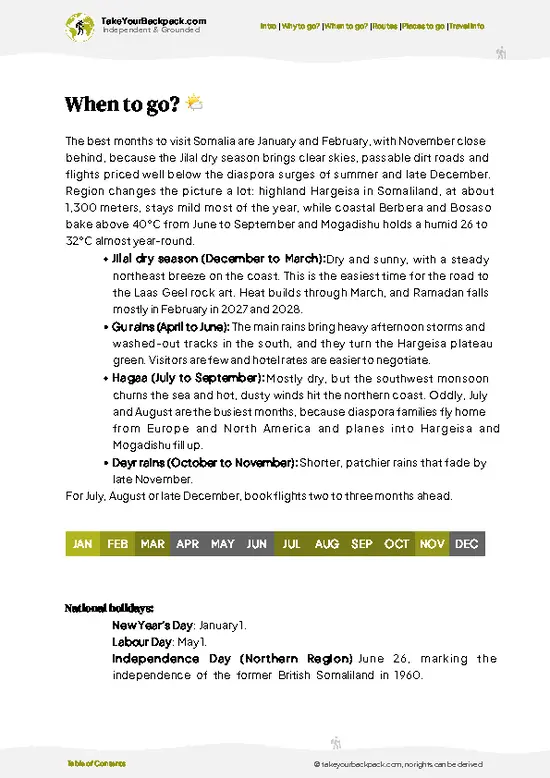
Best months: The best months for towns in Somalia are December to February, when the dry Jilaal season keeps rain away, roads stay passable and coastal heat is at its most bearable. Daytime temperatures run about 25 to 32°C on the northern highlands and coast in this period, and the highlands around Hargeisa can drop to 10 to 15°C at night.

Shoulder seasons: October to November and March to April are workable but less predictable. The Gu rains from April to June bring heavy downpours to the south and central areas, turning dirt roads to mud and cutting off routes for days. The Deyr rains in October and November are shorter and lighter. Somaliland and Puntland are far drier overall, with annual rainfall often under 400 mm along the northern coast.

Months to skip: Skip June to September on … read more 👉
Best months: The best months for towns in Somalia are December to February, when the dry Jilaal season keeps rain away, roads stay passable and coastal heat is at its most bearable. Daytime temperatures run about 25 to 32°C on the northern highlands and coast in this period, and the highlands around Hargeisa can drop to 10 to 15°C at night.

Shoulder seasons: October to November and March to April are workable but less predictable. The Gu rains from April to June bring heavy downpours to the south and central areas, turning dirt roads to mud and cutting off routes for days. The Deyr rains in October and November are shorter and lighter. Somaliland and Puntland are far drier overall, with annual rainfall often under 400 mm along the northern coast.

Months to skip: Skip June to September on the coast. The Hagaa season brings strong monsoon winds, rough seas and temperatures of 35 to 42°C at places like Berbera, which makes walking around towns miserable. Highland areas stay milder at roughly 25 to 30°C. Ramadan shifts opening hours, with many cafes closed until sunset. Crowds are never a factor, and prices do not follow a tourist season, though fuel and transport costs spike after heavy rain.

town hoppingSuggested Travel Strategies

How many days: A trip combining several towns in Somalia needs 7 to 14 days, and anything shorter wastes most of your time in transit. Stick to one region per trip. Somaliland is the only cluster that links together well, using Hargeisa as the hub, with onward routes to Berbera on the coast and Borama toward the west. Puntland and the south sit in separate security zones, and combining them with Somaliland in one trip rarely works.

Direction and timing: Fly into Hargeisa, work outward in loops and return to the hub, rather than crossing the country in one line. Plan 2 to 3 days per stop so you can arrange hosts, security contacts and a rest day. Hargeisa to Berbera takes roughly 2 to 3 hours by road, while Hargeisa to Borama is about 3 hours. Long hauls between regions can take 12 to 24 hours … read more 👉
How many days: A trip combining several towns in Somalia needs 7 to 14 days, and anything shorter wastes most of your time in transit. Stick to one region per trip. Somaliland is the only cluster that links together well, using Hargeisa as the hub, with onward routes to Berbera on the coast and Borama toward the west. Puntland and the south sit in separate security zones, and combining them with Somaliland in one trip rarely works.

Direction and timing: Fly into Hargeisa, work outward in loops and return to the hub, rather than crossing the country in one line. Plan 2 to 3 days per stop so you can arrange hosts, security contacts and a rest day. Hargeisa to Berbera takes roughly 2 to 3 hours by road, while Hargeisa to Borama is about 3 hours. Long hauls between regions can take 12 to 24 hours or more on rough tracks, so use domestic flights where they exist.

Planning mistakes: The commonest error is stacking too many towns into a short window. Roads are slow, checkpoints add delays and a single washed-out route can cost a day. Build in a buffer day for every two stops. Another mistake is arriving without a confirmed local host or driver. Arrange both before you travel. Finally, avoid traveling after dark between towns, and do not assume buses run on a timetable, because they leave when full.

The ListThe Best towns of Somalia

1 Marka

Coral-stone lanes, carved doors, fishing landing, Biimaal history

Wander weathered merchant houses down to the sand, watch the morning catch come in, and hear the town’s resistance history from local elders over tea.

2 Ceerigaabo

Sanaag highlands, juniper air, escarpment edge

Walk cool mountain streets, drink spiced tea with traders, and look out from the edge where the land drops to the plains.

3 Hobyo

Coral-stone lanes, tall coastal dunes

Wander weathered limestone lanes with a local who can tell the sultanate’s story, then climb a dune for the shoreline view.

4 Eyl

Hilltop fort, Puntland coast, pirate-era fishing town

Climb to the old fort above the rooftops, then drop to the harbor where lobster and tuna are sorted on the beach.

5 Jowhar

Middle Shabelle farmland, motorbike streets, sweet shaah

See green banana and sesame plots against the dry plain, then talk harvests over spiced tea on the main road.

6 Dhusamareb

Galmudug capital, camel milk, red-earth plains

Meet townspeople in the tea houses and market, then look out across flat acacia scrub where herders gather at water points.

7 Badhan

Dervish fort, livestock market, inland Sanaag, roadside tea

Walk the stone walls of a 1910s Dervish fort, then join herders haggling over goats and camels before tea with drivers on the Erigavo road.

8 Jamaame

Juba River bananas, papaya plots, riverside tea

Follow farm tracks between banana and papaya fields to the river, where produce is loaded onto small boats each morning.

9 Buurhakaba

Sorghum belt, roadside tea, Af-Maay talk

Take a seat at a roadside tea stall and watch grain sacks, goats and farmers pass through a working market town.

10 Afmadow

Camel and goat trade, inland Lower Juba, invitation-only access

Watch herders haggle over camels and cattle at the livestock market, then settle into a tea stall to hear how the trade works.

11 Qoryoley

Banana and papaya farms, slow brown river, Lower Shabelle

Visit canal-fed plots where fruit is cut and loaded onto trucks, then sit with elders who explain the farming seasons.

12 Wanlaweyn

Rain-fed farms, sorghum market, Afgooye–Baidoa road, Dafet fields

Browse a market stocked with sorghum, maize and sesame, then follow farm tracks with a local host through the fields of the Dafet district.

13 Jalalaqsi

Shabelle river farms, Hiraan valley, dusk on the main road

Walk irrigated plots of maize and sesame beside the Shabelle, then watch minibuses unload as shopkeepers light their lamps.

14 Doolow

Dawa River, Ethiopian border trade, Gedo

Follow the riverbank at dawn and browse a market stocked with goods that crossed the border the day before.

15 El Wak

Divided border town, deep wells, pastoral trade

Trace how people, camels and sugar cross the frontier each day, then cool off over roadside tea beside the market.

16 Buur Gaabo

Warm-water beach, tuna and lobster landings, Kenyan border coast

Spend an afternoon on a long beach lined with fishing boats, watching buyers wait on the sand as the catch is sorted.

17 Taleh

Dervish forts, Sool plateau, roofless stone towers

Walk the ruined fortress walls of the Sayyid’s capital with a guide, then hear the Dervish story told over tea.

18 Harardhere

Former pirate base, pale-sand skiffs, shoreline dunes

Arrive at dawn as wooden skiffs land tuna and kingfish, then walk the low dunes beyond the last houses.

19 El Bur

Ceel Buur wells, Galgaduud herders, short stop

Watch herders draw water for their animals at the wells that gave the town its name, then catch the loud bargaining at the livestock area.

20 Mahadday Weyne

Mogadishu-Jowhar road, farm produce, river irrigation

Browse a roadside market of farm goods, then follow irrigation channels toward the Shabelle and the fields beyond.

21 Wajid

Bakool bush country, airstrip, livestock gathering

Watch goats and camels change hands, then sit on plastic stools at the tea stalls with traders and elders.

Think you know Somalia?

Prove you’re a true local — uncover 11 lesser-known towns in Somalia that locals tend to keep to themselves.
Loading the map 🌍

Expert viewExpert Commentary on towns

How many towns to visit: Visit two to four towns on one trip, all within the same region. Each stop needs advance arrangement of a host, driver and permission from local authorities, and every extra town multiplies that work. Beyond four, you spend the trip in vehicles and waiting on checkpoints rather than seeing anything.

Choosing between kinds of towns: Independent travelers and first-timers should stay in Somaliland, where movement is relatively free and a local contact is enough. Travelers who want coastal atmosphere should choose port towns and accept the heat. Anyone drawn to Puntland or the south needs a professional security provider and should treat it as an expedition, not a backpacking trip. Skip towns where the only draw is a name on a map, since many have no accommodation, no … read more 👉
How many towns to visit: Visit two to four towns on one trip, all within the same region. Each stop needs advance arrangement of a host, driver and permission from local authorities, and every extra town multiplies that work. Beyond four, you spend the trip in vehicles and waiting on checkpoints rather than seeing anything.

Choosing between kinds of towns: Independent travelers and first-timers should stay in Somaliland, where movement is relatively free and a local contact is enough. Travelers who want coastal atmosphere should choose port towns and accept the heat. Anyone drawn to Puntland or the south needs a professional security provider and should treat it as an expedition, not a backpacking trip. Skip towns where the only draw is a name on a map, since many have no accommodation, no sights and no safe way to wander.

What it costs: Budget US$60 to 120 a day in Somaliland for a basic guesthouse (US$20 to 50 a night), local meals (US$3 to 8), and a hired driver or fixer (US$50 to 100 a day). Puntland and the south run far higher, commonly US$200 to 500 a day once armed escort and vehicles are added. Visa on arrival for Somaliland costs around US$90 to 100, and a separate visa is needed for federal Somalia, often roughly US$60 to 90 for an e-visa. Flights into the region are the biggest single cost. Budget for cash in US dollars, because cards rarely work and ATMs are scarce. Mobile money (such as EVC Plus or e-Dahab) is how locals pay, but it needs a local SIM and a local helper.

Costs and delays that catch people out: Arriving without cash is the most expensive error, so carry clean, recent US$ notes, which are widely accepted, and keep small bills for taxis and tea. Unplanned security escorts can appear as demands at checkpoints, so confirm in advance which permits and fees apply. Rainy-season washouts cause multi-day delays, so keep spare days and a flexible flight. Photographing military sites, government buildings or people without asking can lead to detention, and the fine or delay is never worth a photo.

Safety and cultural considerations: Check your government’s travel advice and carry specialist insurance, because standard policies typically exclude Somalia. Register your plans with your embassy where possible. Dress modestly: women should cover hair, arms and legs, and men should wear long trousers. Somalia is overwhelmingly Muslim, so avoid alcohol, public displays of affection and eating in public during Ramadan daylight hours. Use the right hand for greeting and eating. Accept tea when offered, and ask before photographing anyone. Do not walk alone at night, even in calmer areas, and follow your host’s guidance on where to go. Mobile coverage is good in cities, so a local SIM is cheap and useful.

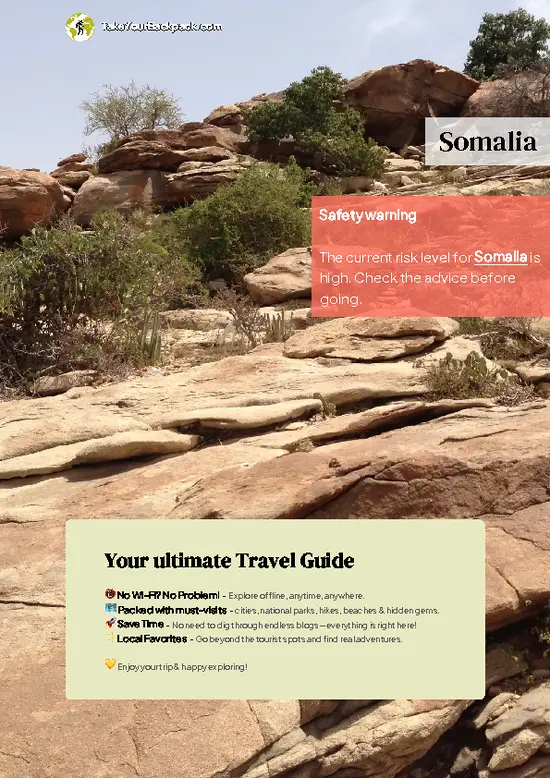
✈️ The backpacker research shortcutSomalia Travel Guide

What the free pages can't give you: ready-made routes, every place ranked, and it works offline. All in 1 guide.
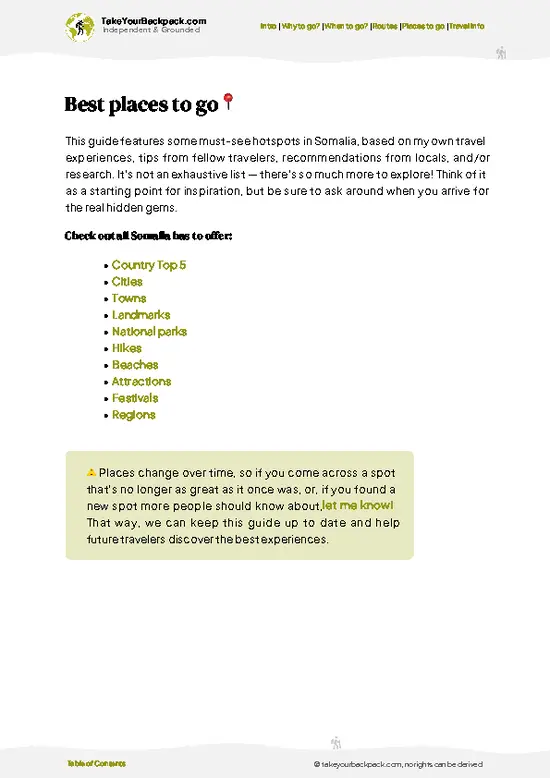
example page 0 from our offline Travel Guide for Somalia
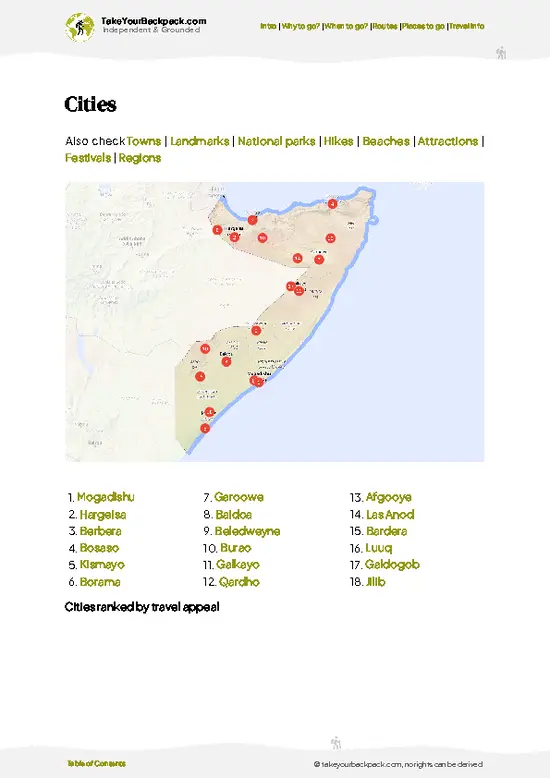
example page 1 from our offline Travel Guide for Somalia
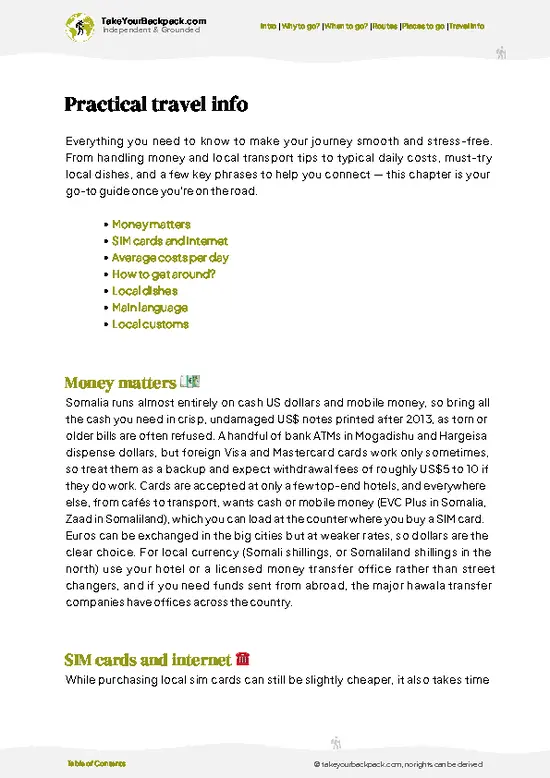
example page 2 from our offline Travel Guide for Somalia
example page 3 from our offline Travel Guide for Somalia
example page 4 from our offline Travel Guide for Somalia
example page 5 from our offline Travel Guide for Somalia
example page 6 from our offline Travel Guide for Somalia
example page 7 from our offline Travel Guide for Somalia
The digital guide (237 pages) contains:-page digital guide:
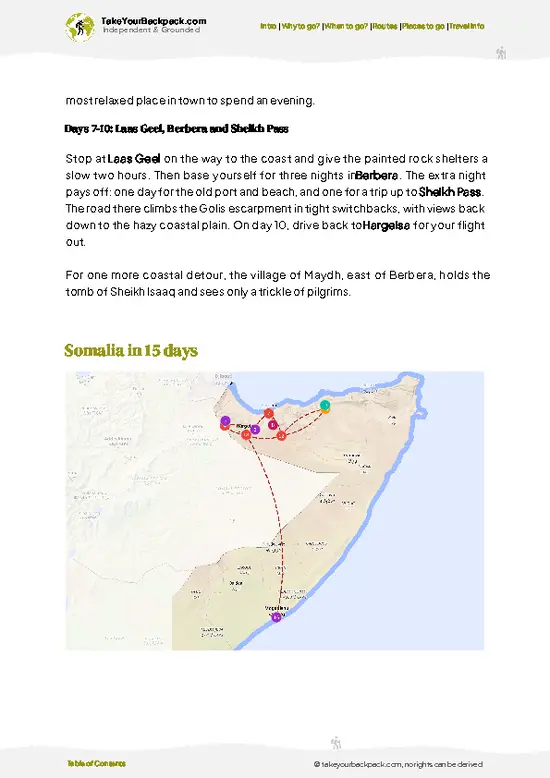
✅ Ready-made 5, 10 & 15-day routes
✅ All 68 places ranked, so you skip the overrated ones
✅ Works offline, all in 1 guide
✅ Cities, national parks, landmarks, beaches
✅ How to get around
👉 Click to see all 30+ guide features

📅 Plan smarter in minutes, not weeks
✅ Month by month travel advice
✅ Festivals & national holidays
✅ Budget expectations

🗺️ Go to the right places, skip the overrated ones
✅ Honest pros & cons of destinations
✅ Top hikes, parks & viewpoints
✅ Lesser-known places most travelers miss
✅ Clear “worth it vs skip it” guidance

🛏️ Travel smoothly without rookie mistakes
✅ Best areas to stay
✅ Transport systems explained simply
✅ Common scams & safety advice
✅ SIM cards, money & practical tips

🌍 Understand the country, not just visit it
✅ Culture & traditions
✅ 52 Essential phrases & customs
✅ Festivals worth planning around
✅ Traveler-friendly historical context
✅ Insights that make places more meaningful

📱 Built for real travel conditions
✅ Fully downloadable PDF
✅ Works completely offline
✅ Optimized for phone use
✅ Useful in remote areas & buses
✅ All in 1 guide
Stop searching, start planning
Get instant access to your full guide. 30‑day money-back guarantee.


By proceeding you agree to our terms.
Sent to your inbox immediately after payment • 100% Secure Checkout
Best Backpacking Travel Advisor 2025 tourism awardBest Backpacking
Travel Advisor
2025
What others say about Take Your Backpack Guides:
⭐⭐⭐⭐⭐
Fantastic, amazing amount of information!
⭐⭐⭐⭐⭐
My goodness this is amazing, it's what I've been looking for hats off too you!
⭐⭐⭐⭐⭐
I think this is absolutely BRILLIANT
⭐⭐⭐⭐
Very complete and informative. It's still missing places, but I gotta to commend you
⭐⭐⭐⭐⭐
This is truly amazing, thank you, can't wait to explore it with my kids!
⭐⭐⭐⭐⭐
Awesome resource, thank you!
⭐⭐⭐⭐⭐
This is amazing! Can't wait to explore the ones I haven't seen
⭐⭐⭐⭐
I love this! Well done, great idea.
⭐⭐⭐⭐⭐
Thanks for taking the time to make this gem!
⭐⭐⭐⭐⭐
This might be the best website I've ever seen.
⭐⭐⭐⭐⭐
Congratulations, and thank you so much for your work; it's incredibly valuable.
⭐⭐⭐⭐
In all seriousness I think you did a great job pointing out the important spots
⭐⭐⭐⭐⭐
10/10 very good
⭐⭐⭐⭐⭐
As someone who's only just starting to visit regularly this is awesome, thank you.
⭐⭐⭐⭐
Thank you very much! I'm going to visit my dad, it's going to be very useful!
⭐⭐⭐⭐⭐
This is really cool! We'll be travelling for the first time and this definitely come in handy.
⭐⭐⭐⭐⭐
You are now our minister of culture, congratulations 👨‍💼
⭐⭐⭐⭐⭐
Just wanted to tell you that this is a pearl! Going to follow your recommendations.
⭐⭐⭐⭐⭐
This is so cool. I'll definitely be using the resource for my travels soon.
⭐⭐⭐⭐⭐
This is very impressive! Good work.
⭐⭐⭐⭐⭐
This is an amazing and informative site. Very well done!

🛏️ Where to stay?Best Stay Options in Somalia

Somalia has no real backpacker hostel scene, so budget travel here means simple guesthouses and local hotels at roughly US$20 to 40 a night in Hargeisa and Garowe, while secure hotels in Mogadishu typically cost US$50 to 150 because guards, blast walls and airport transfers are built into the price. In Mogadishu, Lido puts you near the beach and the city’s seafront cafes but draws crowds and has been targeted before, while Hodan and the KM4 area sit closer to the airport road, with more mid-range options and fewer late-night crowds. Hargeisa’s city center around the main market is the easiest base for walking to restaurants and money changers, though it gets noisy with traffic and the call to … read more 👉
Somalia has no real backpacker hostel scene, so budget travel here means simple guesthouses and local hotels at roughly US$20 to 40 a night in Hargeisa and Garowe, while secure hotels in Mogadishu typically cost US$50 to 150 because guards, blast walls and airport transfers are built into the price. In Mogadishu, Lido puts you near the beach and the city’s seafront cafes but draws crowds and has been targeted before, while Hodan and the KM4 area sit closer to the airport road, with more mid-range options and fewer late-night crowds. Hargeisa’s city center around the main market is the easiest base for walking to restaurants and money changers, though it gets noisy with traffic and the call to prayer from early morning.

If you enjoy meeting fellow travelers, consider choosing hostels with high ratings for atmosphere. On the other hand, if you prefer having your own space, a hotel might be a better option.

SomaliaWhere to Go Next

👋 Meet the founderWho’s Behind Take Your Backpack?

Johan, backpacker and founder of TakeYourBackpackHi, I’m Johan (Netherlands 🇳🇱), the creator of TakeYourBackpack. Over the past 30 years, I’ve backpacked through 88 countries across six continents, gaining extensive experience with independent travel, long-term trips, and overland routes.

This site is built on a combination of firsthand travel experience and carefully curated insights from other backpackers. Many guides are based on places I’ve personally visited, while others bring together tips, observations, and practical advice shared by trusted travelers I’ve met along the way.

The goal is to provide realistic, experience-driven guidance — not generic itineraries — so you can explore destinations with better context, clearer expectations, and more confidence.