×

Spain🇪🇸 | best townsTop-Rated 10 towns in Spain

Spain has roughly 8,000 municipalities, and it feels as if each one holds a fiesta on a day you didn’t plan for. The country sorts its towns into rough camps. Andalusia gives you whitewashed hill towns and cheap tapas, with the heat to match. Castile and Aragon offer walled medieval centers on dry plateaus, where the quiet is real and the roast lamb is serious. The green north, from Galicia to the Basque Country, brings rain, seafood and higher prices. The Mediterranean coast trades character for crowds in August, when even a parking space has a waiting list. Access follows the same split. Fast trains tie the big cities together, but many of the best small places depend on a regional bus that runs twice a day and skips Sunday. For backpacking or any independent trip, that timetable decides more than the guidebook does. Pick the kind of town first, then the season.

By Johan Kruseman 🇳🇱 | Updated October 19, 2026
Explore the best villages in Spain

Why go?Why Travelers Love These Spots

Spain is built for town travel in a way few countries manage. Centuries of Roman, Moorish and Christian rule left small settlements layered with history, and the Reconquista scattered fortified hilltops across the interior. Because the peninsula is mountainous and dry, people clustered around water and defensible ground, so old centers stayed compact and walkable. Then the 20th century drained many rural areas, which is why so many towns kept their old cores intact while the surrounding villages emptied. The social rhythm matters as much as the stones. Evenings revolve around the plaza, the paseo and the bar, so a town feels alive at 10 pm in a way that sleepy northern European equivalents rarely do.

The practical side is just as strong. A big high-speed rail network and a dense bus system, … read more 👉
Spain is built for town travel in a way few countries manage. Centuries of Roman, Moorish and Christian rule left small settlements layered with history, and the Reconquista scattered fortified hilltops across the interior. Because the peninsula is mountainous and dry, people clustered around water and defensible ground, so old centers stayed compact and walkable. Then the 20th century drained many rural areas, which is why so many towns kept their old cores intact while the surrounding villages emptied. The social rhythm matters as much as the stones. Evenings revolve around the plaza, the paseo and the bar, so a town feels alive at 10 pm in a way that sleepy northern European equivalents rarely do.

The practical side is just as strong. A big high-speed rail network and a dense bus system, mostly run by regional companies such as Alsa, reach a surprising number of places. Food is local and regional to a degree that can make a 60 km drive feel like crossing a border, and a cheap menú del día at lunch often includes three courses and wine.

There are things to know before committing. Mealtimes run late: lunch is at 2 pm, dinner rarely before 9 pm, and kitchens in between are shut. Many shops and sights close for a long midday break, and Monday closures catch out plenty of visitors. Heat in the south and interior can make midday sightseeing a bad idea. Rural bus links thin out sharply at weekends and in holidays. Spanish is far more useful than English outside the main tourist circuits, and a few polite phrases go a long way.
Our Approach to Ranking
The list of best towns in Spain is created based on charm, local culture, atmosphere, hidden gems, and visitor appeal. If you feel a town is missing in this list, please let us know.

When to go?Seasonal Guide to Visiting

Best months: April to June and September to October are the best months for towns in Spain, because daytime highs sit around 18 to 28°C, the light is good and the summer crowds have not arrived or have gone home. Nobody sweats through a castle climb in those conditions, which is a rare gift.
Summer and winter: July and August are hot. Seville, Córdoba and much of the interior regularly pass 38 to 42°C, and locals vanish indoors from about 2 to 6 pm. Walking tours at noon are for the optimistic. The north stays cooler, with highs near 22 to 27°C, which is why Spaniards flock there. August is also the national holiday month, so coastal towns fill up and accommodation prices can climb 30 to 60 percent over spring rates. Some inland businesses close for two weeks.

Winter splits the country. The … read more 👉
Best months: April to June and September to October are the best months for towns in Spain, because daytime highs sit around 18 to 28°C, the light is good and the summer crowds have not arrived or have gone home. Nobody sweats through a castle climb in those conditions, which is a rare gift.
Summer and winter: July and August are hot. Seville, Córdoba and much of the interior regularly pass 38 to 42°C, and locals vanish indoors from about 2 to 6 pm. Walking tours at noon are for the optimistic. The north stays cooler, with highs near 22 to 27°C, which is why Spaniards flock there. August is also the national holiday month, so coastal towns fill up and accommodation prices can climb 30 to 60 percent over spring rates. Some inland businesses close for two weeks.

Winter splits the country. The south and the Mediterranean coast stay mild, around 12 to 17°C by day, with sunny spells. The Castilian plateau is properly cold, with frosts and occasional snow, and the Atlantic north is wet, with 100 to 150 rainy days a year in places like Galicia. Hotel prices drop, but some seasonal beach-town restaurants and guesthouses shut from November to March.
Shoulder seasons and festivals: Spring is lovely, but Holy Week (Semana Santa, March or April) and the Seville Feria fill beds across Andalusia and Castile months ahead, with rates doubling in some places. Local fiestas can do the same in any month, so check the calendar before booking. Autumn is the quieter bargain: warm seas, grape harvests in La Rioja and fewer queues. Rain returns in the north from October, and the south can see short, sharp downpours. A light rain jacket is worth packing for the north all year.

town hoppingPlanning Your Route Efficiently

How long you need: A trip combining several towns in Spain works best over 10 to 16 days, which allows three or four regions without living on trains. Fewer days push you into one or two regions, and that is perfectly respectable.
Which regions group well: Andalusia clusters nicely: Seville, Córdoba, Granada and the hill country between them are linked by buses and trains in 1.5 to 3 hours. Castile pairs with Madrid as the hub, since fast trains and buses reach walled towns in 30 minutes to 2 hours. The north (Basque Country, Cantabria, Asturias, Galicia) forms a separate coastal chain best done by bus or hire car, with 1 to 3 hours between stops. The sensible direction is to arrive in one hub and leave from another, for example flying into Madrid, moving through Castile, dropping south to … read more 👉
How long you need: A trip combining several towns in Spain works best over 10 to 16 days, which allows three or four regions without living on trains. Fewer days push you into one or two regions, and that is perfectly respectable.
Which regions group well: Andalusia clusters nicely: Seville, Córdoba, Granada and the hill country between them are linked by buses and trains in 1.5 to 3 hours. Castile pairs with Madrid as the hub, since fast trains and buses reach walled towns in 30 minutes to 2 hours. The north (Basque Country, Cantabria, Asturias, Galicia) forms a separate coastal chain best done by bus or hire car, with 1 to 3 hours between stops. The sensible direction is to arrive in one hub and leave from another, for example flying into Madrid, moving through Castile, dropping south to Andalusia, and flying out of Málaga or Seville. Open-jaw tickets cost little extra and save a 5 to 6 hour backtrack.
Time per stop: Most towns reward one or two nights. Plan two nights for larger ones with several sights and one night for compact places where an afternoon, an evening and a morning cover it. Moving between regions takes 2.5 to 6 hours by train or bus, for example Madrid to Seville in about 2.5 hours by high-speed rail. Madrid to Santiago de Compostela by train is around 5 to 6 hours.
Common planning mistakes: The classic error is cramming a different town in every day, which turns the trip into a series of bus stations. Leave a buffer day every four or five stops. Another is trusting a map: a place 40 km away can take two hours by bus with a change. Check Sunday and holiday timetables, since services drop or vanish, and book high-speed trains early for better fares. Finally, avoid the whole country in one go. Spain is far larger than it looks, and picking two or three regions is not a failure of ambition.

The ListMust-Visit towns in Spain

1 Toledo

Hilltop fortress, winding alleys, layered religions

Lose yourself in tangled streets, discovering traces of Christian, Jewish, and Muslim heritage at every turn.

2 Segovia

Roman aqueduct, fairy-tale castle, roast suckling pig

Follow the arches of a Roman aqueduct into a city where fortress towers and culinary traditions define the experience.

spain-city-segovia
© Google | Ubaldo Naya

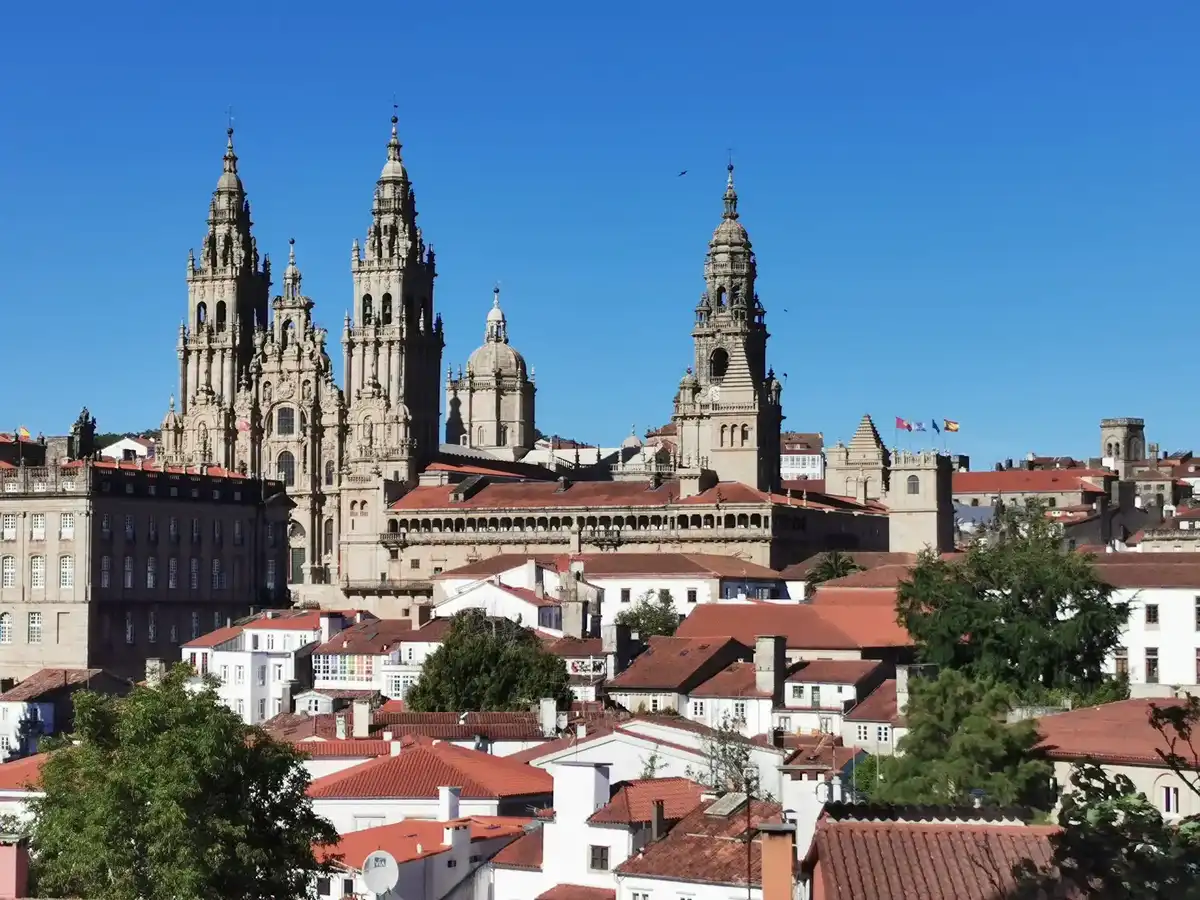
3 Santiago de Compostela

Cathedral square, pilgrim routes, arcaded streets

Arrive with travelers from across Europe, joining a city shaped by centuries of arrivals, rituals, and rain-soaked stone.

spain-city-santiago-de-compostela
© Google | Guerre Alain

4 Ronda

Stone bridge, sheer cliffs, bullring

Cross a dizzying gorge on foot, then explore a town split by dramatic geology and layered with centuries of tradition.

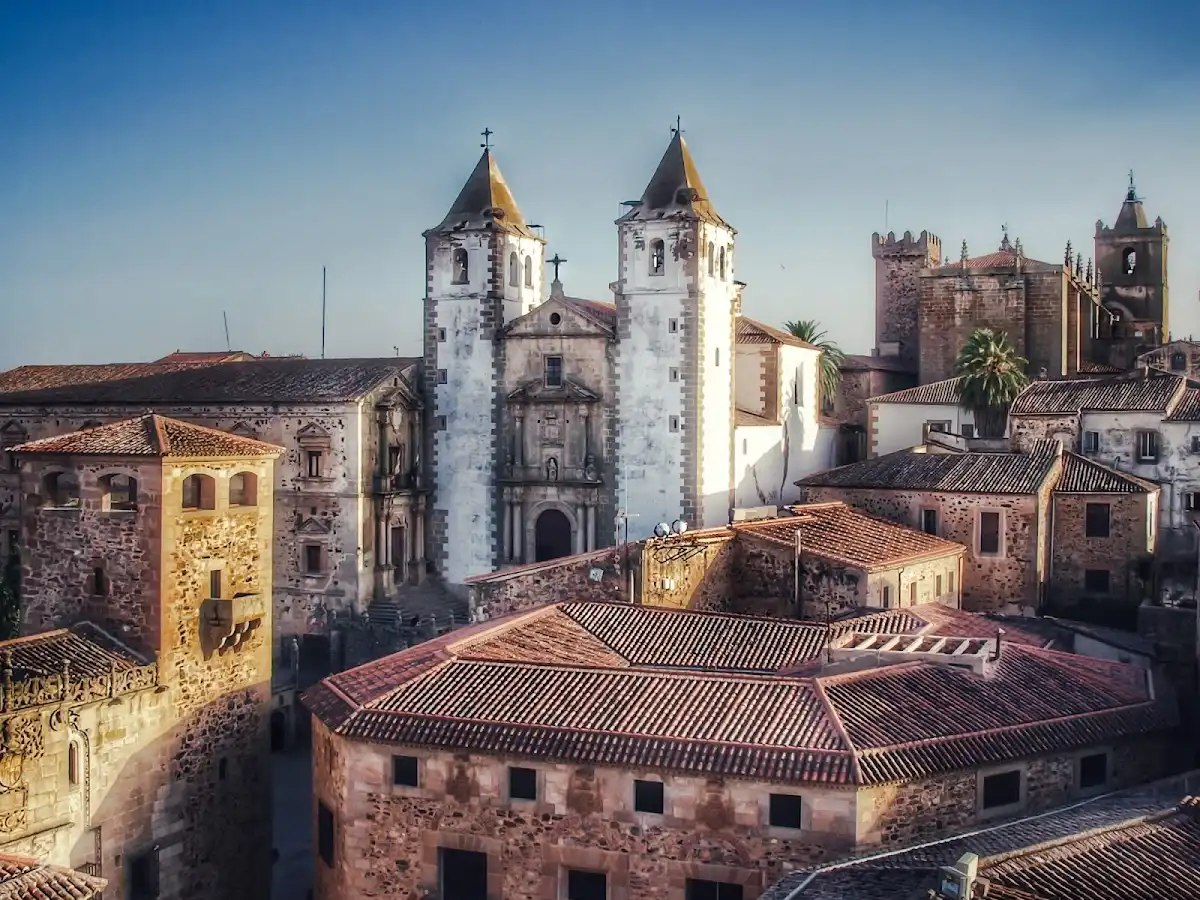
5 Cáceres

Stone towers, walled old quarter, stork nests

Step into a preserved medieval enclave where narrow lanes, fortress homes, and quiet plazas evoke centuries of layered history.

spain-city-caceres
© Google |

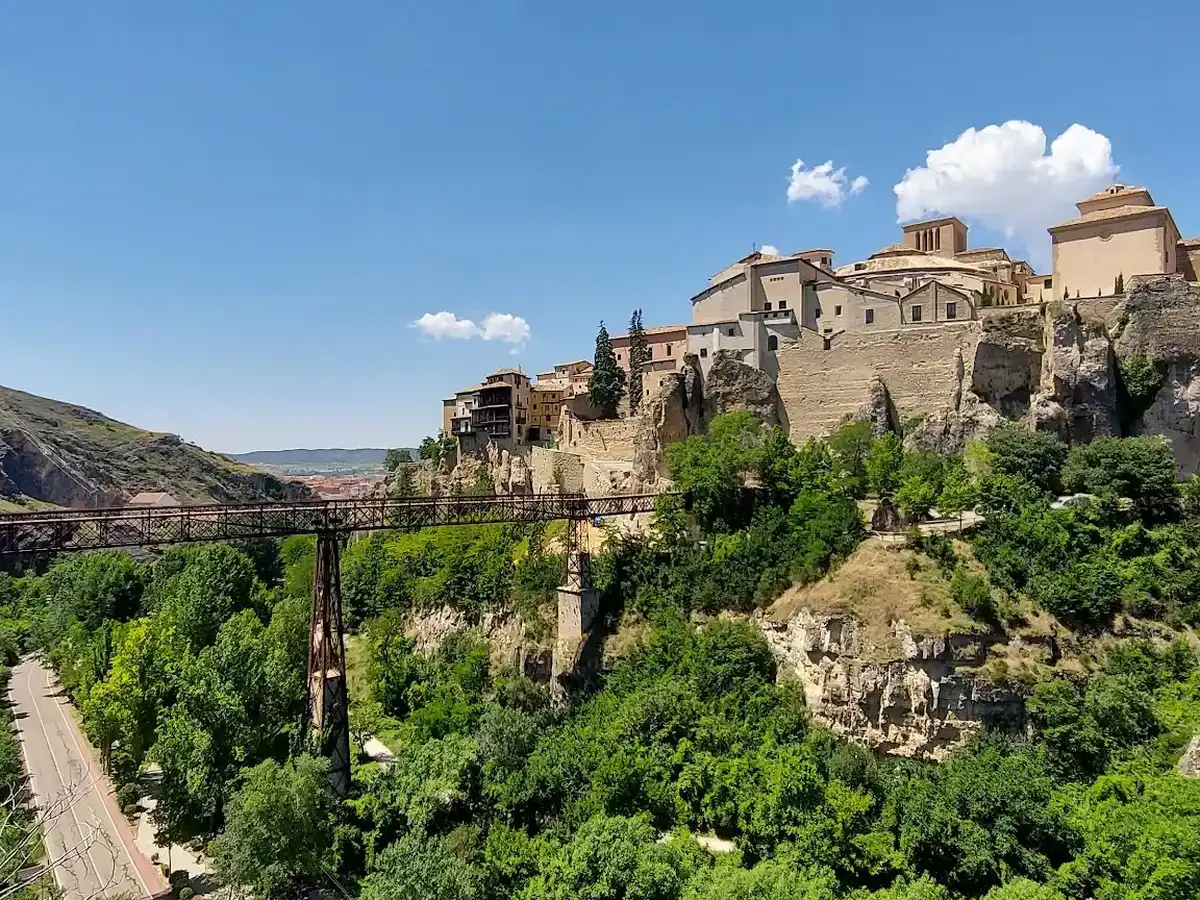
6 Cuenca

Hanging houses, deep gorge, abstract art museum

Stand above dramatic cliffs, where medieval homes cling to rock faces and contemporary art fills unexpected spaces.

spain-city-cuenca
© Google | Ramona Gilda

7 Ávila

Medieval walls, granite towers, quiet convents

Circle the city atop intact ramparts, then descend to silent cloisters and plazas shaped by centuries of solitude.

8 Mérida

Roman theater, ancient bridge, archaeological sites

Sit among marble ruins where performances still echo, surrounded by relics of an empire that shaped the Iberian landscape.

spain-city-merida
© Google |

9 Cadaqués

Whitewashed alleys, rocky coastline, surrealist legacy

Trace winding lanes down to the sea, where rugged shores meet a creative spirit shaped by artists and the Mediterranean light.

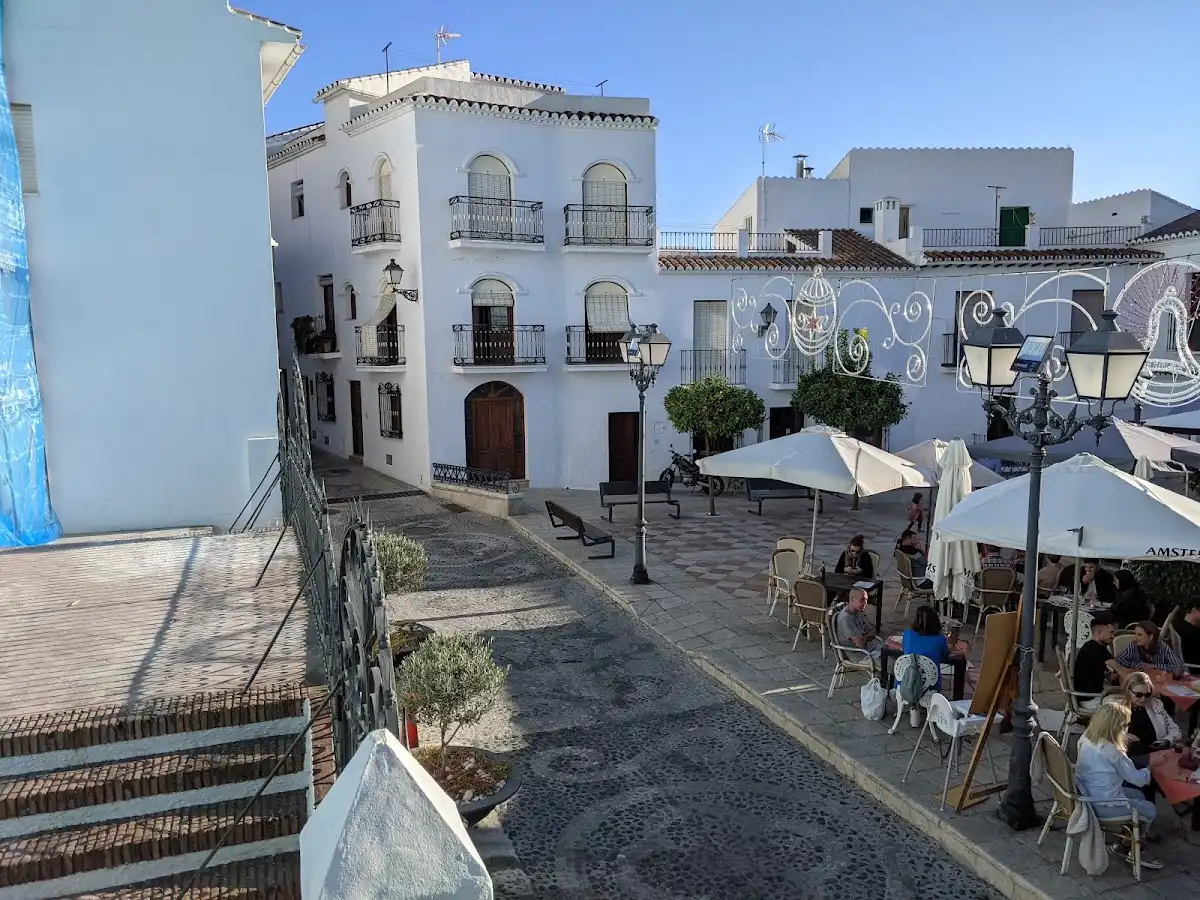
10 Frigiliana

Moorish quarter, mosaic streets, mountain views

Climb narrow lanes paved with patterned stones, surrounded by white walls and panoramic vistas over valleys and sea.

spain-city-frigiliana
© Google |

11 Arcos de la Frontera

Clifftop viewpoints, labyrinthine streets, whitewashed houses

Climb to panoramic terraces above a maze of alleys, where sunlight bounces off bright facades and distant hills.

12 Setenil de las Bodegas

Cave dwellings, overhanging cliffs, narrow river gorge

Walk beneath massive rock ceilings, where homes and cafes are carved directly into the cliffs above a winding stream.

spain-city-setenil-de-las-bodegas
© Google | Jose Antonio Tapia

13 Santillana del Mar

Cobbled lanes, Romanesque church, medieval mansions

Step into a preserved village where stone houses and ancient churches line quiet streets, inviting slow exploration.

spain-city-santillana-del-mar
© Google |

14 Baeza

Renaissance plazas, olive groves, sandstone facades

Wander through quiet squares lined with golden stone, then step into a landscape of endless olive trees and gentle hills.

spain-city-baeza
© Google |

15 Úbeda

Renaissance palaces, olive oil shops, open courtyards

Step into airy plazas framed by elegant facades, where local artisans and centuries-old architecture shape daily life.

16 Trujillo

Granite plaza, conquistador statues, hilltop castle

Stand in a wide square surrounded by noble mansions, then climb to a fortress with sweeping views over Extremadura.

17 Comillas

Gaudí architecture, Cantabrian coast, noble mansions

Stroll past ornate villas and Modernist landmarks, then watch Atlantic waves roll in from grassy bluffs dotted with architectural surprises.

spain-city-comillas
© Google |

18 Cudillero

Clifftop houses, fishing harbor, painted facades

Descend steep paths to a sheltered port, surrounded by colorfully stacked homes and the daily rhythm of the Atlantic.

19 Villajoyosa

Colorful seafront, chocolate factories, fishing boats

Stroll past rows of painted houses along the beach, sampling local sweets and watching the daily catch arrive.

20 Fisterra

Atlantic headland, pilgrimage endpoint, windswept beaches

Reach the land’s edge, where pilgrims finish their journey and the ocean horizon stretches beyond wild, empty sands.

21 Pontevedra

Pedestrian squares, Galician tapas, riverside promenades

Relax in car-free plazas, sampling regional dishes and following the river through a city built for walkers.

22 Zamora

Romanesque churches, riverside ramparts, Semana Santa processions

Trace the silhouettes of stone churches along the river, especially striking during the city’s solemn spring rituals.

23 Ciudad Rodrigo

Fortified walls, stone bridges, frontier history

Walk the ramparts overlooking the plains, where centuries of border conflict have left a legacy of sturdy defenses.

24 Lugo

Roman walls, riverside walks, local markets

Stroll atop ancient ramparts encircling the old town, then descend to riverside paths and bustling food stalls.

25 Soria

Duero riverbanks, Romanesque churches, literary heritage

Follow riverside trails past ancient chapels, discovering a quiet town with deep connections to Spanish poetry.

26 Teruel

Mudéjar towers, dinosaur fossils, hilltop vistas

Admire intricate brickwork rising above the town, then explore museums filled with prehistoric finds and panoramic views.

27 Palencia

Romanesque churches, quiet plazas, Carrión river

Find a slower pace in a small city where riverside walks, understated architecture, and local traditions offer a different side of Castile.

28 Huesca

Pyrenean gateway, Gothic cathedral, local festivals

Use the city as a base for mountain adventures, pausing to explore its historic center and lively seasonal events.

Think you know Spain?

Prove you’re a true local — uncover 18 lesser-known towns in Spain that locals tend to keep to themselves.
Loading the map 🌍

Expert viewWhat You Should Know

How many towns: Plan on six to eight towns for two weeks, and four or five for a week. Each town needs an evening to be understood, since the plaza only comes alive after dark, and every extra stop costs half a day in transit and packing. Past eight, the walled centers start to blur and you become a person who photographs facades without recalling which one.
Which kind for which traveler: If money is tight, put the weight on inland Castilian and Andalusian towns, where beds and food are cheapest and the free tapa with a drink still exists in places like Granada and parts of León. If you want food and green hiking, choose the north, but accept higher prices and rain. Skip big-name coastal resort towns in July and August: you pay more for a dorm bed than the experience justifies, and the beach … read more 👉
How many towns: Plan on six to eight towns for two weeks, and four or five for a week. Each town needs an evening to be understood, since the plaza only comes alive after dark, and every extra stop costs half a day in transit and packing. Past eight, the walled centers start to blur and you become a person who photographs facades without recalling which one.
Which kind for which traveler: If money is tight, put the weight on inland Castilian and Andalusian towns, where beds and food are cheapest and the free tapa with a drink still exists in places like Granada and parts of León. If you want food and green hiking, choose the north, but accept higher prices and rain. Skip big-name coastal resort towns in July and August: you pay more for a dorm bed than the experience justifies, and the beach is a patch of towel space. For history, medieval centers are better in spring or autumn, when you can walk them without heat stroke. Culture-focused travelers should plan around a local fiesta, which can be worth a whole day of schedule, but book beds early.
What it costs: A realistic backpacker budget is €45 to 70 a day. Dorm beds run roughly €18 to 35, a simple private room €45 to 80, and the menú del día €11 to 16. Coffee at the bar is €1.50 to 2.50, and a beer or glass of wine is €2 to 4. Local buses between towns cost around €3 to 20 for typical hops, and fast trains between regions €25 to 70 if booked ahead. Monument and cathedral entries commonly run €5 to 15, often with free hours late in the day or on certain weekdays, and walking tours with a guide cost €10 to 25, or are tip-based. Expect €60 to 100 a day if you want private rooms and sit-down dinners. Add a regional tourist tax in some areas, usually €1 to 3 per night.
What is worth paying for: Pay for the main monument that defines the town, since the interior is usually what the exterior promised. Skip audio guides unless the history interests you, and skip the restaurants with photo menus on the main square. Eat where the lunch crowd is local and the napkins are on the floor.
Safety and local etiquette: Spain is safe for walking at night in towns. Pickpocketing is the real nuisance, mostly in crowded squares, markets and stations, so keep your phone out of back pockets. Have a few phrases ready: buenos días when entering a shop and a polite greeting with staff go a long way. Dress modestly for churches, with covered shoulders and knees. Do not plan to eat dinner at 6 pm, as you will be eating alone with the waiter, and avoid scheduling anything important on a Sunday or in the two to three midday hours when many shops close. Summer heat is a genuine health risk in the interior, so carry water and sunscreen and shift your day toward early morning and evening. In rural areas, carry some cash, as small bars and guesthouses may not take cards.

✈️ The backpacker research shortcutSpain Travel Guide

An offline-friendly backpacking guide with optimized travel routes, ranked highlights, transport advice, and the best areas to stay.
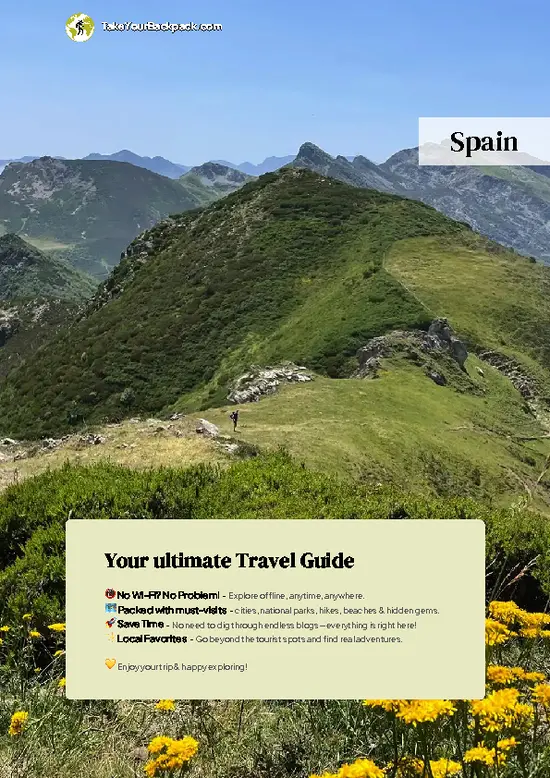
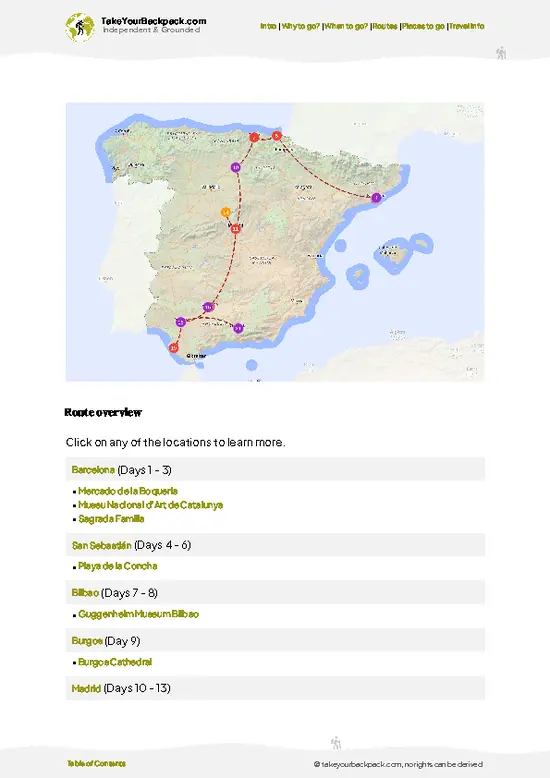
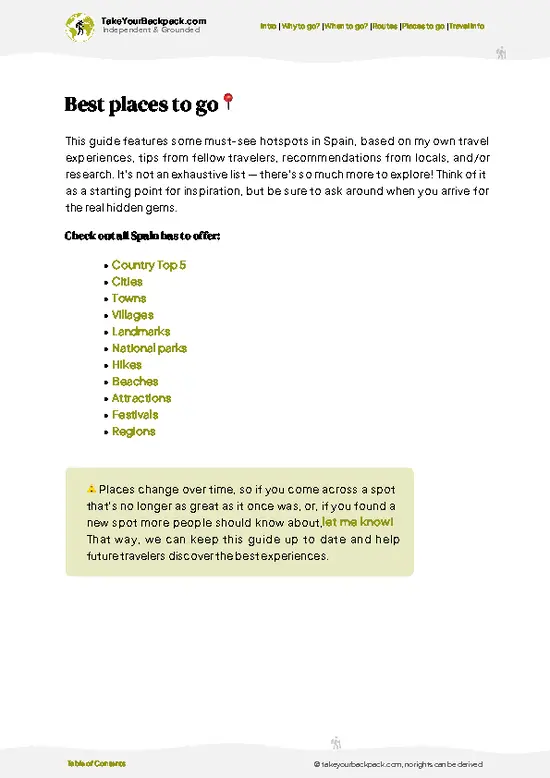
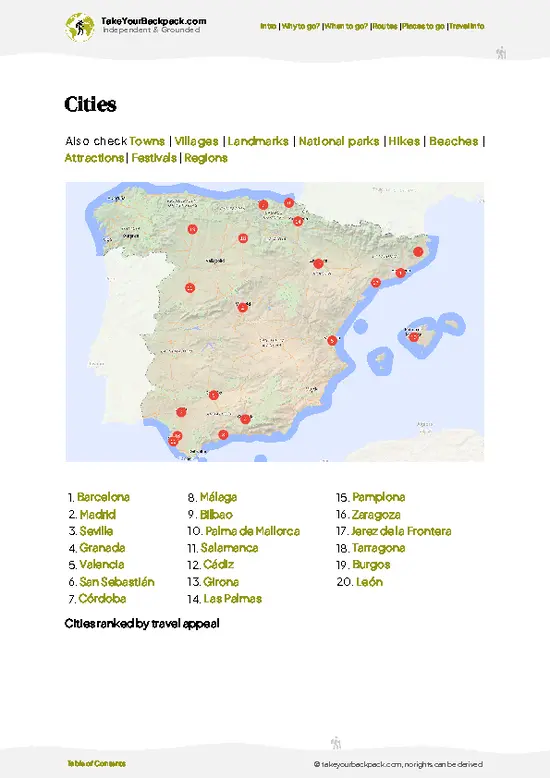
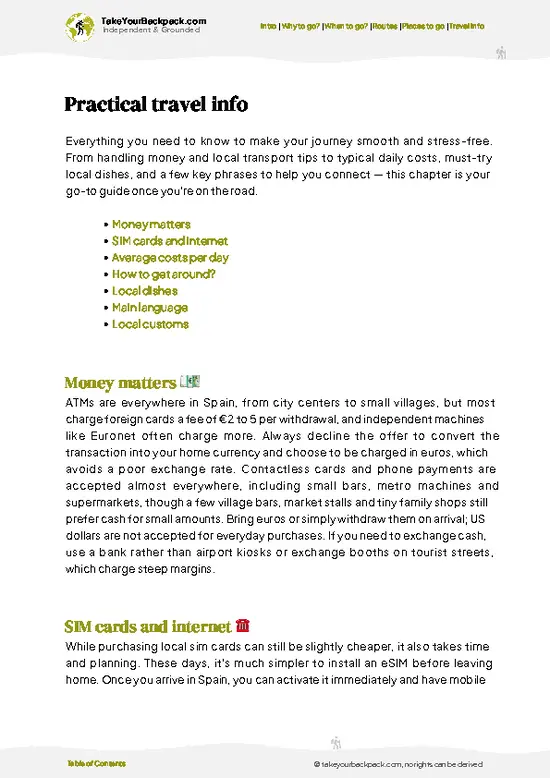
example page 0 from our offline Travel Guide for Spain
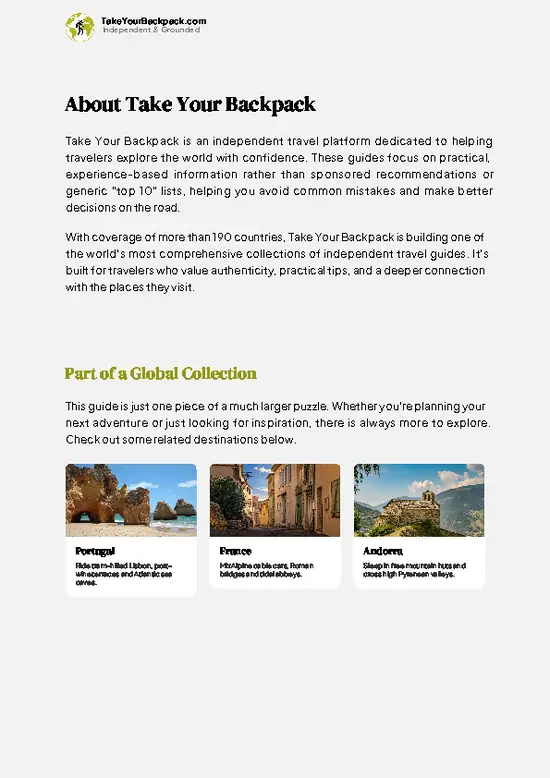
example page 1 from our offline Travel Guide for Spain
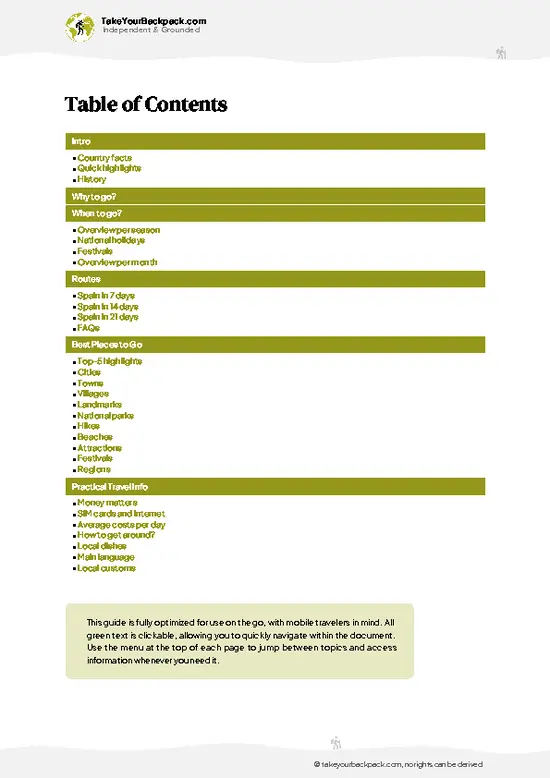
example page 2 from our offline Travel Guide for Spain
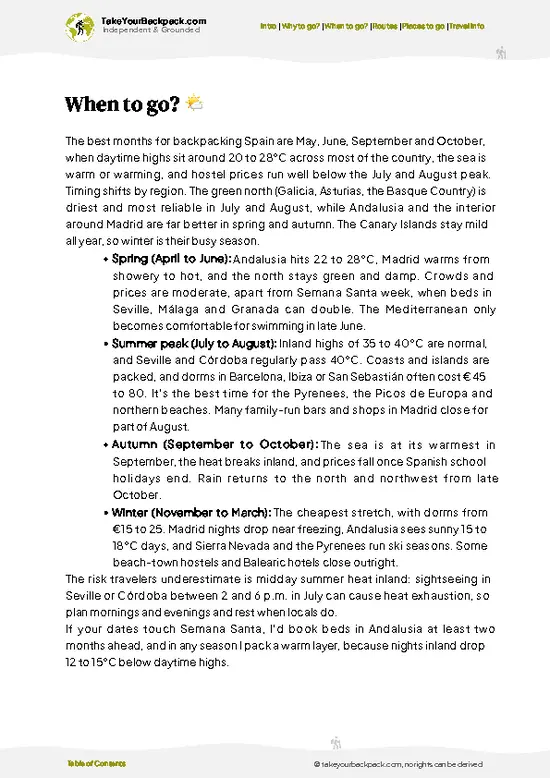
example page 3 from our offline Travel Guide for Spain
example page 4 from our offline Travel Guide for Spain
example page 5 from our offline Travel Guide for Spain
example page 6 from our offline Travel Guide for Spain
example page 7 from our offline Travel Guide for Spain
The digital guide (543 pages) contains:
✅ 147 highlights, ranked by travel appeal
✅ Optimized 7, 14 & 21-day travel routes
✅ Cities, national parks, landmarks, beaches
✅ How to get around
✅ Offline-friendly for travel without Wi-Fi
👉 Click to see all 30+ guide features

📅 Plan smarter in minutes, not weeks
✅ Month by month travel advice
✅ Festivals & national holidays
✅ Budget expectations

🗺️ Go to the right places, skip the overrated ones
✅ Honest pros & cons of destinations
✅ Top hikes, parks & viewpoints
✅ Lesser-known places most travelers miss
✅ Clear “worth it vs skip it” guidance

🛏️ Travel smoothly without rookie mistakes
✅ Best areas to stay
✅ Transport systems explained simply
✅ Common scams & safety advice
✅ SIM cards, money & practical tips

🌍 Understand the country, not just visit it
✅ Culture & traditions
✅ 52 Essential phrases & customs
✅ Festivals worth planning around
✅ Traveler-friendly historical context
✅ Insights that make places more meaningful

📱 Built for real travel conditions
✅ Fully downloadable PDF
✅ Works completely offline
✅ Optimized for phone use
✅ Useful in remote areas & buses
✅ Everything in one place
Stop searching, start planning
Get instant access to your full guide. 30‑day money-back guarantee.
+ Add another guide for just

By proceeding you agree to our terms.
Sent to your inbox immediately after payment • 100% Secure Checkout
Best Backpacking Travel Advisor 2025 tourism awardBest Backpacking
Travel Advisor
2025
What others say about Take Your Backpack Guides:
⭐⭐⭐⭐⭐
Fantastic, amazing amount of information!
⭐⭐⭐⭐⭐
My goodness this is amazing, it's what I've been looking for hats off too you!
⭐⭐⭐⭐⭐
I think this is absolutely BRILLIANT
⭐⭐⭐⭐
Very complete and informative. It's still missing places, but I gotta to commend you
⭐⭐⭐⭐⭐
This is truly amazing, thank you, can't wait to explore it with my kids!
⭐⭐⭐⭐⭐
Awesome resource, thank you!
⭐⭐⭐⭐⭐
This is amazing! Can't wait to explore the ones I haven't seen
⭐⭐⭐⭐
I love this! Well done, great idea.
⭐⭐⭐⭐⭐
Thanks for taking the time to make this gem!
⭐⭐⭐⭐⭐
This might be the best website I've ever seen.
⭐⭐⭐⭐⭐
Congratulations, and thank you so much for your work; it's incredibly valuable.
⭐⭐⭐⭐
In all seriousness I think you did a great job pointing out the important spots
⭐⭐⭐⭐⭐
10/10 very good
⭐⭐⭐⭐⭐
As someone who's only just starting to visit regularly this is awesome, thank you.
⭐⭐⭐⭐
Thank you very much! I'm going to visit my dad, it's going to be very useful!
⭐⭐⭐⭐⭐
This is really cool! We'll be travelling for the first time and this definitely come in handy.
⭐⭐⭐⭐⭐
You are now our minister of culture, congratulations 👨‍💼
⭐⭐⭐⭐⭐
Just wanted to tell you that this is a pearl! Going to follow your recommendations.
⭐⭐⭐⭐⭐
This is so cool. I'll definitely be using the resource for my travels soon.
⭐⭐⭐⭐⭐
This is very impressive! Good work.
⭐⭐⭐⭐⭐
This is an amazing and informative site. Very well done!

🛏️ Where to stay?Top Areas to Stay

Spain has hostels in every major city, with dorm beds usually costing €20 to €40 a night and private budget rooms or pensiones from about €45 to €80. In Madrid, Malasaña and La Latina put you close to the main sights and the best bars but get loud on weekends, while Lavapiés is cheaper and multicultural yet a little rougher after dark. In Barcelona, the Gothic Quarter and El Raval are central and lively but known for pickpockets, Gràcia is calmer and more local at the cost of a metro ride, and in Seville the Alameda area mixes cheap beds with late nightlife a short walk from the cathedral.

If you enjoy meeting fellow travelers, consider choosing hostels with high ratings for atmosphere. On the … read more 👉
Spain has hostels in every major city, with dorm beds usually costing €20 to €40 a night and private budget rooms or pensiones from about €45 to €80. In Madrid, Malasaña and La Latina put you close to the main sights and the best bars but get loud on weekends, while Lavapiés is cheaper and multicultural yet a little rougher after dark. In Barcelona, the Gothic Quarter and El Raval are central and lively but known for pickpockets, Gràcia is calmer and more local at the cost of a metro ride, and in Seville the Alameda area mixes cheap beds with late nightlife a short walk from the cathedral.

If you enjoy meeting fellow travelers, consider choosing hostels with high ratings for atmosphere. On the other hand, if you prefer having your own space, a hotel might be a better option.

SpainDiscover the Country

👋 Meet the founderWho’s Behind Take Your Backpack?

Johan, backpacker and founder of TakeYourBackpackHi, I’m Johan (Netherlands 🇳🇱), the creator of TakeYourBackpack. Over the past 3 decades, I’ve backpacked through 90+ countries across six continents, gaining extensive experience with independent travel, long-term trips, and overland routes.

This site is built on a combination of firsthand travel experience and carefully curated insights from other backpackers. Many guides are based on places I’ve personally visited, while others bring together tips, observations, and practical advice shared by trusted travelers I’ve met along the way.

The goal is to provide realistic, experience-driven guidance — not generic itineraries — so you can explore destinations with better context, clearer expectations, and more confidence.