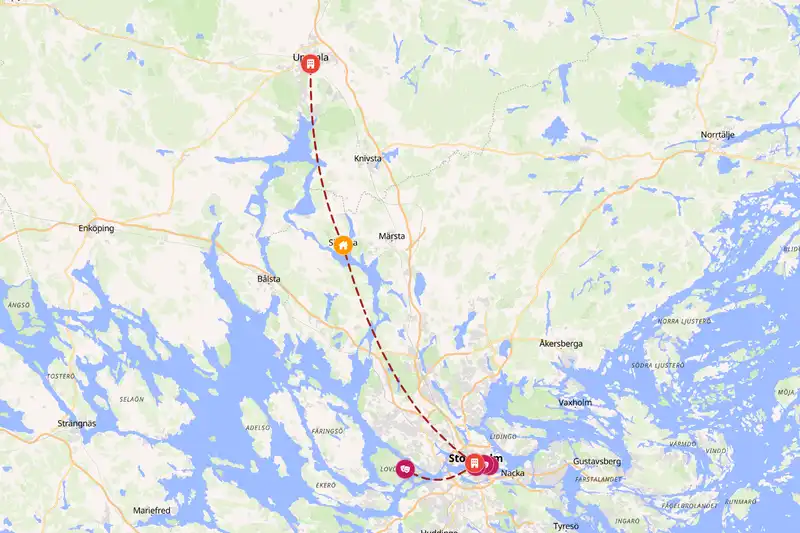
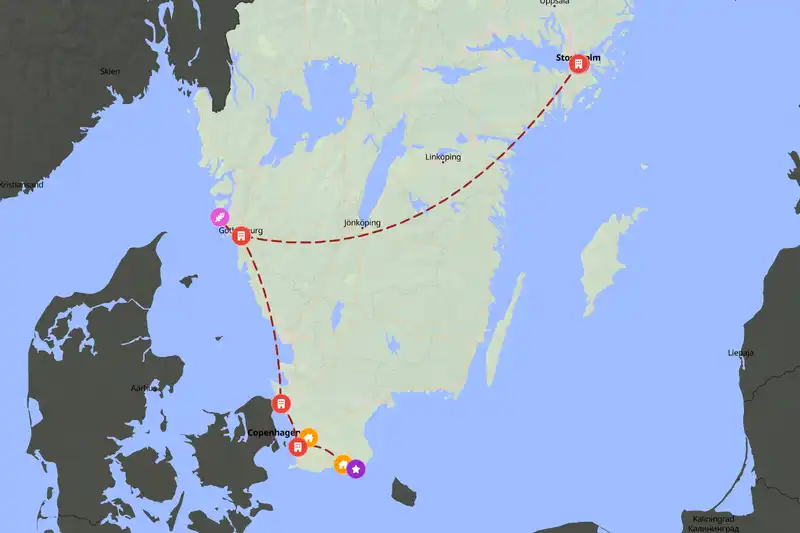
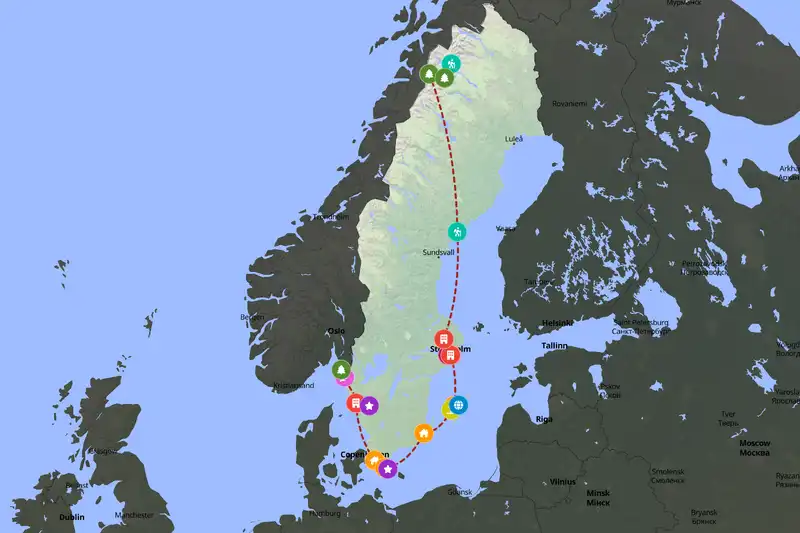
This fifteen-day route covers Sweden from the Danish border to the Arctic. It suits travelers who want the big cities, a medieval island town and real mountain country in one trip without a car. The pace is steady, with every second or third day spent moving and one overnight train doing the longest stretch while you sleep. You will use intercity and regional trains, a regional bus up the west coast, the car ferry to Gotland, Stockholm’s metro and boats, a sleeper train north and one domestic flight home from Kiruna.
Days 1-2: Malmö and Lund
Fly into Copenhagen and cross the Öresund Bridge by train to
Malmö, about 25 minutes from the airport. Starting in the south means the trip builds toward its biggest scenery instead of peaking early. Spend your first afternoon at
Malmöhus Castle and Malmö Museum, a 16th-century fortress from the Danish era with a moat, an aquarium and a natural history wing under one ticket. Then walk the canal-side park toward Lilla Torg for dinner among half-timbered houses.
On day two, take the 10 to 15 minute train to
Lund. The Romanesque cathedral dates to the 12th century, and its astronomical clock plays its mechanical procession at noon and 15:00, so plan your morning around that. Students on bikes fill the side streets. Return to Malmö in the evening; dinner and beds are cheaper and more varied there.
Days 3-5: Gothenburg and Fjällbacka
The train up the west coast to
Gothenburg takes 2.5 to 3 hours. Give it two nights. Ride the trams, eat a shrimp sandwich near the Feskekôrka fish hall and climb to Götaplatsen for
Göteborgs Konstmuseum, which holds a strong Nordic collection with Carl Larsson and Edvard Munch. The Poseidon statue stands outside.
On day five, head north to
Fjällbacka by regional train and a connecting bus, roughly 2 to 2.5 hours. Stay the night, because the evening light on the granite is the point. Climb Vetteberget for a view over hundreds of bare skerries, walk through the Kungsklyftan ravine under boulders wedged overhead, and eat fish soup on the harbor.
Days 6-8: Stockholm
Day six is the long one: back to Gothenburg, then 3 to 3.5 hours by fast train to
Stockholm, so expect 5 to 6 hours door to door. Reward yourself with an evening walk through
Gamla Stan historic quarter, when the day crowds have gone and the lanes off Stortorget are quiet.
On day seven, go to
Stockholm Palace for the Royal Apartments and the treasury, then cross the bridge to Skeppsholmen and
Moderna Museet, where the permanent collection is free and includes Picasso, Dalí and a strong run of Swedish modernists. Day eight belongs to Djurgården. The
Vasa Museum houses a warship that sank on its maiden voyage in 1628 and was raised in 1961, mostly original timber. Next door,
Nordiska museet covers 500 years of Swedish homes, clothes and table settings in a castle-like hall. The Sami section helps set up the north.
Days 9-11: Visby and Gotland
Take the bus to Nynäshamn (about an hour) and the ferry to
Visby (about 3 hours 15 minutes). The medieval ring wall runs for more than 3 km around a town full of roofless church ruins, rose-covered cottages and steep alleys down to the harbor. Order saffron pancake with dewberry jam, the island’s signature dessert.
On day ten, rent a bike or take the bus about 20 km south to
Tofta Beach, a long sandy strand with pine woods behind it and shallow, warm-for-the-Baltic water in July and August. On day eleven, ferry back to the mainland and sleep in Stockholm.
Fotografiska Stockholm, in an old customs house above the water at Slussen, stays open late, so it fits the evening of a travel day.
Days 12-15: Abisko and Kiruna
Use the morning of day twelve for
Drottningholm Palace, the royal residence on Lake Mälaren, with formal gardens, a Chinese Pavilion and an 18th-century court theater. In summer the boat from City Hall takes about an hour; otherwise take the metro to Brommaplan and a bus. In the early evening, board the night train north. The ride takes roughly 17 to 18 hours, and you wake up to birch forest and reindeer near the tracks.
Abisko gets two nights. Walk the first kilometers of
Kungsleden, which starts at the station, follow the Abiskojåkka canyon down to Lake Torneträsk, and ride the Nuolja chairlift to the Aurora Sky Station. From late May to mid-July the sun does not set; from September to March this is one of the most reliable aurora spots in Europe. On day fifteen, take the train about 1 hour 15 minutes to
Kiruna, a mining town being moved block by block away from the iron ore mine. Then take the short bus ride to
Icehotel Jukkasjärvi, whose year-round ice building holds carved art suites. Kiruna’s airport sits between the two, with flights to Stockholm in about 1 hour 35 minutes.
I would send a friend to Högklint, a limestone cliff about 8 km south of Visby: rent a bike in town, pack a picnic, and time it for sunset over the Baltic.
v2.webp)
 Best Backpacking