Yes, backpacking Tanzania independently works well along the main corridor of Dar es Salaam, Zanzibar, Arusha and Moshi, but the big national parks require a tour or a hired vehicle.
Daily coaches connect the major towns. The trip from
Dar es Salaam to
Arusha takes 9 to 11 hours and costs TSh 35,000 to 45,000 (US$14 to 18). Dorm beds cost around US$10 to 20 in Stone Town and Arusha. The parks are where independent travel stops, because you cannot drive or walk into the
Serengeti on your own, so budget US$180 to 250 a day for a shared camping safari booked in Arusha. English is widely spoken in tourist hubs, and a few words of Swahili like “asante” go a long way.
Two weeks is the realistic minimum for Tanzania if you want both a safari and time on the coast, while one week covers a single region well.
With 7 days, stay on
Zanzibar: spend 2 nights in Stone Town and 4 on the beaches at Nungwi and Paje. With 14 days, add a 3 to 4 day northern safari from
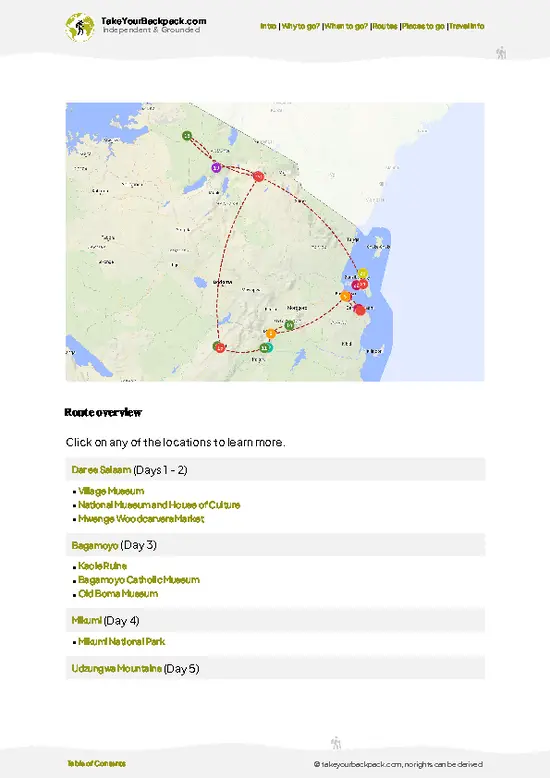
Arusha, a Kilimanjaro day hike from Moshi and 3 nights in the Usambara Mountains. Three weeks lets you add the southern parks,
Ruaha and Mikumi, via Iringa. Plan around the distances, because Dar es Salaam to Arusha is 9 to 11 hours by bus and Iringa to Arusha takes 10 to 12 hours.
Yes, Tanzania is easy to cross without a car, thanks to a dense bus network, a new electric railway and frequent ferries. You only need a vehicle inside the national parks.
Long-distance coaches link
Dar es Salaam with Arusha, Moshi, Iringa and Mbeya every day. The SGR train reaches
Dodoma from Dar es Salaam in roughly 3.5 to 4.5 hours, with a stop in Morogoro. Fast ferries to
Zanzibar take about 2 hours and cost US$35 to 40, and dala-dalas cover local hops for TSh 500 to 3,000 (US$0.20 to 1.20). For parks like the Serengeti or Ruaha, join a shared safari from Arusha or Iringa, because walking and public transport are not allowed inside.
The
Serengeti, the
Ngorongoro Crater and Stone Town on
Zanzibar are the places in Tanzania that most travelers should not miss.
Give the Serengeti at least 2 nights, ideally timed with the migration (December to March in the south, August to October in the north). The crater needs a single dawn game drive. Stone Town deserves 2 days for the Old Slave Market, the Palace Museum and the food stalls at Forodhani Gardens, followed by beach time at
Nungwi or Paje. With more time, add a Kilimanjaro day hike from Moshi, the village trails around Lushoto, or
Ruaha for big game with far fewer vehicles.
If you are short on time in Tanzania, skip
Dodoma, keep
Dar es Salaam to one night and leave the far west for another trip.
Dodoma is the administrative capital but has little to see, and Dar es Salaam works mainly as a transit hub. Kigoma, Gombe Stream and Mahale take 2 days or more each way by train or bus, and the parks there require boat transfers, so they only make sense on trips of 3 weeks or longer. On a short northern safari, you can drop Lake Manyara, which is small and has similar wildlife to Tarangire. Mikumi is easy to reach, but its game viewing is thinner than the Serengeti’s.
Yes, our itinerary-planner does exactly that. Set your trip length in days, give your interests and travel style, optionally give start- and end location and/or some mandatory stops you would like to include and the itinerary planner creates your personalized routes for Tanzania in seconds. Try it out!
Try the itinerary planner
 Best Backpacking


