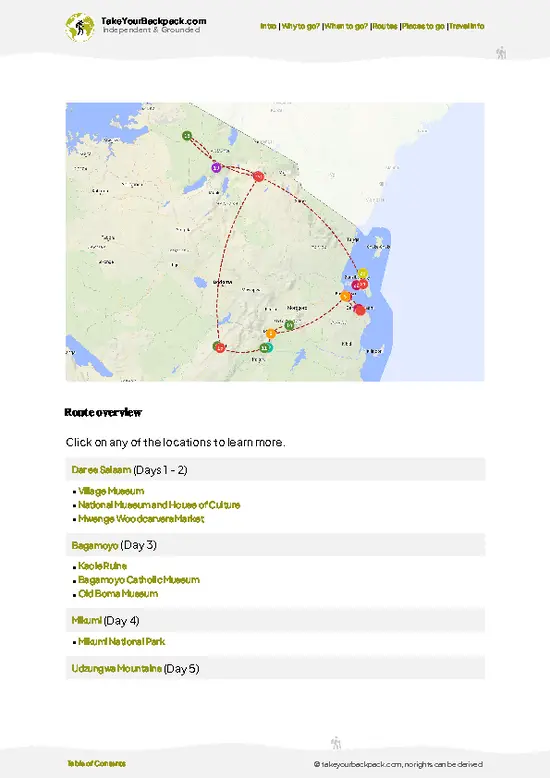
Three weeks in Tanzania suits travelers who want the full arc of the country: Swahili coast history, the quieter southern parks, a classic northern safari and a finish on Zanzibar. The pace is steady with real rest built in. There is one long bus day, and every intense safari block is followed by slower days. You will use long-distance coaches, dala-dalas (shared minibuses), a shared budget safari from Iringa and another from Arusha, plus a short domestic flight or the ferry to reach the island.
Days 1-3: Dar es Salaam
Most international flights land in
Dar es Salaam, and two nights here are enough to adjust to the heat and the noise of the horns. Use the first full day for the
Village Museum, an open-air collection of traditional houses from different ethnic groups across Tanzania, often with dance performances in the afternoon. Then head to the
National Museum and House of Culture near the botanical gardens, which holds hominid fossil casts from Olduvai Gorge and a display on the struggle …
read more 👉Three weeks in Tanzania suits travelers who want the full arc of the country: Swahili coast history, the quieter southern parks, a classic northern safari and a finish on Zanzibar. The pace is steady with real rest built in. There is one long bus day, and every intense safari block is followed by slower days. You will use long-distance coaches, dala-dalas (shared minibuses), a shared budget safari from Iringa and another from Arusha, plus a short domestic flight or the ferry to reach the island.
Days 1-3: Dar es Salaam
Most international flights land in Dar es Salaam, and two nights here are enough to adjust to the heat and the noise of the horns. Use the first full day for the Village Museum, an open-air collection of traditional houses from different ethnic groups across Tanzania, often with dance performances in the afternoon. Then head to the National Museum and House of Culture near the botanical gardens, which holds hominid fossil casts from Olduvai Gorge and a display on the struggle for independence. On the way back north, stop at Mwenge Woodcarvers Market, where Makonde carvers work ebony in open sheds. It is the best place on this route to buy a carving and watch it being made, and the prices are lower than in Arusha or Stone Town.Days 3-4: Bagamoyo
A dala-dala or bus covers the 70 km north to Bagamoyo in about 2 hours. This old caravan terminus deserves a night because its sites are spread out and the late afternoon on the dhow beach is the best time to see it. Walk south to the Kaole Ruins, where coral-stone mosques and pillar tombs date back roughly 700 to 800 years. In town, the Bagamoyo Catholic Museum at the Holy Ghost Mission tells the story of the 19th-century slave and ivory caravans. The Old Boma Museum, the German colonial administration building, sits near the waterfront.Days 4-6: Mikumi and Udzungwa Mountains
From Bagamoyo, buses run via the Chalinze junction onto the Morogoro highway and reach Mikumi town in about 5 to 6 hours. The main road cuts straight through Mikumi National Park, so this is the easiest game drive in Tanzania to arrange without a tour company. Lodges and guesthouses in town organize half-day drives, and the open floodplain regularly shows giraffes, elephants and buffalo. The next morning, a 1.5 to 2 hour bus ride south takes you to Mang’ula, the gateway to Udzungwa Mountains National Park. Here you walk with a ranger on the Udzungwa Mountains Sanje Waterfall Trail through rainforest to a drop of around 170 meters. Red colobus and endemic Sanje mangabey monkeys live along the trail, and you can swim in the pool at the top.Days 6-10: Iringa and Ruaha National Park
Head to Iringa, perched on a ridge at about 1,600 meters. The cool air comes as a relief after the lowlands, and the town has the best budget cafés in the southern highlands. Spend one night here and book a shared trip to Ruaha National Park, about 3 to 4 hours away on a partly unpaved road. Two nights inside the park give you dawn and dusk drives along the Great Ruaha River, where lions, large elephant herds and huge baobabs are the main draws. You may see only a handful of other vehicles all day, a stark contrast to the Serengeti later on the route. Return to Iringa for a night to rest before the longest day of the trip.Days 10-12: Arusha
The coach from Iringa to Arusha runs via Dodoma and takes 10 to 12 hours, so leave at dawn and plan nothing for the evening. Two nights here let you recover and book the northern safari in person, which usually means a better price. The Cultural Heritage Centre on the Dodoma road is part gallery, part shop. Its Tanzanian painting and sculpture collection is worth an hour even if you buy nothing.Days 12-15: Serengeti National Park and Ngorongoro Crater
A shared camping safari of three nights is the right length after Ruaha. Spend the first long day driving up through the Ngorongoro highlands into Serengeti National Park, followed by a full day around the Seronera valley, where leopards and cheetahs are the realistic targets. On the way back, camp on the rim of the Ngorongoro Crater at around 2,300 meters. Pack a warm layer, because nights drop close to freezing. Descend at first light, when the black rhinos are easiest to spot on the crater floor, and arrive back in Arusha by evening for one more night.Days 16-21: Zanzibar and Matemwe
Fly from Arusha to Zanzibar in about 1.5 hours and give Stone Town three nights at a slower pace than the rest of the trip. Focus on the human history. The Old Slave Market & Anglican Cathedral covers the city’s darkest chapter. The Princess Salme Museum tells the story of the sultan’s daughter who eloped to Germany. In the evening, the courtyard of the Old Fort is the place for music and food from the Forodhani stalls across the road. End with two nights in Matemwe on the northeast coast. This fishing village has wide reef flats and dhows that head out at dawn, and it sits close enough to Mnemba Atoll for a snorkel trip.
Before leaving Iringa, take a taxi 20 km south to Isimila, where eroded sandstone pillars stand beside a field of Stone Age hand axes.
 Best Backpacking


