×
Afghanistan🇦🇫 | 14 days itinerary

Afghanistan in 14 Days

By Johan Kruseman 🇳🇱 | Updated May 5, 2026
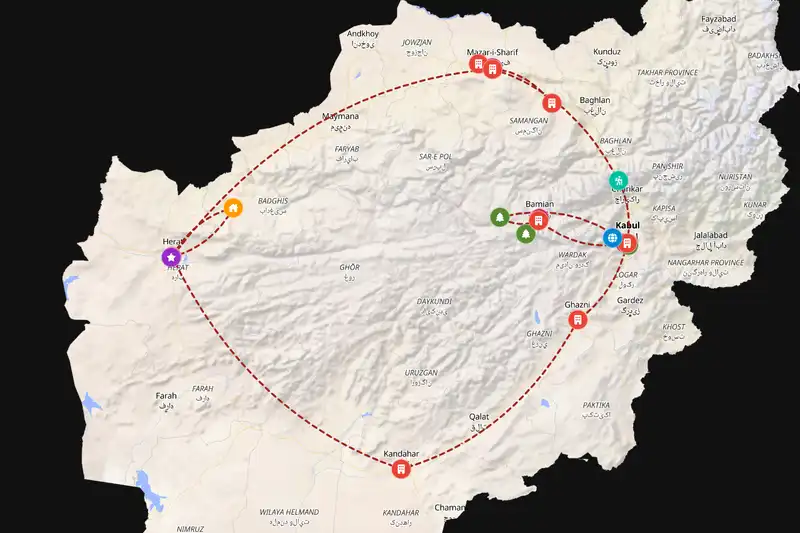
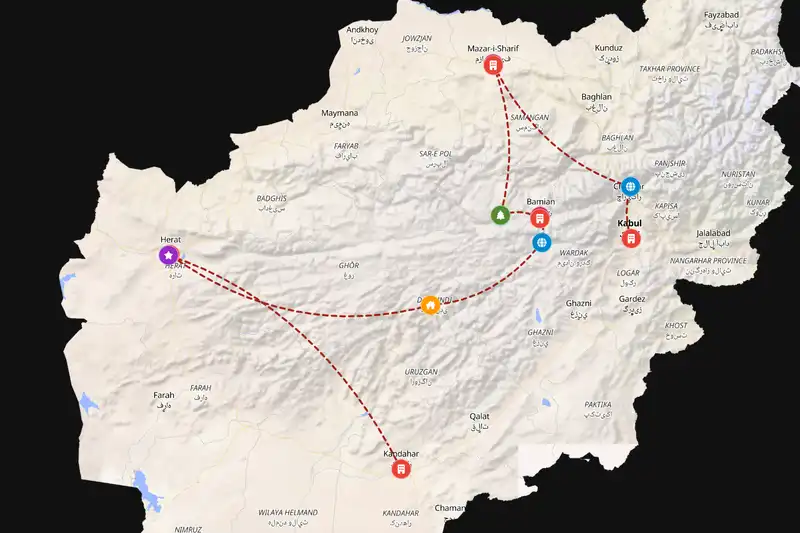
This 14-day route is for travelers who want a balanced first deep dive into Afghanistan: big-city history, highland landscapes, and a taste of the north, at a moderate pace that still leaves room for long tea breaks and sunset walks. You’ll rely on a mix of domestic flights (where available) and overland travel by shared taxi or private car, with no more than one major travel day in a row so the journey feels like exploration, not endurance.

Days 1-3: Kabul’s history, shrines & city life

Start in Kabul, giving yourself three nights to peel back the layers instead of just transiting through. Begin with the National Museum of Afghanistan to anchor the trip in context, then walk the terraces of Babur’s Gardens where Mughal history, families picnicking, and hillside views all collide in one easy-to-love space. On day two, visit the Sakhi Shrine Complex and climb to the Kart-e Sakhi Hill Overlook for a wide-angle view of Kabul’s sprawl, then swing by the Kabul City Center & Shahre Naw Bazaar read more 👉
This 14-day route is for travelers who want a balanced first deep dive into Afghanistan: big-city history, highland landscapes, and a taste of the north, at a moderate pace that still leaves room for long tea breaks and sunset walks. You’ll rely on a mix of domestic flights (where available) and overland travel by shared taxi or private car, with no more than one major travel day in a row so the journey feels like exploration, not endurance.

Days 1-3: Kabul’s history, shrines & city life

Start in Kabul, giving yourself three nights to peel back the layers instead of just transiting through. Begin with the National Museum of Afghanistan to anchor the trip in context, then walk the terraces of Babur’s Gardens where Mughal history, families picnicking, and hillside views all collide in one easy-to-love space. On day two, visit the Sakhi Shrine Complex and climb to the Kart-e Sakhi Hill Overlook for a wide-angle view of Kabul’s sprawl, then swing by the Kabul City Center & Shahre Naw Bazaar Area for snacks and errands; if you’re curious about local arts and public life, an evening stroll around the Kabul National Theater Area shows you a different, more everyday side of the capital. Use your third day for a relaxed outing to Darul Aman Palace, whose restored shell and surrounding grounds tell a story of ambition, conflict, and rebuilding, then finish with a wander down Chicken Street Antique and Carpet Market if you want a crash course in bargaining and Afghan handicrafts.

Days 4-7: Bamiyan Valley & Band-e-Amir highlands

Head overland from Kabul to Bamyan, watching the landscape shift from city chaos to wide, open highlands as you climb into the Bamiyan Valley. Base yourself in Bamyan for three nights, using one full day to explore the Buddha Niches and Cliffside Caves of Bamiyan, tracing the outlines of the statues and ducking into soot-darkened caves that once held monks and murals. Dedicate another day to Band-e-Amir National Park, walking sections of the Band-e-Amir Lakes Trail between the linked lakes, pausing at the Band-e Amir Viewpoints and Lakeside Shrine Area where turquoise water, prayer flags, and cliff edges make every pause feel like a postcard. If you want more altitude, add a half-day hike into the Bamyan Plateau National Park or a short foray on the Koh-e-Baba Range Trail, then on day seven visit Shahr-e Zohak in the morning before returning by road to Kabul for a transit night.

Days 8-11: Herat’s citadel, mosques & bazaars

From Kabul, make your way to Herat, ideally by air to avoid stacking long overland days. Settle in for three nights so you can explore at a walking pace, starting with the Herat Citadel, whose thick walls and inner courtyards give you a tangible sense of Herat’s role as a Silk Road stronghold. Spend time at the Friday Mosque of Herat, where the tilework and courtyard geometry reward slow, repeated visits at different times of day, then wander the Herat Old Bazaar and Caravanserai Area to see how trade and craft still pulse through the city’s veins. Use an extra half-day to simply loop back through your favorite corners—maybe a second pass at the mosque at sunset or another aimless drift through the bazaar—so Herat feels like a place you lived in briefly, not just a stop you ticked off.

Days 12-14: Northern flavor in Mazar-i-Sharif & Balkh

Travel overland or by air to Mazar-i-Sharif, your base for the final three nights, where the north’s flatter landscapes and Turkic influences give the trip a new flavor. Spend your first full day around the Shrine of Hazrat Ali Night Market Area, timing your visit so you see the complex both in daylight, when the blue tiles and white doves dominate, and in the evening, when food stalls and families turn the surrounding streets into a soft, glowing maze. On your last full day, make a side trip to Balkh, often called one of the oldest cities in the region, to walk through ruins and shrines that feel older and quieter than their reputation suggests, then return to Mazar for a final night market wander. Wrap up with an easy final morning in Mazar before your onward journey, letting the contrast between Kabul’s hills, Bamiyan’s cliffs, Herat’s citadel, and the north’s plains settle into a single, coherent story in your head.

For those who catch the bug for quieter corners, keep a future day free for the remote village of Istalif, where potters’ wheels spin in open courtyards and the hillsides smell of clay and woodsmoke.
Loading the map 🌍
film
0
0
0a
Bamyan
film
1
1
1a
Koh-e-Baba Range Trail
film
2
2
2a
Shahr-e Zohak
film
3
3
3a
Herat Citadel

✈️ The backpacker research shortcutAfghanistan Travel Guide

An offline-friendly backpacking guide with optimized travel routes, ranked highlights, transport advice, and the best areas to stay.
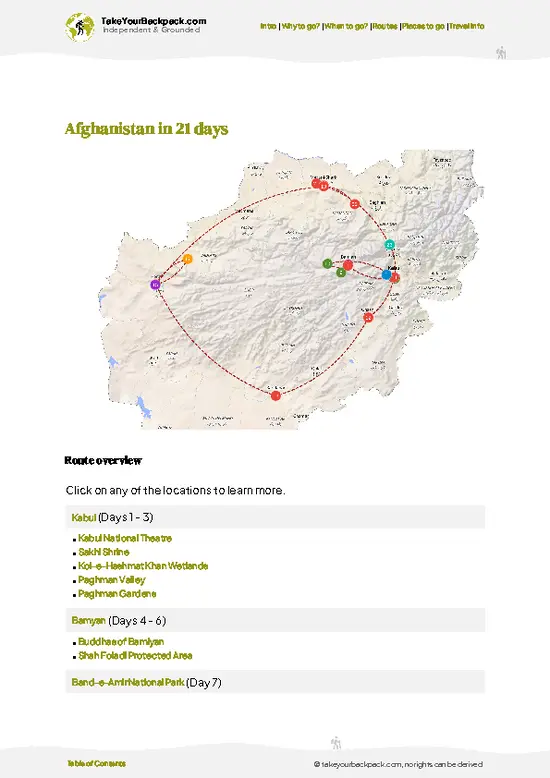
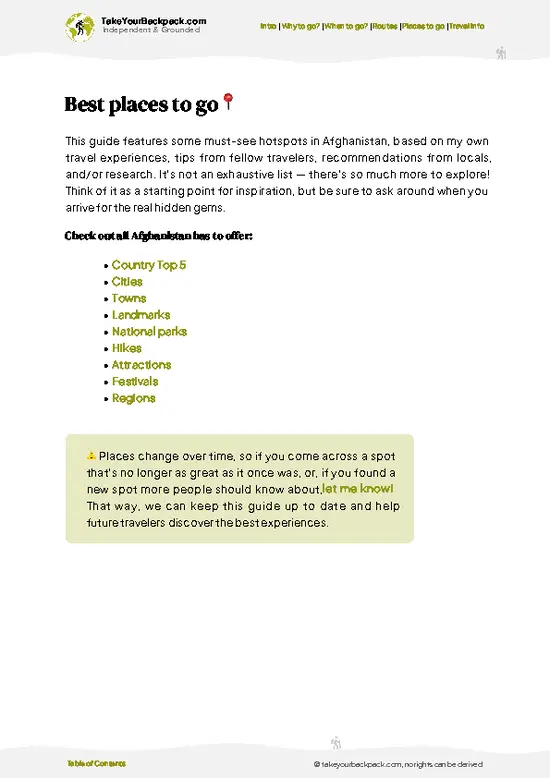
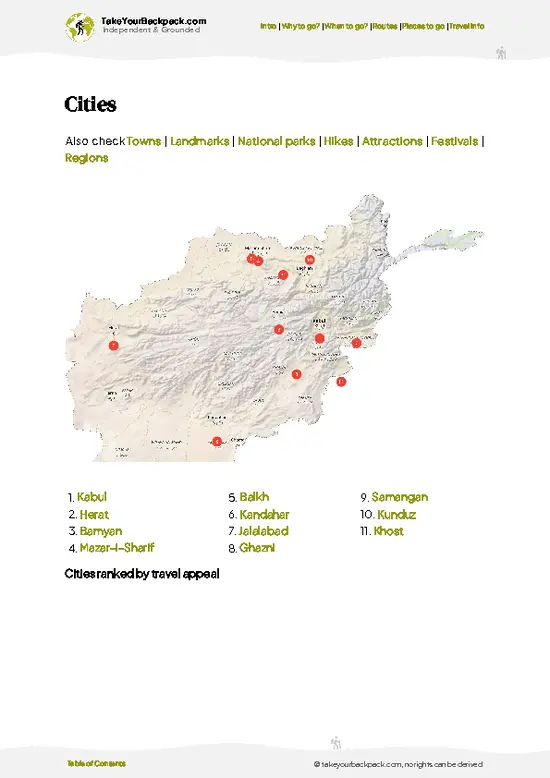
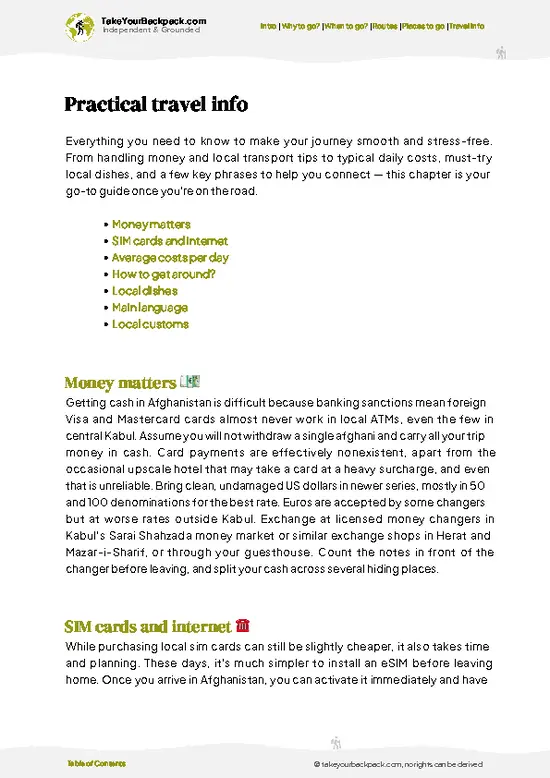
example page 0 from our offline Travel Guide for Afghanistanexample page 1 from our offline Travel Guide for Afghanistanexample page 2 from our offline Travel Guide for Afghanistanexample page 3 from our offline Travel Guide for Afghanistanexample page 4 from our offline Travel Guide for Afghanistanexample page 5 from our offline Travel Guide for Afghanistan
The digital guide (257 pages) contains:
72 highlights, ranked by travel appeal
Optimized 7, 14 & 21-day travel routes
Best neighborhoods to stay
How to get around
Offline-friendly for travel without Wi-Fi
👉 See all 30+ guide features

📅 Plan smarter in minutes, not weeks
Month by month travel advice
Festivals & national holidays
Budget expectations

🗺️ Go to the right places, skip the overrated ones
Honest pros & cons of destinations
Top hikes, parks & viewpoints
Lesser-known places most travelers miss
Clear “worth it vs skip it” guidance

🛏️ Travel smoothly without rookie mistakes
Best areas to stay
Transport systems explained simply
Common scams & safety advice
SIM cards, money & practical tips

🌍 Understand the country, not just visit it
Culture & traditions
52 Essential phrases & customs
Festivals worth planning around
Traveler-friendly historical context
Insights that make places more meaningful

📱 Built for real travel conditions
Fully downloadable PDF
Works completely offline
Optimized for phone use
Useful in remote areas & buses
Everything in one place
Save weeks of stressful planning
Get instant access to the full guide directly. 30-day money-back guarantee.


Sent to your inbox immediately after payment • 100% Secure Checkout
Best Backpacking Travel Advisor 2025 tourism awardBest Backpacking
Travel Advisor
2025
What others say about Take Your Backpack Guides:
⭐⭐⭐⭐⭐
Fantastic, amazing amount of information!
⭐⭐⭐⭐⭐
My goodness this is amazing, it's what I've been looking for hats off too you!
⭐⭐⭐⭐⭐
I think this is absolutely BRILLIANT
⭐⭐⭐⭐
Very complete and informative. It's still missing places, but I gotta to commend you
⭐⭐⭐⭐⭐
This is truly amazing, thank you, can't wait to explore it with my kids!
⭐⭐⭐⭐⭐
Awesome resource, thank you!
⭐⭐⭐⭐⭐
This is amazing! Can't wait to explore the ones I haven't seen
⭐⭐⭐⭐
I love this! Well done, great idea.
⭐⭐⭐⭐⭐
Thanks for taking the time to make this gem!
⭐⭐⭐⭐⭐
This might be the best website I've ever seen.
⭐⭐⭐⭐⭐
Congratulations, and thank you so much for your work; it's incredibly valuable.
⭐⭐⭐⭐
In all seriousness I think you did a great job pointing out the important spots
⭐⭐⭐⭐⭐
10/10 very good
⭐⭐⭐⭐⭐
As someone who's only just starting to visit regularly this is awesome, thank you.
⭐⭐⭐⭐
Thank you very much! I'm going to visit my dad, it's going to be very useful!
⭐⭐⭐⭐⭐
This is really cool! We'll be travelling for the first time and this definitely come in handy.
⭐⭐⭐⭐⭐
You are now our minister of culture, congratulations 👨‍💼
⭐⭐⭐⭐⭐
Just wanted to tell you that this is a pearl! Going to follow your recommendations.
⭐⭐⭐⭐⭐
This is so cool. I'll definitely be using the resource for my travels soon.
⭐⭐⭐⭐⭐
This is very impressive! Good work.
⭐⭐⭐⭐⭐
This is an amazing and informative site. Very well done!

🧭 RouteMore Ways to Explore

Travel Afghanistan your way — from a quick highlights trip to a slow-paced adventure.

🙋 FAQGood to Know

Short answer: no, Afghanistan is not easy to backpack independently, even if you’re experienced. It’s possible, but only for travelers who are very risk-aware, flexible, and comfortable with plans changing fast. Security, permits, and local power dynamics matter more here than in almost any other country you’ll visit.

Independent travel is complicated by several things: checkpoints, shifting rules, and local authorities who may not be used to foreign backpackers. You can’t just wander freely like in Southeast Asia or Latin America. In many areas you’ll need a local contact, fixer, or at least a trusted guesthouse owner who knows which roads are safe that week and which are not.

For budget travelers, the good news is that once you’re on the ground, costs can be low: shared taxis, basic hotels, and local food are all affordable. The bad news is that the safest way to move around often involves hiring private cars or guides for certain stretches, which can blow up a tight budget. You save money by traveling slowly, using shared transport where locals do, and sticking to a few regions instead of trying to see the whole country.

If you’re new to backpacking, Afghanistan is not a good first or second country. It’s better suited to people who already know how to read a situation, say no firmly, and walk away from a plan that suddenly feels wrong. Even then, you travel here with the mindset that some areas are simply off-limits, no matter how tempting the photos look.

The most realistic independent style is a hybrid: you move solo between major hubs, then rely on local guides or trusted drivers for specific routes or day trips. You keep your itinerary loose, stay longer in fewer places, and accept that safety calls always outrank bucket-list goals.
If you’re coming all this way, the sweet spot for most backpackers is 2–3 weeks, but how you use that time matters more than the raw number of days.

Under 7 days: Only worth it if you’re visiting one city and its surroundings, like Kabul plus a side trip (for example, to the Panjshir Valley if conditions allow). You’ll barely scratch the surface and spend a big chunk of your time just figuring out logistics.

10–14 days: This is the minimum that feels satisfying. You can base yourself in 2–3 hubs and explore around them. A classic structure is something like: a few days in Kabul, then another region (for example, Herat or Mazar-e Sharif), plus a side trip or two. You’ll still need to be selective and avoid long, risky overland crossings if they’re not recommended locally.

3 weeks: This is where a backpacking-style trip starts to breathe. You can slow down, wait out bad weather or sketchy road reports, and spend real time in each place instead of just collecting names. You can also afford the inevitable lost day or two to transport delays, security checks, or last-minute route changes.

More than a month: Only makes sense if you’re very comfortable with the environment, have strong local contacts, or are combining travel with work, research, or long-term stays. For most budget travelers, the extra time doesn’t automatically mean more places; it often means deeper time in a few safe-ish pockets.

For a first trip, planning around 2 weeks and focusing on just 2–3 regions is usually the best balance between cost, safety, and actual enjoyment. Trying to “do the whole country” in one go is unrealistic and can push you into riskier routes just to tick boxes.
You can move around Afghanistan without renting or owning your own car, but you can’t rely on public transport the way you would in, say, Turkey or India. Think of it as a patchwork of options you combine based on safety, cost, and what’s actually running when you’re there.

Between cities, the backbone is shared taxis and minibuses. These are cheap, used by locals, and usually leave when full. They’re good for budget travelers, but they come with trade-offs: long travel times, cramped conditions, and less control over who you’re traveling with or which checkpoints you hit at what time of day. You also need to be ready to change vehicles mid-route if something isn’t running or a section is considered unsafe.

Inside cities, you can usually get around with a mix of walking, local taxis, and sometimes motorbike taxis. These are affordable, but you need to be clear on the price before you get in, and you should avoid moving around late at night. In some areas, women traveling alone may find it easier to move with a trusted driver recommended by a guesthouse.

For certain routes, especially those that pass through sensitive areas or remote valleys, the safest option is often a private car with a known driver, sometimes arranged through your guesthouse or a local contact. This is where your budget takes a hit, but it can be the difference between a manageable risk and a bad decision. Splitting these costs with other travelers helps a lot, but you can’t count on always finding people to share with.

So yes, you can get around without your own car, but you should not assume you can just hop on a bus to anywhere you like, any day you like. The smart move is to build your route around what locals say is currently workable, accept that some stretches may require a pricier private ride, and keep your itinerary flexible enough to pivot if a road suddenly becomes a no-go.
“Must-visit” in Afghanistan doesn’t mean chasing every famous name; it means picking a few places where culture, history, and relative safety line up well enough that you can actually enjoy being there.

Kabul: Not an easy city, but it’s the country’s nerve center. For backpackers, Kabul is where you feel the modern pulse: markets, tea houses, and the constant swirl of politics and daily life. You don’t come for pretty streets; you come to understand the country’s present. A few days here, with a trusted base and conservative movement, can be incredibly eye-opening.

Herat: Often the most rewarding city for travelers who like history and architecture. The Friday Mosque, old minarets, and traditional quarters give you that deep, old-world feel without needing to move constantly. It’s a place where you can walk a bit, linger in courtyards, and actually slow down. For many backpackers, if they only had one city outside Kabul, Herat would be it.

Mazar-e Sharif: Known for the Blue Mosque and a more relaxed pace compared to Kabul. The shrine complex is one of those places where you can sit for hours just watching daily life swirl around you. As a budget traveler, you get a lot of cultural immersion for relatively little logistical effort here.

Panjshir Valley (if locally considered safe at the time): When conditions allow, this valley offers dramatic mountain scenery and a strong sense of recent history. It’s not a casual day hike destination; it’s a place where you feel the weight of the last decades. If you’re into landscapes and modern history, it’s worth prioritizing when routes are considered acceptable by locals.

Bamiyan and the surrounding region (again, only if conditions allow): Historically famous for the Buddha niches and the highland scenery. When accessible, this area can be one of the most rewarding for hikers and slow travelers, with lakes, cliffs, and village life. It’s the kind of place where staying a few days in a simple guesthouse pays off more than rushing through.

For a first-timer on a budget, a realistic “must-visit” list is something like: Kabul plus either Herat or Mazar-e Sharif, and then one additional region if and only if local advice says it’s reasonable. Depth over distance is the winning strategy here.
If you’re short on time, the key is to skip anything that eats days of transit or pushes you into higher-risk routes just for bragging rights.

Skip trying to cross the whole country overland. Long, multi-day road journeys that link distant corners of Afghanistan might look epic on a map, but they’re where risk, fatigue, and random problems stack up. If you only have 1–2 weeks, pick one or two regions and fly or use the safest available route between them instead of zigzagging everywhere.

Skip remote border regions and fringe provinces. These areas might appeal to the explorer in you, but they usually demand strong local contacts, more money for secure transport, and a higher tolerance for uncertainty. For a short, budget-focused trip, they don’t give you enough extra value compared to the added risk and logistics.

Skip chasing every famous valley or pass. Afghanistan is full of named valleys and mountain routes that sound legendary, but many require long detours, special local arrangements, or perfect timing. If you’re tight on days, focus on one accessible mountain or rural area that locals currently consider manageable, rather than trying to see three or four.

Skip over-ambitious city counts. Trying to squeeze Kabul, Herat, Mazar-e Sharif, Bamiyan, and multiple side trips into 10 days will leave you exhausted and constantly in transit. For a short trip, it’s better to choose Kabul plus one other main city, and maybe one side trip from that base, instead of racing between every big name.

Also skip any activity that locals clearly discourage at the moment, even if it’s all over old blog posts. Afghanistan changes faster than guidebooks. If a route or area now requires heavy security arrangements or is described as tense, it’s not a smart use of limited time or money. Your best short trip is one where you move less, listen more, and let a few well-chosen places tell you their story properly.

🇦🇫 AfghanistanDiscover the Country

Ready to build a truly unique trip? Predefined routes are perfect for first-time visitors, but there is so much more to discover. Whether you are chasing a city trip, pristine national parks, local food scenes, or quiet beaches, pick a category to design your own path.