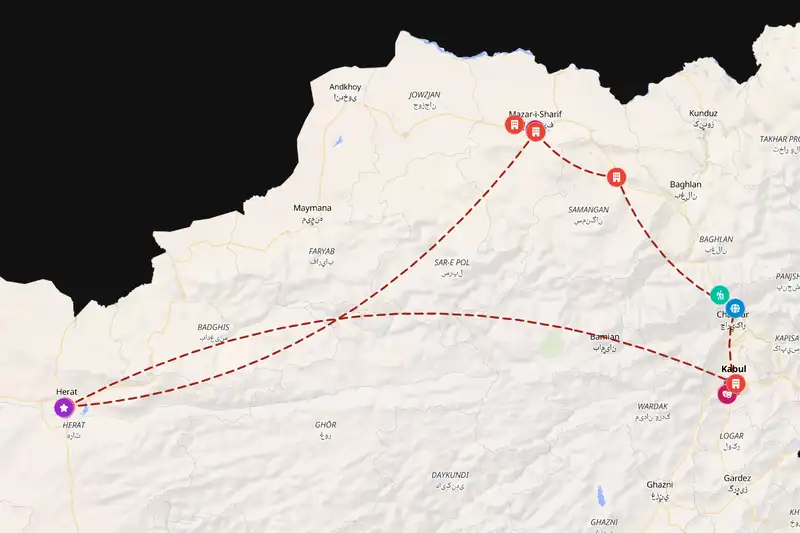
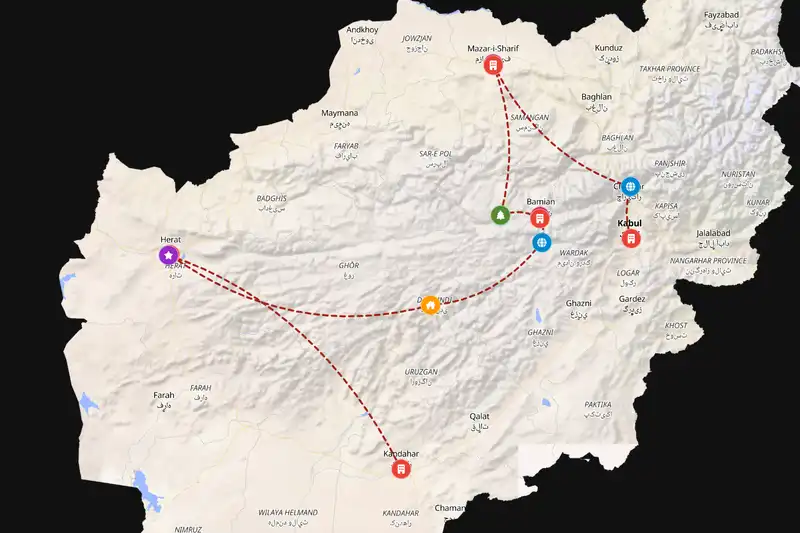
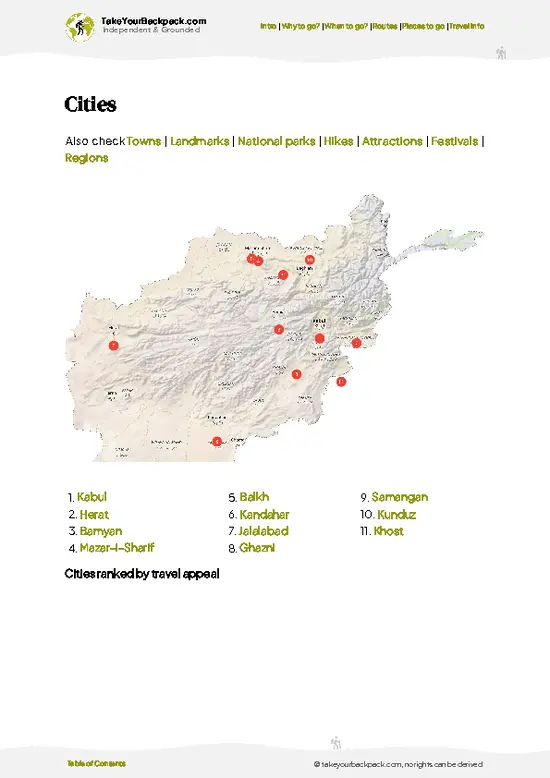
This 21-day circuit is for travelers who already have a trip or two to Asia behind them and want the full sweep of Afghanistan: the capital’s quieter corners, the Hazara highlands, the old southern highway, Herat’s Persian-flavored lanes and the shrine city of the north. The pace is relaxed, with most stops getting two to four nights and no long travel days back to back. You will use shared taxis or a hired car with driver on the roads, plus two domestic flights (Kandahar to Herat and Herat to Mazar-i-Sharif). Most foreigners currently travel with a registered local guide, who also handles the paperwork at each provincial information and culture office.
Days 1-3: Kabul and Paghman Valley
Spend your first days in
Kabul on the city’s less-visited edges. Start in the south-west at the
Kabul National Theater Area, where the gutted shell of the old theater stands a short walk from Darul Aman, a blunt reminder of the 1990s street fighting. Then cross to the west side for the
Sakhi Shrine Complex, …
read more 👉This 21-day circuit is for travelers who already have a trip or two to Asia behind them and want the full sweep of Afghanistan: the capital’s quieter corners, the Hazara highlands, the old southern highway, Herat’s Persian-flavored lanes and the shrine city of the north. The pace is relaxed, with most stops getting two to four nights and no long travel days back to back. You will use shared taxis or a hired car with driver on the roads, plus two domestic flights (Kandahar to Herat and Herat to Mazar-i-Sharif). Most foreigners currently travel with a registered local guide, who also handles the paperwork at each provincial information and culture office.
Days 1-3: Kabul and Paghman Valley
Spend your first days in Kabul on the city’s less-visited edges. Start in the south-west at the Kabul National Theater Area, where the gutted shell of the old theater stands a short walk from Darul Aman, a blunt reminder of the 1990s street fighting. Then cross to the west side for the Sakhi Shrine Complex, a blue-tiled Shia shrine where families picnic on the slopes, and climb the Kart-e Sakhi Hill Overlook late in the afternoon for a view across the whole bowl of the city, with kites dotting the sky on Fridays. Early on your second morning, head to the Kol-e-Hashmat Khan Wetlands in the south-east; in spring and autumn migration the reed beds fill with herons and ducks, a strange sight under the Bala Hissar walls.
Day 3 is a half-day escape to the Paghman Valley, roughly 25 km west and about 600 meters higher, where Kabul’s kings once summered. The Paghman Hill Castle and Memorial Arch anchor the visit: the Taq-e Zafar arch was built after independence from Britain, and the hillside around it fills with families grilling kebabs under walnut trees. Come back to Kabul for a last night before the mountains.Days 4-8: Bamyan and Band-e-Amir
The road over the Shibar Pass to Bamyan takes 5 to 6 hours, and from the moment you drop into the valley the air smells of wood smoke and potato fields. Give the first afternoon to the Buddha Niches and Cliffside Caves of Bamiyan, focusing this time on the monastic cells honeycombing the cliff between the two giant niches, where traces of painted ceilings survive under centuries of soot.
The next two days belong to the high country. The Koh-e-Baba Range Trail takes you onto the ridges south of town for a full day of walking between Hazara hamlets and summer pastures, and the Shah Foladi Protected Area offers the bigger mountain, a peak just under 5,000 meters, with alpine meadows reachable on a day hike even if you skip the summit. Pack layers; even July nights fall close to freezing up there.
On Day 7, drive 2 to 3 hours west to Band-e-Amir National Park and stay overnight in one of the simple guesthouses by the lakes. Sleeping there means you see Band-e-Haibat at dawn, when the water turns from slate to cobalt behind its natural travertine dam and the pilgrims have not yet arrived. Day 8 is the long one, back past Bamyan and over the passes to Kabul for the night.Days 9-11: Ghazni and Kandahar
Take an easy 2.5 to 3 hours south on the highway to Ghazni, the 11th-century capital of Mahmud of Ghazni. Two star-shaped brick minarets from the 12th century stand alone in the fields outside town, and Mahmud’s tomb lies in the village of Rawza just north. One night is enough, and it splits the drive neatly.
The next day continues 5 to 6 hours to Kandahar, the Pashtun heartland and the city where Ahmad Shah Durrani founded the Afghan state in 1747. Two nights let you see his turquoise-domed mausoleum, climb the Chilzina, the “Forty Steps” cut into a rock spur with a Persian inscription commissioned by Babur, and work through the fruit market when the pomegranates are in. Kandahar feels more conservative than anywhere else on this route, so dress accordingly and let your guide set the pace.Days 12-16: Herat and Qala-i-Naw
Fly from Kandahar to Herat instead of facing roughly 10 hours of road. This time, spend your days in the Old City Bazaar and Citadel Area, where the lanes split by trade: coppersmiths in one alley, blue glass blown in small furnaces in another, silk and carpets around the four old gates. Climb the restored Herat Citadel for the view across the rooftops, and end one afternoon at the Friday Mosque of Herat, timing it for golden light on the tiled courtyard.
On Day 15, drive 4 to 5 hours north over the Sabzak Pass to Qala-i-Naw, the small capital of Badghis Province. The rolling loess hills here are covered in wild pistachio woodland, and the town has none of Herat’s polish, which is its appeal. Return to Herat the following day for a last evening in the bazaar.Days 17-19: Mazar-i-Sharif and Balkh
A short flight carries you north to Mazar-i-Sharif. Go straight to the Blue Mosque Complex, then stay into the evening for the Shrine of Hazrat Ali Night Market Area, when the tiles are floodlit, the food carts fire up skewers of liver and the courtyard fills with families. Use one full day for Balkh, 20 km west, an ancient city whose crumbling mud ramparts once ringed one of Central Asia’s great centers, and leave the third day open for the city’s carpet traders and teahouses.Days 20-21: Samangan and Salang Pass to Kabul
The final drive back to Kabul is a long but scenic day of 8 to 10 hours. Break it at Samangan, where Takht-e Rustam, a Buddhist stupa carved down into the bedrock rather than built up, sits on a hill above the town of Aybak. Then climb to the Salang Pass, roughly 3,400 meters at the tunnel, with snow walls lining the road well into spring, before descending to the capital for your final night and departure on Day 21.
If you can add a few days, the road east from Herat toward Ghor passes the domed 12th-century tombs of Chisht-e Sharif, the birthplace of the Chishti Sufi order, standing in a village almost no foreigner visits.v2.webp)
 Best Backpacking