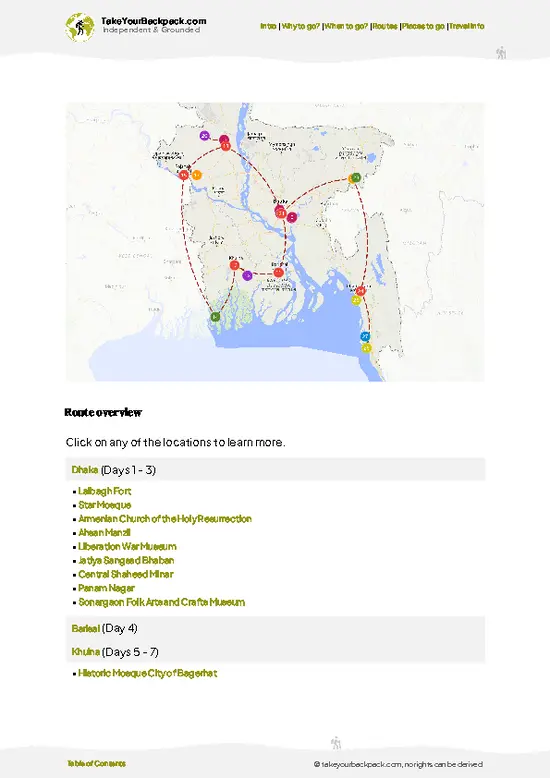
This three-week circuit of Bangladesh is for travelers who want the whole picture: Mughal Dhaka, a night on the rivers, mangrove channels, the Buddhist and Islamic ruins of the northwest, tea country and the Bay of Bengal. The pace is steady but unhurried, with a light day after every long ride. You will use nearly every form of public transport the country has: an overnight river launch, intercity trains and buses, a chartered tour boat in the Sundarbans, a short ferry crossing to Maheshkhali, CNG auto-rickshaws for local hops and one domestic flight home.
Days 1-4: Dhaka and the Sonargaon Day Trip
Give
Dhaka three full days, because this time you dig into its layers. Spend the first morning in the lanes of Old Dhaka: the unfinished Mughal walls of
Lalbagh Fort, the china-shard mosaics of the
Star Mosque and the quiet graveyard of the
Armenian Church of the Holy Resurrection, built in 1781 by a merchant community that has all but vanished. Finish at the pink
Ahsan Manzil as boats crowd …
read more 👉This three-week circuit of Bangladesh is for travelers who want the whole picture: Mughal Dhaka, a night on the rivers, mangrove channels, the Buddhist and Islamic ruins of the northwest, tea country and the Bay of Bengal. The pace is steady but unhurried, with a light day after every long ride. You will use nearly every form of public transport the country has: an overnight river launch, intercity trains and buses, a chartered tour boat in the Sundarbans, a short ferry crossing to Maheshkhali, CNG auto-rickshaws for local hops and one domestic flight home.
Days 1-4: Dhaka and the Sonargaon Day Trip
Give Dhaka three full days, because this time you dig into its layers. Spend the first morning in the lanes of Old Dhaka: the unfinished Mughal walls of Lalbagh Fort, the china-shard mosaics of the Star Mosque and the quiet graveyard of the Armenian Church of the Holy Resurrection, built in 1781 by a merchant community that has all but vanished. Finish at the pink Ahsan Manzil as boats crowd the Buriganga below. Day two moves to the modern city: the Liberation War Museum in Agargaon explains 1971 better than any book, Louis Kahn’s concrete-and-water Jatiya Sangsad Bhaban sits a short ride away, and the Shaheed Minar near Dhaka University marks the 1952 language movement. On day three, head out early to Sonargaon, the old Bengal capital, where the crumbling merchant mansions of Panam City line a single street and the Sonargaon Folk Arts and Crafts Museum holds nakshi kantha quilts and brass work. On the evening of day four, board an overnight launch at Sadarghat. A private cabin costs roughly Tk 1,200 to 2,500 (US$10 to 21), and waking up to fishing boats on the river is the reason to do it.Days 5-10: Barisal, Bagerhat and the Sundarbans
The launch noses into Barisal at dawn. Spend the day on its canals, visit the brick Oxford Mission Church and ride out to the Guthia Mosque, then sleep properly. A 4 to 5 hour bus on day six brings you to Khulna, your base for the next stretch. Day seven is for the Historic Mosque City of Bagerhat, 45 minutes away, where Khan Jahan Ali’s 15th-century Sixty Dome Mosque stands among ponds and smaller tombs. From day eight, join a three-day, two-night boat tour into the Sundarbans, the only way foreigners can visit properly. Expect roughly Tk 18,000 to 30,000 (US$150 to 250) per person including food, guides and armed forest guards. Tigers are rarely seen, but spotted deer, saltwater crocodiles, monkeys and eight or more species of kingfisher are near-certain. Return to Khulna on day ten for a hot shower.Days 11-15: Rajshahi, Puthia, Mahasthangarh and Paharpur
A 6 hour train carries you north to Rajshahi, a clean, slower city on the Padma where evenings on the riverbank are a local ritual. The Varendra Research Museum, founded in 1910, holds stone sculpture from the Pala and Sena eras, a good primer for what comes next. On day twelve, take a one-hour bus to Puthia, where terracotta-covered Hindu temples cluster around ponds near the old raj palace. Move on to Bogura on day thirteen (about 2.5 hours) and stop at the Mahasthangarh Archaeological Site Museum, beside the earthen ramparts of ancient Pundranagara, inhabited from at least the 3rd century BCE. Day fourteen is reserved for the Ruins of the Buddhist Vihara at Paharpur, the 8th-century Somapura Mahavihara, once one of the largest monasteries south of the Himalayas and a UNESCO World Heritage Site. On day fifteen, ride the 5 to 7 hour bus back to Dhaka for one night near Kamalapur station.Days 16-17: Srimangal and Lawachara
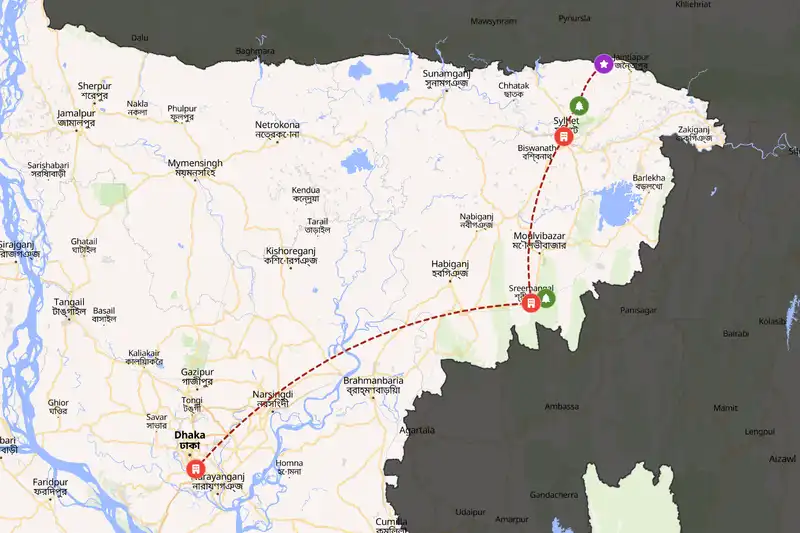
After the long road day, the 4 hour train east to Srimangal feels easy. Rent a bicycle or hire a CNG through the tea estates, and give day seventeen to Lawachara, where hoolock gibbons call above the railway line that cuts through the forest. Go at first light for the best chance of hearing them.Days 18-21: Chittagong, Cox’s Bazar and Maheshkhali
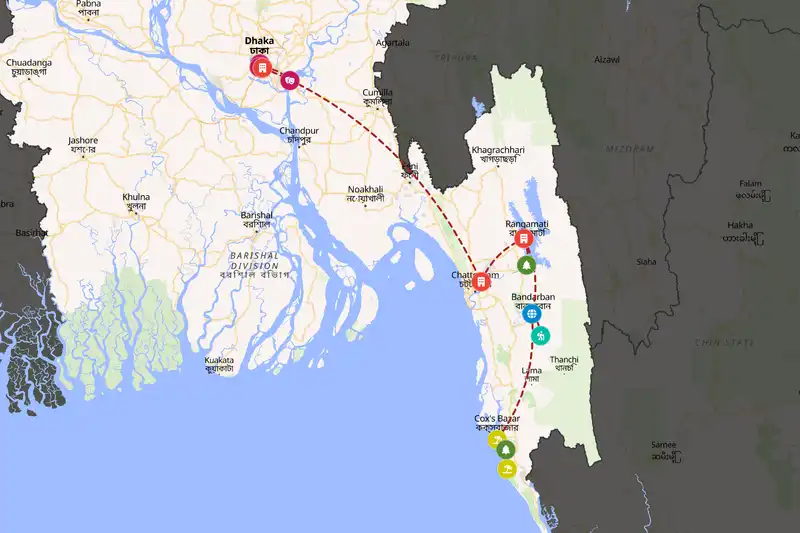
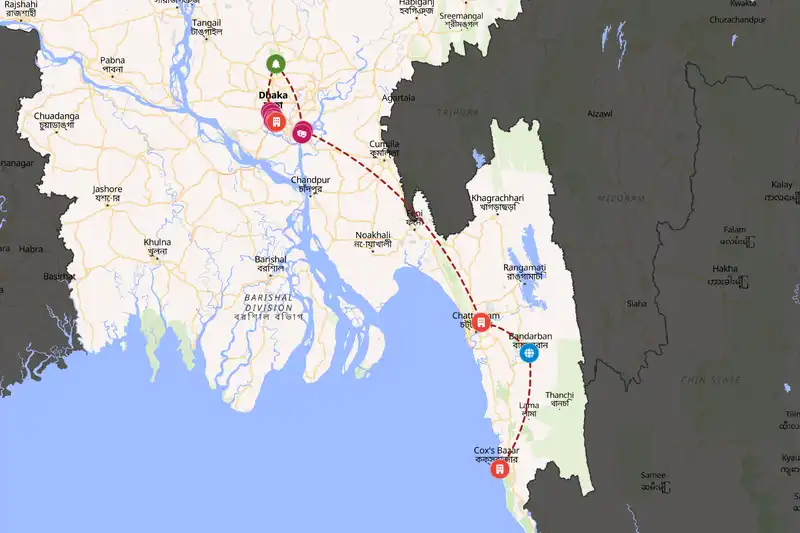
Day eighteen is a 7 to 8 hour train from Srimangal to Chittagong, so keep the evening simple: a rickshaw to Patenga Beach to watch ships queue at the mouth of the Karnaphuli. On day nineteen, travel 3 to 5 hours south by bus or train to Cox’s Bazar and spend the afternoon on the sand. Day twenty is for Maheshkhali, a short boat ride from the Cox’s Bazar jetty, where the hilltop Adinath Temple looks over salt pans and betel plantations. On day twenty-one, fly to Dhaka in about an hour for your international departure.
If you can squeeze in one more day by the sea, hire a boat from Maheshkhali to Sonadia Island, a near-empty sandbar of fishing camps and migratory shorebirds.v2.webp)



 Best Backpacking