×
Bhutan🇧🇹 | 15 days itinerary

Bhutan in 15 Days

By Johan Kruseman 🇳🇱 | Updated May 9, 2026
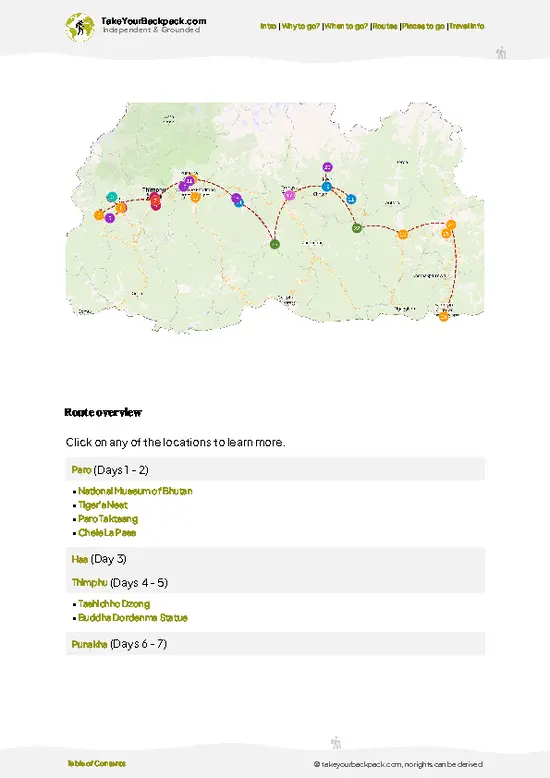
This 15-day route is for travelers who want to really sink into Bhutan—multiple valleys, one serious trek, national parks, and a mix of headline sights and quieter corners—using a private car with driver for long transfers and your own legs for the trekking sections. The pace is adventurous but not punishing: you’ll have time to acclimatize, recover between big days, and actually talk to people instead of just ticking off viewpoints.

Days 1-2: Thimphu - orientation and culture

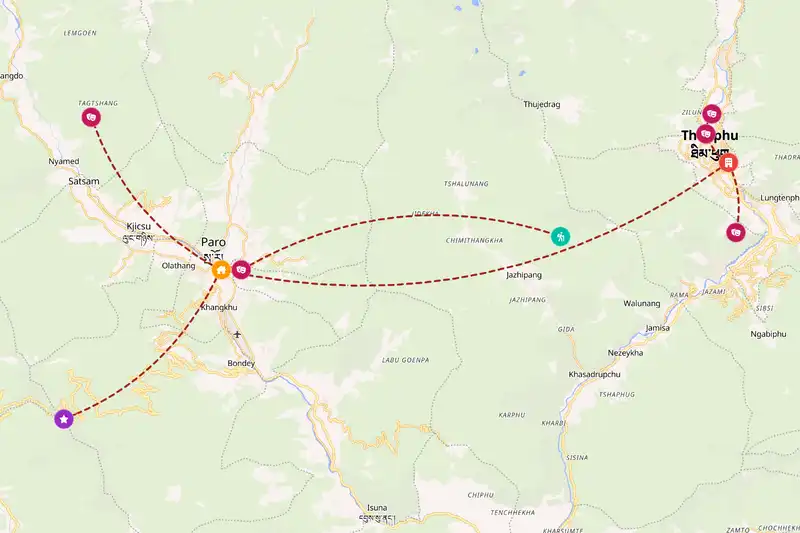
Start in Thimphu, giving yourself two nights to adjust to altitude and understand the country before you disappear into the hills. Visit the Buddha Dordenma Statue for a sweeping introduction to the valley and then spend time in central Thimphu, where government buildings, monasteries, and shops share the same streets. Add the National Folk Heritage Museum to ground yourself in how Bhutanese homes and daily life actually work, and, if time allows, swing by Tashichho Dzong from the outside in the late afternoon when … read more 👉
This 15-day route is for travelers who want to really sink into Bhutan—multiple valleys, one serious trek, national parks, and a mix of headline sights and quieter corners—using a private car with driver for long transfers and your own legs for the trekking sections. The pace is adventurous but not punishing: you’ll have time to acclimatize, recover between big days, and actually talk to people instead of just ticking off viewpoints.

Days 1-2: Thimphu - orientation and culture

Start in Thimphu, giving yourself two nights to adjust to altitude and understand the country before you disappear into the hills. Visit the Buddha Dordenma Statue for a sweeping introduction to the valley and then spend time in central Thimphu, where government buildings, monasteries, and shops share the same streets. Add the National Folk Heritage Museum to ground yourself in how Bhutanese homes and daily life actually work, and, if time allows, swing by Tashichho Dzong from the outside in the late afternoon when the light softens and the complex feels both official and serene.

Days 3-6: Paro, Tiger’s Nest, and Chele La Pass

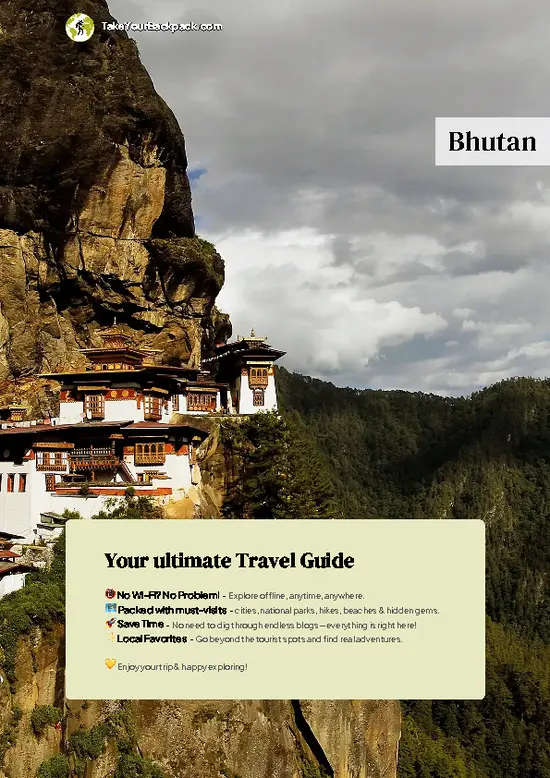
Transfer by road to Paro, your base for a deep dive into western Bhutan’s classic highlights. Dedicate a full day to the Tiger’s Nest hike up to Paro Taktsang, moving slowly enough to enjoy the forest, the cliffside views, and the quiet corners of the monastery complex itself. On another day, drive up to Chele La Pass for high-ridge walks among prayer flags and big-mountain panoramas, then return to Paro for slow evenings in town. Use remaining time to visit the National Museum of Bhutan (Ta Dzong for historical context and to wander the valley floor, letting the rhythm of farm life and small temples balance out the big-ticket sights.

Days 7-10: Druk Path Trek and Jigme Dorji National Park fringes

From the hills above Paro, set out on the Druk Path trek, a multi-day route that links the Paro and Thimphu regions along high ridges and alpine lakes. Over these days you’ll camp near clear mountain tarns, walk through rhododendron forests, and, in places, skirt the edges of Jigme Dorji National Park, where the air feels wilder and the peaks feel closer. The trek gives you a moving window into Bhutan’s backcountry without the extreme commitment of the Jomolhari or Snowman Trek, and by the time you descend toward the Thimphu side you’ll have a completely different mental map of how the valleys connect. Finish this phase with a recovery night back in or near Thimphu, enjoying a hot shower and a proper bed.

Days 11-12: Punakha, Wangdue Phodrang, and Gasa Hot Springs

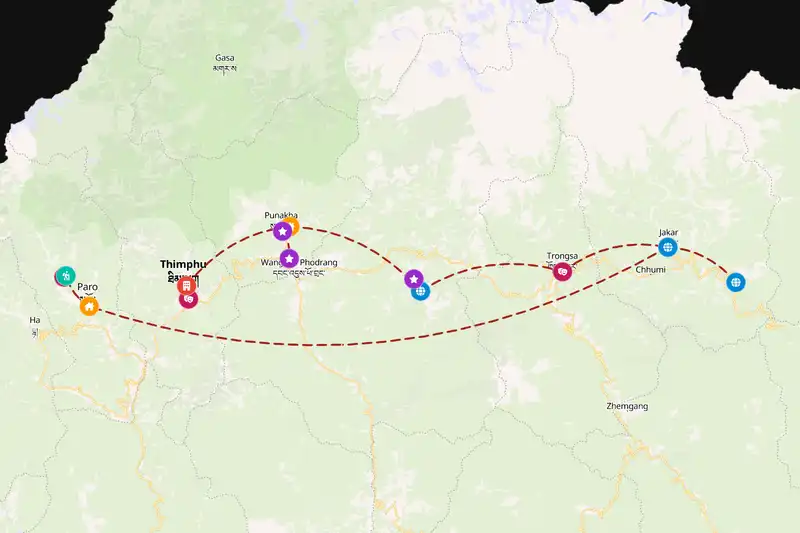
Drive east over the passes to Punakha, where the warmer climate and river valleys feel like a reward after your days at altitude. Anchor your visit with time at Punakha Dzong, exploring its courtyards and riverside setting, then wander through the fields to Chimi Lhakhang to see how spirituality and everyday village life blend. Use a day to continue toward the hills and soak at Gasa Hot Springs, where the mineral pools and mountain backdrop give your trekking legs a well-earned reset, then loop back through the area of Wangdue Phodrang for a night that breaks up the driving and shows you another working Bhutanese town.

Days 13-15: Phobjikha Valley depth and quiet

Finish your journey in the high, open bowl of the Phobjikha Valley, basing yourself in or near Phobjikha village. Spend time at Gangtey Monastery, watching monks move through their routines while the valley spreads out below, and then walk the gentle trails that loop through fields and forest, giving you long, quiet hours to process everything you’ve seen. This last phase is intentionally slower: instead of chasing new valleys, you’ll deepen your connection to one, ending your 15 days with a sense of calm that’s hard to bring home but very easy to remember.

As a final bonus, if you ever come back with a taste for true remoteness, consider planning a future detour to the wild Sakteng region, where high meadows and local legends about the migoi (yeti) add a playful edge to serious trekking country.
Loading the map 🌍
film
0
0
0a
Tiger’s Nest
film
1
1
1a
Chele La Pass
film
2
2
2a
Druk Path
film
3
3
3a
Jigme Dorji
Pixabay
film
4
4
4a
Punakha
film
5
5
5a
Punakha Dzong
film
6
6
6a
Chimi Lhakhang

🛏️ Where to stay?15 Days of Adventure

✈️ The backpacker research shortcutBhutan Travel Guide

An offline-friendly backpacking guide with optimized travel routes, ranked highlights, transport advice, and the best areas to stay.
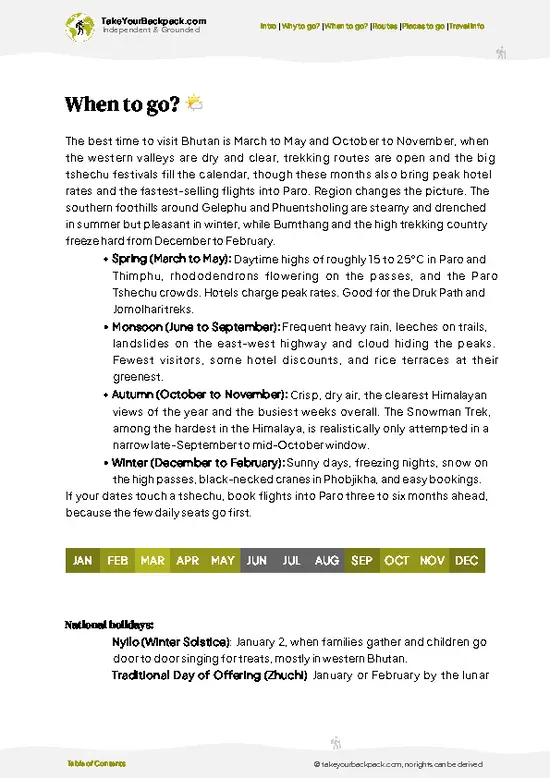
example page 0 from our offline Travel Guide for Bhutanexample page 1 from our offline Travel Guide for Bhutanexample page 2 from our offline Travel Guide for Bhutanexample page 3 from our offline Travel Guide for Bhutanexample page 4 from our offline Travel Guide for Bhutanexample page 5 from our offline Travel Guide for Bhutan
The digital guide (193 pages) contains:
54 highlights, ranked by travel appeal
Optimized 5, 10 & 15-day travel routes
Best neighborhoods to stay
How to get around
Offline-friendly for travel without Wi-Fi
👉 See all 30+ guide features

📅 Plan smarter in minutes, not weeks
Month by month travel advice
Festivals & national holidays
Budget expectations

🗺️ Go to the right places, skip the overrated ones
Honest pros & cons of destinations
Top hikes, parks & viewpoints
Lesser-known places most travelers miss
Clear “worth it vs skip it” guidance

🛏️ Travel smoothly without rookie mistakes
Best areas to stay
Transport systems explained simply
Common scams & safety advice
SIM cards, money & practical tips

🌍 Understand the country, not just visit it
Culture & traditions
52 Essential phrases & customs
Festivals worth planning around
Traveler-friendly historical context
Insights that make places more meaningful

📱 Built for real travel conditions
Fully downloadable PDF
Works completely offline
Optimized for phone use
Useful in remote areas & buses
Everything in one place
Save weeks of stressful planning
Get instant access to the full guide directly. 30-day money-back guarantee.


Sent to your inbox immediately after payment • 100% Secure Checkout
Best Backpacking Travel Advisor 2025 tourism awardBest Backpacking
Travel Advisor
2025
What others say about Take Your Backpack Guides:
⭐⭐⭐⭐⭐
Fantastic, amazing amount of information!
⭐⭐⭐⭐⭐
My goodness this is amazing, it's what I've been looking for hats off too you!
⭐⭐⭐⭐⭐
I think this is absolutely BRILLIANT
⭐⭐⭐⭐
Very complete and informative. It's still missing places, but I gotta to commend you
⭐⭐⭐⭐⭐
This is truly amazing, thank you, can't wait to explore it with my kids!
⭐⭐⭐⭐⭐
Awesome resource, thank you!
⭐⭐⭐⭐⭐
This is amazing! Can't wait to explore the ones I haven't seen
⭐⭐⭐⭐
I love this! Well done, great idea.
⭐⭐⭐⭐⭐
Thanks for taking the time to make this gem!
⭐⭐⭐⭐⭐
This might be the best website I've ever seen.
⭐⭐⭐⭐⭐
Congratulations, and thank you so much for your work; it's incredibly valuable.
⭐⭐⭐⭐
In all seriousness I think you did a great job pointing out the important spots
⭐⭐⭐⭐⭐
10/10 very good
⭐⭐⭐⭐⭐
As someone who's only just starting to visit regularly this is awesome, thank you.
⭐⭐⭐⭐
Thank you very much! I'm going to visit my dad, it's going to be very useful!
⭐⭐⭐⭐⭐
This is really cool! We'll be travelling for the first time and this definitely come in handy.
⭐⭐⭐⭐⭐
You are now our minister of culture, congratulations 👨‍💼
⭐⭐⭐⭐⭐
Just wanted to tell you that this is a pearl! Going to follow your recommendations.
⭐⭐⭐⭐⭐
This is so cool. I'll definitely be using the resource for my travels soon.
⭐⭐⭐⭐⭐
This is very impressive! Good work.
⭐⭐⭐⭐⭐
This is an amazing and informative site. Very well done!

🧭 RouteMore Ways to Explore

Travel Bhutan your way — from a quick highlights trip to a slow-paced adventure.

🙋 FAQGood to Know

Short version: Bhutan is not a classic backpack-anywhere-freely country, but it’s still doable on a budget if you play by the rules and plan smartly.

Bhutan controls tourism with a visa system and a mandatory minimum daily spend called the Sustainable Development Fee (SDF). This means you cannot just show up and drift around like in Nepal or India. You need: visa approval in advance, a confirmed itinerary, and usually a licensed Bhutanese guide and pre-booked accommodation. Rules have shifted over the years, but the core idea stays: independent wandering is limited; structured travel is the norm.

For a budget-minded traveler, the trick is to think “lean, focused trip” instead of “open-ended backpacking.” You keep costs down by:
- Traveling in a small group (2–4 people) to split guide and vehicle costs.
- Sticking mostly to the western corridor (Paro–Thimphu–Punakha) where distances are shorter and logistics are simpler.
- Choosing simple guesthouses instead of fancy hotels.
- Keeping your trip short but dense in experiences rather than long and slow.

You still get a lot of backpacker-style rewards: homestays, local food, hiking, monasteries, and real conversations with your guide and hosts. What you lose is the ability to improvise day by day, hitchhike freely, or bargain for last-minute rooms. If your ideal backpacking style is total spontaneity, Bhutan will feel controlled. If you’re okay with a pre-set skeleton (route, permits, guide) and you treat it as a high-value, short, intense trip, it works very well.
For most backpackers, 7–10 days is the sweet spot. Less than that and you’re rushing; more than that and the cost of the SDF and logistics starts to sting.

Rough breakdown:
- 4–5 days (absolute minimum): Paro + Thimphu
- Day 1: Arrive Paro, explore town and dzong.
- Day 2: Hike to Tiger’s Nest (Taktsang Monastery).
- Day 3: Transfer to Thimphu, city sights, short hikes.
- Day 4: Extra hike or day trip around Thimphu, return to Paro.
- Day 5: Fly out.
This works if you’re tight on money and time, but it’s a sampler, not a deep dive.

- 7–8 days (ideal starter trip): Paro – Thimphu – Punakha
- Add Punakha Dzong, rice terraces, and a couple of half-day hikes.
- You get a feel for different valleys and climates without brutal driving days.
- This is the best balance of cost, variety, and energy for most budget travelers.

- 10–12 days (for trekkers and slow travelers): Western Bhutan + short trek
- Add a 3–4 day trek like the Druk Path (Paro to Thimphu) or similar.
- You get camping, mountain views, and more trail time for the same visa overhead.

If you’re on a tight budget, it’s smarter to do a shorter, high-quality 7–8 day trip than to stretch to 14 days and stress about every extra day of fees. Bhutan rewards depth over length: fewer valleys, more time walking, talking, and drinking butter tea with locals.
You can move around Bhutan without driving yourself, but you usually cannot move around without a vehicle at all.

Key reality: Most visitors are required to travel with a licensed guide, and that usually comes with a private car and driver or at least organized transport between towns. Public buses and shared taxis do exist, but they are slow, crowded, and not always aligned with the permit and itinerary structure that tourists must follow.

Inside towns like Thimphu and Paro:
- You can walk a lot. Town centers are compact, and many guesthouses are within walking distance of food and small sights.
- Short taxis are cheap by Bhutan standards and easy to arrange through your guesthouse or guide.

Between towns and valleys:
- Roads are narrow, winding, and prone to landslides and delays.
- Hitchhiking is not a reliable strategy for tourists because of permit checks and the expectation that you’re with a guide.
- Buses and shared taxis are more for locals and long-term residents; they’re not usually integrated into tourist itineraries.

For a budget traveler, the most practical move is to accept the guide + vehicle setup but keep your route tight: fewer long transfers, more time in each valley. That way you’re not paying for endless driving days, and you can still do what feels backpacker-ish: day hikes, village walks, and exploring on foot once you’re in each base town.
For a first-time, budget-conscious backpacker, these are the places that earn their cost in experience:

1. Paro and Tiger’s Nest (Taktsang Monastery)
- Non-negotiable. The hike to Tiger’s Nest is the image you probably have of Bhutan: a monastery clinging to a cliff, prayer flags, and a steady, sweaty climb.
- Paro town itself is relaxed, walkable, and a good place to ease into Bhutanese food and culture.

2. Thimphu
- The capital is where you feel modern Bhutan: cafes, shops, young monks with smartphones, and the famous traffic officer instead of traffic lights.
- Good for budget travelers because you can walk between many sights and eat cheaply in local restaurants.

3. Punakha
- Warmer climate, terraced fields, and one of the most impressive dzongs in the country sitting at the confluence of two rivers.
- Great area for half-day hikes, suspension bridges, and village walks that don’t require hardcore trekking gear.

4. A short trek (if you can afford the time and cost)
- The Druk Path Trek (between Paro and Thimphu) is the classic: 3–5 days, lakes, ridges, and camping.
- Even one multi-day trek transforms the trip from “cultural tour” to “mountain journey,” which is what most backpackers are really chasing.

If you have extra time and budget:
- Haa Valley: Quieter, more rural feel, good for homestays and walking.
- Phobjikha (Gangtey): Wide glacial valley, black-necked cranes in season, and a strong sense of space and silence.

For a first trip on a budget, Paro + Tiger’s Nest, Thimphu, and Punakha are the core. Add one short trek or one extra valley if your wallet and schedule allow it.
If you’re short on time or watching every dollar, skip anything that adds long driving days without giving you a totally different experience.

1. Very long overland pushes to eastern Bhutan
- Places like Trashigang and Mongar are fascinating but require multiple full days of driving on winding roads.
- For a first trip, that’s a lot of time and money for experiences that, while rich, are more about depth than big new “wow” moments compared to the west.

2. Too many dzongs and monasteries
- After Paro Dzong, Punakha Dzong, and a couple of key monasteries (including Tiger’s Nest), additional dzongs start to blur together.
- If your guide suggests yet another similar complex and you’re tired, it’s okay to say you’d rather walk through a village or along the river instead.

3. High-end resort experiences
- Luxury hot-stone baths, spa days, and fancy hotel dinners are nice but not essential to understanding Bhutan.
- For backpackers, a simple homestay, local bath, and momos in a family kitchen give you more story for far less money.

4. Overstuffed itineraries with a new town every night
- Constant packing and driving eats into your energy and your budget.
- It’s better to skip one valley and spend an extra night in Paro or Punakha, doing a day hike or a village visit.

5. Shopping-heavy stops
- Handicrafts and textiles are beautiful but can be expensive and heavy in your pack.
- If money or time is tight, limit shopping to one focused stop in Thimphu or Paro instead of multiple markets.

In short, skip long-haul drives to the far east, extra dzongs that feel like repeats, and luxury add-ons. Keep your focus on one or two valleys, Tiger’s Nest, Punakha, and at least one good hike or short trek.

🇧🇹 BhutanDiscover the Country

Ready to build a truly unique trip? Predefined routes are perfect for first-time visitors, but there is so much more to discover. Whether you are chasing a city trip, pristine national parks, local food scenes, or quiet beaches, pick a category to design your own path.