×
Colombia🇨🇴 | 14 days itinerary

Colombia in 14 Days

By Johan Kruseman 🇳🇱 | Updated May 7, 2026
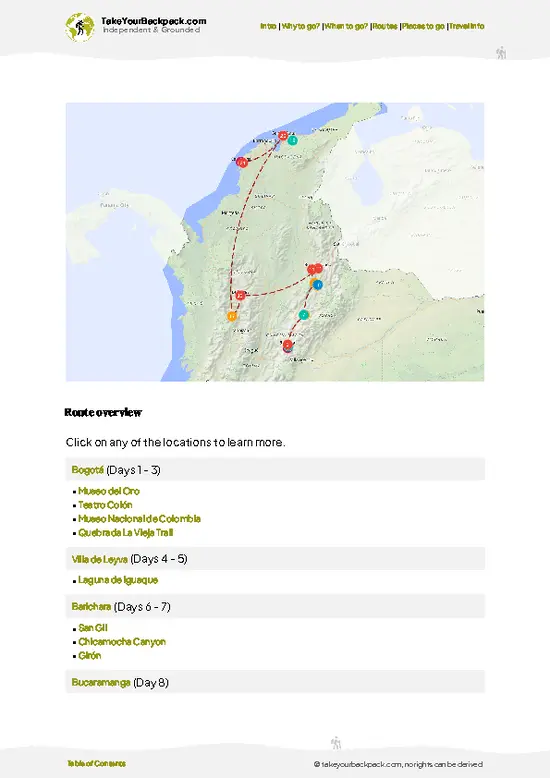
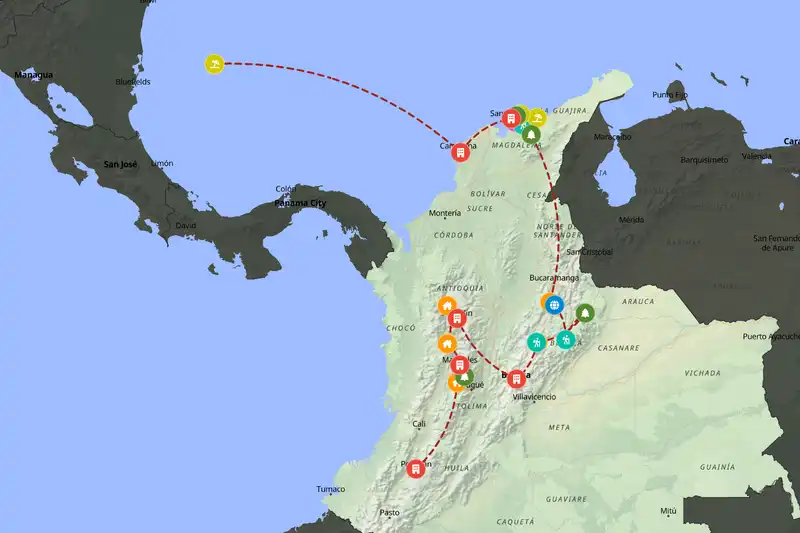
This 14-day itinerary is for travelers who want a classic Colombia arc: big-city culture, colonial towns, canyon country, and a taste of the Caribbean, at a moderate pace that mixes buses and a couple of domestic flights. You’ll get variety without chaos, with enough time in each stop to actually sit in a plaza, learn a neighborhood, and not feel like you’re just chasing checklists.

Days 1-3: Bogota - Museums, history, and high-altitude buzz

Start in Bogota, where the altitude slows you down just enough to appreciate the city’s layers of history and street life. Spend a day in La Candelaria moving between the Gold Museum and Museo Botero, two of the country’s strongest collections and a perfect crash course in pre-Hispanic goldwork and modern art, then add Museo Nacional de Colombia or Museo de Arte Moderno de Bogotá if you want more context. Evenings are for neighborhood-hopping between Candelaria’s bohemian corners and the more polished bars and restaurants further north, giving you a … read more 👉
This 14-day itinerary is for travelers who want a classic Colombia arc: big-city culture, colonial towns, canyon country, and a taste of the Caribbean, at a moderate pace that mixes buses and a couple of domestic flights. You’ll get variety without chaos, with enough time in each stop to actually sit in a plaza, learn a neighborhood, and not feel like you’re just chasing checklists.

Days 1-3: Bogota - Museums, history, and high-altitude buzz

Start in Bogota, where the altitude slows you down just enough to appreciate the city’s layers of history and street life. Spend a day in La Candelaria moving between the Gold Museum and Museo Botero, two of the country’s strongest collections and a perfect crash course in pre-Hispanic goldwork and modern art, then add Museo Nacional de Colombia or Museo de Arte Moderno de Bogotá if you want more context. Evenings are for neighborhood-hopping between Candelaria’s bohemian corners and the more polished bars and restaurants further north, giving you a sense of how different Bogota feels from block to block.

Days 4-6: Villa de Leyva, Monguí & Páramo de Ocetá - Stone plazas and high moorlands

Head by bus to Villa de Leyva, where the huge stone plaza and whitewashed streets slow your pace and make walking the main activity; this is where you linger over long lunches and watch local life unfold. From there, continue to Monguí, a smaller Andean town that feels even more old-world, and use it as your base to hike the Páramo de Ocetá Trail, one of Colombia’s most rewarding highland walks, with frailejones and rolling moorland that feel like another planet. The combination of crisp air, quiet streets, and big skies makes this phase a reset between big-city Bogota and the warmer north.

Days 7-9: Chicamocha Canyon, Barichara & San Gil - Canyons and cobblestones

Travel north toward Santander, stopping to take in Chicamocha Canyon, where the road clings to the mountainside and you get a sense of just how rugged Colombia’s interior really is. Base yourself in Barichara, a beautifully preserved town of stone streets and tiled roofs, and use one day to walk the old trail down to nearby villages while another day is reserved for a side trip to San Gil if you’re into rafting or canyoning. Even if you skip the adrenaline, just wandering Barichara at golden hour is enough to make this leg worth the detour.

Days 10-12: Bucaramanga & Girón - Urban pause and colonial contrast

Continue to Bucaramanga, a livable, less-hyped city that gives you parks, viewpoints, and a more everyday Colombian vibe after the tourist focus of Barichara. Use it as a base to visit Girón, a nearby colonial town with whitewashed houses and stone streets that’s quieter than many better-known spots, ideal for a slow afternoon and a coffee in the plaza. This stretch is about catching your breath, sampling local food, and feeling what life is like away from the main tourist corridors.

Days 13-14: Santa Marta & Minca - Caribbean gateway and cool mountain air

Fly or bus to the coast and land in Santa Marta, your jumping-off point for the Caribbean and a good place to reset with sea air and evening strolls along the waterfront. Spend a full day up in Minca, trading heat for cool mountain breezes, coffee farms, and short hikes to viewpoints and waterfalls, then return to Santa Marta for your final night, where you can toast the trip with fresh fish and a last walk by the water. The contrast between high-altitude Bogota, Andean towns, canyon country, and the Caribbean fringe makes these two weeks feel like several trips in one.

The part of this route that sticks with me most is watching the light fade over Barichara’s rooftops after a day in Chicamocha Canyon, when the whole country suddenly feels both huge and very close.
Loading the map 🌍
film
0
0
0a
Bogota
Elio Guzman
film
1
1
1a
Gold Museum
Pixabay
film
2
2
2a
Museo Botero
film
3
3
3a
Museo Nacional de Colombia
film
4
4
4a
Museo de Arte Moderno de Bogotá
film
5
5
5a
Chicamocha Canyon
Luis Arturo Suavita Peña
film
6
6
6a
Barichara
Julio Fernandez Casanova
film
7
7
7a
San Gil
La Casona Barichara

🛏️ Where to stay?14 Days of Adventure

✈️ The backpacker research shortcutColombia Travel Guide

An offline-friendly backpacking guide with optimized travel routes, ranked highlights, transport advice, and the best areas to stay.
example page 0 from our offline Travel Guide for Colombiaexample page 1 from our offline Travel Guide for Colombiaexample page 2 from our offline Travel Guide for Colombiaexample page 3 from our offline Travel Guide for Colombiaexample page 4 from our offline Travel Guide for Colombiaexample page 5 from our offline Travel Guide for Colombia
The digital guide (411 pages) contains:
125 highlights, ranked by travel appeal
Optimized 7, 14 & 21-day travel routes
Best neighborhoods to stay
How to get around
Offline-friendly for travel without Wi-Fi
👉 See all 30+ guide features

📅 Plan smarter in minutes, not weeks
Month by month travel advice
Festivals & national holidays
Budget expectations

🗺️ Go to the right places, skip the overrated ones
Honest pros & cons of destinations
Top hikes, parks & viewpoints
Lesser-known places most travelers miss
Clear “worth it vs skip it” guidance

🛏️ Travel smoothly without rookie mistakes
Best areas to stay
Transport systems explained simply
Common scams & safety advice
SIM cards, money & practical tips

🌍 Understand the country, not just visit it
Culture & traditions
52 Essential phrases & customs
Festivals worth planning around
Traveler-friendly historical context
Insights that make places more meaningful

📱 Built for real travel conditions
Fully downloadable PDF
Works completely offline
Optimized for phone use
Useful in remote areas & buses
Everything in one place
Save weeks of stressful planning
Get instant access to the full guide directly. 30-day money-back guarantee.


Sent to your inbox immediately after payment • 100% Secure Checkout
Best Backpacking Travel Advisor 2025 tourism awardBest Backpacking
Travel Advisor
2025
What others say about Take Your Backpack Guides:
⭐⭐⭐⭐⭐
Fantastic, amazing amount of information!
⭐⭐⭐⭐⭐
My goodness this is amazing, it's what I've been looking for hats off too you!
⭐⭐⭐⭐⭐
I think this is absolutely BRILLIANT
⭐⭐⭐⭐
Very complete and informative. It's still missing places, but I gotta to commend you
⭐⭐⭐⭐⭐
This is truly amazing, thank you, can't wait to explore it with my kids!
⭐⭐⭐⭐⭐
Awesome resource, thank you!
⭐⭐⭐⭐⭐
This is amazing! Can't wait to explore the ones I haven't seen
⭐⭐⭐⭐
I love this! Well done, great idea.
⭐⭐⭐⭐⭐
Thanks for taking the time to make this gem!
⭐⭐⭐⭐⭐
This might be the best website I've ever seen.
⭐⭐⭐⭐⭐
Congratulations, and thank you so much for your work; it's incredibly valuable.
⭐⭐⭐⭐
In all seriousness I think you did a great job pointing out the important spots
⭐⭐⭐⭐⭐
10/10 very good
⭐⭐⭐⭐⭐
As someone who's only just starting to visit regularly this is awesome, thank you.
⭐⭐⭐⭐
Thank you very much! I'm going to visit my dad, it's going to be very useful!
⭐⭐⭐⭐⭐
This is really cool! We'll be travelling for the first time and this definitely come in handy.
⭐⭐⭐⭐⭐
You are now our minister of culture, congratulations 👨‍💼
⭐⭐⭐⭐⭐
Just wanted to tell you that this is a pearl! Going to follow your recommendations.
⭐⭐⭐⭐⭐
This is so cool. I'll definitely be using the resource for my travels soon.
⭐⭐⭐⭐⭐
This is very impressive! Good work.
⭐⭐⭐⭐⭐
This is an amazing and informative site. Very well done!

🧭 RouteMore Ways to Explore

Travel Colombia your way — from a quick highlights trip to a slow-paced adventure.

🙋 FAQGood to Know

Short answer: yes, Colombia is very doable to backpack independently, even on a tight budget, as long as you use basic street smarts and plan routes with geography in mind.

The classic backpacker trail is well established: Cartagena – Santa Marta/Taganga – Minca – Tayrona – Medellín – Salento – Bogotá – San Gil – the coffee region. You will find hostels, shuttles, and tours that make logistics almost plug-and-play, especially in those hubs.

Spanish helps a lot. You can get by with phrasebook-level Spanish plus a translation app, but knowing numbers, directions, and basic small talk makes buses, markets, and bargaining much smoother and cheaper.

Safety is better than its reputation but still not a joke. The main rules that actually matter: keep your phone out of sight on the street in big cities, use registered taxis or ride-hailing apps at night, avoid wandering drunk in unfamiliar neighborhoods, and ask hostel staff which areas to avoid. In tourist zones, the biggest risks are petty theft and scams, not dramatic crime.

For solo travelers, hostels are social and easy. Most cities have at least one backpacker-focused hostel with dorms, kitchens, and daily activities. It is easy to join others for day trips, split taxis, or share info on bus routes.

Cash and ATMs are straightforward in cities and bigger towns, but smaller villages and islands can be cash-only. Always carry some backup cash for buses and food, and do not rely on a single card.

Independent backpacking works best if you stay flexible. Weather, protests, or road closures can change plans quickly. Keep your itinerary loose, book only the first few nights in each place, and adjust as you go based on what other travelers and locals recommend.
If you want a real feel for Colombia without racing, 3–4 weeks is the sweet spot for a budget backpacker. You can do less, but you will have to be ruthless about what you skip.

Rough timing guidelines that actually work on the ground:

• 10–14 days: Pick one region and do it well. For example:
– Caribbean loop: Cartagena (3 days), Santa Marta/Taganga (2–3), Minca (2–3), Tayrona or nearby beaches (2–3).
– Andes loop: Medellín (3–4), Guatapé (1–2), Salento and the coffee region (3–4), Bogotá (2–3).

• 3 weeks: Connect two regions without feeling like you live on buses. For example:
– Caribbean + Andes: Cartagena – Santa Marta/Minca/Tayrona – fly to Medellín – Salento – Bogotá.

• 4+ weeks: You can add more adventurous corners like La Guajira desert, San Gil for adventure sports, or the Pacific coast, and still keep rest days.

Colombia is big, and overland travel is slower than it looks on a map. A 300 km bus ride can easily be 8–10 hours. When planning, assume you will lose half a day to a full day every time you move between major regions.

For budget travelers, more time usually means better value. Slower travel lets you take cheaper buses instead of flights, negotiate longer-stay hostel rates, and cook more of your own meals.
You can absolutely get around Colombia without a car; most backpackers do. The country is built for bus travel, and in popular areas there are also shared shuttles and cheap domestic flights.

Main options that actually matter:

• Long-distance buses: These connect almost every city and big town. They are cheap, reasonably comfortable, and run often on major routes like Bogotá–Medellín, Medellín–Cali, and Cartagena–Santa Marta. Night buses can save you a hostel night, but mountain roads are winding, so bring layers and motion sickness pills if you need them.

• Minibuses and colectivos: For shorter hops (like Santa Marta–Minca or Medellín–Guatapé), you will use smaller vans or shared taxis. They leave when full and are usually faster than big buses.

• Domestic flights: For long jumps (Caribbean to Medellín or Bogotá, or to remote areas like Leticia in the Amazon), budget airlines can be surprisingly cheap if you book a bit ahead. Factor in baggage fees; a big backpack may count as checked luggage.

• City transport: In big cities you will use a mix of metro (Medellín), bus systems (Bogotá’s TransMilenio), local buses, and ride-hailing apps or registered taxis. For budget travelers, public transport plus walking is usually enough.

• Boats: On the Caribbean coast and in the Amazon, boats are part of the deal. They can be more expensive than buses but are often the only option to certain beaches or river towns.

You do not need to drive, and in many areas you are better off not driving due to traffic, road conditions, and parking hassles. For day trips, you can rent a scooter or moto-taxi in some towns, but it is optional, not essential.
If you are backpacking Colombia on a budget, these places give you the best mix of culture, nature, and value for your time and money:

• Medellín: Great base for longer stays. Affordable hostels, good food, metro that actually works, and easy day trips to Guatapé and coffee farms. It is also one of the easiest cities to meet other travelers.

• Salento and the Coffee Region: Classic backpacker territory. Think cheap hostels, mountain views, coffee farm tours, and the Cocora Valley with its giant wax palms. It is one of the best places to slow down, hike, and enjoy cooler air.

• Cartagena (old town and Getsemaní): Yes, it is touristy and pricier than most of Colombia, but the old city is gorgeous, and Getsemaní has lively plazas, street art, and budget-friendly hostels. Two or three days is usually enough.

• Minca: Chill mountain village above Santa Marta. Cooler temperatures, waterfalls, coffee and cacao tours, and hostels with big views. It is a great reset if you are coming from hot coastal cities.

• Tayrona area (or nearby beaches): Whether you sleep inside the park or at beaches just outside, this stretch of coast gives you jungle-meets-sea scenery, good hiking, and simple beach living. It is not the cheapest spot in Colombia, but it is worth a couple of days if you are already on the Caribbean coast.

• Bogotá (short but focused stay): The city itself can feel intense, but La Candelaria, the Gold Museum, and the view from Monserrate are worth a quick stop. It is also a major transport hub, so you will probably pass through anyway.

• San Gil (if you like adventure sports): Rafting, paragliding, caving, and canyoning at prices that are usually lower than in many other countries. If you are into adrenaline, it is a strong value stop.

If you have extra time, La Guajira desert, the Pacific coast (Nuquí, Bahía Solano), and the Amazon (Leticia) are incredible but more logistically and financially demanding. They are great add-ons if you have a month or more or if you are okay with a few strategic splurges.
If you are short on time or money, you do not need to chase everything. These are the things many backpackers end up skipping or trimming without regret:

• Overdoing the Caribbean coast: You do not need to see every beach. If you hit Cartagena, Minca, and one beach area (Tayrona or a nearby alternative), you can skip extra coastal towns like Barranquilla or long detours to less distinctive beaches unless you are a hardcore beach person.

•Too many big cities: Bogotá, Medellín, and Cali all have their own character, but you do not need long stays in all three. For most backpackers, Medellín plus a short Bogotá stop is enough. Cali is great for salsa lovers; if that is not you, it is easy to skip on a tight schedule.

•Expensive island trips: Places like San Andrés and Providencia are beautiful but require flights and higher daily costs. If your budget is tight, that money usually goes further in the coffee region, Minca, or adventure towns.

•Overnighting in every small town: You can often visit places like Guatapé or nearby villages as day trips from a bigger base instead of packing and unpacking constantly. This saves both money and energy.

•Long detours to very remote regions: La Guajira, the Pacific coast, and the Amazon are special but time-consuming and pricier. On a 2–3 week trip, trying to squeeze them in usually means you rush everything else. If you are short on time, keep them on the list for a future, slower trip.

When in doubt, prioritize fewer regions with more days in each. Colombia rewards depth over box-ticking, and your budget stretches further when you are not constantly paying for long-distance transport and one-night stays.

🇨🇴 ColombiaDiscover the Country

Ready to build a truly unique trip? Predefined routes are perfect for first-time visitors, but there is so much more to discover. Whether you are chasing a city trip, pristine national parks, local food scenes, or quiet beaches, pick a category to design your own path.