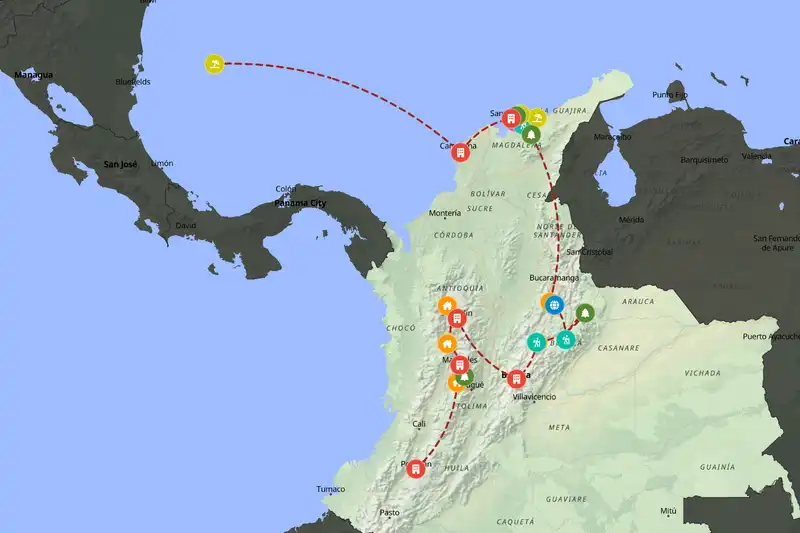
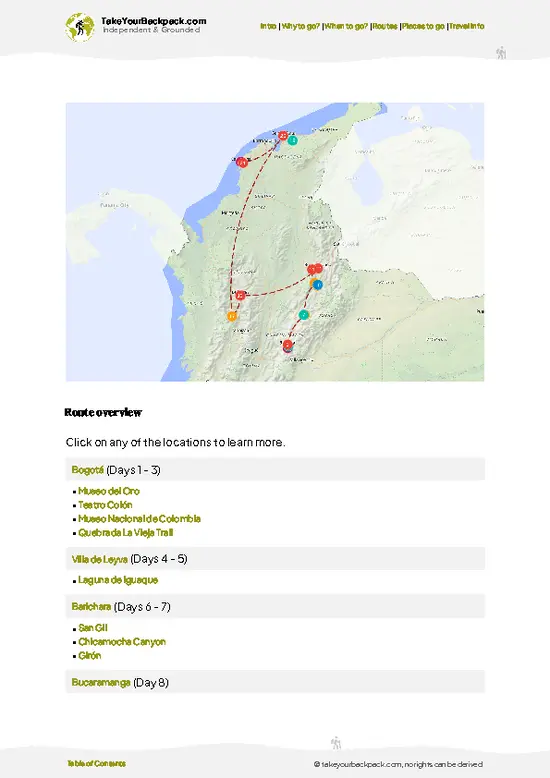
Three weeks in Colombia is for travelers who want the full arc of the country: Andean capital, colonial towns in the high plateau, canyon country, Medellín’s hillsides, a coffee village, a jungle trek and finally the Caribbean. The pace is steady with built-in breathing room, since no two long travel days sit back to back, and you get around by intercity bus, colectivos, Medellín’s metro and two domestic flights (Bucaramanga to Medellín, Medellín to Santa Marta) that save you more than 20 hours of road time.
Days 1-3: Bogotá
Start in
Bogota because the altitude, 2,640 meters, is easier to absorb sitting in museums than climbing toward a sacred lake. Spend day one in La Candelaria: the
Gold Museum holds more than 30,000 pieces of pre-Hispanic goldwork and the top-floor offering room, where the lights drop and come back up on a wall of gold, is worth the trip by itself. Across the old center, peek inside the
Teatro Colón, an Italianate 19th-century opera house that hosts concerts and dance …
read more 👉Three weeks in Colombia is for travelers who want the full arc of the country: Andean capital, colonial towns in the high plateau, canyon country, Medellín’s hillsides, a coffee village, a jungle trek and finally the Caribbean. The pace is steady with built-in breathing room, since no two long travel days sit back to back, and you get around by intercity bus, colectivos, Medellín’s metro and two domestic flights (Bucaramanga to Medellín, Medellín to Santa Marta) that save you more than 20 hours of road time.
Days 1-3: Bogotá
Start in Bogota because the altitude, 2,640 meters, is easier to absorb sitting in museums than climbing toward a sacred lake. Spend day one in La Candelaria: the Gold Museum holds more than 30,000 pieces of pre-Hispanic goldwork and the top-floor offering room, where the lights drop and come back up on a wall of gold, is worth the trip by itself. Across the old center, peek inside the Teatro Colón, an Italianate 19th-century opera house that hosts concerts and dance on most weekends, so check the program and book a cheap upper seat.
On day two, go north to the Museo Nacional de Colombia, housed in a former star-shaped prison with cell blocks turned into galleries. It runs from Muisca ceramics to modern painting and gives you the context for everything you’ll see over the next three weeks. Day three starts early on the Quebrada La Vieja Trail, a steep forest path in the eastern hills that only opens in the early morning and closes by mid-morning, with Bogotá spread flat below you from the top. Both museums close on Mondays, so plan around that.Days 4-5: Villa de Leyva
A bus of about 3.5 to 4 hours takes you to Villa de Leyva, where whitewashed houses with green shutters frame a cobbled Plaza Mayor of roughly 14,000 square meters, one of the largest town squares in the Americas. Arrive, eat, and wander. Day five belongs to the Iguaque National Park Trail, which climbs from around 2,850 meters through cloud forest and frailejón páramo to Laguna de Iguaque at about 3,600 meters, the lake where Muisca tradition says humanity emerged. Plan for 6 to 8 hours round trip, start at dawn, and book your entry with the park in advance, since daily numbers are capped and the trail occasionally closes for recovery.Days 6-8: Barichara, San Gil and Chicamocha Canyon
Moving north into Santander takes 4 to 5 hours of buses via San Gil, then 45 minutes up to Barichara, a town of rust-colored stone streets and adobe walls that looks freshly swept every morning. On day seven walk the old Camino Real down to the hamlet of Guane, about 9 kilometers of stone path through dry hills, and catch the bus back. If you crave adrenaline, swap the walk for rafting on the Río Fonce out of San Gil, which runs most of the region’s adventure outfits.
Day eight is a scenic transfer instead of a dead one. The road to Bucaramanga skirts Chicamocha Canyon, and stopping at the national park on the rim lets you ride the 6-kilometer cable car down into and across the gorge (closed Mondays and Tuesdays outside holidays). Finish the afternoon in Girón, a whitewashed colonial town about 9 kilometers from the city where locals come for weekend strolls, then sleep one night in Bucaramanga near the airport.Days 9-11: Medellín
A one-hour flight replaces a 9-hour bus to Medellin. Treat it as a city of public spaces: ride the metro to the Jardín Botánico de Medellín Joaquín Antonio Uribe, free to enter, with an orchid house and a wooden latticed canopy called the Orquideorama where locals eat lunch in the shade. Downtown, the Museo de Antioquia holds a large collection donated by Fernando Botero, and the plaza outside displays 23 of his bronze sculptures. Give a slower half day to Casa de la Memoria, a museum about Colombia’s armed conflict built around testimonies from victims; it is sobering and explains the city’s recent turnaround better than any tour.Days 12-13: Jardín
From Medellín’s Terminal del Sur, buses reach Jardín in 3 to 4 hours. The main square has a neo-Gothic basilica, wooden chairs outside cafés painted every color imaginable, and farmers in ruanas arriving on horseback. Spend a full day walking trails above town, riding the small cable car to a hilltop viewpoint, or visiting a coffee farm, then take the evening off in the plaza with a tinto.Days 14-18: Santa Marta and the Lost City Trek
Day 14 is the longest transfer: bus back to Medellín in the morning, then an afternoon flight to Santa Marta, where you sleep near the center and meet your trek operator. The Lost City Trek (Ciudad Perdida) takes four days and three nights, covering around 45 to 47 kilometers of river crossings, mud and steep climbs to Teyuna, a Tayrona city built centuries before Machu Picchu and reached by roughly 1,200 stone steps. Licensed operators charge a set price of around COP 2.2 to 2.6 million (about US$550 to 650), including guide, meals, bunks with mosquito nets and park fees. Back on day 18, take a full night’s rest in Santa Marta and wash everything you own.Days 19-21: Cartagena
A shuttle of 4 to 5 hours brings you to Cartagena for a soft landing. Base yourself in San Diego, the quieter residential corner of the walled city, and spend your mornings in the free Museo del Oro Zenú on Plaza de Bolívar, a compact collection of gold and woven ornaments from the Zenú people of the Caribbean lowlands that pairs neatly with what you saw in Bogotá on day one. Afternoons are for siesta, evenings for walking the walls and eating fried fish. Fly out on day 21.
If a friend had a spare half day in Jardín, I’d send them to Cueva del Esplendor, where a waterfall pours through a hole in a cave roof; book a jeep-and-hike tour from town and bring shoes you don’t mind soaking.
 Best Backpacking