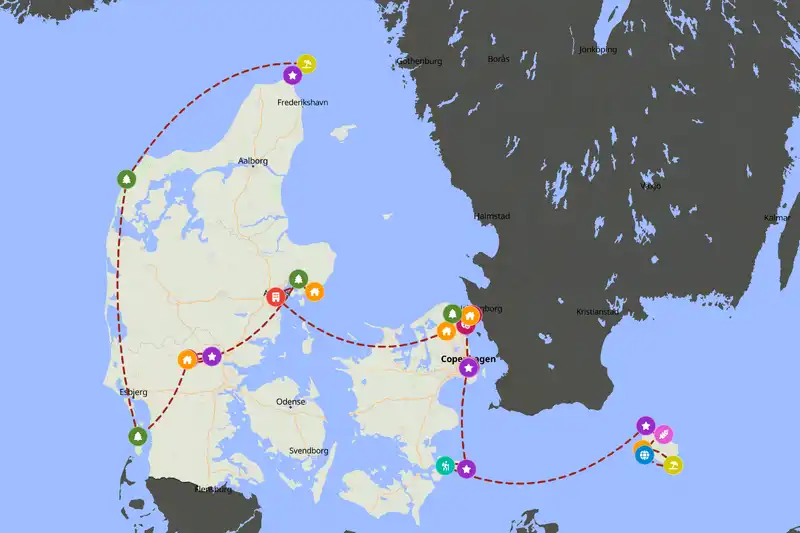
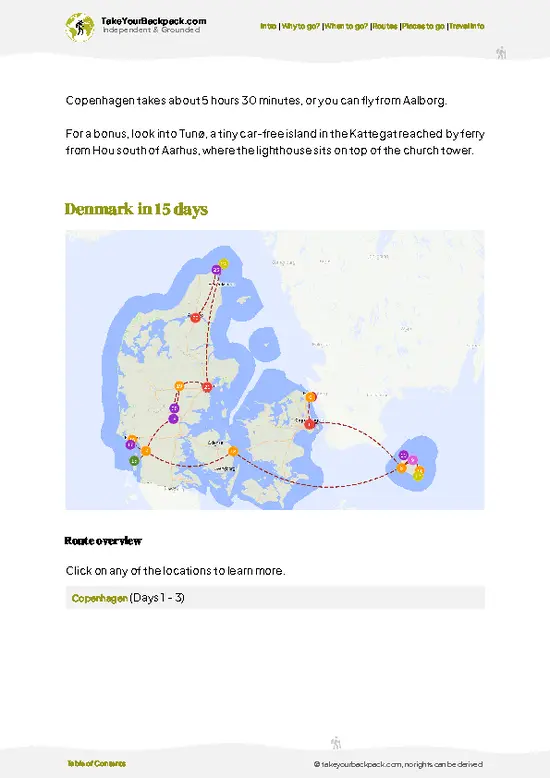
This fifteen-day loop is for travelers who want the whole Danish picture at a steady, unhurried pace: royal Copenhagen, the granite island of Bornholm, the tidal flats of the southwest, the lake district of central Jutland and the sand-blown northern tip. You sleep in seven bases, rarely move two days in a row, and get by entirely on regional trains, the Ystad-Rønne ferry, the short Esbjerg-Fanø ferry and local buses on Bornholm and around Skagen. Expect one long travel day off Bornholm and otherwise short hops of one to three hours.
Days 1-3: Copenhagen and the Øresund Coast
Start in
Copenhagen with three nights and a deliberately historical focus. Walk the waterfront at the
Nyhavn Canal District early, before the tour boats load, then cross to
Rosenborg Castle, where the crown jewels sit in the basement treasury and the King’s Garden outside fills with picnickers on any dry afternoon. Give your second day to the
National Museum of Denmark for its Bronze Age lurs and the Egtved Girl, then …
read more 👉This fifteen-day loop is for travelers who want the whole Danish picture at a steady, unhurried pace: royal Copenhagen, the granite island of Bornholm, the tidal flats of the southwest, the lake district of central Jutland and the sand-blown northern tip. You sleep in seven bases, rarely move two days in a row, and get by entirely on regional trains, the Ystad-Rønne ferry, the short Esbjerg-Fanø ferry and local buses on Bornholm and around Skagen. Expect one long travel day off Bornholm and otherwise short hops of one to three hours.
Days 1-3: Copenhagen and the Øresund Coast
Start in Copenhagen with three nights and a deliberately historical focus. Walk the waterfront at the Nyhavn Canal District early, before the tour boats load, then cross to Rosenborg Castle, where the crown jewels sit in the basement treasury and the King’s Garden outside fills with picnickers on any dry afternoon. Give your second day to the National Museum of Denmark for its Bronze Age lurs and the Egtved Girl, then walk five minutes to Christiansborg Palace, seat of parliament, where you can climb the tower for free and descend into the ruins of the medieval castles buried under the current building.
On day three take the train up the coast to Helsingør (about 45 minutes). Kronborg Castle is Shakespeare’s Elsinore and the place where Danish kings collected the Sound Dues from every ship passing through the 4-kilometer strait to Sweden. Go down to the dark casemates, where the statue of Holger Danske sleeps until Denmark needs him, and be back in the city for dinner.Days 4-6: Bornholm
Bornholm earns three nights because it moves at its own speed. The train runs from Copenhagen to Ystad in Sweden in about 1 hour 15 minutes, and the fast ferry crosses to Rønne in roughly 1 hour 20 minutes. Skip staying in Rønne itself and catch the bus straight on to Gudhjem, a fishing village of half-timbered houses stacked up a hillside above a tiny harbor, where the chimneys of the smokehouses turn out herring every afternoon. From here, the island buses reach the Castleruin of Hammershus on the north coast cliffs, the largest medieval fortress ruin in Northern Europe, with a coastal path that drops to the sea on both sides. Your last full day heads south through Nexø, the island’s working fishing port, to Duodde Beach, where the sand is so fine and white that it was once sold for hourglasses, backed by pine forest and a lighthouse you can climb.Days 7-8: Nyborg
Leaving Bornholm is the long day of the trip: ferry back to Ystad, train through Copenhagen and across the Great Belt to Nyborg, around five hours with connections. Breaking the journey here is the smart move. Nyborg Slot, the restored royal castle where the medieval Danehof parliament met, sits on a moat a few minutes from the station, and the old ramparts make an easy evening stroll after a day in transit. On the morning of day eight continue west to Ribe, about 2 hours 30 minutes by train.Days 8-10: Ribe and the Wadden Sea
Ribe is Denmark’s oldest town, with crooked cobbled lanes, leaning merchant houses and a cathedral tower you can climb for views over the marshes. Join the night watchman on his evening round (free, starting at the main square) for the town’s history sung in old verses. Day nine belongs to National Park Vadehavet: the Wadden Sea is a UNESCO-listed tidal flat where, in spring and autumn, up to a million starlings gather at dusk in the swirling clouds Danes call “black sun”. Take the train to Esbjerg (around 35 minutes) and the 12-minute ferry to Fanø, an island of thatched-roof Sønderho houses and a west-facing beach so wide and firm that cars drive on it.Days 10-12: Jelling and the Silkeborg Lakes
On day ten head north with a stop at the Jelling Stones, reached by a 15-minute branch line from Vejle. The two 10th-century runestones and the burial mounds beside them are free to visit; the larger stone, raised by Harald Bluetooth, records the conversion of the Danes to Christianity. Then continue to Silkeborg for two nights, where Denmark looks least like its flat reputation: forested hills, a chain of lakes and the Gudenåen, the country’s longest river, which you can paddle by rented canoe. Museum Silkeborg holds the Tollund Man, a 2,400-year-old bog body with his face preserved down to the stubble. In summer, the paddle steamer Hjejlen chugs across the lakes toward Himmelbjerget.Days 12-13: Aarhus
Silkeborg to Aarhus takes about 50 minutes, so you arrive with most of the day ahead. One night is enough for the two essential sights: the rooftop rainbow walkway of ARoS Aarhus Art Museum, a circular corridor of colored glass with views over the city, and Den Gamle By, an open-air museum of relocated townhouses that runs from the 1600s to a fully furnished 1970s street, complete with period shops. Eat in the Aarhus Street Food hall near the bus station for the cheapest decent meal in town.Days 13-15: Skagen and the Northern Tip
The train from Aarhus to Frederikshavn takes about 2 hours 45 minutes, and a local line covers the final 35 minutes to Skagen. Two nights here let you walk out to Grenen, the sandbar where the Skagerrak and Kattegat seas meet in a visible line of colliding waves, and spend an afternoon on Skagen Beach under the long, pale light that drew the Skagen painters in the late 1800s. Take the bus south to Råbjerg Mile, Denmark’s largest migrating dune, a 40-meter heap of bare sand creeping eastward across the heath every year. On day fifteen, ride the bus and train to Aalborg (about 2 hours) for a flight back to Copenhagen, or stay on the rails all the way, roughly 5 hours 30 minutes.
If a friend asked me for one extra stop, I’d send them on the 5-kilometer walk inland from Gudhjem to Østerlars Rundkirke, a whitewashed 12th-century round church built like a fortress, and tell them to bring a smoked herring sandwich from the harbor to eat on the way.v2.webp)

 Best Backpacking