×
Haiti🇭🇹 | 15 days itinerary

Your 15-Day Haiti Itinerary

By Johan Kruseman 🇳🇱 | Updated May 9, 2026
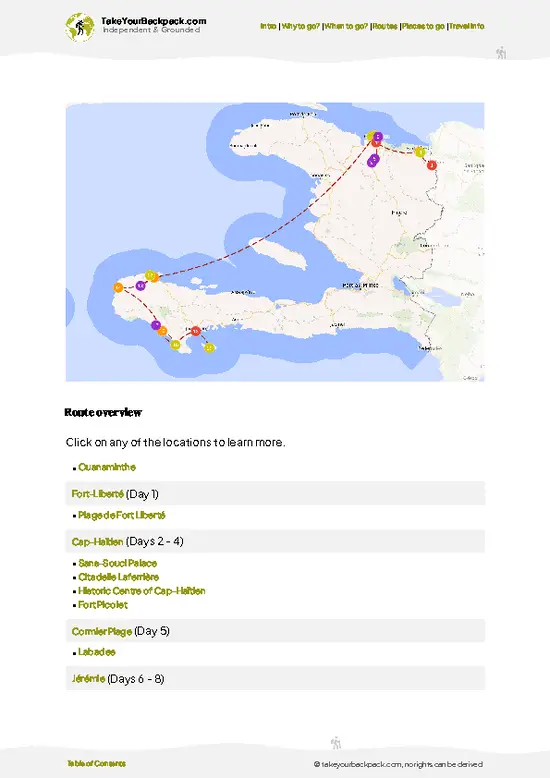
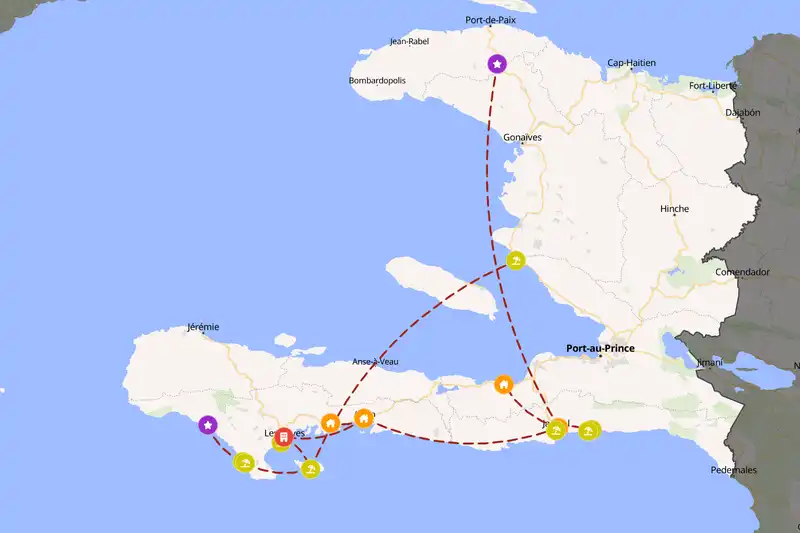
This 15-day itinerary is for travelers who want to go beyond the greatest hits and really feel Haiti’s regions—north, capital, mountains, and deep south—using a mix of private drivers, shared transport, and a couple of boat hops. The pace is exploratory but not punishing: you’ll change bases several times, but with two- to three-night stays in most places so you can settle in, meet people, and let the country’s complexity sink in.

Days 1-3: Cap-Haïtien, Citadelle & Northern Forts

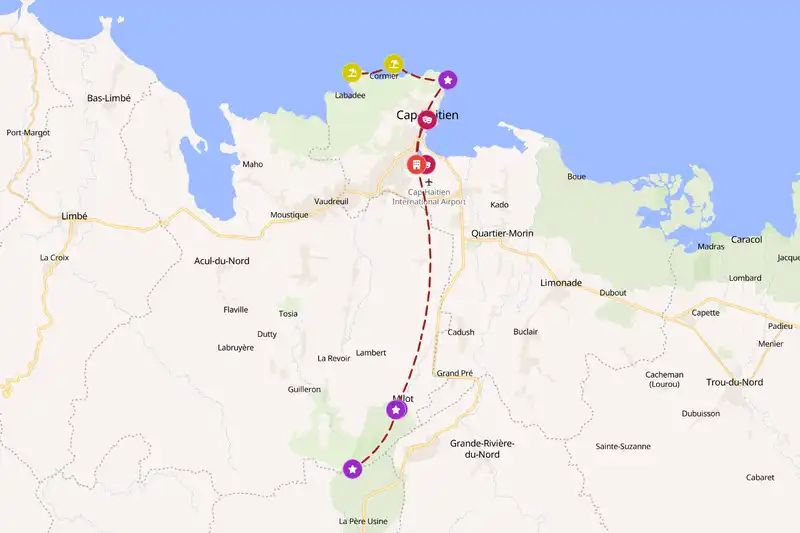
Begin in Cap-Haïtien, giving your first day to the Place d’Armes and Historic Quarter of Cap-Haïtien and the Cathedral of Cap-Haïtien, where the street life and colonial architecture introduce you to Haiti’s layered past. On day two, spend a full day at Citadelle Laferrière, the Palace of Sans Souci, and the adjacent Sans-Souci Palace, taking time to walk the ramparts, explore the palace ruins, and connect the dots between the revolution and the landscape. Use day three to explore coastal defenses like Fort Picoletread more 👉
This 15-day itinerary is for travelers who want to go beyond the greatest hits and really feel Haiti’s regions—north, capital, mountains, and deep south—using a mix of private drivers, shared transport, and a couple of boat hops. The pace is exploratory but not punishing: you’ll change bases several times, but with two- to three-night stays in most places so you can settle in, meet people, and let the country’s complexity sink in.

Days 1-3: Cap-Haïtien, Citadelle & Northern Forts

Begin in Cap-Haïtien, giving your first day to the Place d’Armes and Historic Quarter of Cap-Haïtien and the Cathedral of Cap-Haïtien, where the street life and colonial architecture introduce you to Haiti’s layered past. On day two, spend a full day at Citadelle Laferrière, the Palace of Sans Souci, and the adjacent Sans-Souci Palace, taking time to walk the ramparts, explore the palace ruins, and connect the dots between the revolution and the landscape. Use day three to explore coastal defenses like Fort Picolet and the nearby Ruine Fort Valliere, low-key sites that reward history nerds with sea views and crumbling stone, before a sunset swim at Cormier Plage to balance out all the fort-hopping.

Days 4-5: Fort-Liberté & Île de la Tortue

Head east along the coast to the quiet town of Fort-Liberté, where the bay and old fortifications give a slower, more contemplative feel than Cap-Haïtien. Spend time walking the waterfront and, if you want more sand, detour to Plage de Fort Liberté for a simple, local beach experience. From this northern base, arrange a boat trip out to Île de la Tortue, an Optional / Niche island that’s more about raw coastline and pirate lore than polished resorts; this two-day northern extension adds a sense of remoteness and adventure that the main tourist circuit often skips.

Days 6-8: Port-au-Prince, Pétion-Ville & Cultural Core

Travel south to the capital and split your time between Port-au-Prince and hilltop Pétion-Ville, using trusted drivers to navigate the city. One day, dive into the Iron Market and the National Museum of Haiti, pairing the sensory overload of the bazaar with the sober, powerful exhibits that trace Haiti’s fight for freedom. Another day, wander the Gingerbread Houses of Pacot and Turgeau, then spend time at the Centre d’Art and Galerie Monnin, where you’ll see how Haitian artists channel Vodou symbolism, politics, and everyday life into bold, colorful work. If you have a spare evening, swing by the National Theatre of Haiti area to feel the cultural pulse, then retreat to Pétion-Ville for food, music, and cooler air; this phase grounds the trip in Haiti’s contemporary reality, not just its postcard moments.

Days 9-11: Kenscoff, Furcy & La Visite Highlands

Climb into the mountains around Kenscoff and the village of Furcy, trading car horns for roosters and wind in the pines. Base yourself in Furcy and spend a full day on the Furcy to Seguin Trail, walking ridge paths and farmland lanes that show how closely rural life is tied to the land. Use another day to explore Parc National La Visite and the broader Morne La Visite National Park area, where cooler temperatures, highland meadows, and birdlife give you a completely different side of Haiti than the coasts; these three days slow the trip down, letting you reset your body and brain before the deep south push.

Days 12-15: Les Cayes, Macaya & Île-à-Vache

Head to Les Cayes, your launchpad for Haiti’s wild southwest and some of its best nature. Spend a day exploring Macaya National Park and the broader Macaya National Park-Pic Macaya area, where cloud forests and endemic species make this a holy grail for hikers and nature lovers; keep the pace realistic by focusing on one well-guided hike rather than trying to conquer every trail. Another day, visit Pic Macaya more directly if conditions and logistics allow, or opt for a gentler exploration of the La Hotte Biosphere Reserve foothills to avoid back-to-back brutal hiking days. Then shift into full coastal mode with a boat ride out to Île-à-Vache, spending your final days between Plage de Port-Morgan, Plage de Saint-Louis-du-Sud (via a mainland detour), and the laid-back rhythms of island life, where you can walk palm-lined paths, watch fishermen at work, and let the whole journey sink in before looping back to Les Cayes and onward to your departure point.

When you’re ready for an even deeper cut, dream about a future trek out toward the remote cliffs near Baie de Henne, where salt flats, wind, and sea carve out a stark, beautiful edge of Haiti that few travelers ever see.

Loading the map 🌍
film
0
0
0a
Place d’Armes and Historic Quarter of Cap-Haïtien
film
1
1
1a
Citadelle Laferrière
Wens
film
2
2
2a
Palace of Sans Souci
Liz'annick Jean-charles
film
3
3
3a
Sans-Souci Palace
film
4
4
4a
Port-au-Prince
Zlatko ŠkrabiĆ
film
5
5
5a
Pétion-Ville
film
6
6
6a
Iron Market
film
7
7
7a
Centre d’Art
film
8
8
8a
Kenscoff
Martial Jahson
film
9
9
9a
Parc National La Visite
Karl Arthur
film
10
10
10a
Morne La Visite
Karl Arthur
film
11
11
11a
Macaya
film
12
12
12a
Pic Macaya
Randy Romero
film
13
13
13a
Île-à-Vache
Karl Arthur

✈️ The backpacker research shortcutHaiti Travel Guide

An offline-friendly backpacking guide with optimized travel routes, ranked highlights, transport advice, and the best areas to stay.
example page 0 from our offline Travel Guide for Haitiexample page 1 from our offline Travel Guide for Haitiexample page 2 from our offline Travel Guide for Haitiexample page 3 from our offline Travel Guide for Haitiexample page 4 from our offline Travel Guide for Haitiexample page 5 from our offline Travel Guide for Haiti
The digital guide (319 pages) contains:
99 highlights, ranked by travel appeal
Optimized 5, 10 & 15-day travel routes
Best neighborhoods to stay
How to get around
Offline-friendly for travel without Wi-Fi
👉 See all 30+ guide features

📅 Plan smarter in minutes, not weeks
Month by month travel advice
Festivals & national holidays
Budget expectations

🗺️ Go to the right places, skip the overrated ones
Honest pros & cons of destinations
Top hikes, parks & viewpoints
Lesser-known places most travelers miss
Clear “worth it vs skip it” guidance

🛏️ Travel smoothly without rookie mistakes
Best areas to stay
Transport systems explained simply
Common scams & safety advice
SIM cards, money & practical tips

🌍 Understand the country, not just visit it
Culture & traditions
52 Essential phrases & customs
Festivals worth planning around
Traveler-friendly historical context
Insights that make places more meaningful

📱 Built for real travel conditions
Fully downloadable PDF
Works completely offline
Optimized for phone use
Useful in remote areas & buses
Everything in one place
Save weeks of stressful planning
Get instant access to the full guide directly. 30-day money-back guarantee.


Sent to your inbox immediately after payment • 100% Secure Checkout
Best Backpacking Travel Advisor 2025 tourism awardBest Backpacking
Travel Advisor
2025
What others say about Take Your Backpack Guides:
⭐⭐⭐⭐⭐
Fantastic, amazing amount of information!
⭐⭐⭐⭐⭐
My goodness this is amazing, it's what I've been looking for hats off too you!
⭐⭐⭐⭐⭐
I think this is absolutely BRILLIANT
⭐⭐⭐⭐
Very complete and informative. It's still missing places, but I gotta to commend you
⭐⭐⭐⭐⭐
This is truly amazing, thank you, can't wait to explore it with my kids!
⭐⭐⭐⭐⭐
Awesome resource, thank you!
⭐⭐⭐⭐⭐
This is amazing! Can't wait to explore the ones I haven't seen
⭐⭐⭐⭐
I love this! Well done, great idea.
⭐⭐⭐⭐⭐
Thanks for taking the time to make this gem!
⭐⭐⭐⭐⭐
This might be the best website I've ever seen.
⭐⭐⭐⭐⭐
Congratulations, and thank you so much for your work; it's incredibly valuable.
⭐⭐⭐⭐
In all seriousness I think you did a great job pointing out the important spots
⭐⭐⭐⭐⭐
10/10 very good
⭐⭐⭐⭐⭐
As someone who's only just starting to visit regularly this is awesome, thank you.
⭐⭐⭐⭐
Thank you very much! I'm going to visit my dad, it's going to be very useful!
⭐⭐⭐⭐⭐
This is really cool! We'll be travelling for the first time and this definitely come in handy.
⭐⭐⭐⭐⭐
You are now our minister of culture, congratulations 👨‍💼
⭐⭐⭐⭐⭐
Just wanted to tell you that this is a pearl! Going to follow your recommendations.
⭐⭐⭐⭐⭐
This is so cool. I'll definitely be using the resource for my travels soon.
⭐⭐⭐⭐⭐
This is very impressive! Good work.
⭐⭐⭐⭐⭐
This is an amazing and informative site. Very well done!

🧭 RouteAdjust Your Pace

Travel Haiti your way — from a quick highlights trip to a slow-paced adventure.

🙋 FAQTraveler FAQ

Short version: Haiti is not an “easy” first-time backpacking country, but it can be deeply rewarding if you already have some travel miles and you prepare well. Infrastructure is rough, information is thin on the ground, and you need to be comfortable with uncertainty and changing plans.

Independent travel is possible on a budget using tap-taps (shared pickup trucks), moto-taxis, and local guesthouses, but you’ll move slower than in most of Latin America or the Caribbean. Roads can be in bad shape, power cuts are normal, and you’ll often rely on word-of-mouth instead of online bookings.

French or Haitian Creole helps a lot. Without at least basic French, you can still get by with patience, offline translation apps, and a lot of pointing, but you’ll miss nuance and it will feel more tiring.

Safety is the main reason Haiti is not “easy.” Conditions change fast by neighborhood and by year. You need to:
- Stick to daylight travel whenever possible.
- Ask locals (guesthouse owners, drivers, guides) which areas to avoid that week, not just in theory.
- Avoid flashing electronics or cash; keep a low profile and dress simply.
- Keep your itinerary flexible so you can skip or reroute if things feel off.

For a first trip, independent backpacking works best if you:
- Base yourself in a couple of safer, more stable hubs (for example, Cap-Haïtien and Jacmel) and do day trips.
- Use trusted local guides for specific legs (like visiting Citadelle Laferrière or rural waterfalls) instead of trying to DIY every single move.
- Accept that “slow and simple” beats “see everything.”

If you’ve backpacked in places with limited infrastructure (rural West Africa, parts of Central America, or remote islands), Haiti will feel intense but familiar. If your experience is mostly Western Europe and Southeast Asia, Haiti will feel like a big jump; still doable, but only if you’re excited by challenge, not just beaches.
If you only have 4–5 days, pick one region and stay put. Haiti is not a country where you can sprint around and “collect” sights; transport is slow and tiring. A short, focused trip is better than a rushed loop.

Good 4–5 day options:
- Cap-Haïtien base: Explore the old town, take a day trip to Citadelle Laferrière and Sans-Souci Palace, and squeeze in a beach day at Labadee or nearby local beaches.
- Jacmel base: Hang out in the artsy streets, hit Bassin Bleu (waterfalls), and spend time on the southern coast beaches.

For 7–10 days, you can do a “two-base” trip without burning out:
- 3–4 days in Cap-Haïtien for history and northern beaches.
- 3–4 days in Jacmel or the southern coast for art, waterfalls, and a more relaxed vibe.
- Add 1–2 buffer days for slow transport, rest, and inevitable delays.

With 2 weeks, you can travel at a backpacker pace and still keep it sane:
- 4 days Cap-Haïtien area (Citadelle, beaches, local markets).
- 4–5 days Jacmel and surroundings (Bassin Bleu, coastal villages, street art).
- 2–3 days in the mountains (Kenscoff / Furcy area) for cooler air and hiking, if conditions allow.
- 1–2 flex days for weather, road issues, or just doing nothing.

More than 2 weeks only makes sense if you’re really into slow travel, language learning, volunteering with a vetted organization, or deep cultural projects. For most backpackers, 10–14 days is the sweet spot: enough time to see Haiti’s character without getting worn down by logistics.
You can absolutely get around Haiti without renting a car, but it takes patience and a bit of grit. Think “old-school backpacking” more than “smooth island hopping.”

Your main options:
- Tap-taps: Colorful shared pickups or minibuses running fixed routes. They’re cheap and everywhere on main corridors, but they’re cramped, hot, and slow. Great for short hops and for feeling the local rhythm.
- Moto-taxis: Motorbike taxis are fast and flexible, especially for short distances or when roads are rough. Always agree on the price first and wear a helmet if one is available. Avoid riding at night or in heavy rain.
- Shared taxis / minibuses: On intercity routes, you’ll often find shared cars or vans that leave when full. They cost more than tap-taps but are still budget-friendly and usually a bit faster.
- Private drivers: For specific legs (like airport transfers, late arrivals, or sketchy stretches), hiring a driver through your guesthouse is worth the extra money. Split the cost with other travelers when you can.

What to expect:
- Schedules are loose. Vehicles leave when full, not at a fixed time, so start early in the day.
- Roads can be rough, especially after heavy rain. Build in buffer time and don’t stack tight connections.
- Night travel is strongly discouraged for safety and road-condition reasons. Plan to arrive before dark.

If you’re comfortable with chicken buses in Central America or matatus in East Africa, Haiti’s transport will feel familiar. If not, ease in: use tap-taps for short city routes first, then graduate to longer intercity rides once you understand how locals queue, pay, and signal where they’re getting off.

You do not need your own car, and for most backpackers, driving yourself is more stress than it’s worth. Using local transport plus the occasional private driver is the safer and more realistic combo.
For a budget traveler, “must-visit” in Haiti means places that give you maximum culture, history, and landscape for the effort it takes to reach them. These are the ones that consistently deliver:

1. Citadelle Laferrière & Sans-Souci Palace (near Cap-Haïtien)
This is Haiti’s headline act: a massive mountaintop fortress and the ruins of a royal palace that tell the story of the world’s first successful slave revolt. The hike or horse ride up to the Citadelle is sweaty but epic, and the views over the countryside are worth every step. Go early, bring water, and hire a local guide at the entrance to get the full context.

2. Cap-Haïtien old town
Cap-Haïtien’s streets, colonial-era buildings, and waterfront give you a strong sense of Haiti’s past and present in one compact area. It’s walkable, photogenic without being polished, and a good place to ease into Haitian street life, food stalls, and markets. Use it as a base for the Citadelle and nearby beaches.

3. Jacmel
Jacmel is Haiti’s artsy, coastal soul. You get colorful street art, craft workshops, a laid-back seafront, and a creative scene that’s very different from the capital. It’s a great place to slow down, meet people, and support small local businesses. If you time it around Carnival, the papier-mâché masks and parades are on another level.

4. Bassin Bleu (near Jacmel)
A series of blue pools and waterfalls tucked into the hills above Jacmel. The walk in can be a bit of a scramble, but local guides help you navigate and handle the ropes and jumps. It’s one of the most rewarding day trips in the country: swimming, cliff-jumping if you’re into it, and a cool break from the coastal heat.

5. Southern coast beaches around Jacmel
You don’t come to Haiti just for beaches, but the stretch near Jacmel offers relaxed, budget-friendly spots where you can eat grilled fish, sip a cold drink, and watch the waves without resort prices. They’re ideal rest days between heavier travel legs.

6. Mountain villages near Kenscoff / Furcy (if conditions allow)
In the hills above Port-au-Prince, the air is cooler, the pace is slower, and you get a glimpse of rural life and terraced farming. Simple guesthouses and basic hikes make this a good reset if you’ve been in cities and heat. Only worth it if current conditions and road access are reasonable.

If you have limited time, prioritizing Cap-Haïtien + Citadelle, then Jacmel + Bassin Bleu, gives you Haiti’s history, art, and nature in a compact, backpacker-friendly package.
With limited time and a backpacker budget, the key is to skip anything that eats days of travel or money without giving you a strong sense of Haiti’s character. These are the easiest things to cut:

1. Trying to “do the whole country”
Haiti’s roads and security situation make cross-country loops exhausting. If you only have 1–2 weeks, skip the idea of seeing every region. Pick one or two hubs (for example, Cap-Haïtien and Jacmel) and go deep instead of wide.

2. Overpriced resort-style beach stays
High-end, fenced-off resorts (including cruise-ship enclaves) can be comfortable, but they’re expensive and give you very little real contact with Haiti. If you’re on a budget, you’re better off with simple guesthouses near local beaches where your money stays in the community.

3. Multiple days in Port-au-Prince for sightseeing
Port-au-Prince can be intense, fascinating, and complicated, but it’s not an easy city for casual wandering, and conditions can change quickly. If you’re short on time, treat it as a transit point rather than a destination: one night on arrival or departure is enough for most backpackers.

4. Far-flung regions that require long, uncertain travel legs
Places that demand full days of rough transport each way (especially if they don’t have clear, standout sights or reliable accommodation) are best saved for a longer, more flexible trip. With a tight schedule, those days are better spent enjoying where you already are instead of bouncing between buses and tap-taps.

5. Over-stacking waterfalls and minor attractions
Once you’ve done a major highlight like Bassin Bleu, you don’t need to chase every other small waterfall or viewpoint, especially if each one requires negotiating transport and guides. Use that time to linger in markets, talk with people, or just sit in a café and watch daily life.

If you’re short on time, the smart play is:
- Focus on Cap-Haïtien + Citadelle for history.
- Focus on Jacmel + Bassin Bleu + nearby beaches for art and nature.
- Use Port-au-Prince only as a logistics hub unless you have a specific reason to stay longer.

Cut the rest without guilt; Haiti rewards depth far more than checklists.

🇭🇹 HaitiSee More of Haiti

Ready to build a truly unique trip? Predefined routes are perfect for first-time visitors, but there is so much more to discover. Whether you are chasing a city trip, pristine national parks, local food scenes, or quiet beaches, pick a category to design your own path.