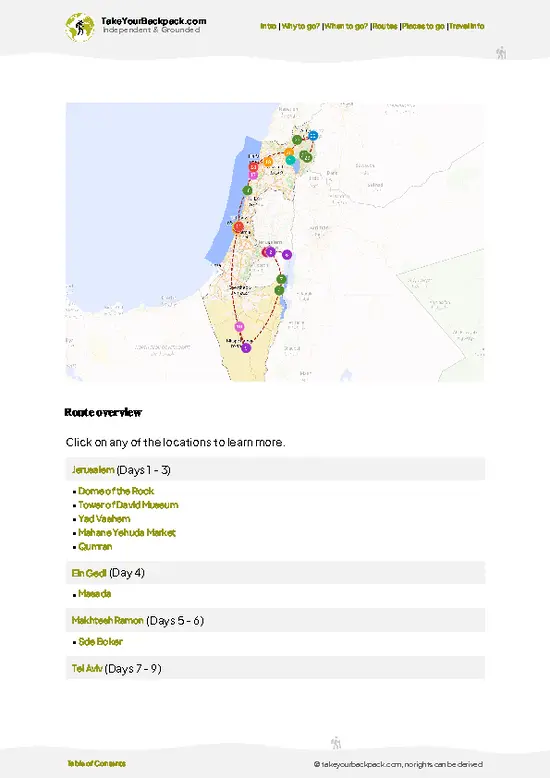
This fifteen-day loop through Israel is for travelers who want the whole country in one trip: Jerusalem’s stone alleys, a night beside the Dead Sea, two nights on the rim of a desert crater, Tel Aviv’s beaches and the green, hilly north. The pace is relaxed, with no more than one long transit day in a row and at least one full day in every base. Trains and intercity buses cover the first ten days without trouble. For the last four days in the Upper Galilee and the Golan, rent a car in Haifa, because buses there are sparse and stop entirely for Shabbat.
Days 1-3: Jerusalem
Starting in
Jerusalem puts the heaviest history at the front, while you still have fresh legs for Old City stairs. Use the first morning for the Temple Mount compound, which non-Muslim visitors enter through the wooden Mughrabi Bridge during short morning and early-afternoon windows (Sunday to Thursday). You can walk the plaza around the
Dome of the Rock (Qubbat aṣ-Ṣaḵra) and study its blue-and-gold tilework up close, but the interior is open to Muslims only. Dress with knees and shoulders covered or you will be turned back at the gate.
Spend the afternoon at the
Tower of David Museum inside the citadel at Jaffa Gate. The ramparts give you the best overview of how the four quarters fit together, and the exhibits sort out 3,000 years of rulers so the rest of the trip makes sense.
Give day two to
Yad Vashem on the western edge of the city. The main history museum takes three hours minimum, it is free, and it closes on Saturdays and early on Fridays, so plan around that. The light rail gets you there in about 25 minutes from downtown. On the evening of day three, walk to
Mahane Yehuda Market. By day it sells halva, spices and pastries; on Thursday nights the shutters roll down and the alleys fill with bar stools and music.
Days 4-5: Qumran, Ein Gedi and Masada
The road from Jerusalem drops more than 1,000 meters in under an hour, and the air changes from pine to mineral. Stop first at the
Dead Sea Scrolls at Qumran, where a short trail leads past the settlement ruins to a viewpoint facing the caves where the scrolls were hidden. Continue south to
Ein Gedi and hike up Nahal David to the waterfalls in the afternoon, when the ibex come down to graze near the paths. Sleep at Ein Gedi; the hostel and the kibbutz guesthouse are the only beds for kilometers.
That overnight is what makes
Masada work. You are 20 minutes from the base, so you can start up the Snake Path in the dark and reach Herod’s cliff-top palace for sunrise over the Jordanian mountains. In summer the heat passes 40°C by late morning, which is why the trails close early and why you should carry at least 2 liters of water.
Days 5-7: The Negev and the Ramon Crater
After Masada, head inland through Arad and Dimona to
Mitzpeh Ramon Crater, about 2.5 hours of desert road. This is the day’s only long transit, and you arrive with time to watch the light drain from the crater walls from the town’s promenade. Makhtesh Ramon is roughly 40 kilometers long and up to 500 meters deep, a landform carved by erosion, with striped sandstone, black volcanic hills and fossil beds on its floor. Day six is a full day down inside it, on foot or with a local jeep outfit, and the night sky here, with almost no light pollution, is the clearest you will see in Israel.
On day seven, drive or bus north via
Sde Boker, where David Ben-Gurion lived in a modest kibbutz hut and is buried on a ledge above the Zin canyon. The grave site view alone justifies the detour. Then continue to Tel Aviv, roughly 2.5 to 3 hours away, and keep the evening low-key.
Days 8-9: Tel Aviv and Jaffa
Tel Aviv is your recovery stop after the desert. Start with breakfast in
Carmel Market, where fruit juice stalls and burekas counters open early and the side lanes of the Yemenite Quarter serve some of the city’s best cheap lunches. Walk off the food through the White City’s Bauhaus apartment blocks, then spend the afternoon in the cool galleries of the
Tel Aviv Museum of Art, strong on Israeli painters and with a good Impressionist room.
Day nine runs south along the promenade to
Jaffa. Mornings in the flea market are best for vintage finds and haggling; by late afternoon the old port and the stone lanes above it fill with families. Finish back on the sand at
Hilton Beach, the city’s surf beach, with a breakwater that tames the swell and a crowd that mixes surfers, LGBTQ+ regulars and dog owners on the adjoining stretch.
Days 10-11: The Carmel Coast and Haifa
Moving north, break the 1.5-hour trip with two stops.
Caesarea holds Herod’s harbor city, a Roman theater still used for concerts and a hippodrome running right along the shore. Twenty minutes up the coast,
Ein Hod is an artists’ village on the lower slopes of Mount Carmel, with open studios, a small Dada museum and lanes of olive trees. A car makes this day easy; without one, train to Binyamina and use taxis.
Use
Haifa as your base for two nights. It is calmer and cheaper than Tel Aviv, with the Carmelit underground funicular climbing the mountain and hummus joints in the Arab neighborhood of Wadi Nisnas. On day eleven, take the 30-minute train to
Akko, where the Crusader halls of the Hospitaller Fortress sit beneath an Ottoman town and a tunnel once used by the Templars runs out toward the sea wall. Eat fish at the port before heading back.
Days 12-15: Safed, the Upper Galilee and the Golan Heights
Pick up your rental car and drive about 1.5 hours inland to
Safed, the hilltop center of Jewish mysticism. Its blue-painted synagogues and artists’ quarter quiet down completely from Friday afternoon, so time your arrival for a weekday. The next morning, hike
Nahal Amud, which drops from below the town into a wooded stream valley with old flour mill ruins and springs. Allow three to four hours and arrange a taxi back up.
From there it is under an hour to the
Golan Heights, where you spend the last two nights in a guesthouse. Day fourteen covers
Gamla Nature Reserve, a ridge-top town destroyed by Rome in 67 CE with griffon vultures circling below the lookout, and then the swimming holes of
Yehudiya Forest, where some pools are framed by hexagonal basalt columns. Check which trails are open, since some close after rain or in high heat. On the final morning, stop at the
Hula Valley Nature Reserve in the valley below, best in autumn and winter when migrating cranes and pelicans pass through, before the roughly three-hour drive to Ben Gurion Airport.
If a friend asked me for one extra stop on this route, I would send them to Nimrod Fortress on the slope above the Banias springs late in the afternoon, and tell them to bring a flashlight for the dark staircases inside the towers.
v2.webp)

 Best Backpacking

