Yes, Israel is easy to backpack on your own: buses and trains reach most sights, signs carry English alongside Hebrew and Arabic, and English is widely spoken.
Get a Rav-Kav card at the airport station and plan rides with the Moovit app. Hostel dorms in
Jerusalem and
Tel Aviv cost about ₪120 to 180 (US$32 to 50), and a lean daily budget runs US$60 to 90. The one rule to plan around is Shabbat: most public transport stops from Friday afternoon until Saturday after dark, so travel on Thursday or early Friday. Arab towns such as
Nazareth keep running, and the Golan is the only region where a one-day car rental makes sense.
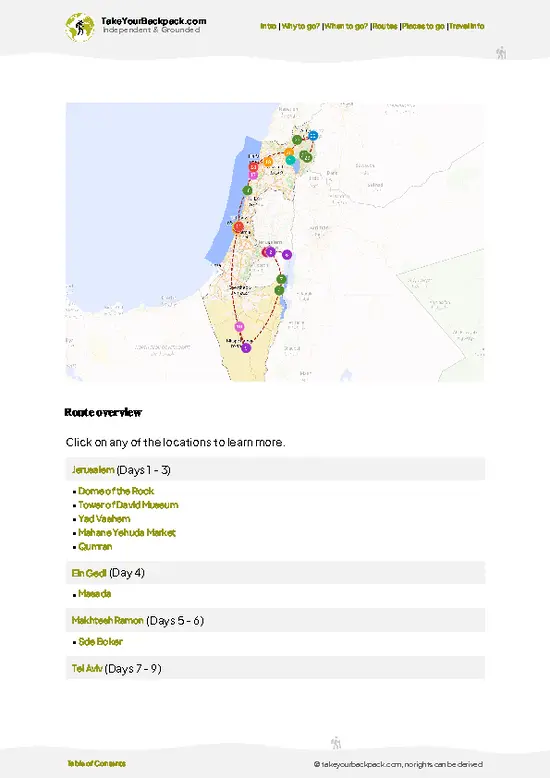
Ten days is the right length for a first trip to Israel, enough for Tel Aviv, the northern coast, Jerusalem and either the Dead Sea or the Negev without rushing.
With 5 days, stay in one area: 3 nights in
Jerusalem plus 1 night at
Ein Gedi for a sunrise climb of
Masada. Ten days adds 2 nights in
Tel Aviv, 2 in
Haifa with a day in
Akko, and 2 at the
Mitzpeh Ramon Crater. Two weeks lets you add the Galilee and the
Golan Heights. Distances are short, with Tel Aviv to Jerusalem about 30 to 40 minutes by train and Haifa to Jerusalem around 2 hours. Shabbat, though, removes most transport for roughly one day a week.
Yes, you can see most of Israel without a car, because trains and intercity buses connect every major city, the coast and the Dead Sea.
Typical times:
Tel Aviv to
Jerusalem 30 to 40 minutes by train,
Tel Aviv to
Haifa about 1 hour,
Haifa to
Akko around 30 minutes,
Jerusalem to
Ein Gedi about 1.5 hours by bus, and
Jerusalem to
Mitzpe Ramon 3.5 to 4 hours via Beersheba. Most fares fall between ₪6 and 40 (US$2 to 11). The
Golan Heights is the exception: buses there are sparse, so rent a car for a day from Tiberias for US$40 to 70 plus fuel. Remember that most services stop from Friday afternoon to Saturday night.
The places you should not miss in Israel are Jerusalem’s Old City, Masada at sunrise, Tel Aviv with Jaffa, and the Crusader town of Akko.
In
Jerusalem, book the
Western Wall Tunnels ahead, give
Yad Vashem at least 3 hours, and see the Shrine of the Book at the
Israel Museum. Climb
Masada’s Snake Path in 45 to 60 minutes before dawn, then hike the waterfalls at
Ein Gedi, 20 minutes north.
Akko is a 30-minute train ride from Haifa. With extra days, add the springs of
Banias Nature Reserve in the Golan and the 40-kilometer
Mitzpeh Ramon Crater in the Negev, 3.5 to 4 hours from Jerusalem by bus.
If time is short in Israel, skip Eilat first: it sits 4.5 to 5 hours by bus from Tel Aviv, and the Red Sea diving is the only strong reason to make the trip.
Ashkelon and the beach resorts south of Tel Aviv add little that
Gordon Beach and
Jaffa do not already offer.
Tiberias works as a base for Galilee hikes, but the town itself needs no more than an evening. In Jerusalem, niche stops like the
Bloomfield Science Museum Jerusalem can wait for a second trip, and
Haifa can shrink to half a day at the Baha’i terraces if you sleep in Akko or Tel Aviv instead. Those cuts free up 2 to 4 days for Jerusalem and the Dead Sea.
Yes, our itinerary-planner does exactly that. Set your trip length in days, give your interests and travel style, optionally give start- and end location and/or some mandatory stops you would like to include and the itinerary planner creates your personalized routes for Israel in seconds. Try it out!
Try the itinerary plannerv2.webp)
 Best Backpacking

