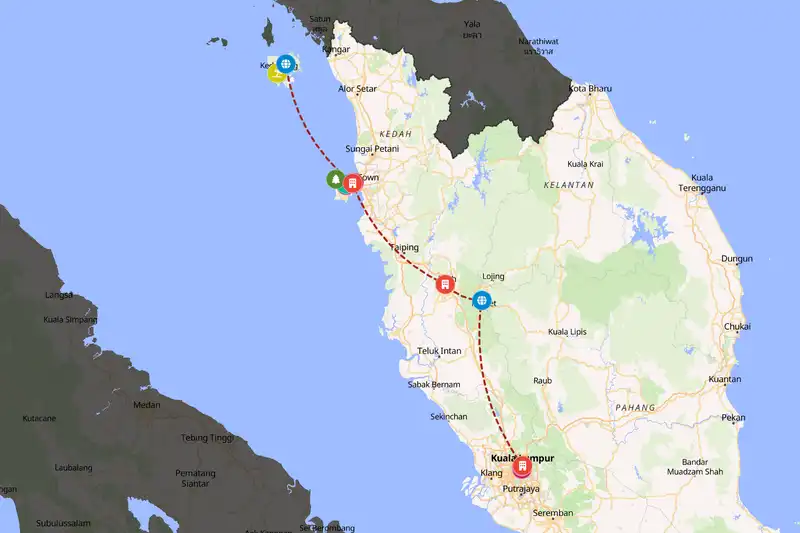
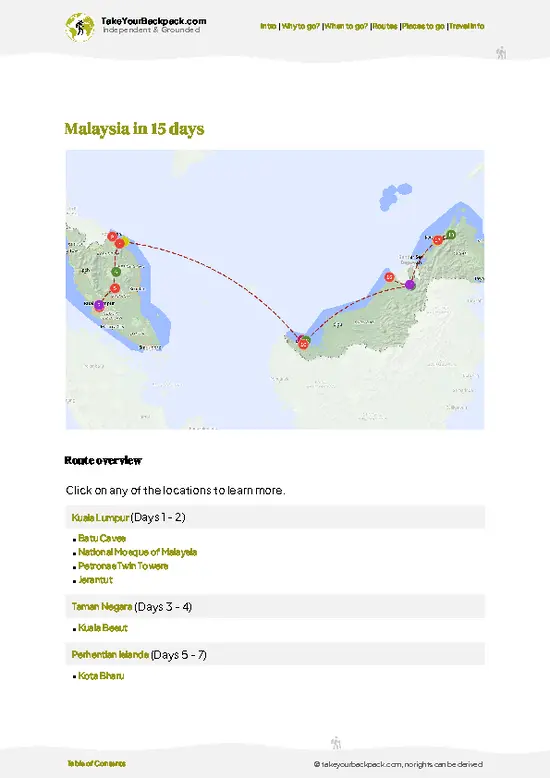
This 15-day route is for travelers who want the full spread of Malaysia in one trip: rainforest, coral island and two Borneo states, with just enough city time to bookend it. Expect a moderate pace with two long travel days, deliberately separated. You will use KL’s rail network, an express bus or tourist minivan to the national park, a speedboat to the islands, and five domestic flight legs (Kota Bharu to Kuching via Kuala Lumpur, Kuching to Mulu, Mulu to Kota Kinabalu via Miri). Run it between March and October, because the east-coast islands largely shut down during the November to February monsoon.
Days 1-2: Kuala Lumpur
Use
Kuala Lumpur as a two-day launch pad and stock up on anything you will not find in the jungle (leech socks, a dry bag, cash). Go to
Batu Caves on your first morning, when the limestone cathedral cave is cool and quiet. For the architecture of modern Malaysia, pair the
National Mosque of Malaysia, with its folded-umbrella roof (robes are lent at the door), with a …
read more 👉This 15-day route is for travelers who want the full spread of Malaysia in one trip: rainforest, coral island and two Borneo states, with just enough city time to bookend it. Expect a moderate pace with two long travel days, deliberately separated. You will use KL’s rail network, an express bus or tourist minivan to the national park, a speedboat to the islands, and five domestic flight legs (Kota Bharu to Kuching via Kuala Lumpur, Kuching to Mulu, Mulu to Kota Kinabalu via Miri). Run it between March and October, because the east-coast islands largely shut down during the November to February monsoon.
Days 1-2: Kuala Lumpur
Use Kuala Lumpur as a two-day launch pad and stock up on anything you will not find in the jungle (leech socks, a dry bag, cash). Go to Batu Caves on your first morning, when the limestone cathedral cave is cool and quiet. For the architecture of modern Malaysia, pair the National Mosque of Malaysia, with its folded-umbrella roof (robes are lent at the door), with a short walk into the old colonial core. Save the Petronas Twin Towers for your last evening, when the steel facade turns silver against the night sky and the park is full of families escaping the heat.Days 3-4: Taman Negara
Head east to Taman Negara, one of the oldest rainforests on the planet. Direct tourist buses from central KL reach Kuala Tahan in 4 to 5 hours; the slower alternative is a bus or train to Jerantut followed by a road transfer or, when the river is high enough, a 3-hour longboat ride. Two nights give you the canopy walkway, the steep climb up Bukit Teresek for a view over unbroken forest, and a guided night walk where the stick insects, scorpions and glowing fungi come out. Sleep in the guesthouses across the river in Kuala Tahan, where a basic room runs RM60 to 120 (US$13 to 27).Days 5-7: Perhentian Islands
Day five is your first long haul: shared minivans run from Kuala Tahan to the jetty at Besut (Kuala Besut) in 6 to 7 hours, and a speedboat covers the last 30 to 45 minutes to the Perhentian Islands. After two days of sweat and humidity, three nights here feel earned. Perhentian Kecil’s Long Beach has the dorms and the beach bars; Perhentian Besar is quieter and better for snorkeling straight off the sand, with turtles and blacktip reef sharks common in the shallows. Dive courses here are among the cheapest in the region, with an Open Water certification usually costing RM1,300 to 1,600 (US$290 to 360).Days 8-10: Kuching
Day eight is the second long transfer: boat back to Besut, about an hour by taxi to Kota Bharu airport, then a flight to Kuching with a connection in Kuala Lumpur. Sarawak’s capital is the slow, friendly antidote, so spend the evening on the Kuching Waterfront and Main Bazaar, eating a bowl of Sarawak laksa and watching the sampans cross the river. Day nine belongs to Bako National Park: a bus to Kampung Bako (about 45 minutes), then a 20-minute boat, and you are on beach-and-cliff trails where proboscis monkeys feed in the mangroves near park HQ. On day ten, ride out to the Sarawak Cultural Village at Damai, where the longhouses of the Iban, Bidayuh and Orang Ulu peoples are rebuilt full-size and staffed by members of those communities.Days 11-12: Gunung Mulu
A short flight from Kuching lands you at Gunung Mulu, a park reachable only by air or a long river journey. The Mulu Caves are the reason to come: Deer Cave is big enough to swallow several cathedrals, and at dusk millions of bats pour out of it in twisting ribbons that last up to half an hour. Use your full day for Clearwater and Wind caves by longboat, then the canopy skywalk if it is running. Park accommodation and flights sell out, so book both before you leave home.Days 13-15: Kinabalu Park & Kota Kinabalu
Fly to Kota Kinabalu via Miri on day 13 and spend the evening at the Filipino night market eating grilled fish by the waterfront. Next morning, a minivan takes about 2 hours to Kinabalu Park HQ at roughly 1,560 meters, where the air is suddenly cool enough for a fleece. Walk the botanical garden and the forest trails for pitcher plants and orchids; the summit climb needs a permit, a mandatory guide and two extra days, so only add it if you booked months ahead. On day 15, ride back down and finish at Tanjung Aru Beach for a sunset over the South China Sea before your flight home.
If you have one spare morning in Kuching, I would send a friend to the Semenggoh Wildlife Centre for the orangutan feeding, about 40 minutes out of town; pick the 9 am session and lower your expectations, because the semi-wild apes skip breakfast when the forest fruit is plentiful.
 Best Backpacking