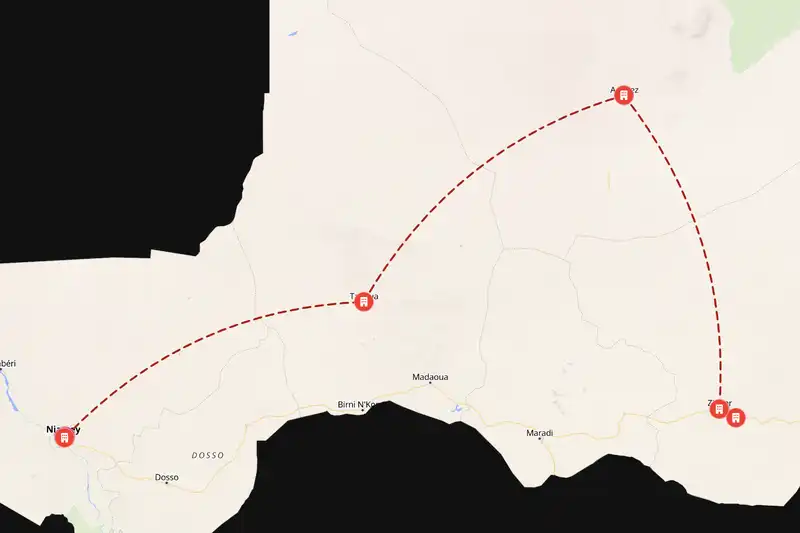
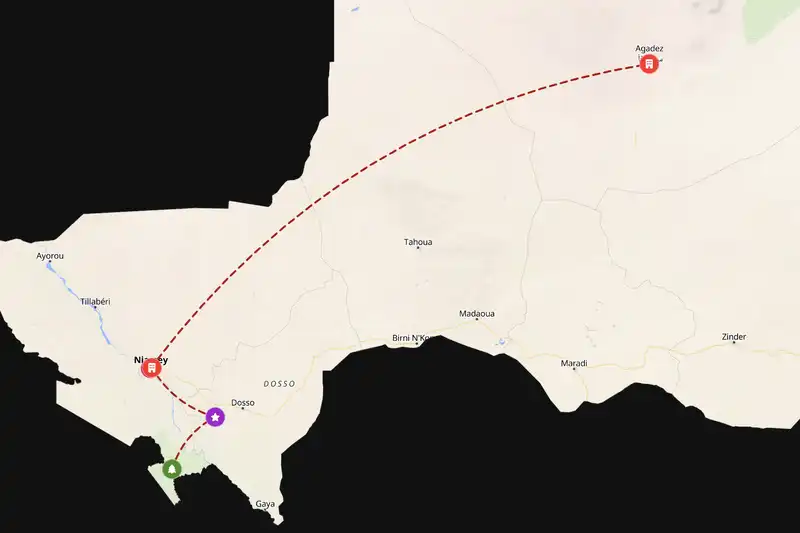
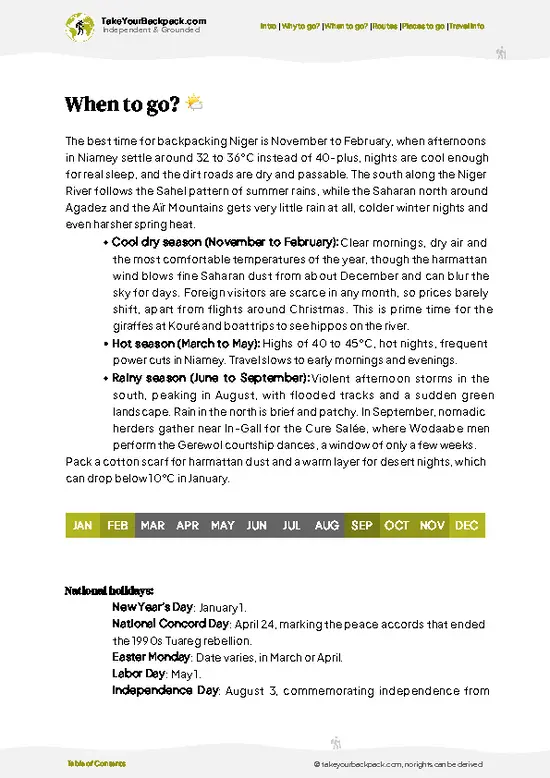
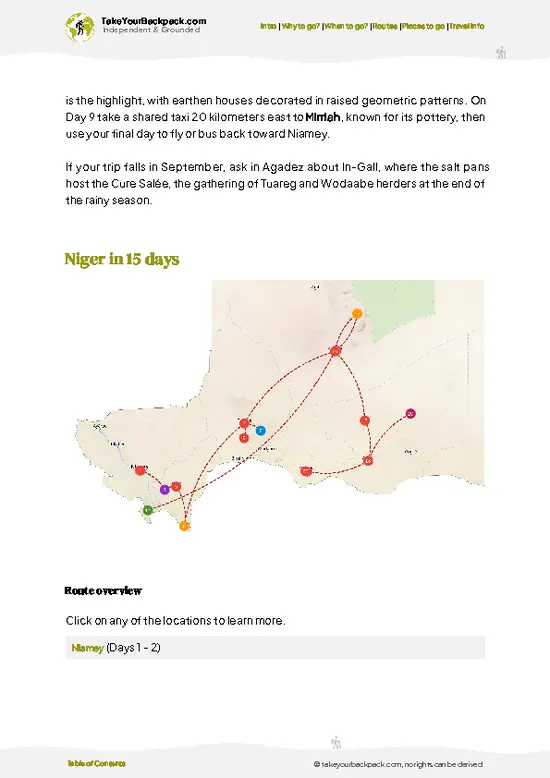
This fifteen-day crossing of Niger suits patient travelers who want the full west-to-east cross-section: the Niger River, Zarma chiefdoms, Hausa adobe towns, the Tuareg capital of Agadez, a stay inside the Aïr Mountains and the old sultanate of Zinder. The pace is slow, with a rest or sightseeing day after every long ride. You’ll rely on intercity buses for the main legs, bush taxis for shorter hops, and a 4x4 with driver from a licensed Agadez agency for the Aïr, where independent travel is not permitted.
Days 1-2: Niamey
Use your two days in
Niamey on the capital’s quieter side. The Cathédrale Notre-Dame de l’Immaculée Conception de Niamey is a cool, calm brick interior and a reminder that a small Catholic community has long lived alongside the Muslim majority. In the evening, check the program at the Centre Culturel Oumarou Ganda, named after the Nigerien filmmaker, where the open-air stage hosts concerts, theater and film nights that draw a young local crowd. Ending each day with grilled …
read more 👉This fifteen-day crossing of Niger suits patient travelers who want the full west-to-east cross-section: the Niger River, Zarma chiefdoms, Hausa adobe towns, the Tuareg capital of Agadez, a stay inside the Aïr Mountains and the old sultanate of Zinder. The pace is slow, with a rest or sightseeing day after every long ride. You’ll rely on intercity buses for the main legs, bush taxis for shorter hops, and a 4x4 with driver from a licensed Agadez agency for the Aïr, where independent travel is not permitted.
Days 1-2: Niamey
Use your two days in Niamey on the capital’s quieter side. The Cathédrale Notre-Dame de l’Immaculée Conception de Niamey is a cool, calm brick interior and a reminder that a small Catholic community has long lived alongside the Muslim majority. In the evening, check the program at the Centre Culturel Oumarou Ganda, named after the Nigerien filmmaker, where the open-air stage hosts concerts, theater and film nights that draw a young local crowd. Ending each day with grilled brochettes and a cold bissap juice by the river sets the right rhythm for the weeks ahead.Days 3-4: Dallol Bosso, Dosso and Gaya
Heading southeast, the road drops into the Dallol Bosso, a wide fossil river valley where doum palms, wells and Fulani cattle mark a water table that sits far closer to the surface than on the surrounding plateau. Ask your driver to stop where the valley floor opens out. Spend the night in Dosso, seat of the Djermakoy, the traditional Zarma ruler, whose palace district gives the town its character. The next morning a short 150-kilometer ride takes you to Gaya on the Niger River near the Benin border, a relaxed trading town where pirogues cross the river and the market spills toward the water.Days 5-6: Tahoua, Illéla and the Ader Doutchi
Day 5 is a full day on the road north to Tahoua, so leave at dawn and treat the bus as part of the trip. Tahoua sits where Hausa farmers and Tuareg herders meet, and the market shows it: millet, indigo cloth and livestock change hands in a dozen dialects. On Day 6, hire a car for the flat-topped mesas of the Ader Doutchi and the town of Illéla, known for Hausa earthen architecture built with vaulted roofs that need no timber, a technique adapted to a land with almost no trees.Days 7-11: Agadez and Timia in the Aïr Mountains
The road to Agadez is another long day, and arriving at dusk to the outline of the mud-brick minaret is a fine way to meet the city. Spend two days in the old town: climb the Grande Mosquée d’Agadez for views across flat earthen roofs, visit the Palais du Sultan d’Agadez facing it, and lose an hour in the Marché Central d’Agadez among silver jewelry, leather saddlebags and stacks of dates. Then your agency’s 4x4 heads north into the Aïr Mountains, roughly five to six hours over dark granite and sand, to Timia. This Kel Ewey Tuareg oasis grows citrus, pomegranates and vegetables in walled gardens fed by wells, and two nights let you walk to the nearby guelta and up to the ruined French fort above town. Return to Agadez for a final night before the long ride east.Days 12-15: Tanout, Zinder and Maradi
The road south passes through Tanout, a good lunch stop where the desert gives way to the first millet fields. In Zinder, capital of the Damagaram sultanate until the French moved the colonial capital to Niamey, give two days to the Vieux Quartier et Palais du Sultan de Zinder, where facades are molded with geometric relief patterns, then add the Musée Régional de Zinder and the Marché de Zinder. Finish in Maradi, Niger’s Hausa commercial hub, a few hours west, where the Marché de Maradi trades heavily with Nigeria and is the busiest market you’ll see on this route.
With an extra day in Agadez, ask your agency about the Tiguidit cliffs south of the city, where dinosaur fossils weather out of the escarpment above a wide desert plain.v2.webp)

 Best Backpacking