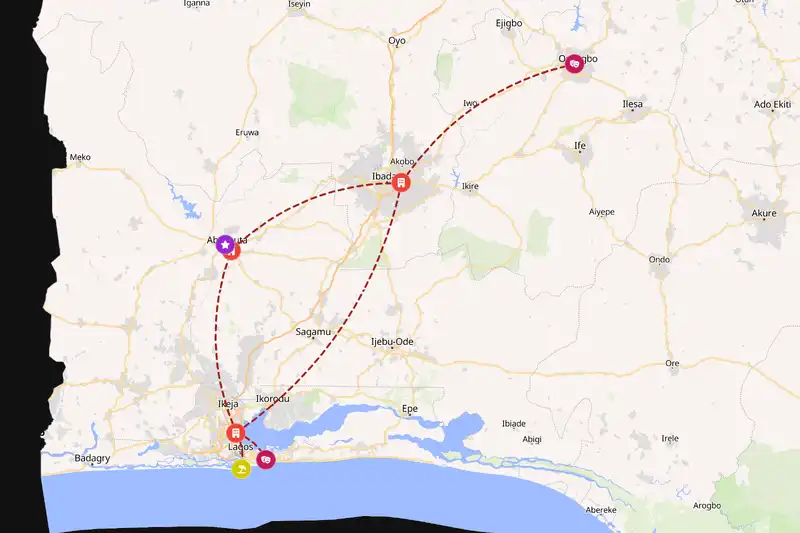
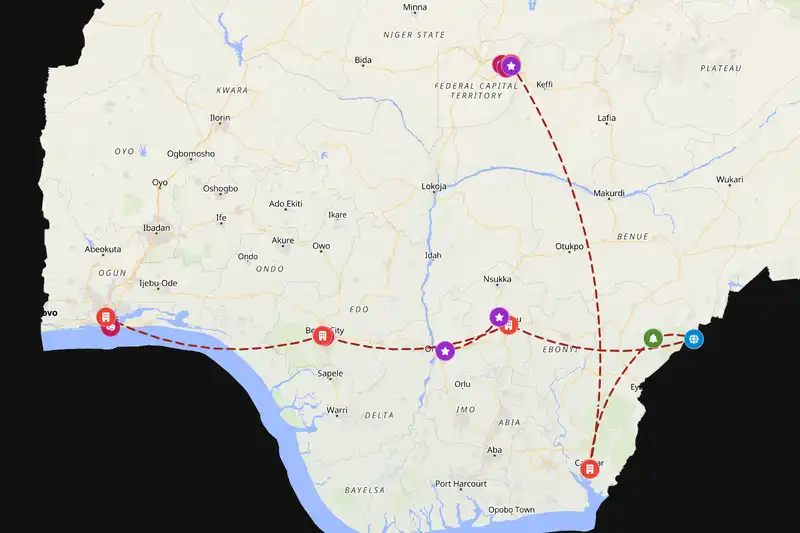
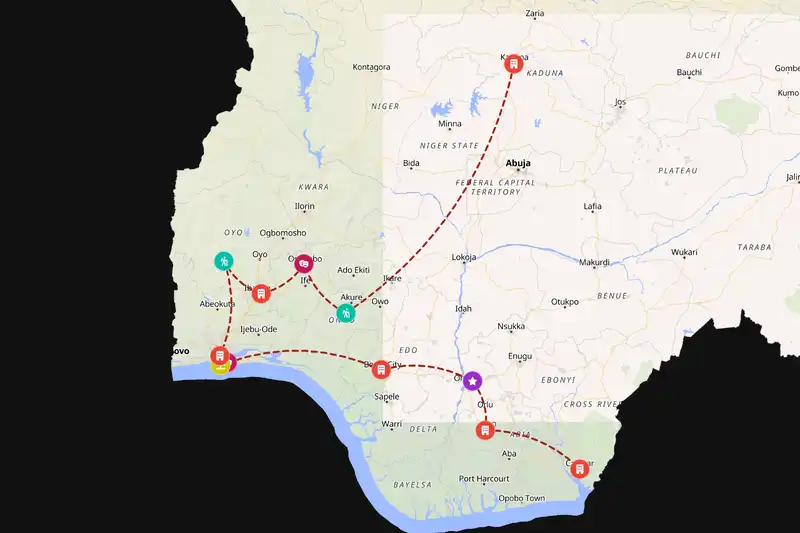
This three-week route is for travelers ready to see how much Nigeria changes between the Atlantic and the edge of the Sahel: Lagos art and nightlife, Yoruba sacred sites, Edo bronze, the cool Jos Plateau, elephants in Yankari and the mud-walled lanes of old Kano. The pace is relaxed for the distance covered. Every long road day is followed by at least one full day without a transfer. You’ll use the Lagos-Ibadan train, hired cars with drivers and shared taxis in the southwest, one domestic flight from Benin City to Abuja, road transfers through the Middle Belt with a driver arranged through your hotel or lodge, and a flight out of Kano at the end.
Days 1-3: Lagos
Give
Lagos three nights and treat it as two cities. On the mainland side of the lagoon, the
National Museum Lagos in Onikan holds Nok terracottas, Benin bronzes and the bullet-marked car in which head of state Murtala Mohammed was assassinated in 1976, a blunt reminder of how recent the country’s turbulence is. A short walk away, …
read more 👉This three-week route is for travelers ready to see how much Nigeria changes between the Atlantic and the edge of the Sahel: Lagos art and nightlife, Yoruba sacred sites, Edo bronze, the cool Jos Plateau, elephants in Yankari and the mud-walled lanes of old Kano. The pace is relaxed for the distance covered. Every long road day is followed by at least one full day without a transfer. You’ll use the Lagos-Ibadan train, hired cars with drivers and shared taxis in the southwest, one domestic flight from Benin City to Abuja, road transfers through the Middle Belt with a driver arranged through your hotel or lodge, and a flight out of Kano at the end.
Days 1-3: Lagos
Give Lagos three nights and treat it as two cities. On the mainland side of the lagoon, the National Museum Lagos in Onikan holds Nok terracottas, Benin bronzes and the bullet-marked car in which head of state Murtala Mohammed was assassinated in 1976, a blunt reminder of how recent the country’s turbulence is. A short walk away, Freedom Park occupies the grounds of the old colonial Broad Street prison and now hosts concerts, food stalls and open-air theater. Spend a day out east for Nike Art Gallery, where several floors of paintings, beadwork and adire cloth cover every wall, and the Lekki Conservation Centre Canopy Walkway, a swaying 401-meter span over swamp forest best done before 10 a.m. Save the last morning for the boat to Tarkwa Bay Beach, where the breakwater keeps the water calm enough to swim. If your dates include a Thursday or Sunday, finish at the New Afrika Shrine in Ikeja, the club the Kuti family built in Fela’s name, where Femi Kuti or his son Made often plays late into the night.Days 4-6: Abeokuta and Ibadan
Leave Lagos traffic behind for Abeokuta, about 1.5 to 2 hours by road. The point of the overnight is Olumo Rock, the granite outcrop where the Egba people sheltered during the nineteenth-century wars. Climb at sunset, when the tin roofs of the old town glow orange below you. The next morning, move on to Ibadan, one of West Africa’s largest cities and a far easier place to spend time than Lagos. From here, a day trip of roughly 2 hours each way reaches the Osun-Osogbo Sacred Grove Shrine Complex, a UNESCO-listed forest on the Osun River. Its shrines were rebuilt from the 1950s onward by the Austrian artist Susanne Wenger and local sculptors, and their cement figures rise out of the undergrowth like something half-grown. Hire one of the guides at the entrance; the stories behind each shrine are the reason to come.Days 7-8: Erin Ijesha and Akure
Day 7 is a long but varied drive. Break it at Erin Ijesha Waterfall, where the water drops in a series of tiers through forest, and the first two levels are a short, slippery climb from the gate. Wear shoes with grip and bring a change of clothes. Continue to Akure for two nights, then spend Day 8 at Idanre Hills, about 45 minutes away. A staircase of roughly 660 steps leads to the abandoned hilltop town, with its old palace, court and school still standing among the domes of bare rock. Start early; the granite holds heat by midday.Days 9-11: Benin City
From Akure it is roughly 3 to 4 hours to Benin City, seat of the Oba of Benin and home of the bronze casters on Igun Street, where families still pour metal using methods centuries old. The Benin City National Museum, on the roundabout at the center of town, gives you the backstory of the kingdom whose plaques were looted in 1897 and are now slowly being returned from Europe. Use the third day for Okomu National Park, around 1.5 to 2 hours west, one of the last refuges of the white-throated monkey and a block of rainforest where you can climb a tree-house platform above the canopy. Book the park visit through the park office in advance.Days 12-13: Abuja
Fly from Benin City to Abuja rather than face the long road north. The capital is planned, green and quiet compared with anywhere you’ve been so far, which is exactly why it makes a good reset. Aso Rock, a 400-meter granite monolith, looms over the government district and dictates every skyline photo. The National Christian Centre, with its tall white facade, sits close enough to the National Mosque to make a point about the country’s two great faiths. In the evening, head to the Thought Pyramid Art Centre in Wuse 2 for contemporary Nigerian painting and sculpture.Days 14-15: Jos
The drive up to Jos takes about 4 to 5 hours and climbs onto a plateau at roughly 1,200 meters, where you’ll want a fleece at night for the first time on this trip. The Jos Museum and Museum of Traditional Nigerian Architecture share a compound: the first holds some of the country’s finest Nok terracotta heads, the second has full-size replicas of buildings from across Nigeria, including a section of the Kano walls and the Zaria mosque. Walk through it before reaching Kano and you’ll read the old city’s buildings far better.Days 16-17: Yankari National Park
Drive via Bauchi to Yankari National Park, around 4 to 5 hours, and stay at Wikki Camp. The park is Nigeria’s best chance of seeing elephants, plus buffalo, waterbuck and plenty of baboons that will raid any unlocked chalet. Take an early morning game drive in the dry season, then spend the heat of the day in the Wikki Warm Spring, a clear stream that stays around 31°C year-round. Two nights here means one full day with no travel at all, which you’ll appreciate before the final push north.Days 18-21: Kano
Day 18 is the longest road day, about 6 to 7 hours via Bauchi, so leave at dawn with a driver who knows the route and arrive before dark. Your reward is three nights in Kano, the oldest city in West Africa still functioning on its original plan. Walk sections of the Ancient Kano City Walls and Gates, where earthen ramparts and gates like Kofar Mata mark the old boundary, and visit the indigo dye pits nearby, worked by hand for over five centuries. Gidan Rumfa, the Emir’s palace, dates back to the fifteenth century, and the Gidan Makama Museum just opposite tells the city’s history inside a restored mud-brick building with cool, thick walls. Dress conservatively throughout, and on Day 21 fly out from Kano or connect via Abuja or Lagos.
If you have a spare afternoon in Jos, ask a driver to take you out to the Riyom rock formations, stacked boulders balanced on the plateau that almost no foreign visitor bothers to see.
 Best Backpacking