×

Philippines🇵🇭 | best attractionsYour Guide to the 10 Best attractions in Philippines

Attractions in the Philippines mostly mean water, volcanoes and living tradition spread across more than 7,000 islands, so where you land changes everything. Palawan and the Visayas (Cebu, Bohol, Siquijor) carry the beach and diving crowds, with the highest prices and the busiest boats. Northern Luzon is cooler, cheaper and slower, with mountain terraces and highland towns reached by long overnight buses. Mindanao and the quieter Visayan islands have fewer visitors and lower costs, but connections are thinner. Independent travelers do well here because jeepneys, tricycles and ferries reach almost everywhere, and a local ride costs a fraction of a tour. My small trick: book the first boat or flight of the day, since morning slots mean calmer seas and emptier sites before the tour vans arrive around 10 a.m. Pick one region that matches your pace, and the rest follows.

By Johan Kruseman 🇳🇱 | Updated October 18, 2026
Explore the best festivals in Philippines

Why go?Why These attraction Stand Out

The Philippines is an archipelago on the Pacific Ring of Fire, and that single fact explains most of what you will see. Volcanic ridges, coral reefs, limestone cliffs and rice terraces all come from the same restless geography. Warm seas and the Coral Triangle give some of the richest marine life on earth, which is why diving and snorkeling are so cheap and so good here compared with the Caribbean or the Red Sea.

History adds a second layer. Over three centuries of Spanish rule left stone churches and colonial towns, American influence left English as a working second language, and older Indigenous and Islamic cultures survive in the north and south. Because English is widely spoken, independent travel is easier here than in most of Southeast Asia.

What you should know before choosing it: … read more 👉
The Philippines is an archipelago on the Pacific Ring of Fire, and that single fact explains most of what you will see. Volcanic ridges, coral reefs, limestone cliffs and rice terraces all come from the same restless geography. Warm seas and the Coral Triangle give some of the richest marine life on earth, which is why diving and snorkeling are so cheap and so good here compared with the Caribbean or the Red Sea.

History adds a second layer. Over three centuries of Spanish rule left stone churches and colonial towns, American influence left English as a working second language, and older Indigenous and Islamic cultures survive in the north and south. Because English is widely spoken, independent travel is easier here than in most of Southeast Asia.

What you should know before choosing it: distance is the real cost. Islands are scattered, ferries run on weather rather than timetables, and a short hop on the map can eat half a day. Infrastructure is uneven. Manila traffic is slow, rural roads can be rough, and popular spots can feel crowded because access is limited to a few piers. Typhoon season also shapes what is open and how you get there, so build in buffer days and keep your plans loose.

Prices are modest but climbing at famous sites, where environmental fees, boat rentals and mandatory guides add up. Off the main circuit, costs drop sharply and locals are quick to invite you into a meal. Cash matters: ATMs thin out fast outside towns, so withdraw before you board.
Our Approach to Ranking
The list of best attractions in Philippines is created based on cultural significance or entertainment value. If you feel a attraction is missing in this list, please let us know.

When to go?Timing Your Visit for the Best Experience

Best months and why: The best months are December to May, when the dry northeast monsoon (amihan) brings sunshine, calm seas and reliable boat crossings to most of the country. Daytime temperatures run about 27 to 33°C, and rainfall in places like Palawan and the Visayas drops to a few dozen millimeters a month in the driest stretch from February to April.

Shoulder seasons: November and late May to early June are the sweet spot for savings. Rain is lighter at the edges, crowds thin out, and room rates at beach hubs can fall 20 to 30 percent from peak. March to May turns hot and humid, often 33 to 36°C on the coast, so do your hiking at dawn and save the afternoon for the water.

Wet season and typhoons: From June to October the southwest monsoon (habagat) brings heavy, frequent rain, and … read more 👉
Best months and why: The best months are December to May, when the dry northeast monsoon (amihan) brings sunshine, calm seas and reliable boat crossings to most of the country. Daytime temperatures run about 27 to 33°C, and rainfall in places like Palawan and the Visayas drops to a few dozen millimeters a month in the driest stretch from February to April.

Shoulder seasons: November and late May to early June are the sweet spot for savings. Rain is lighter at the edges, crowds thin out, and room rates at beach hubs can fall 20 to 30 percent from peak. March to May turns hot and humid, often 33 to 36°C on the coast, so do your hiking at dawn and save the afternoon for the water.

Wet season and typhoons: From June to October the southwest monsoon (habagat) brings heavy, frequent rain, and typhoon risk peaks from July to October, especially across Luzon and the eastern Visayas. Ferries get canceled with little warning, so keep a spare day before any flight home. Rain totals in Manila can exceed 400 mm in August. Prices are lowest now, but sea conditions can close dive sites and island-hopping routes.

Regional differences: Eastern coasts (Siargao, Samar, Catanduanes) follow a different pattern, with their wettest months from November to February. Mountain towns in northern Luzon stay cooler, around 15 to 22°C, and are best between November and April.

Peak periods that change plans: Holy Week (March or April) and the Christmas to New Year stretch fill transport and rooms, with prices up by 30 to 50 percent. Book buses and boats weeks ahead, and expect many shops and some sites to close on Good Friday.

attraction hoppingHow to Combine attractions Into One Trip

How long you need: A trip combining several attractions needs 10 to 21 days, and 14 is comfortable for two regions without feeling hurried. The Philippines punishes overambition, because every move between islands costs hours.

Regions that pair well: The Visayas cluster (Cebu, Bohol, Negros, Siquijor) links by short ferries of 1 to 4 hours, so it works as one loop. Palawan pairs best with Manila or Cebu by flight, since the ferry options are limited. Northern Luzon is a separate trip from Manila, with overnight buses of 8 to 10 hours, so treat it as its own chapter. Mindanao fits those with extra time and flexible plans.

Direction of travel: Fly into Manila or Cebu and work in a single sweep rather than doubling back. A common flow is north Luzon first while you are fresh, then a flight … read more 👉
How long you need: A trip combining several attractions needs 10 to 21 days, and 14 is comfortable for two regions without feeling hurried. The Philippines punishes overambition, because every move between islands costs hours.

Regions that pair well: The Visayas cluster (Cebu, Bohol, Negros, Siquijor) links by short ferries of 1 to 4 hours, so it works as one loop. Palawan pairs best with Manila or Cebu by flight, since the ferry options are limited. Northern Luzon is a separate trip from Manila, with overnight buses of 8 to 10 hours, so treat it as its own chapter. Mindanao fits those with extra time and flexible plans.

Direction of travel: Fly into Manila or Cebu and work in a single sweep rather than doubling back. A common flow is north Luzon first while you are fresh, then a flight south to the Visayas, finishing in Palawan or on a beach, ending near an airport with good onward connections. In the dry season, go against the crowds by starting at the least popular end.

Time per stop: Give a major base 2 to 4 nights and a smaller town 1 to 2. A one-night stop costs a full travel day for little return. Typical transfers: Manila to Baguio about 5 to 6 hours by bus, Cebu to Bohol 2 hours by fast ferry, Manila to Puerto Princesa 1.5 hours by flight.

Planning mistakes: Travelers often cram too many islands into a week, ignore weather delays, and book tight same-day connections between ferry and flight. Instead, leave a buffer day before any international departure, keep ferries and flights in separate legs, and check sailing times locally, since schedules shift. Travel by day when possible, as roads and piers are easier to read in the light.

The ListHighly Recommended attractions of Philippines

1 Intramuros

walled city, cobblestone streets, colonial landmarks

Stroll through Manila’s oldest district, passing restored churches, museums, and plazas that reveal centuries of layered history.

2 San Agustin Church

baroque church, religious relics, stone cloisters

Visit the oldest stone church in the Philippines, admire ornate interiors, and browse ecclesiastical artifacts in the adjoining museum.

3 Fort Santiago

stone ramparts, Rizal shrine, Spanish-era prison

Walk through preserved fortifications, explore dungeons, and visit historical exhibits in a riverside citadel central to Manila’s colonial past.

4 Rizal Park

open lawns, national hero memorial, ornamental gardens

Relax in a central urban park featuring landscaped grounds, historical markers, and the iconic monument to José Rizal.

5 Ayala Museum

pre-colonial gold, diorama history, Filipino textiles

Discover Philippine history and culture through curated artifacts, multimedia exhibits, and rotating art displays in a modern museum environment.

6 National Museum of Fine Arts

Filipino paintings, neoclassical building, sculpture halls

Browse galleries of Philippine visual art, from colonial-era masterpieces to modern works, in a grand historic structure.

7 National Museum of Anthropology

ethnographic collections, indigenous artifacts, textile displays

Examine objects from diverse Philippine cultures, including tools, clothing, and ritual items, in a museum dedicated to anthropology.

8 National Museum of Natural History

biodiversity exhibits, tree of life atrium, endemic species

Learn about the country’s flora and fauna through immersive displays, dioramas, and interactive features in a light-filled museum.

9 Las Casas Filipinas de Acuzar

heritage houses, riverside resort, architectural restoration

Tour relocated ancestral homes and period buildings, each reconstructed to showcase Filipino craftsmanship in a living heritage village.

10 The Ruins

mansion remains, Italianate columns, sugar estate history

Wander through the skeletal remains of a prewar mansion, set amid landscaped gardens and illuminated at dusk for dramatic effect.

11 Manila Ocean Park

aquarium tunnels, marine life exhibits, water shows

View diverse aquatic species in walk-through tanks, attend animal presentations, and enjoy interactive marine-themed activities.

12 Enchanted Kingdom

theme park rides, fantasy zones, family attractions

Experience a variety of amusement rides, themed areas, and live entertainment suitable for all ages in a large outdoor park.

13 Cultural Center of the Philippines

performance halls, Filipino architecture, national arts

Attend live performances or explore galleries showcasing contemporary and traditional Filipino arts in a landmark brutalist complex.

14 Museo Sugbo

old jail, Cebuano artifacts, Spanish-era cells

Explore Cebu’s provincial museum housed in a former prison, featuring galleries on local history, politics, and culture.

15 Yap-Sandiego Ancestral House

wooden interiors, antique furnishings, 17th-century home

Step inside one of Cebu’s oldest surviving residences, featuring period décor and architecture reflecting Chinese-Filipino heritage.

16 Mind Museum

science galleries, interactive exhibits, planetarium dome

Engage with hands-on science installations, themed zones, and educational displays designed for curious minds of all ages.

17 Museo Orlina

glass sculptures, artist’s studio, hillside views

Appreciate contemporary glass art and rotating exhibitions in a multi-level space overlooking Taal Lake and the surrounding landscape.

18 Davao Crocodile Park

crocodile enclosures, wildlife encounters, animal shows

Observe native and exotic reptiles up close, watch scheduled feeding sessions, and learn about conservation efforts in a managed park.

19 Star City

indoor rides, carnival games, seasonal attractions

Enjoy amusement rides, arcade games, and themed entertainment in a covered park popular for group outings and family visits.

Think you know Philippines?

Prove you’re a true local — uncover 9 lesser-known attractions in Philippines that locals tend to keep to themselves.
Loading the map 🌍

Expert viewTips and Advice from Travelers

How many attractions to plan: I would advise one major attraction every two to three days, so a two-week trip holds roughly five or six, plus unplanned stops. Distances and weather eat more time than the sites themselves, and a rushed schedule costs more in transport fares and lost days than adding another stop could give back. Fewer, longer stays also let you slip into cheaper local eateries and guesthouses, which is where a backpacker saves the most money.

Choosing the kind of attraction: For beaches and marine life, the most value comes from snorkeling and diving. A snorkel mask costs about US$10 to 15 at home or in a shop, and many reefs sit just off the beach, so you pay nothing but a small environmental fee. Diving, at about US$25 to 40 per dive, is worth the splurge here because prices … read more 👉
How many attractions to plan: I would advise one major attraction every two to three days, so a two-week trip holds roughly five or six, plus unplanned stops. Distances and weather eat more time than the sites themselves, and a rushed schedule costs more in transport fares and lost days than adding another stop could give back. Fewer, longer stays also let you slip into cheaper local eateries and guesthouses, which is where a backpacker saves the most money.

Choosing the kind of attraction: For beaches and marine life, the most value comes from snorkeling and diving. A snorkel mask costs about US$10 to 15 at home or in a shop, and many reefs sit just off the beach, so you pay nothing but a small environmental fee. Diving, at about US$25 to 40 per dive, is worth the splurge here because prices are among the lowest in the world. For hiking and landscapes, highland and volcano treks cost little but take real time, so they suit travelers with a loose schedule. For culture, colonial towns, churches and local festivals cost almost nothing and give the best look at daily life. Tour-heavy island-hopping is the priciest option, but a shared boat is cheaper than a private one, and the whole experience is just as good.

What things cost: A thrifty backpacker can live on US$25 to 40 a day (about 1,400 to 2,300 pesos), covering a dorm or basic fan room, local meals and public transport. Add US$10 to 20 on days with a guided activity, and budget US$40 to 60 a day in peak beach areas. Entry and environmental fees usually run 50 to 500 pesos (US$1 to 9). Guides are often required at protected sites and cost around 500 to 1,500 pesos per group. Boat tours range from 1,200 to 2,500 pesos per person when shared, and private boats cost far more. Tricycle and jeepney rides add 20 to 150 pesos each. Carry plenty of small bills, because change is scarce at remote piers and ATMs vanish outside towns.

Safety: Most attractions are easy to visit, and the main risks are practical. Sea conditions matter most: skip boats when the coast guard cancels sailings, since cancellations exist for good reason. Check that your boat carries life jackets, and wear them. Use reef-safe sunscreen and keep your feet off coral, which many sites fine. Do not climb volcanoes or enter closed zones near active ones, as restrictions change with volcanic activity. Take a registered guide on mountain trails, and start at dawn to avoid afternoon storms.

Keep valuables out of sight on crowded buses and in markets, and use licensed taxis or ride-hailing apps in Manila. Some southern areas of Mindanao and parts of the Sulu archipelago carry government travel advisories, so check current guidance before heading there.

Cultural considerations: Filipinos are warm hosts, and a smile and a few words of Tagalog go far. Dress modestly in churches and cover shoulders and knees. Ask before photographing people, especially in highland communities, and expect to pay a small fee for a photo with traditionally dressed locals. Bargain gently in markets, never aggressively. Tip about 10 percent where service is not included, and keep your voice level, because public anger costs you goodwill. Join a fiesta if invited and accept the food offered, since a refusal can feel rude. Pack a small amount of patience, because delays are part of the rhythm here.

✈️ The backpacker research shortcutPhilippines Travel Guide

An offline-friendly backpacking guide with optimized travel routes, ranked highlights, transport advice, and the best areas to stay.
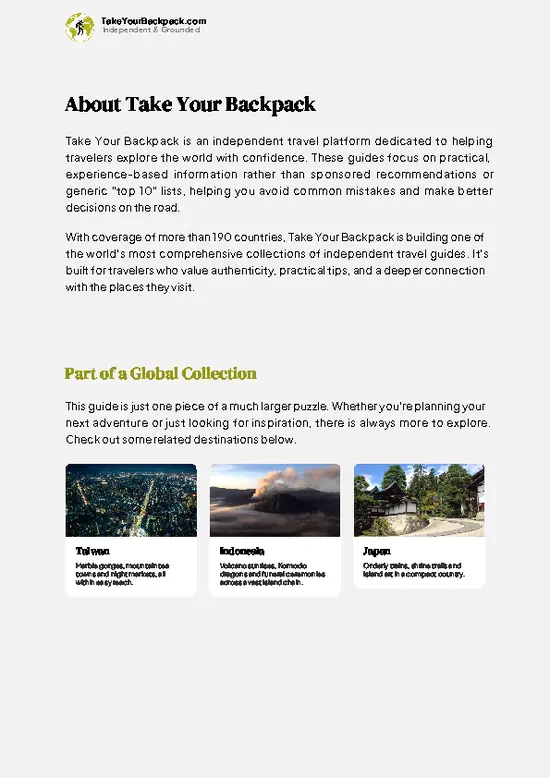
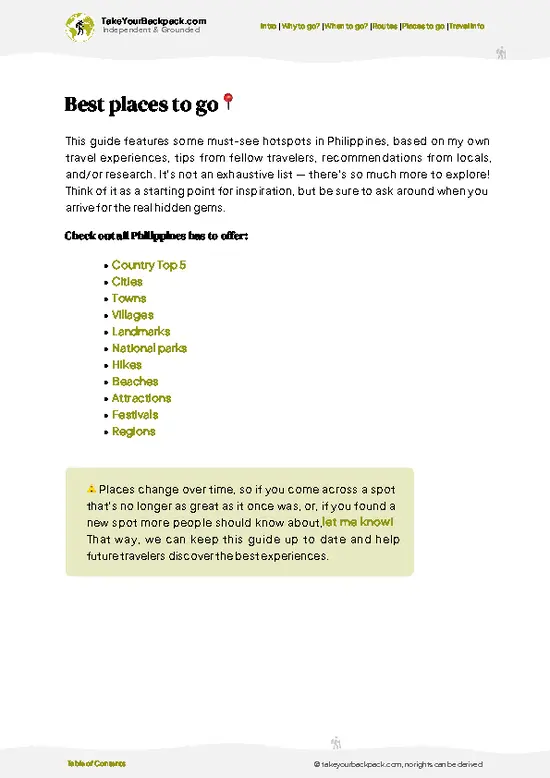
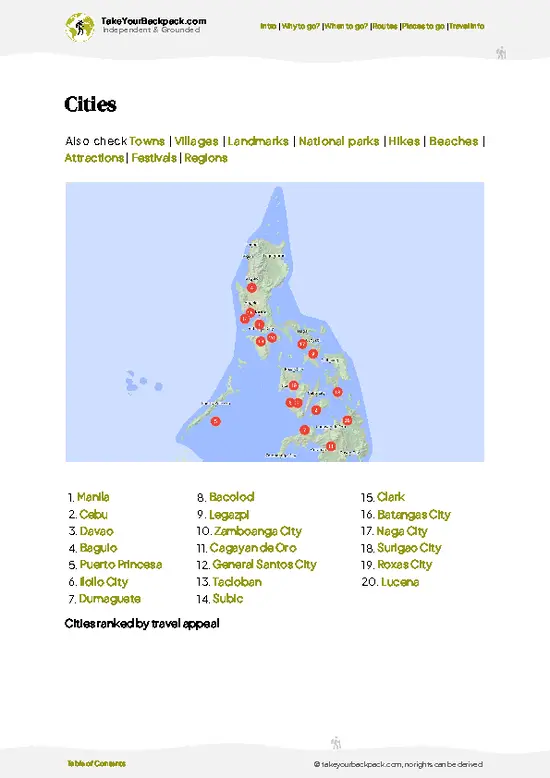
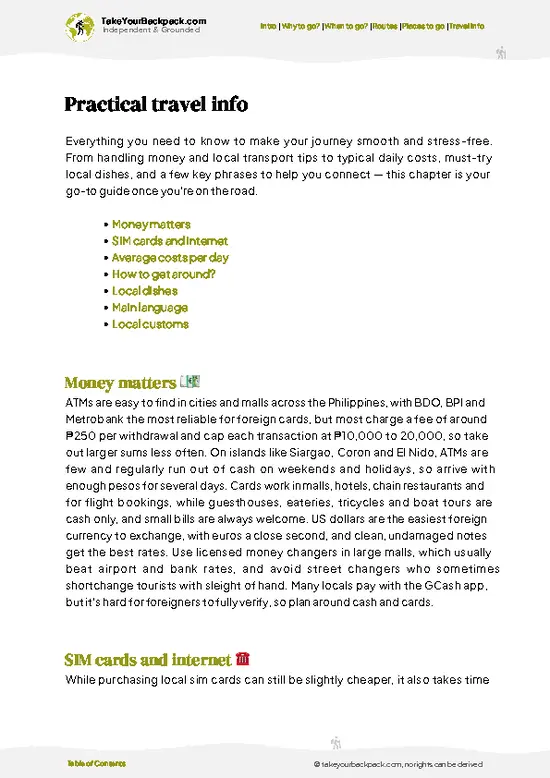
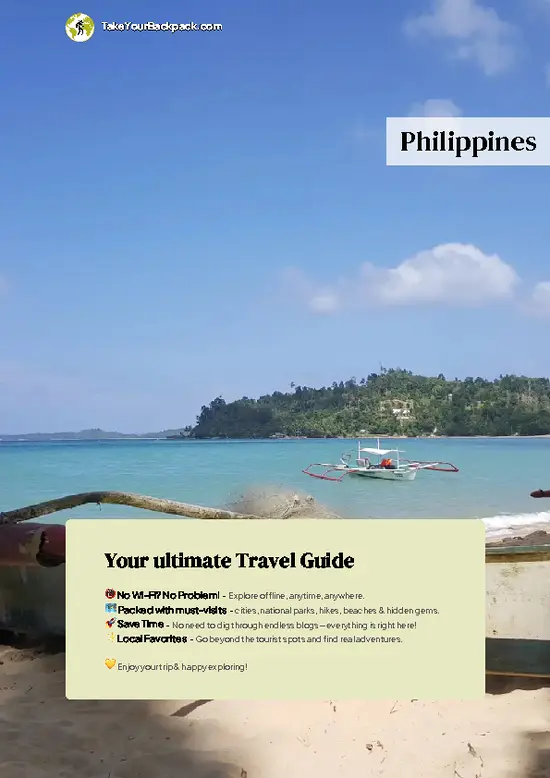
example page 0 from our offline Travel Guide for Philippines
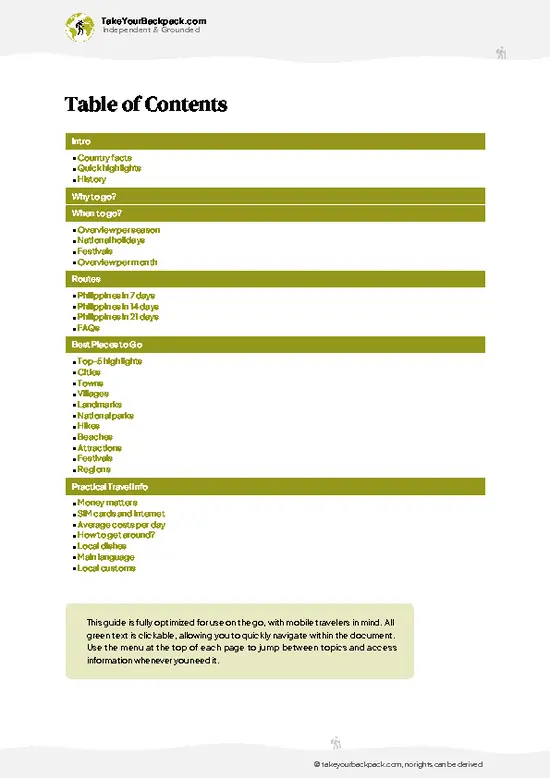
example page 1 from our offline Travel Guide for Philippines
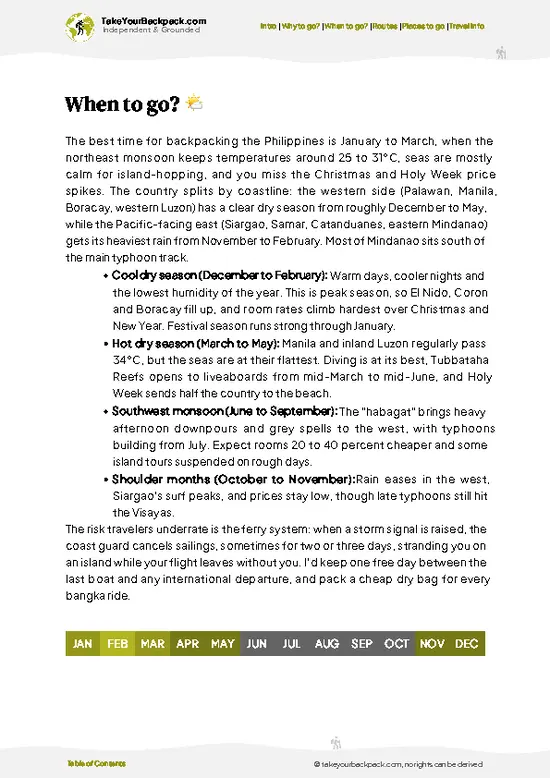
example page 2 from our offline Travel Guide for Philippines
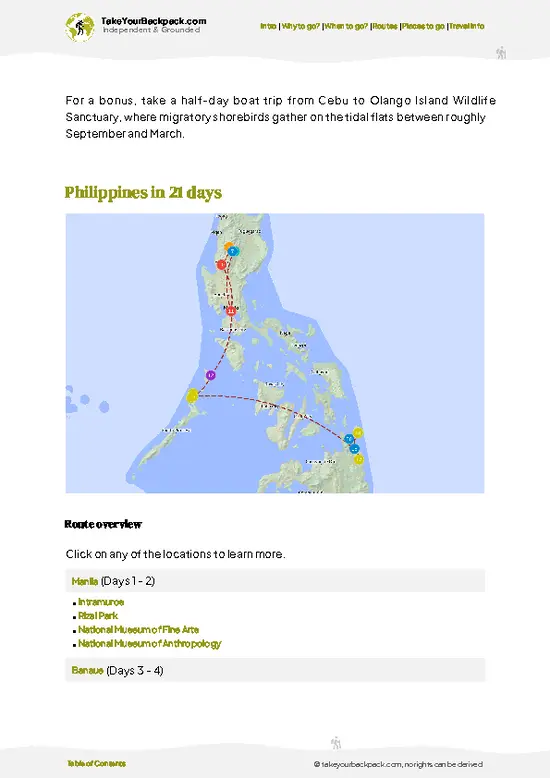
example page 3 from our offline Travel Guide for Philippines
example page 4 from our offline Travel Guide for Philippines
example page 5 from our offline Travel Guide for Philippines
example page 6 from our offline Travel Guide for Philippines
example page 7 from our offline Travel Guide for Philippines
The digital guide (517 pages) contains:
✅ 151 highlights, ranked by travel appeal
✅ Optimized 7, 14 & 21-day travel routes
✅ Cities, national parks, landmarks, beaches
✅ How to get around
✅ Offline-friendly for travel without Wi-Fi
👉 Click to see all 30+ guide features

📅 Plan smarter in minutes, not weeks
✅ Month by month travel advice
✅ Festivals & national holidays
✅ Budget expectations

🗺️ Go to the right places, skip the overrated ones
✅ Honest pros & cons of destinations
✅ Top hikes, parks & viewpoints
✅ Lesser-known places most travelers miss
✅ Clear “worth it vs skip it” guidance

🛏️ Travel smoothly without rookie mistakes
✅ Best areas to stay
✅ Transport systems explained simply
✅ Common scams & safety advice
✅ SIM cards, money & practical tips

🌍 Understand the country, not just visit it
✅ Culture & traditions
✅ 52 Essential phrases & customs
✅ Festivals worth planning around
✅ Traveler-friendly historical context
✅ Insights that make places more meaningful

📱 Built for real travel conditions
✅ Fully downloadable PDF
✅ Works completely offline
✅ Optimized for phone use
✅ Useful in remote areas & buses
✅ Everything in one place
Stop searching, start planning
Get instant access to your full guide. 30‑day money-back guarantee.
+ Add another guide for just

By proceeding you agree to our terms.
Sent to your inbox immediately after payment • 100% Secure Checkout
Best Backpacking Travel Advisor 2025 tourism awardBest Backpacking
Travel Advisor
2025
What others say about Take Your Backpack Guides:
⭐⭐⭐⭐⭐
Fantastic, amazing amount of information!
⭐⭐⭐⭐⭐
My goodness this is amazing, it's what I've been looking for hats off too you!
⭐⭐⭐⭐⭐
I think this is absolutely BRILLIANT
⭐⭐⭐⭐
Very complete and informative. It's still missing places, but I gotta to commend you
⭐⭐⭐⭐⭐
This is truly amazing, thank you, can't wait to explore it with my kids!
⭐⭐⭐⭐⭐
Awesome resource, thank you!
⭐⭐⭐⭐⭐
This is amazing! Can't wait to explore the ones I haven't seen
⭐⭐⭐⭐
I love this! Well done, great idea.
⭐⭐⭐⭐⭐
Thanks for taking the time to make this gem!
⭐⭐⭐⭐⭐
This might be the best website I've ever seen.
⭐⭐⭐⭐⭐
Congratulations, and thank you so much for your work; it's incredibly valuable.
⭐⭐⭐⭐
In all seriousness I think you did a great job pointing out the important spots
⭐⭐⭐⭐⭐
10/10 very good
⭐⭐⭐⭐⭐
As someone who's only just starting to visit regularly this is awesome, thank you.
⭐⭐⭐⭐
Thank you very much! I'm going to visit my dad, it's going to be very useful!
⭐⭐⭐⭐⭐
This is really cool! We'll be travelling for the first time and this definitely come in handy.
⭐⭐⭐⭐⭐
You are now our minister of culture, congratulations 👨‍💼
⭐⭐⭐⭐⭐
Just wanted to tell you that this is a pearl! Going to follow your recommendations.
⭐⭐⭐⭐⭐
This is so cool. I'll definitely be using the resource for my travels soon.
⭐⭐⭐⭐⭐
This is very impressive! Good work.
⭐⭐⭐⭐⭐
This is an amazing and informative site. Very well done!

🛏️ Where to stay?Where to Stay: Philippines Edition

The Philippines has a solid hostel scene, with dorm beds typically running ₱500 to 1,000 (US$9 to 18) and simple private rooms from about ₱1,200 (US$21). In Manila, Poblacion in Makati packs the most social hostels and late-night bars, though the noise runs past midnight, while Malate and Ermita are cheaper and close to Intramuros but feel grittier after dark. On the islands, El Nido town and General Luna on Siargao put you steps from boats and surf, with lively evenings and beds that fill fast in peak season, and Boracay’s Station 3 stays quieter and cheaper than the party strip around Station 2.

If you enjoy meeting fellow travelers, consider choosing hostels with high ratings for atmosphere. … read more 👉
The Philippines has a solid hostel scene, with dorm beds typically running ₱500 to 1,000 (US$9 to 18) and simple private rooms from about ₱1,200 (US$21). In Manila, Poblacion in Makati packs the most social hostels and late-night bars, though the noise runs past midnight, while Malate and Ermita are cheaper and close to Intramuros but feel grittier after dark. On the islands, El Nido town and General Luna on Siargao put you steps from boats and surf, with lively evenings and beds that fill fast in peak season, and Boracay’s Station 3 stays quieter and cheaper than the party strip around Station 2.

If you enjoy meeting fellow travelers, consider choosing hostels with high ratings for atmosphere. On the other hand, if you prefer having your own space, a hotel might be a better option.

PhilippinesExplore Beyond This Category

👋 Meet the founderWho’s Behind Take Your Backpack?

Johan, backpacker and founder of TakeYourBackpackHi, I’m Johan (Netherlands 🇳🇱), the creator of TakeYourBackpack. Over the past 3 decades, I’ve backpacked through 90+ countries across six continents, gaining extensive experience with independent travel, long-term trips, and overland routes.

This site is built on a combination of firsthand travel experience and carefully curated insights from other backpackers. Many guides are based on places I’ve personally visited, while others bring together tips, observations, and practical advice shared by trusted travelers I’ve met along the way.

The goal is to provide realistic, experience-driven guidance — not generic itineraries — so you can explore destinations with better context, clearer expectations, and more confidence.