How many parks to visit: I advise two to four national parks on a single trip, and three is the number I’d plan around. The Philippines is 7,600-plus islands, so every park costs you a boat, a flight or a long van ride before you even reach the gate. Past four, you spend more of your trip in transit than on a trail or in the water. Three gives you one mountain or forest park, one coastal or marine park and one cave or river park, which is enough variety to feel like you’ve seen three different countries without burning a week on logistics.
A realistic daily budget is US$30 to 50 (about PHP 1,700 to 2,800) on a park day, covering a simple room, meals, local transport and a modest fee. Add a one-off park cost of roughly US$10 to 60 per visit for most places once you count entry, a compulsory …
read more 👉 How many parks to visit: I advise two to four national parks on a single trip, and three is the number I’d plan around. The Philippines is 7,600-plus islands, so every park costs you a boat, a flight or a long van ride before you even reach the gate. Past four, you spend more of your trip in transit than on a trail or in the water. Three gives you one mountain or forest park, one coastal or marine park and one cave or river park, which is enough variety to feel like you’ve seen three different countries without burning a week on logistics.
A realistic daily budget is US$30 to 50 (about PHP 1,700 to 2,800) on a park day, covering a simple room, meals, local transport and a modest fee. Add a one-off park cost of roughly US$10 to 60 per visit for most places once you count entry, a compulsory local guide and a boat or tricycle.
Choosing the kind that fits you: Mountain and forest parks cost the least in money and the most in comfort. Registration and guide fees usually run PHP 500 to 2,500 (US$9 to 45) per person, and the guide is mandatory almost everywhere. You pay in cold nights, early alarms (many summit hikes start between midnight and 3 a.m.) and basic homestay beds at US$5 to 15. For a backpacker on a tight budget who likes effort, this gives the most for the least.
Island and coastal parks flip that. Entry is often only PHP 100 to 500 (US$2 to 9), but the boat is the real bill: a shared island-hopping trip is US$10 to 25, a private boat US$40 to 80. You get the easiest comfort, since you’re usually based in a town with hostels and fan rooms at US$8 to 20, and you gain a lot of time because one boat day covers several stops. If you only want one park type and have little time, this is the one that returns the most for a short trip.
Remote marine reserves are the splurge. Some can only be reached on multi-day liveaboards that run about US$1,000 to 2,000 and operate only during a short spring window. They’re extraordinary for divers and a poor use of money for anyone who isn’t certified. Skip them on a budget unless diving is the reason you’re flying in.
Cave and river parks sit in the middle. Expect PHP 500 to 2,000 (US$9 to 36) for permits, boats and audio gear, often with a booking you must make days ahead. They cost little time, usually half a day, and moderate comfort. They’re the best choice when you’re short on days and want one dramatic morning.
What the fees actually cover: Budget for small cash payments. Many park offices, barangay desks and boat cooperatives don’t take cards, and ATMs in gateway towns run dry on weekends and holidays. Carry PHP 2,000 to 3,000 in small bills, and keep some coins for environmental fees, which are charged separately from the entry ticket in many places. A guide’s tip of PHP 200 to 500 per day is normal and appreciated, because guide fees are set low and often shared with a community association.
Book popular permits early. High-demand parks cap daily visitors, and weekends sell out. Midweek mornings are cheaper in crowds and in patience.
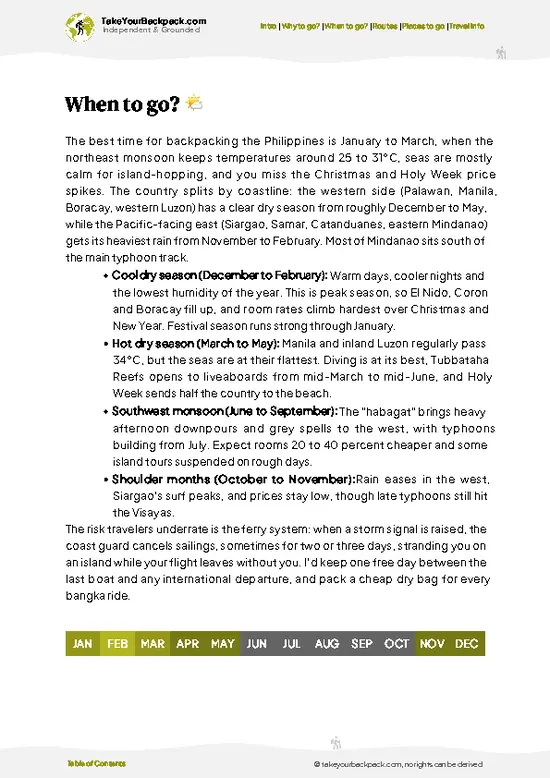
Safety and local respect: Typhoon season, roughly June to November, is the biggest risk. Boat departures are suspended when the coast guard raises a storm signal, trails close after heavy rain, and rivers rise quickly in canyon and cave parks. Leave a buffer day at both ends of any trip with a fixed flight, and trust a cancellation without arguing; guides and boatmen know the local conditions better than any forecast app.
Mountain trails get cold and wet even in the dry months, so a real rain shell and a warm layer matter more than they seem. On the water, wear a life jacket on every boat, even short hops, and check that your travel insurance covers hiking at altitude and diving.
Many parks sit on ancestral land, including areas belonging to Ifugao, Ibaloi, Kankanaey and Aeta communities. Hiring local guides is part of the arrangement, not an upsell. Ask before photographing people or ritual sites, keep to marked paths, and don’t move stones or cairns. Don’t touch coral, feed fish or step on reef flats; use reef-safe sunscreen or a rash guard instead. Carry out every wrapper, since many trailheads have no bins.
Some parts of Mindanao and the Sulu archipelago carry government travel advisories, so check your own country’s guidance before booking there. Elsewhere, standard care with valuables on crowded boats and in transit hubs is enough.
v2.webp)

 Best Backpacking
.jpg) Hi, I’m Johan (Netherlands 🇳🇱), the creator of TakeYourBackpack. Over the past 3 decades, I’ve backpacked through 90+ countries across six continents, gaining extensive experience with independent travel, long-term trips, and overland routes.
Hi, I’m Johan (Netherlands 🇳🇱), the creator of TakeYourBackpack. Over the past 3 decades, I’ve backpacked through 90+ countries across six continents, gaining extensive experience with independent travel, long-term trips, and overland routes.