×

Portugal🇵🇹 | best townsExplore the 10 Best towns in Portugal

Portugal packs its towns into a country roughly 560 kilometers long, so the character changes fast. In the north, granite houses stay damp and gray-green, Minho cafés smell of woodsmoke and strong bica, and prices run lowest. Central towns climb stone lanes above rivers, with tiled facades flashing in hard afternoon light. The Alentejo flattens into cork oak, whitewashed walls and silence broken by church bells at noon. The Algarve brings salt air, ochre cliffs and the highest bills and crowds. For backpacking or independent travel, the real question is whether you want cobbled hills, quiet plains or beach lanes, because trains, buses and budgets behave differently in each.

By Johan Kruseman 🇳🇱 | Updated October 18, 2026
Explore the best villages in Portugal

Why go?Why These town Stand Out

Portugal suits town travel because it is small, old and densely settled. Its borders have barely moved since the 13th century, so medieval castles, Roman bridges and Moorish street plans survive within a day’s ride of each other. Most places are compact enough to cross on foot in twenty minutes, over calçada paving that is polished slick by centuries of soles and murderous in wet weather. Climate does the rest. The Atlantic keeps the coast mild, the interior bakes dry in summer, and the light turns buildings white, yellow and blue-tiled to a degree you notice at once.

Before choosing Portugal for towns, know the limits. Hills are steep and luggage on cobbles is miserable, so pack light. Rail is good on the main corridors but thins out inland, where regional buses may run only a few times … read more 👉
Portugal suits town travel because it is small, old and densely settled. Its borders have barely moved since the 13th century, so medieval castles, Roman bridges and Moorish street plans survive within a day’s ride of each other. Most places are compact enough to cross on foot in twenty minutes, over calçada paving that is polished slick by centuries of soles and murderous in wet weather. Climate does the rest. The Atlantic keeps the coast mild, the interior bakes dry in summer, and the light turns buildings white, yellow and blue-tiled to a degree you notice at once.

Before choosing Portugal for towns, know the limits. Hills are steep and luggage on cobbles is miserable, so pack light. Rail is good on the main corridors but thins out inland, where regional buses may run only a few times a day and rarely on Sundays. Lunch is the main meal, often with a cheap prato do dia, and many kitchens close between 3 and 7 p.m. Smaller places shut shops for lunch and on Mondays. The most famous towns fill with day-trippers by late morning, which makes early mornings and evenings the quiet hours.
How the List Was Created
The list of best towns in Portugal is created based on charm, local culture, atmosphere, hidden gems, and visitor appeal. If you feel a town is missing in this list, please let us know.

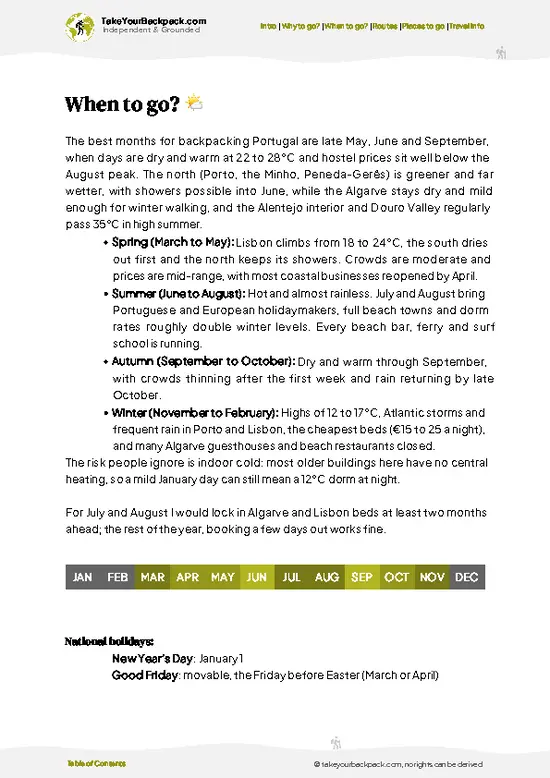
When to go?Seasonal Guide to Visiting

Best months: April to June and September to October are the best months for towns in Portugal, with daytime highs of about 18 to 26°C, long soft light and far fewer crowds than July and August. Spring brings green hills and wildflowers in the Alentejo, while early autumn keeps the sea warm enough to swim.

Summer and peak season: July and August push the Alentejo and Douro interiors past 35°C, sometimes above 40°C, and afternoons go silent behind shutters. Algarve towns fill up, and accommodation can cost 40 to 80 percent more than in spring, with dorm beds often sold out days ahead. The north and the Atlantic coast stay cooler, around 22 to 28°C, though fog can roll in off the sea.

Winter and shoulder months: November to March is wet, especially in the north and center. Porto and Minho can … read more 👉
Best months: April to June and September to October are the best months for towns in Portugal, with daytime highs of about 18 to 26°C, long soft light and far fewer crowds than July and August. Spring brings green hills and wildflowers in the Alentejo, while early autumn keeps the sea warm enough to swim.

Summer and peak season: July and August push the Alentejo and Douro interiors past 35°C, sometimes above 40°C, and afternoons go silent behind shutters. Algarve towns fill up, and accommodation can cost 40 to 80 percent more than in spring, with dorm beds often sold out days ahead. The north and the Atlantic coast stay cooler, around 22 to 28°C, though fog can roll in off the sea.

Winter and shoulder months: November to March is wet, especially in the north and center. Porto and Minho can see 120 to 160 millimeters of rain a month in winter, with damp stone and cold indoors, since many guesthouses have weak heating. Lisbon and the Algarve are drier and mild, around 12 to 17°C by day. Prices drop to their lowest, but some seaside cafés, boat trips and smaller guesthouses close from November to February. February can bring almond blossom to the Algarve, a pleasant surprise for off-season visitors.

town hoppingTips for Visiting Multiple Destinations

Pacing: A trip combining several towns in Portugal needs 10 to 14 days, and 7 days works if you stay to one or two regions. The country is narrow, but hills, slow regional trains and infrequent buses stretch distances.

Direction and clusters: The cleanest approach is a north to south sweep. Start around Porto and the Minho, move to the central region via Coimbra, then through Lisbon, and finish in the Alentejo or the Algarve, where you can end on the sand. Fly into Porto and out of Faro, or reverse it, to avoid backtracking. Porto to Lisbon takes about 3 hours by Alfa Pendular or Intercidades train, and Lisbon to Faro about 3 hours by train or 3.5 hours by express bus. Lisbon to inland Alentejo towns is typically 1.5 to 2.5 hours by bus.

Allow two nights per stop, three where there are walks … read more 👉
Pacing: A trip combining several towns in Portugal needs 10 to 14 days, and 7 days works if you stay to one or two regions. The country is narrow, but hills, slow regional trains and infrequent buses stretch distances.

Direction and clusters: The cleanest approach is a north to south sweep. Start around Porto and the Minho, move to the central region via Coimbra, then through Lisbon, and finish in the Alentejo or the Algarve, where you can end on the sand. Fly into Porto and out of Faro, or reverse it, to avoid backtracking. Porto to Lisbon takes about 3 hours by Alfa Pendular or Intercidades train, and Lisbon to Faro about 3 hours by train or 3.5 hours by express bus. Lisbon to inland Alentejo towns is typically 1.5 to 2.5 hours by bus.

Allow two nights per stop, three where there are walks or day trips. Small towns can be seen in half a day, but the early and late hours are the best, when stone glows and the streets empty.

Common mistakes: Travelers often try to cover too many stops and spend half of each day with a backpack on cobbles. Cap the trip at one new base every two or three days. Another error is assuming that every inland town has a good bus link. Check timetables on Rede Expressos and CP the day before, book Sunday departures early, and consider renting a car for just the Alentejo days.

The ListTop towns of Portugal

1 Évora

Roman temple, whitewashed lanes, university town

Step between ancient columns and lively squares, then linger in shaded courtyards where students gather and storks nest overhead.

2 Lagos

sea caves, golden beaches, lively marina

Kayak beneath sculpted cliffs, relax on sheltered coves, and enjoy a bustling harbor lined with casual seafood spots.

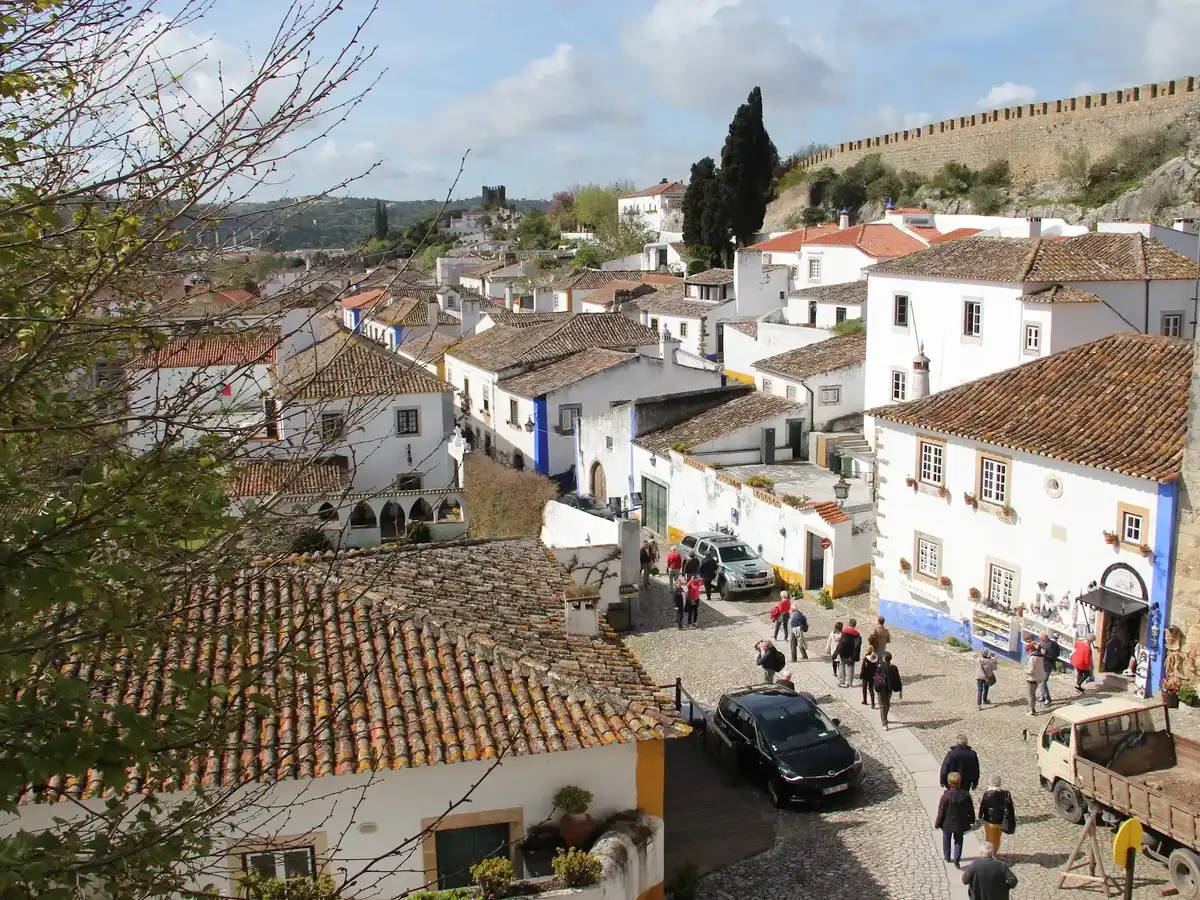
3 Óbidos

medieval walls, bookshops, festival town

Walk atop ancient ramparts, browse literary nooks, and time your visit for lively events that transform the cobbled streets.

4 Aveiro

canals, Art Nouveau houses, salt pans

Glide on colorful boats past tiled facades, then sample sweet ovos moles and watch flamingos in the nearby wetlands.

portugal-city-aveiro
© Google |

5 Faro

walled old town, lagoon access, bone chapel

Wander cobbled streets to find Moorish arches, then take a boat to island beaches or visit the chapel decorated with human bones.

portugal-city-faro
© Google |

6 Tavira

riverfront, tiled facades, island beaches

Cross the Roman bridge to discover quiet plazas, then catch a ferry to sandy offshore islands with calm, clear water.

portugal-city-tavira
© Google |

7 Nazaré

giant waves, fishing traditions, clifftop viewpoint

Watch surfers tackle record-breaking swells, then explore the upper town for panoramic ocean vistas and seafood markets.

8 Tomar

Templar castle, riverside park, convent complex

Follow the river to a UNESCO-listed fortress, then wander monastery corridors filled with centuries of religious symbolism.

9 Aljezur

hilltop ruins, wild beaches, sweet potato fields

Hike to the ruined castle for valley views, then head west for uncrowded surf and simple meals in rural taverns.

10 Viana do Castelo

Art Deco center, riverside promenade, hilltop basilica

Ride the funicular for sweeping coastal views, then return to sample local pastries and admire elegant 20th-century architecture.

11 Peniche

surf beaches, sea fort, fishing port

Catch Atlantic swells or take a boat to Berlenga Island, then return for grilled fish at the working harbor.

12 Alcobaça

Cistercian monastery, river park, pastry shops

Tour the vast abbey where royal lovers rest, then relax by the river and try local sweets in nearby cafés.

13 Elvas

star-shaped fort, aqueduct, border town

Walk the massive fortifications, then follow the aqueduct arches and notice the Spanish influence in local food and architecture.

14 Mértola

riverside citadel, Islamic heritage, whitewashed lanes

Explore a fortress above the Guadiana, visit a former mosque, and wander quiet streets that reveal layers of Moorish history.

15 Castelo de Vide

hilltop castle, Jewish quarter, spring fountains

Stroll narrow lanes lined with stone houses, discover traces of Sephardic heritage, and refill your bottle at centuries-old fountains.

portugal-city-castelo-de-vide
© Google | Fernando Martins

16 Vila Nova de Milfontes

river mouth, Atlantic beaches, relaxed seaside town

Swim where the Mira River meets the ocean, wander sandy stretches, and experience a mellow coastal rhythm shaped by wind and water.

17 Ponte de Lima

medieval bridge, riverside gardens, weekly market

Stroll across the ancient bridge, picnic by the river, and time your visit for the bustling market that draws locals from the region.

18 Sines

harbor, Vasco da Gama birthplace, music festival

Visit the castle museum, watch fishing boats come and go, and plan for the annual world music event if timing allows.

19 Amarante

riverfront arcades, stone church, pastry shops

Sip coffee under arcades overlooking the Tâmega, then visit the church and sample sweets unique to this northern town.

20 Estremoz

marble quarries, castle tower, Saturday market

Climb the keep for views over marble plains, then browse the lively market for antiques and regional produce.

21 Vila Viçosa

ducal palace, marble squares, orange groves

Tour the grand palace of the Braganza dynasty, then stroll through marble-paved plazas shaded by citrus trees.

22 Chaves

Roman bridge, thermal springs, fortress walls

Soak in mineral-rich waters, cross a two-thousand-year-old bridge, and explore ramparts that once guarded the northern frontier.

23 Beja

medieval tower, wheat fields, regional museum

Ascend the tall keep for sweeping views, then explore exhibits on Alentejo’s rural past and Roman roots.

24 Lamego

baroque sanctuary, vineyard slopes, tiled stairway

Climb the ornate staircase to a hilltop church, then descend through terraced vineyards and sample local sparkling wine.

25 Vila Real

palace gardens, river gorge, university campus

Wander manicured grounds at Mateus Palace, then hike down to the Corgo River for a change of pace from city life.

26 Vila do Conde

monastery, shipyard, sandy coastline

Walk from the riverside convent to the Atlantic shore, passing ship replicas and quiet stretches of sand along the way.

27 Santiago do Cacém

Roman ruins, castle ruins, cork forests

Trace Roman roads to a hilltop fortress, then explore quiet trails through cork oak groves and rural Alentejo scenery.

28 Caminha

river mouth, pine forests, ferry crossing

Cycle through shady woods to the river’s edge, then take the short ferry to Spain or linger at riverside cafés.

Think you know Portugal?

Prove you’re a true local — uncover 18 lesser-known towns in Portugal that locals tend to keep to themselves.
Loading the map 🌍

Expert viewPro Tips for Exploring the Best

How many towns: Aim for four to six towns on a two-week trip, and three or four on a week. Portuguese towns reward lingering over a long lunch and an evening walk, and the transit between them eats more time than the map suggests. Fewer stops also lower costs, since you pay for fewer one-night stays and fewer train tickets.

Choosing between kinds: Pick by travel style. If you like hiking, wine and quiet, choose northern and interior hill towns, where stone lanes smell of woodsmoke and the pace is slow. If you want history without crowds, the Alentejo and central region offer castles, Roman remains and cheap, heavy food. If you want beaches and nightlife, the Algarve coast is easiest to reach and the most expensive, and works best outside July and August. Mix one coastal base with two inland … read more 👉
How many towns: Aim for four to six towns on a two-week trip, and three or four on a week. Portuguese towns reward lingering over a long lunch and an evening walk, and the transit between them eats more time than the map suggests. Fewer stops also lower costs, since you pay for fewer one-night stays and fewer train tickets.

Choosing between kinds: Pick by travel style. If you like hiking, wine and quiet, choose northern and interior hill towns, where stone lanes smell of woodsmoke and the pace is slow. If you want history without crowds, the Alentejo and central region offer castles, Roman remains and cheap, heavy food. If you want beaches and nightlife, the Algarve coast is easiest to reach and the most expensive, and works best outside July and August. Mix one coastal base with two inland ones and the trip stays balanced.

What it costs: Budget about US$45 to 70 a day (roughly €40 to 65) in low season, rising to US$65 to 100 in July and August in the Algarve. Dorm beds run roughly €18 to 35, a double guesthouse room €50 to 90. A prato do dia lunch costs €8 to 12, a pastel de nata €1.30 to 2, a coffee €0.80 to 1.50. Castle and monastery entries are usually €3 to 12, many churches are free, and a guided town walk runs €15 to 30 or is tip-based. Regional trains and buses between towns cost about €5 to 25 a ticket.

Safety and etiquette: Portugal is among the safest countries in Europe. Pickpocketing is the main risk in crowded tourist streets and on trams, so keep phones and wallets in front pockets. Wet cobbles are the most common cause of injury, so wear shoes with grip, not smooth-soled sandals. In summer, wildfire smoke and heat can affect the interior, so carry water and check local alerts.

Culturally, greet shopkeepers with a “bom dia” or “boa tarde,” a small step that changes the tone of a transaction. Restaurants often bring bread, olives and cheese you did not order, and you will be charged only if you eat them, so send back what you don’t want. Dinner starts around 7:30 to 8 p.m. Churches expect covered shoulders, and quiet after about 10 p.m. in residential lanes is taken seriously. Cash is still needed in small cafés and rural stops, so keep some euros on hand even though cards are widely accepted.

✈️ The backpacker research shortcutPortugal Travel Guide

An offline-friendly backpacking guide with optimized travel routes, ranked highlights, transport advice, and the best areas to stay.
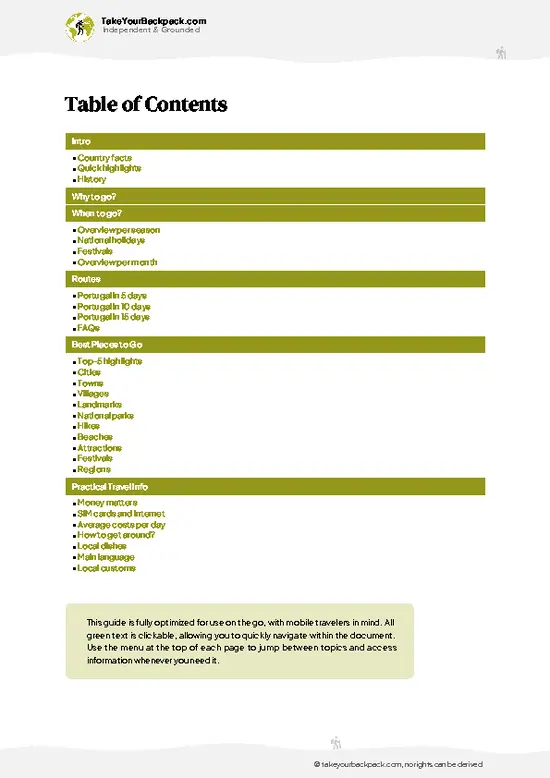
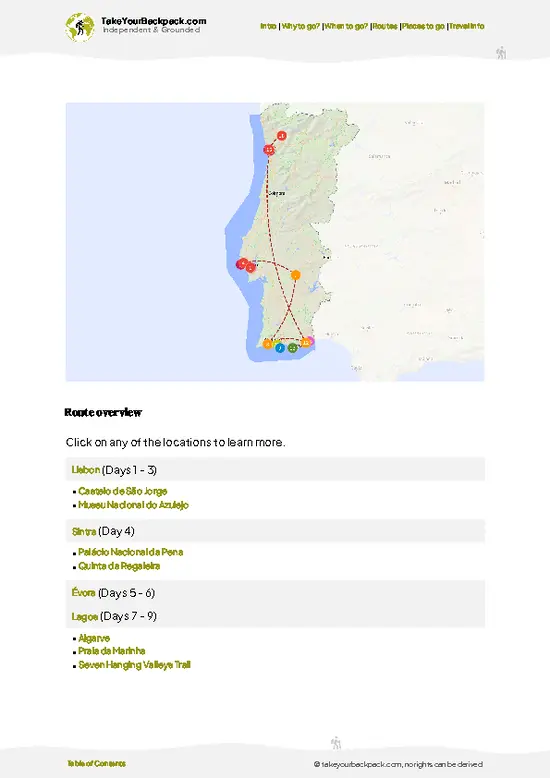
example page 0 from our offline Travel Guide for Portugal
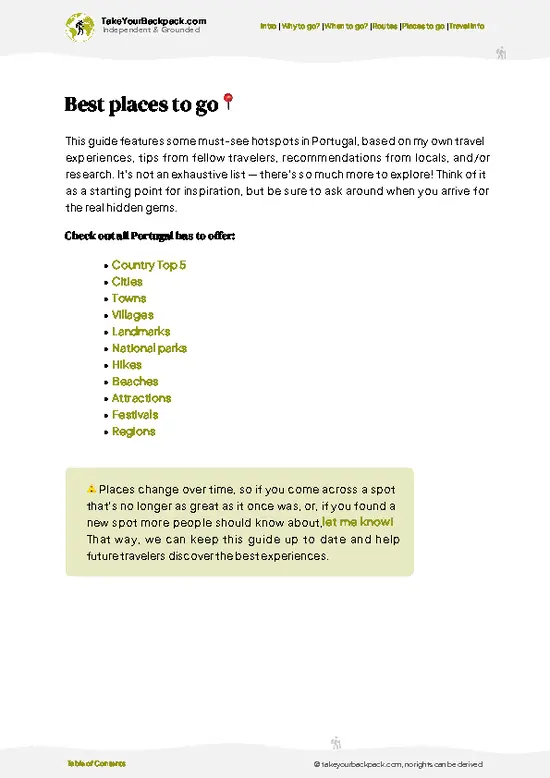
example page 1 from our offline Travel Guide for Portugal
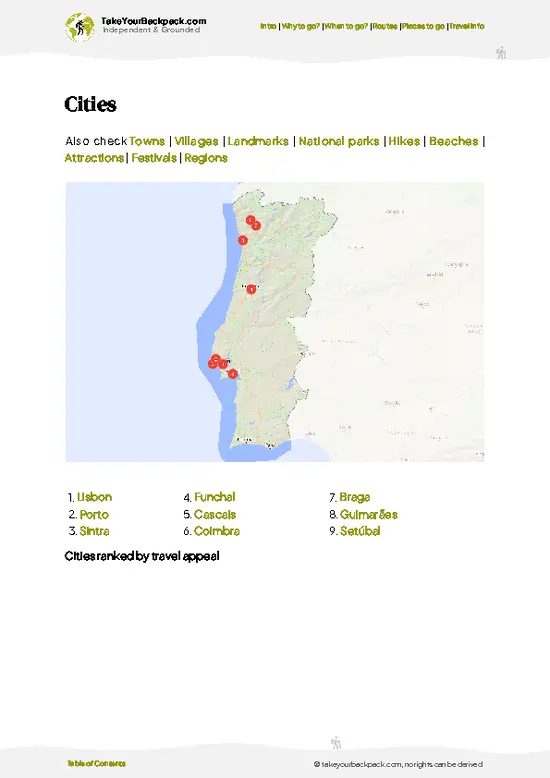
example page 2 from our offline Travel Guide for Portugal
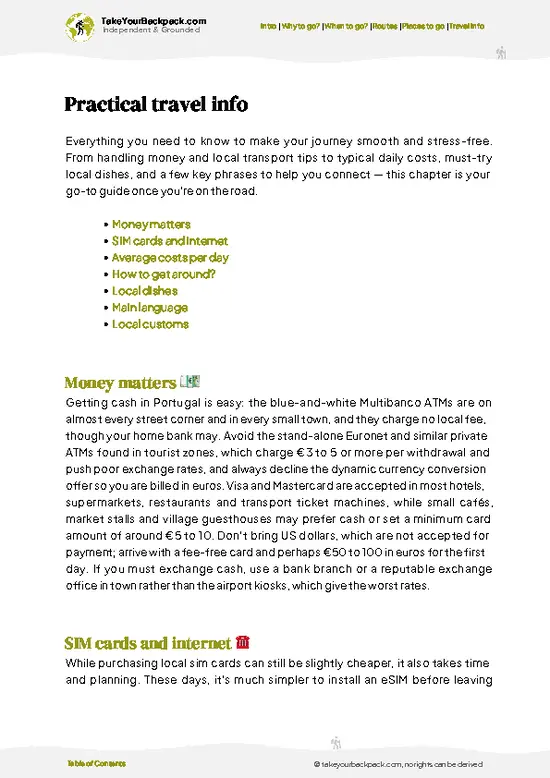
example page 3 from our offline Travel Guide for Portugal
example page 4 from our offline Travel Guide for Portugal
example page 5 from our offline Travel Guide for Portugal
example page 6 from our offline Travel Guide for Portugal
example page 7 from our offline Travel Guide for Portugal
The digital guide (361 pages) contains:
✅ 87 highlights, ranked by travel appeal
✅ Optimized 5, 10 & 15-day travel routes
✅ Cities, national parks, landmarks, beaches
✅ How to get around
✅ Offline-friendly for travel without Wi-Fi
👉 Click to see all 30+ guide features

📅 Plan smarter in minutes, not weeks
✅ Month by month travel advice
✅ Festivals & national holidays
✅ Budget expectations

🗺️ Go to the right places, skip the overrated ones
✅ Honest pros & cons of destinations
✅ Top hikes, parks & viewpoints
✅ Lesser-known places most travelers miss
✅ Clear “worth it vs skip it” guidance

🛏️ Travel smoothly without rookie mistakes
✅ Best areas to stay
✅ Transport systems explained simply
✅ Common scams & safety advice
✅ SIM cards, money & practical tips

🌍 Understand the country, not just visit it
✅ Culture & traditions
✅ 52 Essential phrases & customs
✅ Festivals worth planning around
✅ Traveler-friendly historical context
✅ Insights that make places more meaningful

📱 Built for real travel conditions
✅ Fully downloadable PDF
✅ Works completely offline
✅ Optimized for phone use
✅ Useful in remote areas & buses
✅ Everything in one place
Stop searching, start planning
Get instant access to your full guide. 30‑day money-back guarantee.
+ Add another guide for just

By proceeding you agree to our terms.
Sent to your inbox immediately after payment • 100% Secure Checkout
Best Backpacking Travel Advisor 2025 tourism awardBest Backpacking
Travel Advisor
2025
What others say about Take Your Backpack Guides:
⭐⭐⭐⭐⭐
Fantastic, amazing amount of information!
⭐⭐⭐⭐⭐
My goodness this is amazing, it's what I've been looking for hats off too you!
⭐⭐⭐⭐⭐
I think this is absolutely BRILLIANT
⭐⭐⭐⭐
Very complete and informative. It's still missing places, but I gotta to commend you
⭐⭐⭐⭐⭐
This is truly amazing, thank you, can't wait to explore it with my kids!
⭐⭐⭐⭐⭐
Awesome resource, thank you!
⭐⭐⭐⭐⭐
This is amazing! Can't wait to explore the ones I haven't seen
⭐⭐⭐⭐
I love this! Well done, great idea.
⭐⭐⭐⭐⭐
Thanks for taking the time to make this gem!
⭐⭐⭐⭐⭐
This might be the best website I've ever seen.
⭐⭐⭐⭐⭐
Congratulations, and thank you so much for your work; it's incredibly valuable.
⭐⭐⭐⭐
In all seriousness I think you did a great job pointing out the important spots
⭐⭐⭐⭐⭐
10/10 very good
⭐⭐⭐⭐⭐
As someone who's only just starting to visit regularly this is awesome, thank you.
⭐⭐⭐⭐
Thank you very much! I'm going to visit my dad, it's going to be very useful!
⭐⭐⭐⭐⭐
This is really cool! We'll be travelling for the first time and this definitely come in handy.
⭐⭐⭐⭐⭐
You are now our minister of culture, congratulations 👨‍💼
⭐⭐⭐⭐⭐
Just wanted to tell you that this is a pearl! Going to follow your recommendations.
⭐⭐⭐⭐⭐
This is so cool. I'll definitely be using the resource for my travels soon.
⭐⭐⭐⭐⭐
This is very impressive! Good work.
⭐⭐⭐⭐⭐
This is an amazing and informative site. Very well done!

🛏️ Where to stay?Where to Base Yourself

Portugal has one of Europe’s densest and best-rated hostel scenes, with dorm beds from roughly €18 to €35 in summer and plenty of budget guesthouses outside the big cities. In Lisbon, Baixa and Chiado put you on flat ground near the metro and most sights, Bairro Alto and Cais do Sodré are the nightlife picks but stay loud until 3am, and Alfama is hilly and quieter, with fado bars instead of clubs. In Porto, Ribeira is right on the river but steep and touristy, while Baixa around the university area has more beds, cheaper food and an easy walk to the bars, and on the Algarve Lagos old town is the party hub, so pick a spot a few streets back if you want sleep.

If you enjoy meeting fellow travelers, … read more 👉
Portugal has one of Europe’s densest and best-rated hostel scenes, with dorm beds from roughly €18 to €35 in summer and plenty of budget guesthouses outside the big cities. In Lisbon, Baixa and Chiado put you on flat ground near the metro and most sights, Bairro Alto and Cais do Sodré are the nightlife picks but stay loud until 3am, and Alfama is hilly and quieter, with fado bars instead of clubs. In Porto, Ribeira is right on the river but steep and touristy, while Baixa around the university area has more beds, cheaper food and an easy walk to the bars, and on the Algarve Lagos old town is the party hub, so pick a spot a few streets back if you want sleep.

If you enjoy meeting fellow travelers, consider choosing hostels with high ratings for atmosphere. On the other hand, if you prefer having your own space, a hotel might be a better option.

PortugalExpand Your Journey

👋 Meet the founderWho’s Behind Take Your Backpack?

Johan, backpacker and founder of TakeYourBackpackHi, I’m Johan (Netherlands 🇳🇱), the creator of TakeYourBackpack. Over the past 3 decades, I’ve backpacked through 90+ countries across six continents, gaining extensive experience with independent travel, long-term trips, and overland routes.

This site is built on a combination of firsthand travel experience and carefully curated insights from other backpackers. Many guides are based on places I’ve personally visited, while others bring together tips, observations, and practical advice shared by trusted travelers I’ve met along the way.

The goal is to provide realistic, experience-driven guidance — not generic itineraries — so you can explore destinations with better context, clearer expectations, and more confidence.