×

South Sudan🇸🇸 | best townsDiscover the 10 Best towns Across South Sudan

In South Sudan, the best towns offer a unique blend of charm, culture, and walkability that can shape your entire travel experience. Each region has its own vibe, influenced by local customs and seasonal changes. For instance, towns in the Equatoria region are known for their lush landscapes and welcoming communities, while those in Greater Bahr el Ghazal present a more rugged, traditional atmosphere.

Choosing the right town impacts your budget, safety, and ease of travel. Some areas are more accessible for backpacking and independent travel, while others may require more planning. Understanding these nuances is key to immersing yourself in the rich tapestry of South Sudanese life.

By Johan Kruseman 🇳🇱 | Updated September 4, 2026
Explore the best villages in South Sudan

Why go?Key Factors That Shape the Experience

In South Sudan, towns are more than just dots on a map; they are vibrant reflections of a complex cultural tapestry. Each town carries its own local charm, shaped by the diverse ethnic groups that call this country home. The pace of life is often slower, allowing travelers to engage meaningfully with locals and experience daily routines that feel authentic and unfiltered.

Culinary highlights vary widely, from traditional dishes that showcase local ingredients to street food that bursts with flavor. This is a land where food tells stories, and every meal can be a lesson in history and culture. However, the regional differences are stark; some areas may be more accessible than others, impacting how deeply one can explore the richness of South Sudanese life.

Travelers should consider the trade-offsread more 👉
In South Sudan, towns are more than just dots on a map; they are vibrant reflections of a complex cultural tapestry. Each town carries its own local charm, shaped by the diverse ethnic groups that call this country home. The pace of life is often slower, allowing travelers to engage meaningfully with locals and experience daily routines that feel authentic and unfiltered.

Culinary highlights vary widely, from traditional dishes that showcase local ingredients to street food that bursts with flavor. This is a land where food tells stories, and every meal can be a lesson in history and culture. However, the regional differences are stark; some areas may be more accessible than others, impacting how deeply one can explore the richness of South Sudanese life.

Travelers should consider the trade-offs involved in their itineraries. Clustering towns can save time but may limit the depth of exploration. Conversely, venturing into more remote areas can yield immersive experiences but often requires significant travel time. The infrastructure is still developing, which can affect accessibility and comfort levels.

Understanding these dynamics is crucial. South Sudan is uniquely positioned for those seeking genuine experiences, but the realities of travel here demand patience and flexibility. Embrace the journey, and you’ll uncover the heart of a nation still finding its way.
Evaluating the Top Choices
The list of best towns in South Sudan is created based on charm, local culture, atmosphere, hidden gems, and visitor appeal. If you feel a town is missing in this list, please let us know.

When to go?Seasonal Guide to Visiting

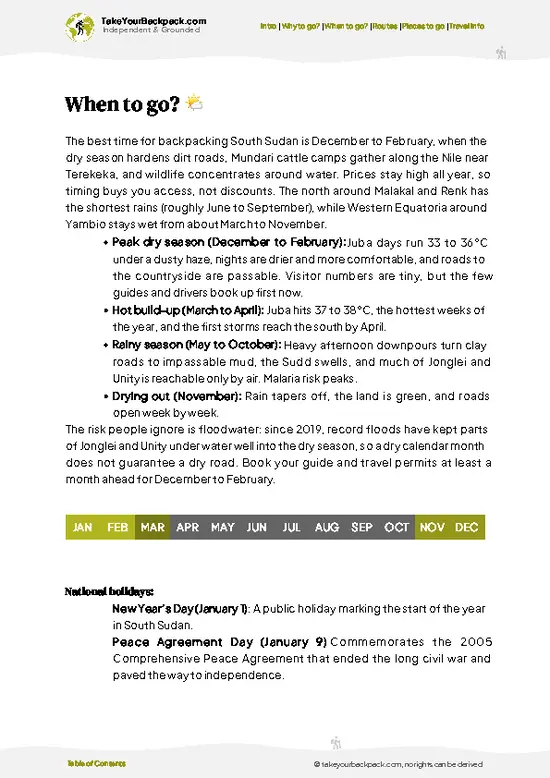
Seasonality plays a crucial role in the experience of towns across South Sudan. The country has a tropical climate, characterized by a distinct wet and dry season. The dry season, typically from November to March, offers the most favorable weather. Expect warm temperatures and lower humidity, making it ideal for exploring local life and engaging with communities. This period also coincides with various cultural events, showcasing the vibrant traditions of the region.

April to October marks the wet season, bringing heavy rains that can disrupt travel plans. While the landscape transforms into lush greenery, many roads become impassable, and some towns may feel isolated. However, this season can also provide unique opportunities to witness local agricultural practices and the resilience of … read more 👉
Seasonality plays a crucial role in the experience of towns across South Sudan. The country has a tropical climate, characterized by a distinct wet and dry season. The dry season, typically from November to March, offers the most favorable weather. Expect warm temperatures and lower humidity, making it ideal for exploring local life and engaging with communities. This period also coincides with various cultural events, showcasing the vibrant traditions of the region.

April to October marks the wet season, bringing heavy rains that can disrupt travel plans. While the landscape transforms into lush greenery, many roads become impassable, and some towns may feel isolated. However, this season can also provide unique opportunities to witness local agricultural practices and the resilience of communities adapting to the rains.

Shoulder seasons exist between these extremes, particularly in late October and early November, where travelers might encounter fewer crowds and lower costs. Yet, the weather can be unpredictable, with lingering rains affecting accessibility.

Understanding these patterns is essential for planning. The best experiences often come from timing visits to align with local events while considering the trade-offs of weather and accessibility. Prioritize the dry months for a smoother journey, but remain flexible to embrace the unexpected.

town hoppingOptimizing Your Multi-Stop Itinerary

Traveling through South Sudan requires a smart approach to maximize experiences while minimizing fatigue. Start by clustering towns within regions. For instance, focus on the Central Equatoria area first, then move to Western Bahr el Ghazal. This not only saves time but also allows for a deeper dive into local cultures.

Plan for at least two to three days in each town. This pacing helps avoid the whirlwind effect that leaves travelers feeling rushed and disconnected. Each stop should offer unique insights into South Sudan’s rich tapestry, so take the time to engage with locals and explore beyond the surface.

A common mistake is underestimating travel times. Roads can be unpredictable, and distances may seem shorter on a map. Always factor in extra time for travel and potential delays. read more 👉
Traveling through South Sudan requires a smart approach to maximize experiences while minimizing fatigue. Start by clustering towns within regions. For instance, focus on the Central Equatoria area first, then move to Western Bahr el Ghazal. This not only saves time but also allows for a deeper dive into local cultures.

Plan for at least two to three days in each town. This pacing helps avoid the whirlwind effect that leaves travelers feeling rushed and disconnected. Each stop should offer unique insights into South Sudan’s rich tapestry, so take the time to engage with locals and explore beyond the surface.

A common mistake is underestimating travel times. Roads can be unpredictable, and distances may seem shorter on a map. Always factor in extra time for travel and potential delays. Flexibility is key; be prepared to adjust plans based on local conditions.

Consider the trade-offs between speed and depth. Rushing through towns may save time but sacrifices meaningful interactions. Budget constraints can also impact comfort levels, so weigh the benefits of splurging on a local guide against the potential for richer experiences. Ultimately, the goal is to balance effort with reward, ensuring that each stop adds value to the journey.

The ListThe Best towns of South Sudan

1 Nimule

national park gateway, White Nile rapids, border crossing

Cross into Uganda or enter wildlife-rich landscapes, with river views and easy access to South Sudan’s best-known park.

2 Yambio

tropical forests, Azande heartland, fruit markets

Walk through lush surroundings and taste fresh produce in a town known for its greenery and Azande cultural roots.

3 Kapoeta

Toposa settlements, dry savanna, livestock markets

Navigate open plains and interact with Toposa communities, where livestock trading and traditional jewelry define daily life.

4 Mundri

river crossings, Moru communities, forested outskirts

Cross rivers and meet Moru people in a town where forest and farmland blend at the edge of the Western Equatoria.

5 Terekeka

Nile banks, fishing camps, Mundari cattle

Watch herders move cattle along the Nile and see fishing camps that shape the local economy and daily routines.

6 Tonj

cattle camps, rural markets, Dinka Bor influence

Observe daily life in a town where cattle culture and rural trade are central, reflecting Dinka Bor traditions.

7 Gogrial

riverbank town, cattle herding, Dinka Agaar

See herders along the river and explore a town where Dinka Agaar customs and livestock define the landscape.

8 Akobo

Ethiopian border, Lou Nuer area, floodplain villages

Reach a borderland town shaped by cross-border ties and seasonal flooding, with a strong Lou Nuer presence.

9 Pibor

river confluence, Murle communities, remote outpost

Venture to a riverside town marked by isolation, where the rhythms of the Murle people and the river set the tone.

10 Pochalla

Anyuak villages, riverine forests, Ethiopian border

Cross into a border town where riverine forests and Anyuak culture create a distinct atmosphere near Ethiopia.

11 Raga

remote northwest, forested borderlands, trade outpost

Reach a distant town near the Central African Republic, where forest and cross-border trade shape daily rhythms.

12 Nzara

rubber plantations, forest fringe, old factory sites

Walk past remnants of colonial industry and through forested areas, where rubber and timber once drove the economy.

13 Lafon

hilltop villages, Lopit communities, seasonal migration

Climb into the hills to meet Lopit people, where migration and terraced settlements define the landscape.

14 Lainya

forest corridor, smallholder farms, roadside villages

Travel a green corridor lined with farms and villages, where the forest and agriculture blend along the main road.

15 Leer

swampy terrain, Nuer villages, seasonal isolation

Navigate challenging wetlands and visit Nuer settlements, where access depends on the rains and the land feels remote.

16 Yirol

lakeshore town, fishing communities, cattle herding

Spend time in a lakeside town where fishing and cattle herding shape the rhythms of work and social life.

17 Fashoda

Shilluk kingdom, Nile bend, cultural heritage

Discover a town with deep Shilluk roots, set on a river bend and known for its unique cultural significance.

18 Tali

rural outpost, Mundari settlements, open grassland

Experience a remote area where Mundari communities live among wide grasslands and daily life moves at a steady pace.

19 Panyijar

swamp islands, Nuer heartland, seasonal fishing

Move between islands in a watery landscape, where fishing and Nuer traditions are central to life.

20 Raja

wooded savanna, trade routes, ethnic diversity

Experience a crossroads town surrounded by woodland, where multiple groups meet and trade shapes the local scene.

Think you know South Sudan?

Prove you’re a true local — uncover 10 lesser-known towns in South Sudan that locals tend to keep to themselves.
Loading the map 🌍

Expert viewInsights from Locals and Experts

Expert Commentary


South Sudan is a land of contrasts, and its towns reflect the rich tapestry of cultures, histories, and challenges that define this young nation. When planning your journey, aim to visit around three to five towns. This range allows you to soak in the local vibe without feeling rushed or overwhelmed. Each town has its own character, and the travel rhythm can vary significantly, so don’t bite off more than you can chew.

Regional Clustering


Consider clustering your visits based on geographical proximity. The towns in the Greater Upper Nile region, for instance, offer a unique perspective on the country’s resilience and spirit. Here, you’ll encounter a mix of ethnic groups, each with its own traditions and stories. However, be prepared for the infrastructure challenges. Roads … read more 👉

Expert Commentary


South Sudan is a land of contrasts, and its towns reflect the rich tapestry of cultures, histories, and challenges that define this young nation. When planning your journey, aim to visit around three to five towns. This range allows you to soak in the local vibe without feeling rushed or overwhelmed. Each town has its own character, and the travel rhythm can vary significantly, so don’t bite off more than you can chew.

Regional Clustering


Consider clustering your visits based on geographical proximity. The towns in the Greater Upper Nile region, for instance, offer a unique perspective on the country’s resilience and spirit. Here, you’ll encounter a mix of ethnic groups, each with its own traditions and stories. However, be prepared for the infrastructure challenges. Roads can be rough, and travel times may stretch longer than anticipated. Factor in extra time for delays, and don’t underestimate the impact of weather on your plans.

Local Charm


Each town has its own charm, often found in the daily lives of its residents. Markets buzz with activity, and local cuisine offers flavors that tell stories of heritage and survival. Engage with the locals; they’re often eager to share their culture. However, be mindful of cultural sensitivities. Dress modestly and approach conversations with respect. This isn’t just about being polite; it’s about building trust.

Logistical Considerations


Logistics can be a headache, but they’re part of the adventure. Transportation options are limited, and while you might find some public transport, it’s often unreliable. Hiring a local driver can be a worthwhile investment, allowing you to navigate the terrain more efficiently. Budget-wise, expect to spend more than you would in other countries for basic services, so plan accordingly.

Safety & Cultural Considerations


Safety is paramount. While many areas are welcoming, some regions may have underlying tensions. Always stay updated on local news and heed travel advisories. It’s wise to connect with local guides who can provide insights into safe areas and cultural norms. They can also help you avoid potential pitfalls, like inadvertently offending someone with a misstep in etiquette.

Trade-offs and Constraints


One significant trade-off is the balance between comfort and authenticity. While you might find a few upscale accommodations, many options are basic. This can be a shock if you’re used to certain standards. Embrace the simplicity; it’s part of the experience. You’ll find that the connections you make in these settings often outweigh the comforts of a hotel.

In conclusion, navigating South Sudan’s towns requires a blend of flexibility, respect, and a willingness to adapt. The rewards are immense, from the stories shared over a meal to the breathtaking landscapes that surround you. Prioritize your visits based on what resonates with you, and remember: it’s not just about the destinations, but the journey and the people you meet along the way.

✈️ The backpacker research shortcutSouth Sudan Travel Guide

An offline-friendly backpacking guide with optimized travel routes, ranked highlights, transport advice, and the best areas to stay.
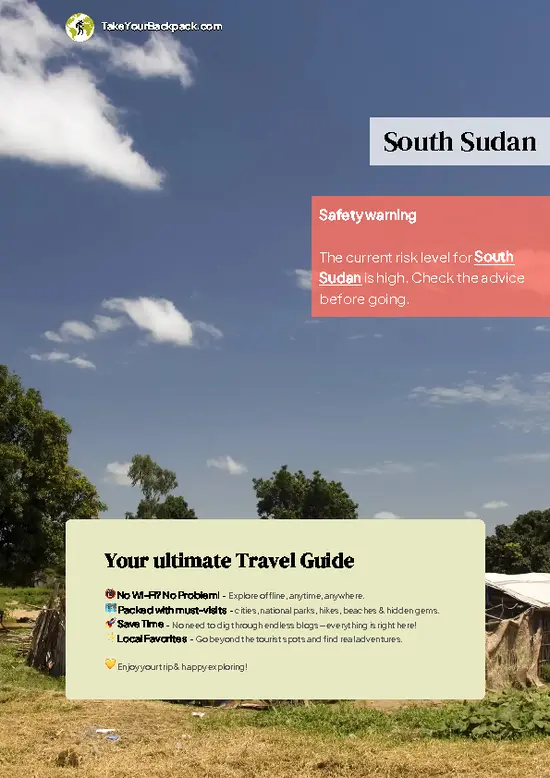
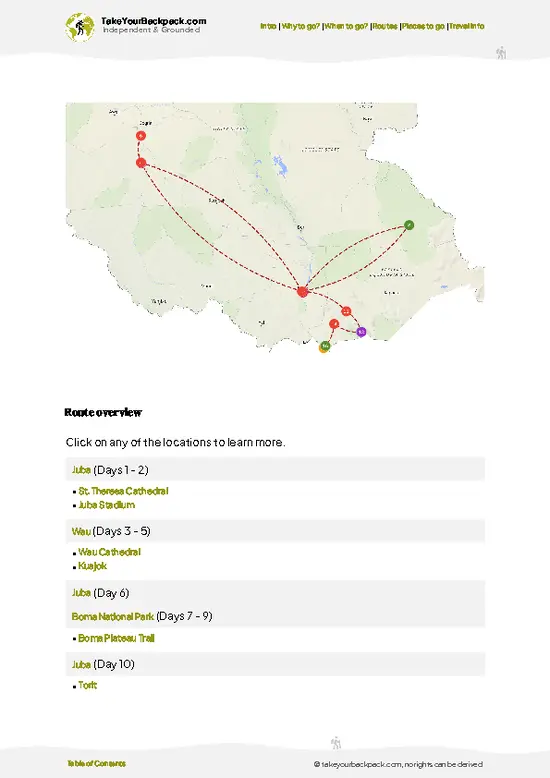
example page 0 from our offline Travel Guide for South Sudan
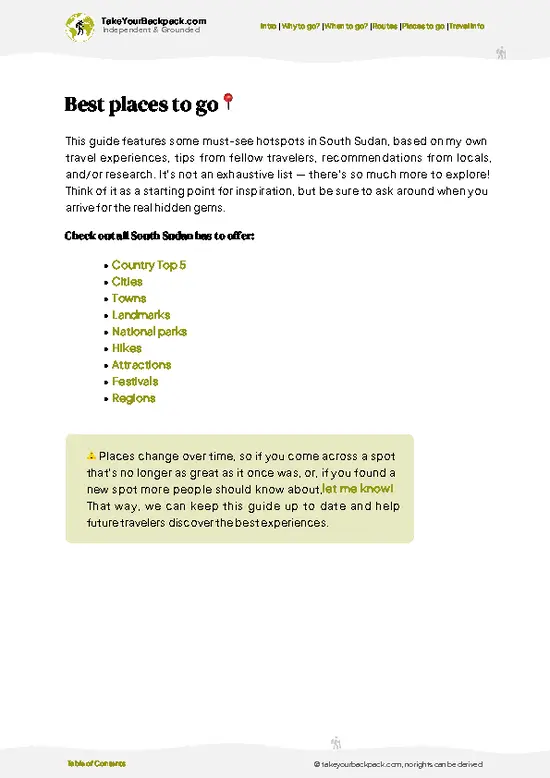
example page 1 from our offline Travel Guide for South Sudan
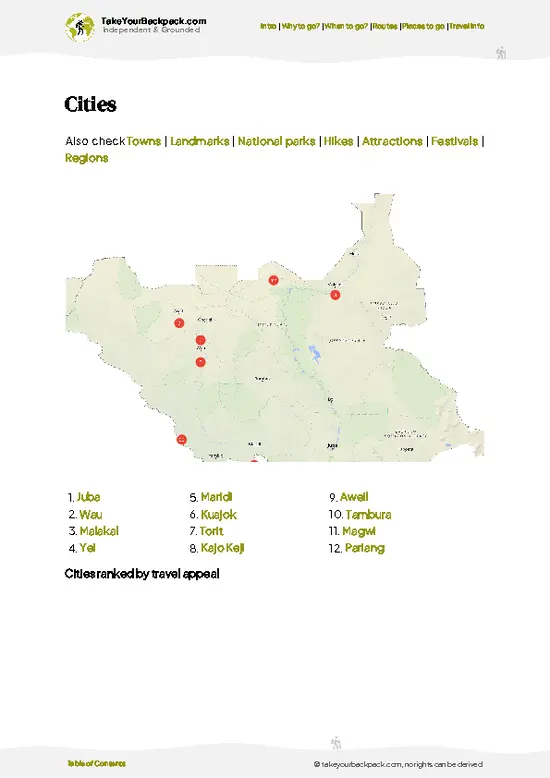
example page 2 from our offline Travel Guide for South Sudan
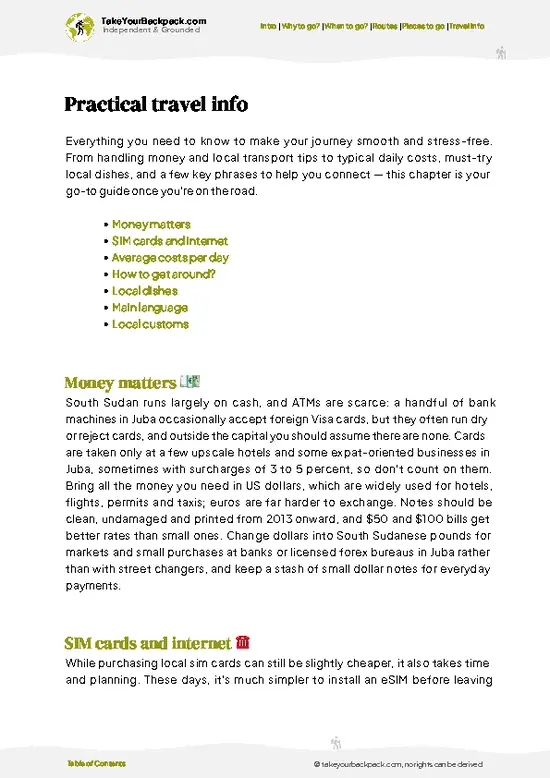
example page 3 from our offline Travel Guide for South Sudan
example page 4 from our offline Travel Guide for South Sudan
example page 5 from our offline Travel Guide for South Sudan
example page 6 from our offline Travel Guide for South Sudan
example page 7 from our offline Travel Guide for South Sudan
The digital guide (270 pages) contains:
68 highlights, ranked by travel appeal
Optimized 5, 10 & 15-day travel routes
Cities, national parks, landmarks, beaches
How to get around
Offline-friendly for travel without Wi-Fi
👉 Click to see all 30+ guide features

📅 Plan smarter in minutes, not weeks
Month by month travel advice
Festivals & national holidays
Budget expectations

🗺️ Go to the right places, skip the overrated ones
Honest pros & cons of destinations
Top hikes, parks & viewpoints
Lesser-known places most travelers miss
Clear “worth it vs skip it” guidance

🛏️ Travel smoothly without rookie mistakes
Best areas to stay
Transport systems explained simply
Common scams & safety advice
SIM cards, money & practical tips

🌍 Understand the country, not just visit it
Culture & traditions
52 Essential phrases & customs
Festivals worth planning around
Traveler-friendly historical context
Insights that make places more meaningful

📱 Built for real travel conditions
Fully downloadable PDF
Works completely offline
Optimized for phone use
Useful in remote areas & buses
Everything in one place
Save weeks of stressful planning
Get instant access to your full guide. 30‑day money-back guarantee.
+ Add another guide for just US$7.80

By proceeding you agree to our terms.
Sent to your inbox immediately after payment • 100% Secure Checkout
Best Backpacking Travel Advisor 2025 tourism awardBest Backpacking
Travel Advisor
2025
What others say about Take Your Backpack Guides:
⭐⭐⭐⭐⭐
Fantastic, amazing amount of information!
⭐⭐⭐⭐⭐
My goodness this is amazing, it's what I've been looking for hats off too you!
⭐⭐⭐⭐⭐
I think this is absolutely BRILLIANT
⭐⭐⭐⭐
Very complete and informative. It's still missing places, but I gotta to commend you
⭐⭐⭐⭐⭐
This is truly amazing, thank you, can't wait to explore it with my kids!
⭐⭐⭐⭐⭐
Awesome resource, thank you!
⭐⭐⭐⭐⭐
This is amazing! Can't wait to explore the ones I haven't seen
⭐⭐⭐⭐
I love this! Well done, great idea.
⭐⭐⭐⭐⭐
Thanks for taking the time to make this gem!
⭐⭐⭐⭐⭐
This might be the best website I've ever seen.
⭐⭐⭐⭐⭐
Congratulations, and thank you so much for your work; it's incredibly valuable.
⭐⭐⭐⭐
In all seriousness I think you did a great job pointing out the important spots
⭐⭐⭐⭐⭐
10/10 very good
⭐⭐⭐⭐⭐
As someone who's only just starting to visit regularly this is awesome, thank you.
⭐⭐⭐⭐
Thank you very much! I'm going to visit my dad, it's going to be very useful!
⭐⭐⭐⭐⭐
This is really cool! We'll be travelling for the first time and this definitely come in handy.
⭐⭐⭐⭐⭐
You are now our minister of culture, congratulations 👨‍💼
⭐⭐⭐⭐⭐
Just wanted to tell you that this is a pearl! Going to follow your recommendations.
⭐⭐⭐⭐⭐
This is so cool. I'll definitely be using the resource for my travels soon.
⭐⭐⭐⭐⭐
This is very impressive! Good work.
⭐⭐⭐⭐⭐
This is an amazing and informative site. Very well done!

🛏️ Where to stay?Best Places to Stay in South Sudan

There are very few formal hostels in South Sudan; budget options are mostly basic guesthouses and small hotels concentrated in Juba with sporadic lodgings in regional centers like Malakal, Wau and Bentiu.
In Juba the most choices cluster in the Central Business District / Kator (closest to restaurants, government offices and NGO hubs but busier and subject to checkpoints), Gudele (near the airport and NGO compounds, quieter and often relatively secure but with fewer amenities) and the riverfront/Jebel areas (more scenic and quiet evenings but limited budget availability).
Outside the capital expect very basic facilities, intermittent water and power, strict security procedures and limited … read more 👉
There are very few formal hostels in South Sudan; budget options are mostly basic guesthouses and small hotels concentrated in Juba with sporadic lodgings in regional centers like Malakal, Wau and Bentiu.
In Juba the most choices cluster in the Central Business District / Kator (closest to restaurants, government offices and NGO hubs but busier and subject to checkpoints), Gudele (near the airport and NGO compounds, quieter and often relatively secure but with fewer amenities) and the riverfront/Jebel areas (more scenic and quiet evenings but limited budget availability).
Outside the capital expect very basic facilities, intermittent water and power, strict security procedures and limited nightlife, so arrive in daylight, carry cash, pack basic bedding and insect protection, and plan to use guesthouses that cater to foreigners rather than relying on backpacker-style hostels.

If you enjoy meeting fellow travelers, consider choosing hostels with high ratings for atmosphere. On the other hand, if you prefer having your own space, a hotel might be a better option.

South SudanExplore South Sudan

👋 Meet the founderWho’s Behind Take Your Backpack?

Johan, backpacker and founder of TakeYourBackpackHi, I’m Johan (Netherlands 🇳🇱), the creator of TakeYourBackpack. Over the past decade, I’ve backpacked through 80+ countries across six continents, gaining extensive experience with independent travel, long-term trips, and overland routes.

This site is built on a combination of firsthand travel experience and carefully curated insights from other backpackers. Many guides are based on places I’ve personally visited, while others bring together tips, observations, and practical advice shared by trusted travelers I’ve met along the way.

The goal is to provide realistic, experience-driven guidance — not generic itineraries — so you can explore destinations with better context, clearer expectations, and more confidence.

Get full country guide •
Instant download • 68 highlights • Full Offline guide