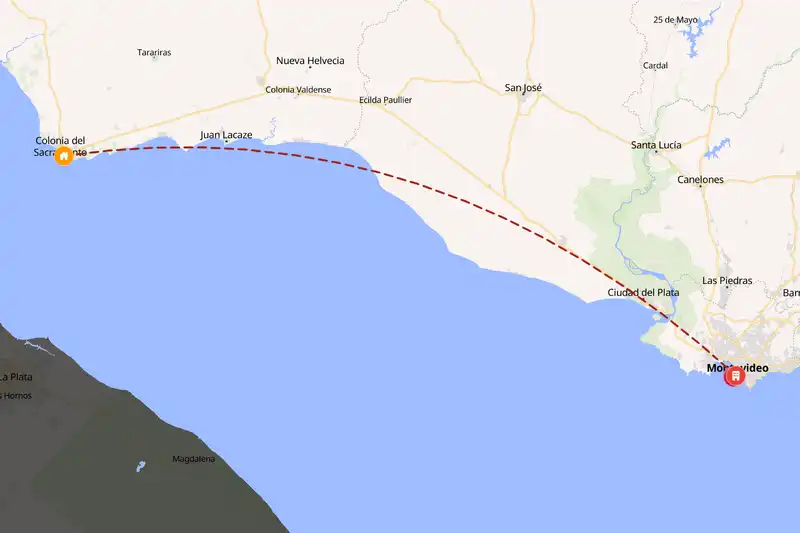
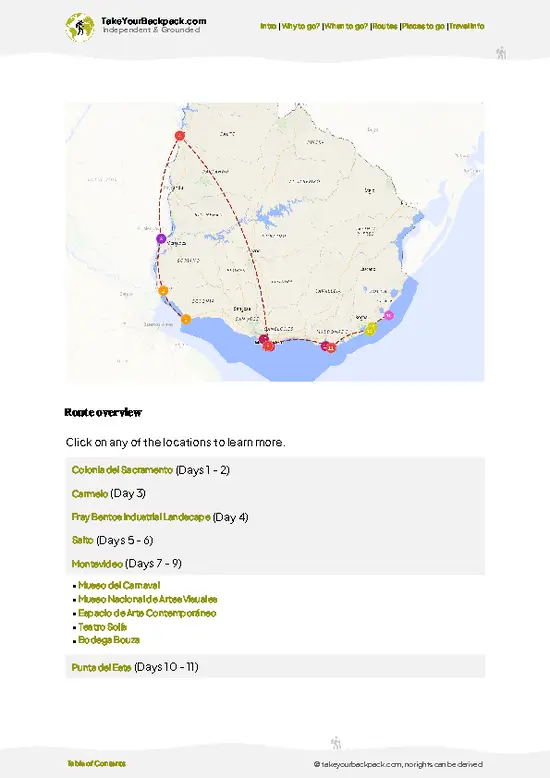
This fifteen-day loop around Uruguay suits travelers with time to see the country beyond its beaches: the colonial river ports and meatpacking towns of the west, the hot springs of the north, the capital’s museums, and a finale on the Rocha coast. The pace is relaxed, with two or three nights at most stops and only one bus ride over six hours, followed by three unhurried days. Intercity buses carry you the whole way, with the ferry from Buenos Aires as an optional start and 4x4 trucks for the final crossing into Cabo Polonio.
Days 1-2: Colonia del Sacramento
Begin in
Colonia del Sacramento, which works as the western gateway whether you sail in from Argentina or bus up from Montevideo. Treat it as a slow start: two nights, a bike for the riverside road, and late dinners once the ferry crowds thin out. Use the combined ticket for the
Colonia del Sacramento Historic Quarter Museums to understand why this tiny town changed hands between Portugal and Spain repeatedly in the 1700s. The azulejo …
read more 👉This fifteen-day loop around Uruguay suits travelers with time to see the country beyond its beaches: the colonial river ports and meatpacking towns of the west, the hot springs of the north, the capital’s museums, and a finale on the Rocha coast. The pace is relaxed, with two or three nights at most stops and only one bus ride over six hours, followed by three unhurried days. Intercity buses carry you the whole way, with the ferry from Buenos Aires as an optional start and 4x4 trucks for the final crossing into Cabo Polonio.
Days 1-2: Colonia del Sacramento
Begin in Colonia del Sacramento, which works as the western gateway whether you sail in from Argentina or bus up from Montevideo. Treat it as a slow start: two nights, a bike for the riverside road, and late dinners once the ferry crowds thin out. Use the combined ticket for the Colonia del Sacramento Historic Quarter Museums to understand why this tiny town changed hands between Portugal and Spain repeatedly in the 1700s. The azulejo museum and the Portuguese house fill in the story behind the stone walls and crooked lanes.Days 3-4: Carmelo and Fray Bentos
Follow the river north. Carmelo, about 1 hour 15 minutes by bus, is a quiet port on the Arroyo de las Vacas with a hand-operated swing bridge and family wineries on its outskirts that you can reach by bicycle. One night is enough to taste a few tannats and watch the boats come in. Next morning, continue to Fray Bentos, roughly 3 hours away via Mercedes. The old Anglo meatworks here once shipped corned beef and stock cubes across the world, and the riverside plant is now a UNESCO World Heritage site with a museum covering cold stores, machinery and offices left largely as the workers left them.Days 5-6: Salto
Push on to Salto, Uruguay’s second-largest city, about 4 hours upriver. Two nights give you time for a soak at the Termas del Daymán, public hot spring pools about 10 km south of town, and a look at the Salto Grande dam to the north. The riverside promenade and a colonnaded center are good for an easy walk, and this is the only part of the trip where you will be one of few foreign faces.Days 7-9: Montevideo
Day seven is the long ride: about 6.5 hours by bus south to Montevideo. Three nights here let you spend a full day on art and carnival. The Museo del Carnaval by the port explains murga and candombe with costumes, drums and recordings. The free Museo Nacional de Artes Visuales in Parque Rodó holds the country’s largest collection of Uruguayan painting, including Pedro Figari and Joaquín Torres García. The Espacio de Arte Contemporáneo fills the cell blocks of the former Miguelete prison with rotating exhibitions. Catch a performance at Teatro Solís on one evening, and give an afternoon to Bodega Bouza, a family winery about 25 minutes from the center known for tannat and albariño, with a vintage car collection on site.Days 10-11: Punta del Este
A 2-hour bus takes you to Punta del Este. Skip the nightlife strip and spend your two days on the art angle instead. Casapueblo, the white sculptural house Carlos Páez Vilaró built by hand on the cliffs of Punta Ballena, holds a museum of his paintings and ceramics. The Museo Ralli, in a quiet residential district, displays Latin American art and a set of Dalí sculptures, and admission is free.Day 12: La Paloma and La Pedrera
Head east to La Paloma, a laid-back surf town in Rocha with the Cabo Santa María lighthouse at its tip. Stay one night and use the afternoon to visit La Pedrera, about 10 km up the coast, where a low cliff overlooks a long surf beach and a small strip of cafés and wooden houses.Days 13-15: Cabo Polonio
Finish where the road ends. From the Cabo Polonio gate on the coast road, trucks bounce about 7 km over the dunes into Cabo Polonio, a cluster of shacks and hostels with no paved streets and very little electricity. Two nights here mean dark skies, the lighthouse beam sweeping the dunes, and the sea lion colony grunting on the rocks below. On day fifteen, ride the truck out and catch a bus back to Montevideo, about 4.5 hours.
If you have a free day in the west, detour to the Gruta del Palacio near Trinidad, a small cave of natural rock columns that most travelers in Uruguay never hear about.v2.webp)
 Best Backpacking