×
Benin🇧🇯 | 5 days itinerary

A Complete 5-Day Plan for Benin

By Johan Kruseman 🇳🇱 | Updated May 12, 2026
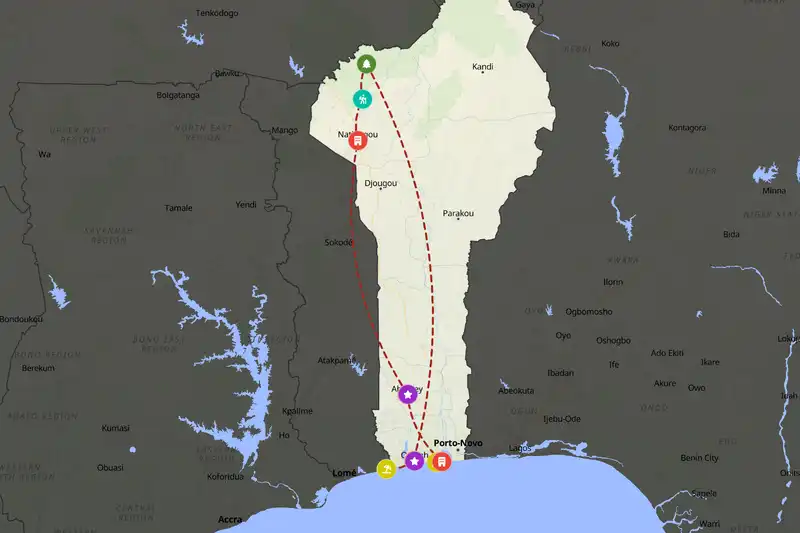
This 5-day coastal loop is for travelers who want a deep dive into Benin’s history and voodoo culture without racing across the whole country, moving at a relaxed pace using mainly taxis, moto-taxis, and short bush-taxi hops between cities. You’ll base yourself in and around Cotonou and Ouidah, trading long bus rides for slow mornings, strong coffee, and time to actually sit with what you’re seeing.

Days 1-2: Cotonou & Ganvie Stilt Village

Start in Cotonou, Benin’s chaotic, addictive hub, where the goal isn’t to tick off monuments but to feel the city’s pulse. Use your first afternoon to get your bearings and then head to Cotonou’s Artisanal Center or the Centre Artisanal de Cotonou to see how wood, fabric, and bronze are worked before they end up in markets across West Africa; this is where you start to understand how art and daily life blur together. On day two, take a boat trip out to Ganvie Stilt Village, a must-see that feels like a floating world of its own, with houses on stilts, … read more 👉
This 5-day coastal loop is for travelers who want a deep dive into Benin’s history and voodoo culture without racing across the whole country, moving at a relaxed pace using mainly taxis, moto-taxis, and short bush-taxi hops between cities. You’ll base yourself in and around Cotonou and Ouidah, trading long bus rides for slow mornings, strong coffee, and time to actually sit with what you’re seeing.

Days 1-2: Cotonou & Ganvie Stilt Village

Start in Cotonou, Benin’s chaotic, addictive hub, where the goal isn’t to tick off monuments but to feel the city’s pulse. Use your first afternoon to get your bearings and then head to Cotonou’s Artisanal Center or the Centre Artisanal de Cotonou to see how wood, fabric, and bronze are worked before they end up in markets across West Africa; this is where you start to understand how art and daily life blur together. On day two, take a boat trip out to Ganvie Stilt Village, a must-see that feels like a floating world of its own, with houses on stilts, kids paddling dugout canoes to school, and fishermen working the lagoon; it’s one of those places where you suddenly grasp how people have adapted to water as home, not obstacle, and it sets the tone for how inventive Beninese communities are in shaping their environment.

Days 3-4: Ouidah - Voodoo, Memory, and the Atlantic

Transfer by road to Ouidah, a short but atmospheric ride that shifts you from urban sprawl to a town loaded with layered history. Spend your first afternoon between the Musée d’Histoire de Ouidah and the Temple des Pythons de Ouidah, where the story of the slave trade, Portuguese forts, and voodoo traditions all collide; this is where Benin stops being abstract and becomes personal, especially when you follow the narrative from the museum out into the streets. The next day, walk or ride out to Ouidah Beach, tracing the symbolic route many enslaved people took toward the ocean, and give yourself time to sit with the weight of that history while watching present-day life unfold along the sand; the contrast between heavy stories and everyday joy is exactly why Ouidah hits so hard.

Day 5: Cotonou & Fidjrosse Beach Wind-Down

Head back to Cotonou for a final day that’s deliberately light, letting everything you’ve seen settle in. Spend the afternoon at Fidjrosse Beach, where you can watch football games in the sand, snack on grilled fish, and see how locals actually use the coast as a living room rather than a postcard; it’s a soft landing that keeps you in the present after several days of intense history and culture, and it makes leaving Benin feel more like pausing a story than closing a book.
As a final secret tip, if you ever have an extra half-day, detouring to the quiet lagoon-side hamlet of Avlékété village (not the beach) gives you a raw, low-key glimpse of coastal life far from any crowds.
Loading the map 🌍

🛏️ Where to stay?Itinerary Summary

✈️ The backpacker research shortcutBenin Travel Guide

An offline-friendly backpacking guide with optimized travel routes, ranked highlights, transport advice, and the best areas to stay.
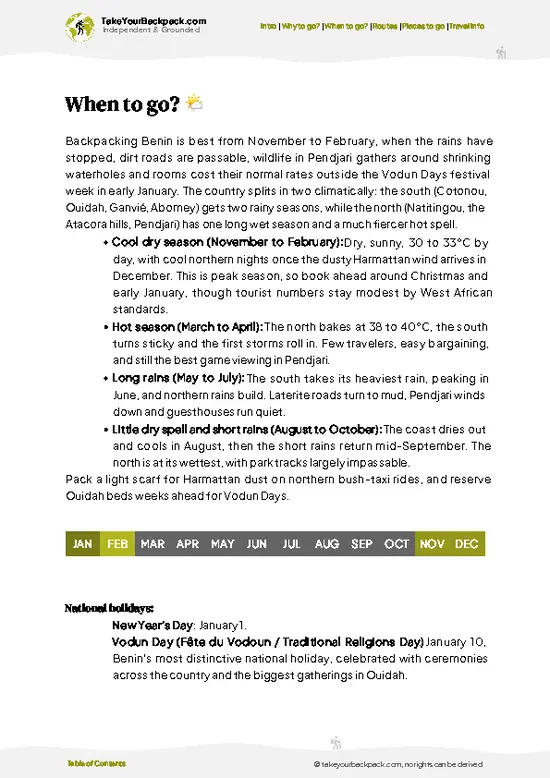
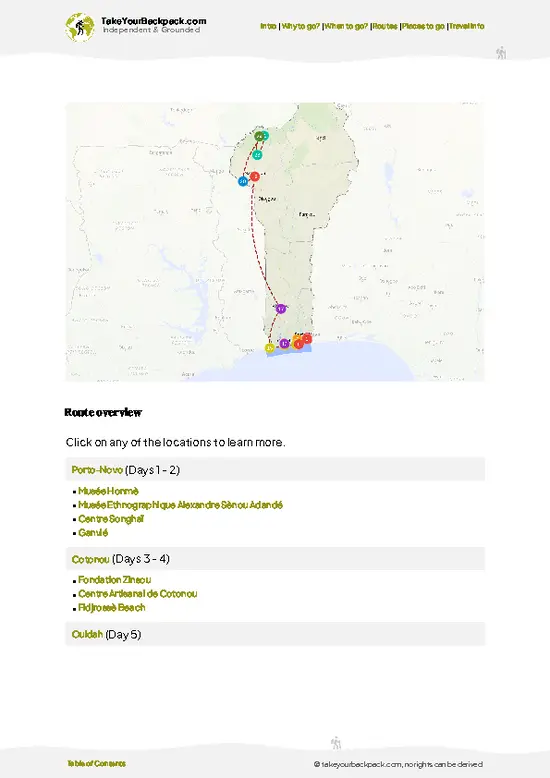
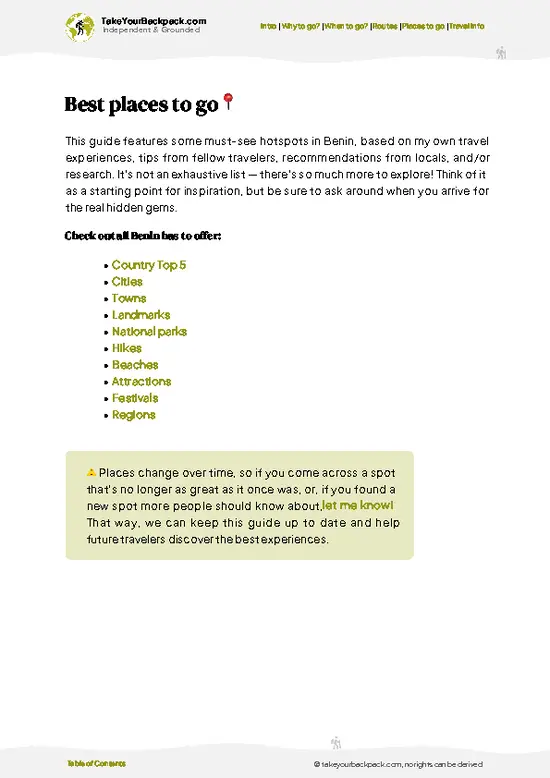
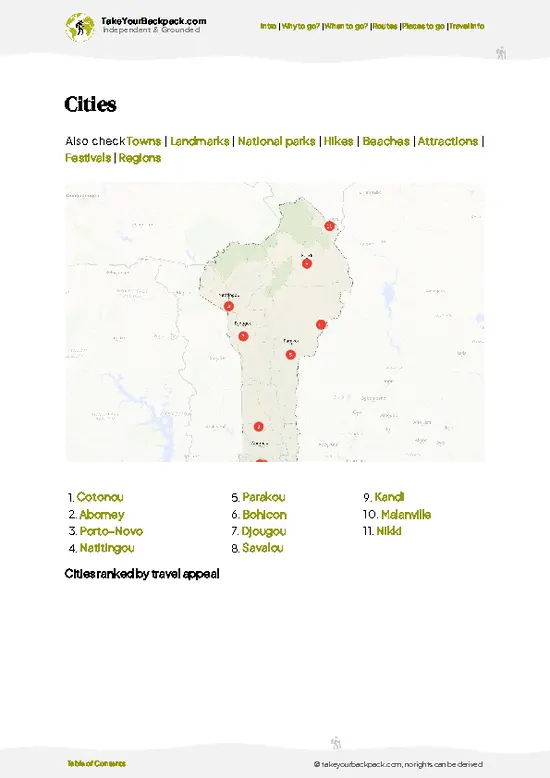
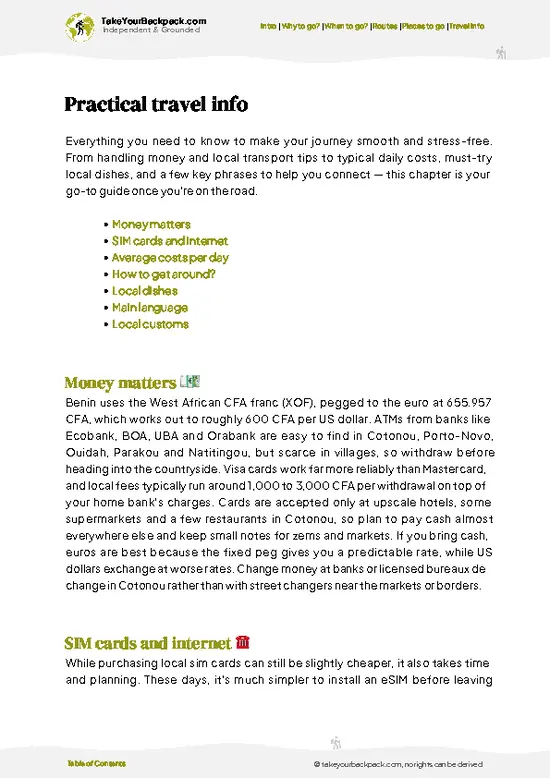
example page 0 from our offline Travel Guide for Beninexample page 1 from our offline Travel Guide for Beninexample page 2 from our offline Travel Guide for Beninexample page 3 from our offline Travel Guide for Beninexample page 4 from our offline Travel Guide for Beninexample page 5 from our offline Travel Guide for Benin
The digital guide (234 pages) contains:
64 highlights, ranked by travel appeal
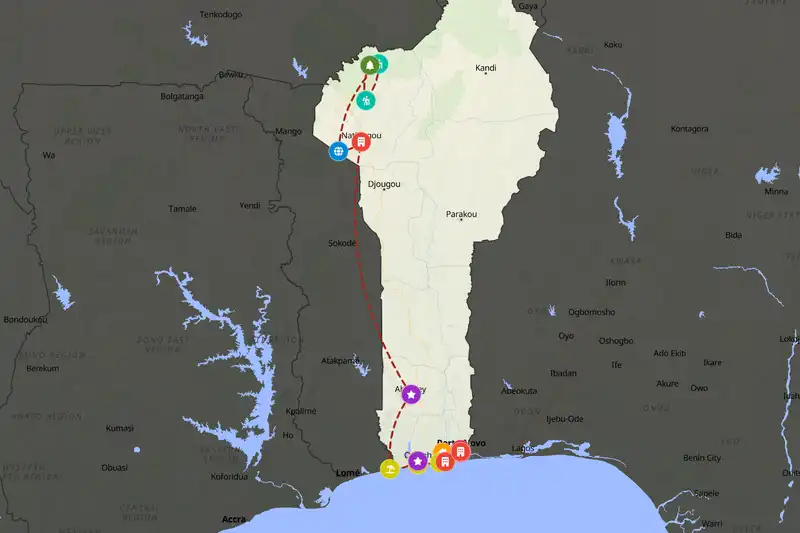
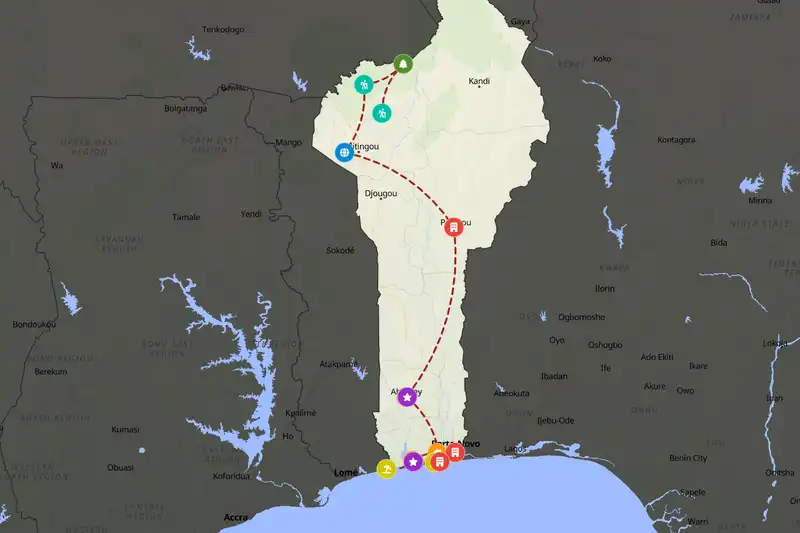
Optimized 5, 10 & 15-day travel routes
Best neighborhoods to stay
How to get around
Offline-friendly for travel without Wi-Fi
👉 See all 30+ guide features

📅 Plan smarter in minutes, not weeks
Month by month travel advice
Festivals & national holidays
Budget expectations

🗺️ Go to the right places, skip the overrated ones
Honest pros & cons of destinations
Top hikes, parks & viewpoints
Lesser-known places most travelers miss
Clear “worth it vs skip it” guidance

🛏️ Travel smoothly without rookie mistakes
Best areas to stay
Transport systems explained simply
Common scams & safety advice
SIM cards, money & practical tips

🌍 Understand the country, not just visit it
Culture & traditions
52 Essential phrases & customs
Festivals worth planning around
Traveler-friendly historical context
Insights that make places more meaningful

📱 Built for real travel conditions
Fully downloadable PDF
Works completely offline
Optimized for phone use
Useful in remote areas & buses
Everything in one place
Save weeks of stressful planning
Get instant access to the full guide directly. 30-day money-back guarantee.


Sent to your inbox immediately after payment • 100% Secure Checkout
Best Backpacking Travel Advisor 2025 tourism awardBest Backpacking
Travel Advisor
2025
What others say about Take Your Backpack Guides:
⭐⭐⭐⭐⭐
Fantastic, amazing amount of information!
⭐⭐⭐⭐⭐
My goodness this is amazing, it's what I've been looking for hats off too you!
⭐⭐⭐⭐⭐
I think this is absolutely BRILLIANT
⭐⭐⭐⭐
Very complete and informative. It's still missing places, but I gotta to commend you
⭐⭐⭐⭐⭐
This is truly amazing, thank you, can't wait to explore it with my kids!
⭐⭐⭐⭐⭐
Awesome resource, thank you!
⭐⭐⭐⭐⭐
This is amazing! Can't wait to explore the ones I haven't seen
⭐⭐⭐⭐
I love this! Well done, great idea.
⭐⭐⭐⭐⭐
Thanks for taking the time to make this gem!
⭐⭐⭐⭐⭐
This might be the best website I've ever seen.
⭐⭐⭐⭐⭐
Congratulations, and thank you so much for your work; it's incredibly valuable.
⭐⭐⭐⭐
In all seriousness I think you did a great job pointing out the important spots
⭐⭐⭐⭐⭐
10/10 very good
⭐⭐⭐⭐⭐
As someone who's only just starting to visit regularly this is awesome, thank you.
⭐⭐⭐⭐
Thank you very much! I'm going to visit my dad, it's going to be very useful!
⭐⭐⭐⭐⭐
This is really cool! We'll be travelling for the first time and this definitely come in handy.
⭐⭐⭐⭐⭐
You are now our minister of culture, congratulations 👨‍💼
⭐⭐⭐⭐⭐
Just wanted to tell you that this is a pearl! Going to follow your recommendations.
⭐⭐⭐⭐⭐
This is so cool. I'll definitely be using the resource for my travels soon.
⭐⭐⭐⭐⭐
This is very impressive! Good work.
⭐⭐⭐⭐⭐
This is an amazing and informative site. Very well done!

🧭 RouteChoose Your Itinerary

Travel Benin your way — from a quick highlights trip to a slow-paced adventure.

🙋 FAQFrequently Asked Questions

Short version: yes, Benin is very doable to backpack independently if you’re comfortable with a bit of chaos and basic French.

Benin is one of West Africa’s more relaxed countries for independent travel. People are generally friendly, scams are low-key compared to big tourist hotspots, and the main backpacker circuit (Cotonou – Ouidah – Abomey – Grand Popo – Porto-Novo – north to Dassa/Zagnanado/Natitingou/Pendjari) is well-trodden by regional standards.

What makes it easier:
- Language: French is widely spoken; in tourist-facing spots you’ll find at least basic English, but you’ll move smoother with a few key French phrases.
- Accommodation: In most towns you can find simple guesthouses for budget prices; in Cotonou, Ouidah, Abomey, Natitingou, and Grand Popo there are clear backpacker-friendly options.
- Transport: Shared taxis, minibuses, and moto-taxis (zemidjans) are everywhere and cheap.
- Safety: Petty theft is the main concern; violent crime against travelers is rare on the usual routes. Normal city awareness is enough for most situations.

What makes it trickier:
- Infrastructure: Schedules are loose, vehicles leave when full, and roads can be rough away from main arteries.
- Heat and dust: Travel days can be physically tiring; you need to hydrate and not overpack.
- Information: On-the-ground info (prices, times) is mostly word-of-mouth; you ask at your guesthouse or the bus park, not an official desk.

If you’ve backpacked in Southeast Asia or Latin America and handled local buses and basic guesthouses, Benin will feel adventurous but manageable. For a first-time backpacker, it’s still doable if you keep your route simple, move in daylight, and give yourself buffer days instead of a tight schedule.
For a solid backpacking trip that doesn’t feel rushed, 2 weeks is a sweet spot. You can do less, but you’ll be trimming hard.

Rough timing guidelines:
- 1 week (fast but doable):
- Cotonou (arrival hub, 1 day)
- Ouidah (Voodoo history, coast, 1–2 days)
- Grand Popo or Possotomé (lagoon/coast chill, 1–2 days)
- Abomey (royal palaces, history, 1–2 days)
- Maybe a quick stop in Porto-Novo if you’re efficient.
This works if you accept long travel days and skip the far north.

- 2 weeks (recommended):
- Cotonou + Porto-Novo: 2–3 days total
- Ouidah + Grand Popo/Possotomé: 3–4 days
- Abomey + Dassa region: 3–4 days
- Natitingou + nearby Somba/Tata villages: 3–4 days
This gives you coast, history, and the cultural north without sprinting.

- 3 weeks+ (deep dive):
- Everything above
- Add more time in the Atacora region (hiking, waterfalls in season)
- If conditions and budget allow, add Pendjari National Park for wildlife.

Because transport is slow and departures are unpredictable, it’s smart to treat every travel day as a half-day or full-day activity. Budget travelers should avoid planning more than one big move per day and keep at least one buffer day in Cotonou at the end for any surprise delays.
Yes, you can absolutely get around Benin without renting a car; most locals do exactly that.

Your main tools:
- Shared taxis (taxis-brousse): Connect cities and larger towns. They leave when full, not on strict schedules. Cheap, cramped, but effective.
- Minibuses and bush buses: Similar role to shared taxis on busier routes. Slightly more space, still slow. Good for Cotonou–Porto-Novo, Cotonou–Abomey, Cotonou–Parakou.
- Moto-taxis (zemidjans): Ubiquitous in towns and for short hops between villages or from bus parks to your guesthouse. Negotiate the fare before hopping on; carry a light daypack, not a huge dangling backpack.
- Occasional organized transfers: Some guesthouses (especially in the north or near parks) can arrange private or shared 4x4 transfers if you’re heading somewhere remote.

How this feels in practice for a backpacker:
- You move between major towns by shared taxi or minibus.
- You use moto-taxis for local runs and to reach nearby villages or sites.
- For very remote areas or national parks, you may need to pay for a local guide with a vehicle, but that’s usually for specific day trips, not your whole journey.

If you’re on a tight budget, stick to the main routes and travel in daylight. Avoid night travel between cities, keep your valuables on you in vehicles, and don’t be shy about asking other passengers or drivers which vehicle is going where; the system looks chaotic but it works once you lean into it.
For a budget backpacker, these are the places that give you the most character per dollar and travel hour:

1. Ouidah
- Key for understanding the slave trade and Voodoo traditions.
- Walk the Route des Esclaves, visit the museums, and talk to local guides about the spiritual side of the region.
- Easy day or overnight trip from Cotonou.

2. Abomey
- Former capital of the Dahomey kingdom, with royal palaces and a heavy, fascinating history.
- Great place to hire a local guide and get context on Benin’s past and how it shaped the region.

3. Grand Popo or Possotomé
- Laid-back coastal/lagoon area to decompress between bus rides.
- Affordable guesthouses, pirogue (canoe) trips on the lagoon, and a slower pace without resort prices.

4. Porto-Novo
- Official capital with Afro-Brazilian architecture, markets, and a more compact, walkable feel than Cotonou.
- Good for a day or two of wandering, photography, and street-level life.

5. Natitingou and the Atacora region
- Base for visiting Somba/Tata houses, hills, and (in the right season) waterfalls.
- Feels very different from the south: cooler evenings, more rural, strong sense of local identity.

6. Pendjari National Park (if your budget and conditions allow)
- One of West Africa’s better wildlife spots, with elephants and other big game.
- Not cheap for a backpacker, but if you’ve never done a safari and you’re already in Benin, this can be a justified splurge.

If you have limited time and money, prioritize Ouidah, Abomey, and at least one coastal or lagoon stop in the south, plus Natitingou in the north if you can stretch your schedule.
If you’re short on time or cash, you can trim without losing the core of what makes Benin special.

Lower priority for most backpackers:
- Multiple beach towns
- Pick one of Grand Popo, Possotomé, or a Cotonou-area beach and skip the rest. The coast is pleasant but not so different from town to town that it justifies lots of extra travel days.

- Extended time in Cotonou
- Cotonou is your main hub, but it’s more about logistics than sights. One full day to adjust, hit a market, and sort transport is enough for most budget travelers. Extra days are better spent in Ouidah, Abomey, or the north.

- Deep dives into very small towns with no clear draw
- Unless you have a specific reason (volunteering, visiting friends, research), random small towns off the main routes can eat time without adding much beyond what you’ll already see from the bus window and in villages near Natitingou or Abomey.

- Pendjari National Park (if your budget is tight)
- It’s a strong experience, but it’s expensive by backpacker standards and takes time to reach. If you’ve already done safaris elsewhere or your funds are limited, skip it and focus on culture and history instead.

- Trying to “do everything” north and south in under 7–8 days
- Rushing from Cotonou to Ouidah to Abomey to Porto-Novo to Natitingou and back in a week will turn your trip into a bus marathon. If you’re short on time, choose either a south-focused loop (Cotonou, Ouidah, Abomey, Grand Popo/Porto-Novo) or a north-focused trip (Cotonou to Natitingou and surroundings) instead of both.

Cutting these lets you keep the heart of Benin—history, Voodoo culture, and the contrast between the south and the Atacora—without burning out or blowing your budget.

🇧🇯 BeninExplore Benin

Ready to build a truly unique trip? Predefined routes are perfect for first-time visitors, but there is so much more to discover. Whether you are chasing a city trip, pristine national parks, local food scenes, or quiet beaches, pick a category to design your own path.