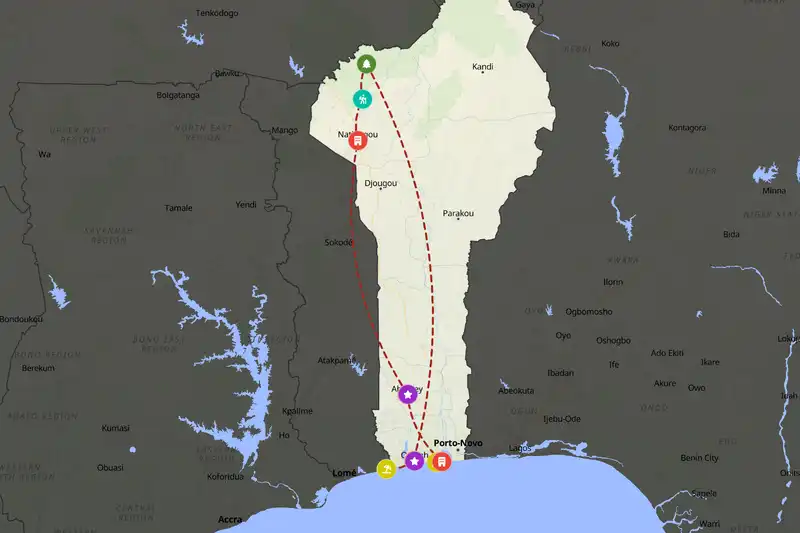
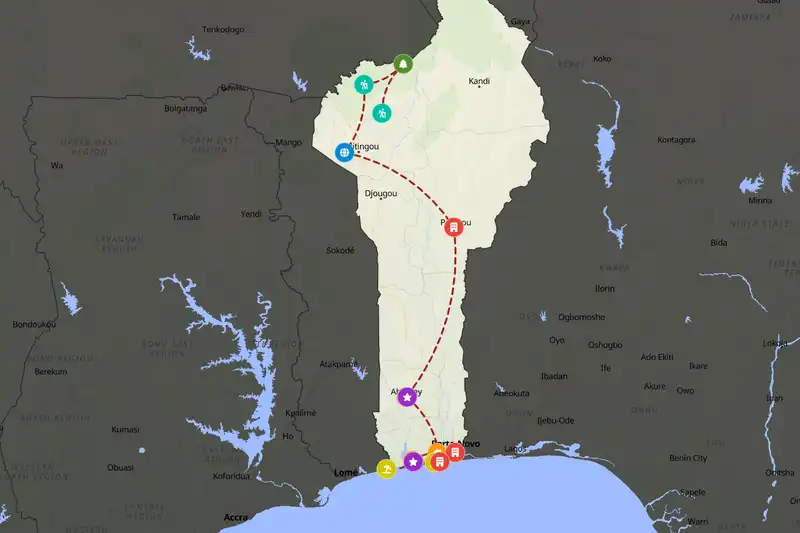
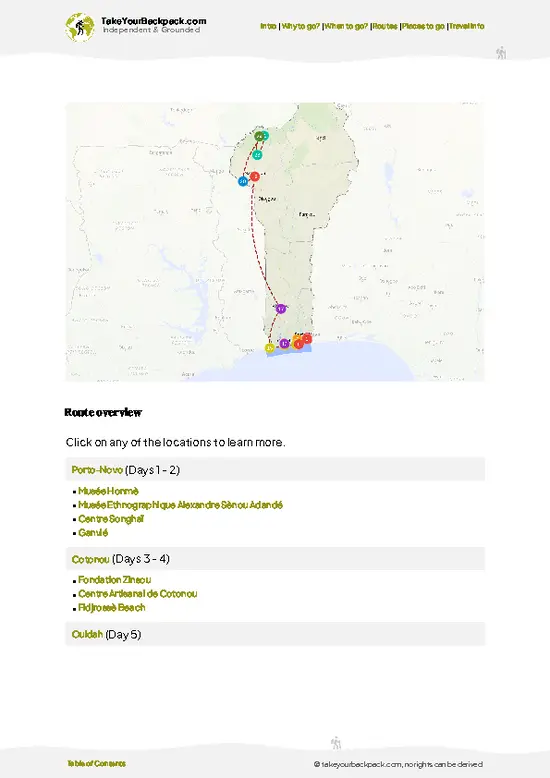
This 15-day loop is for travelers who want the whole north-south sweep of Benin at a pace that leaves room for slow mornings: royal capitals, Vodun shrines, the coast, then the fortified earthen houses of the Atakora and a proper safari in Pendjari. The pace is relaxed for most of the route, with two long road days, placed far apart. You’ll use zemidjan motorbike taxis in towns, shared taxis and minibuses along the coast, a motorboat across Lake Nokoué, long-distance buses on the main north road, and a hired 4x4 with a guide for the park.
Days 1-2: Porto-Novo
Skip Cotonou on arrival and go straight to
Porto-Novo, 45 to 90 minutes east depending on traffic. The official capital is calmer and greener, with Afro-Brazilian merchant houses fading in pastel and a Great Mosque built in the style of a Brazilian church. Spend a morning at
Musée Honmè, the former palace of King Toffa, where guides explain the walled courtyards once used by the king’s wives and for rituals. The
Musée Ethnographique …
read more 👉This 15-day loop is for travelers who want the whole north-south sweep of Benin at a pace that leaves room for slow mornings: royal capitals, Vodun shrines, the coast, then the fortified earthen houses of the Atakora and a proper safari in Pendjari. The pace is relaxed for most of the route, with two long road days, placed far apart. You’ll use zemidjan motorbike taxis in towns, shared taxis and minibuses along the coast, a motorboat across Lake Nokoué, long-distance buses on the main north road, and a hired 4x4 with a guide for the park.
Days 1-2: Porto-Novo
Skip Cotonou on arrival and go straight to Porto-Novo, 45 to 90 minutes east depending on traffic. The official capital is calmer and greener, with Afro-Brazilian merchant houses fading in pastel and a Great Mosque built in the style of a Brazilian church. Spend a morning at Musée Honmè, the former palace of King Toffa, where guides explain the walled courtyards once used by the king’s wives and for rituals. The Musée Ethnographique Alexandre Sènou Adandé holds one of the country’s best collections of Gèlèdè masks and is worth an unhurried hour.
On day two, head to Centre Songhaï, the organic farm and training center on the edge of town. You can tour the fish ponds and workshops, then eat lunch in its restaurant, made largely from what the farm produces. It gives you a sense of modern Benin that the history museums don’t.Days 3-4: Ganvie and Cotonou
On the way back west, stop at the Abomey-Calavi jetty and take a boat to Ganvie Stilt Village, where around 20,000 to 30,000 Tofinu people live in houses on stilts above Lake Nokoué. Expect roughly 6,000 to 10,000 XOF (US$10 to 17) per person for the boat. Go in the morning, when the floating market is running and women paddle pirogues loaded with fish and charcoal.
Then settle into Cotonou for two nights. Use one day for the fabric and fetish stalls of Dantokpa market, then browse the Centre Artisanal de Cotonou for bronze figures, appliqué cloth and masks at prices that drop sharply once you start bargaining. In the late afternoon, take a zemidjan out to Fidjrosse Beach for grilled fish and a cold Béninoise at the beach shacks. Admire the surf from the sand, since the currents along this coast are strong.Days 5-7: Ouidah and Grand Popo
Ouidah is an hour west, and one night is enough if you start early. The Musée d’Histoire de Ouidah, set in the old Portuguese fort, lays out the town’s role in the Atlantic slave trade. Walk to Place Chacha, the square tied to the slave trader Francisco Félix de Souza, then cross to the Temple of Pythons, where a priest will drape a sleepy royal python over your shoulders for a small fee. Finish with the 4-kilometer Route des Esclaves to Ouidah Beach and the Door of No Return.
Two nights in Grand Popo Beach, about an hour further west, are pure recovery. Coconut palms, lagoon pirogue trips and cheap guesthouses on the sand make this the spot to do nothing for a day before the long haul north.Days 8-9: Abomey
From Grand Popo it’s about three hours inland to Abomey, the old capital of the Dahomey kingdom. The Royal Palaces of Abomey cover a huge walled compound, and the bas-reliefs on the palace walls tell the kingdom’s history in lions, sharks and executions. The Musée Historique d’Abomey sits inside that compound, and guided visits are the only way to make sense of who built what. In the evening, sit near Place Goho, where the statue of King Béhanzin faces the road out of town. Two nights let you see the palaces without rushing and visit a few of the smaller Vodun temples around town.Days 10-12: Natitingou, Koutammakou and Tanongou
Day 10 is the first long ride: 7 to 9 hours by bus north via Djougou to Natitingou, the base for the Atakora hills. Rest that evening. On day 11, travel 1 to 1.5 hours west to Koutammakou, the landscape of the Batammariba people around Boukoumbé, and spend the day on the Somba Country Trek between tata somba, the two-story fortified earth houses with granaries on the roof. Sleep in a tata if you can; the night up on the plateau is cool and very quiet.
On day 12, move to Tanongou, a village at the foot of the escarpment near Tanguiéta. A short walk leads to Tanougou Falls, where you can swim in the pool below the cascade. The water is strongest from roughly July to November and drops to a trickle by late dry season.Days 13-15: Pendjari and the Ride South
From Tanongou it’s a short drive into Pendjari National Park, managed by African Parks, with elephants, lions, buffalo and hippos around the waterholes, especially from December to May. Hire a 4x4 with driver for roughly 60,000 to 90,000 XOF (US$100 to 150) a day, split among a group if you can. On day 14, add a guided outing on the Pendjari Biosphere Reserve Walking Trails to see the bush at ground level before a last sunset at the waterholes. Day 15 is the second long road day, 11 to 13 hours back to Cotonou, so leave at first light.
If you have one more day, take the road northeast from Abomey to the granite hills of Dassa-Zoumè, where pilgrims climb to a grotto and you can scramble up for wide views over central Benin.v2.webp)
 Best Backpacking