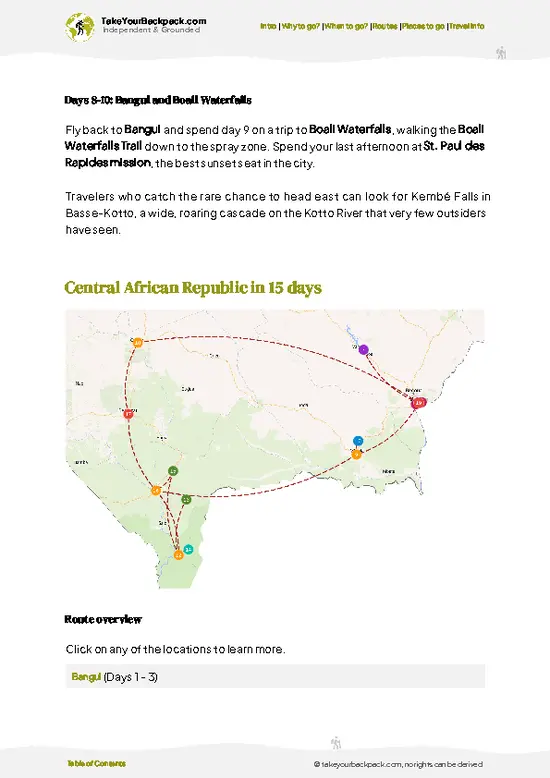
This fifteen-day loop through the Central African Republic is for the traveler with patience, a flexible budget and real curiosity about the southwest, where the rainforest begins. It runs overland from Bangui through the Lobaye to the Sangha River, then swings north through diamond country before returning to the capital. The pace is slow on purpose, because laterite roads set the schedule. You will rely on shared minibuses and bush taxis on the main roads, a hired 4x4 with driver for the forest stretches, and dugout pirogues on the Sangha.
Days 1-3: Bangui and Boali Waterfalls
Give
Bangui three nights, because it is where you sort out cash, permits and a reliable driver for the weeks ahead. Start along the
Bangui riverfront, where the city faces the Congolese town of Zongo across 1 kilometer of brown water, then walk to the red-brick
Notre-Dame of Bangui Cathedral and the
Bangui Central Market for fabric, smoked fish and SIM cards. The
Boganda National Museum is the best primer for the …
read more 👉This fifteen-day loop through the Central African Republic is for the traveler with patience, a flexible budget and real curiosity about the southwest, where the rainforest begins. It runs overland from Bangui through the Lobaye to the Sangha River, then swings north through diamond country before returning to the capital. The pace is slow on purpose, because laterite roads set the schedule. You will rely on shared minibuses and bush taxis on the main roads, a hired 4x4 with driver for the forest stretches, and dugout pirogues on the Sangha.
Days 1-3: Bangui and Boali Waterfalls
Give Bangui three nights, because it is where you sort out cash, permits and a reliable driver for the weeks ahead. Start along the Bangui riverfront, where the city faces the Congolese town of Zongo across 1 kilometer of brown water, then walk to the red-brick Notre-Dame of Bangui Cathedral and the Bangui Central Market for fabric, smoked fish and SIM cards. The Boganda National Museum is the best primer for the trip, with harps, masks and BaAka hunting nets you will later see in use. Spend an evening at the Alliance Française de Bangui Cultural Center, which hosts concerts and films and is the easiest place to meet local artists. On day 3, make the 95-kilometer run (about 2 hours) to Boali Waterfalls and walk the Boali Waterfalls Trail to the base of the roughly 50-meter drop, before heading back to the capital.Days 4-5: Mbaïki and the Lobaye Region
The road southwest to Mbaïki takes 2 to 3 hours and drops you at the edge of the forest. The Lobaye Region is coffee plots, rubber trees and BaAka settlements, and a guided walk on the Lobaye River Trail shows you how quickly farmland gives way to canopy. One night is enough, since the next leg is long.Days 5-6: Nola
Day 5 is the big haul, 8 to 10 hours of laterite to Nola on the Sangha River. Overnight here, watch the pirogues come in at dusk, and let the next morning’s shorter 3 to 4 hour drive to Bayanga feel easy by comparison.Days 6-10: Bayanga and Dzanga-Sangha National Park
Four nights in Bayanga is the core of the trip, and it is where the money goes. Dzanga-Sangha National Park is where forest elephants, western lowland gorillas and bongo live in numbers you will struggle to see anywhere else in Central Africa. The Dzanga Bai Trail is a 30 to 45 minute wade through streams and mud to a viewing platform over a mineral clearing, where dozens of forest elephants (sometimes over a hundred) dig for salts in the afternoon. Book a gorilla tracking day with habituated groups, a net hunt with BaAka guides, and a pirogue trip on the Sangha, which forms part of the Sangha Trinational protected area shared with Cameroon and the Republic of the Congo.Days 10-13: Nola, Berbérati and Carnot
Retrace the road to Nola for one night, then continue 5 to 6 hours north to Berbérati, the west’s largest town and the center of the diamond trade. Two nights let you wander the market and the buying offices without rushing. A short hop east brings you to Carnot on the Mambéré River, a mining town of dusty pits and river panners, for a final night in the provinces.Days 14-15: Back to Bangui
The drive from Carnot to Bangui fills most of day 14, so keep the evening loose, and on day 15 squeeze in a sunset at St. Paul des Rapides Church and Rapids Viewpoint, where the Oubangui churns over rocks below the hill, before you fly out.
If you ever return with more time, the Tazunu standing stones around Bouar are some of the oldest megaliths in Central Africa.

 Best Backpacking


