×

Ecuador🇪🇨 | best townsBest 10 towns in Ecuador

Ecuador packs four worlds into a country smaller than Colorado, and its towns change character with every climb or descent. The Andean highlands hold cobbled, high-altitude towns at 2,500 to 3,000 meters, with Indigenous markets, cool nights and the lowest prices. The coast swaps wool for flip-flops, with surf villages and fishing ports that fill up on weekends. The Amazon side offers rainforest jump-off towns, humid and slower to reach. Distances are short and buses cheap, so independent travel here is easy and fast. Pick your altitude, climate and crowd level, then start moving.

By Johan Kruseman 🇳🇱 | Updated October 20, 2026
Explore the best landmarks in Ecuador

Why go?What Makes Them Special

Ecuador suits town-hopping because the Andes split the country into sharply different zones within a few hours of each other. A morning in a cold, thin-air valley can end with an afternoon in subtropical heat, and every shift in elevation brings a new climate, food and rhythm. The highlands carry deep Indigenous roots, notably Kichwa communities whose weekly markets still anchor local life, layered over Spanish colonial grids of plazas, churches and tiled roofs. That mix gives towns here real working character rather than a museum feel.

Infrastructure helps. Buses run constantly between almost every settlement, fares are low (often US$1 to 2 per hour of travel), and the country uses the US dollar, which removes exchange headaches. Distances are compact, so a long ride rarely tops eight hours. … read more 👉
Ecuador suits town-hopping because the Andes split the country into sharply different zones within a few hours of each other. A morning in a cold, thin-air valley can end with an afternoon in subtropical heat, and every shift in elevation brings a new climate, food and rhythm. The highlands carry deep Indigenous roots, notably Kichwa communities whose weekly markets still anchor local life, layered over Spanish colonial grids of plazas, churches and tiled roofs. That mix gives towns here real working character rather than a museum feel.

Infrastructure helps. Buses run constantly between almost every settlement, fares are low (often US$1 to 2 per hour of travel), and the country uses the US dollar, which removes exchange headaches. Distances are compact, so a long ride rarely tops eight hours.

Know the limits before you commit. Altitude above 2,800 meters can cause headaches in your first days, so acclimatize before big hikes. Mountain roads wind and landslides can close routes in the rainy season. Coastal and Amazon towns are less polished and slower to reach, with fewer tourist services. Pack layers, since highland weather swings from sun to chill in an hour, and carry small bills, because markets and village shops rarely break large notes.
Why These Made the Cut
The list of best towns in Ecuador is created based on charm, local culture, atmosphere, hidden gems, and visitor appeal. If you feel a town is missing in this list, please let us know.

When to go?Optimal Periods for Travel

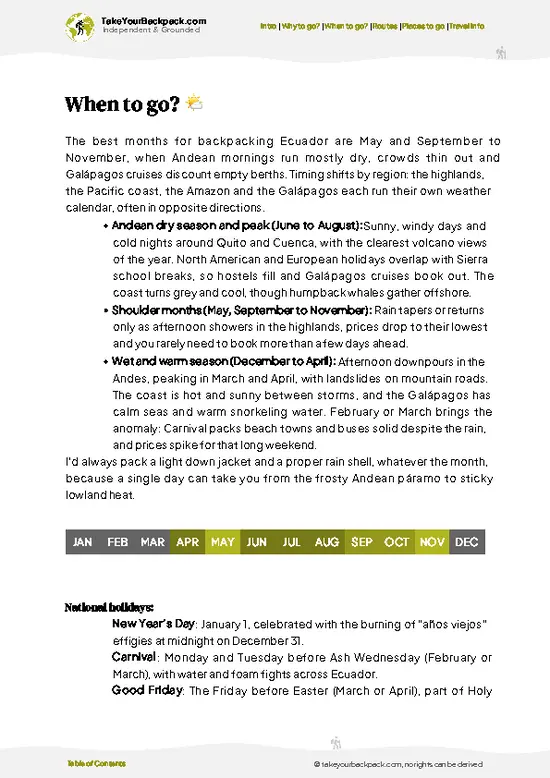
Best months by region: The best months for Ecuador’s towns are June to September in the Andes and Amazon edges, when highland skies are clearest and rain is lightest. Days in the highlands reach 18 to 22°C, while nights drop to 5 to 10°C, so a warm layer matters. Mornings are usually the sunniest, with clouds building after midday.

Coast and the wetter months: The coast runs on opposite logic. December to May is the hot, wet season there, with temperatures of 27 to 32°C and heavy afternoon showers, while June to November brings drier, cooler, grayer weather that suits beach villages less but still works for exploring. Surf and warm-water seasons favor the wet months.

The Amazon is wet year-round, with the heaviest rain generally between March and July. Expect 24 to 30°C and humidity that … read more 👉
Best months by region: The best months for Ecuador’s towns are June to September in the Andes and Amazon edges, when highland skies are clearest and rain is lightest. Days in the highlands reach 18 to 22°C, while nights drop to 5 to 10°C, so a warm layer matters. Mornings are usually the sunniest, with clouds building after midday.

Coast and the wetter months: The coast runs on opposite logic. December to May is the hot, wet season there, with temperatures of 27 to 32°C and heavy afternoon showers, while June to November brings drier, cooler, grayer weather that suits beach villages less but still works for exploring. Surf and warm-water seasons favor the wet months.

The Amazon is wet year-round, with the heaviest rain generally between March and July. Expect 24 to 30°C and humidity that never lets up, so waterproofs matter in any month.

Shoulder seasons and crowds: October to November and April to May in the highlands bring more showers but thinner crowds and easy room availability. Peak times are July to August, Carnival in February or March, and Christmas to New Year, when Ecuadorian families fill coastal towns and prices rise 20 to 50 percent. Book ahead for those weeks, and reserve for local festivals, when highland guesthouses sell out.

town hoppingOptimizing Your Multi-Stop Itinerary

How long to allow: A trip linking several Ecuadorian towns needs 10 to 16 days. That gives room for the highlands, one coastal or Amazon leg, and the delays that mountain roads throw up.

Grouping and direction: The Andes group best along the Avenue of the Volcanoes, the north-south highway corridor running through Quito and Cuenca. Treat Quito as the main hub, then move south by bus, since most routes feed downward into Cuenca, and finish with a flight or long bus to the coast or Guayaquil. Travelers drawn to the Amazon do best taking it as a side branch from Baños or Quito, rather than a stop in the middle. Heading north to south keeps your altitude changes gradual.

Time per stop and transport: Allow 2 to 3 nights per town so markets, day hikes and local transport fit in. Neighboring highland … read more 👉
How long to allow: A trip linking several Ecuadorian towns needs 10 to 16 days. That gives room for the highlands, one coastal or Amazon leg, and the delays that mountain roads throw up.

Grouping and direction: The Andes group best along the Avenue of the Volcanoes, the north-south highway corridor running through Quito and Cuenca. Treat Quito as the main hub, then move south by bus, since most routes feed downward into Cuenca, and finish with a flight or long bus to the coast or Guayaquil. Travelers drawn to the Amazon do best taking it as a side branch from Baños or Quito, rather than a stop in the middle. Heading north to south keeps your altitude changes gradual.

Time per stop and transport: Allow 2 to 3 nights per town so markets, day hikes and local transport fit in. Neighboring highland towns sit 1 to 3 hours apart. Quito to Cuenca takes about 9 to 11 hours by bus, and Quito to the coast runs 5 to 8 hours. Flights cover the longer hops in about an hour.

Mistakes to avoid: The biggest error is cramming one stop per day, which turns the trip into bus windows. Choose fewer places and stay longer. Another is scheduling overnight transfers on winding roads or travel after dark, so leave early and arrive by afternoon. Finally, avoid planning market-day towns for the wrong weekday, since the best markets run on one fixed day.

The ListHighly Recommended towns of Ecuador

1 Baños

Thermal pools, bridge swings, Tungurahua views, waterfall road

Soak in hot pools beneath a waterfall, climb to a hilltop cross above the valley, and swing from a bridge over the Pastaza gorge.

2 Puerto Ayora

Tortoise research station, Tortuga Bay, pier fish market, Las Grietas

Walk a paved path to a white beach with marine iguanas, swim in a volcanic fissure, and watch sea lions crowd the morning fish counters.

3 Mindo

Cloud forest birding, chocolate workshop, cable car, river tubing

Watch hummingbirds and toucans at dawn feeders, cross a canyon by cable car to waterfall trails, then float the river on an inner tube.

4 Puerto Baquerizo Moreno

Beach sea lions, Tijeretas trail, Playa Mann, Punta Carola surf

Snorkel with turtles at a beach in town, hike to frigatebird cliffs, and share the waterfront benches with sprawled sea lions.

5 Puerto Villamil

Sierra Negra crater, Tintoreras sharks, Wall of Tears, flamingo lagoons

Hike one of the world’s largest volcanic craters, snorkel lava channels with resting reef sharks, and cycle to a wall built by prisoners.

ecuador-city-puerto-villamil
© Google |

6 Puerto López

Humpback season, fishing boats, Salango museum, malecón grills

Board a bay boat for humpbacks between June and September, then watch the catch come in and eat grilled fish at sunset.

7 Vilcabamba

Mandango ridge hike, horseback valleys, hammock cafés, Saturday market

Scramble up a sleeping-giant ridge at dawn, ride horses to waterfalls, and spend slow afternoons over sugarcane juice near the plaza.

ecuador-city-vilcabamba
© Google | Mohamed Elsaid

8 Tena

Jatunyacu rafting, river confluence, island park, Amazon fruit market

Paddle Class III to IV rapids in the morning, then cross a footbridge to an island park where two rivers meet.

9 Alausí

Devil’s Nose switchbacks, gorge-side station, San Pedro lookout

Ride the zigzag railway down a near vertical rock face, then climb to the San Pedro statue for rooftop and gorge views.

10 Cotacachi

Leather workshops, Cuicocha crater lake, Kichwa heritage

Browse jackets and boots along the main street, then head upslope to a flooded crater with two forested islands and a rim trail.

11 Atacames

Gray-sand malecón, Los Cocos huts, shrimp and conch, beginner surf

Spend afternoons on a long promenade beach, then move to thatched seafood bars after dark with music and cocktails in coconuts.

12 Zaruma

Gold mine tunnels, leaning wooden balconies, Zaruma coffee, Carmen church

Descend with a guide into the mine running beneath the houses, then taste local coffee and climb to a tiled-roof panorama.

ecuador-city-zaruma
© Google | Gabriela Cedillo

13 Cayambe

Bizcocho bakeries, Sunday Kichwa market, equator sundial, Cochasquí mounds

Taste crisp biscuits with milk caramel and cheese, browse the Sunday market, then visit pre-Inca mounds and an equator monument outside town.

14 Puyo

Maito in bijao leaf, Omaere forest park, Puyo riverwalk, Amazon gateway

Eat grilled fish steamed in leaves at the market, then walk medicinal plant trails and learn Shuar, Achuar and Kichwa plant knowledge.

15 Jipijapa

Plantain dumpling soup, toquilla straw hats, coffee and cacao stalls

Eat caldo de bolas de verde in the early market, watch artisans weave straw, and pick up roasted beans or chocolate.

16 Sangolquí

Sunday hornado market, valley plaza, hacienda lanes, cheap almuerzos

Follow the smell of roast pork to a locals-only Sunday market, then stroll quiet lanes around an old hacienda on the town edge.

Think you know Ecuador?

Prove you’re a true local — uncover 6 lesser-known towns in Ecuador that locals tend to keep to themselves.
Loading the map 🌍

Expert viewTips and Advice from Travelers

How many towns to visit: Visit four to six towns over two to three weeks. Fewer than four wastes Ecuador’s variety, while more than six means constant packing and bus days that eat into the places themselves. Each town needs a couple of nights to show its rhythm, and altitude slows the first days anyway.

Choosing between kinds: Highland towns give a backpacker the most for the money. They cost the least, offer markets, hiking and culture within walking distance, and run on frequent buses. Coastal villages cost more and trade culture for sand and surf, so one stop is plenty unless the water is your priority. Amazon towns cost the most in time and money, because guides and lodge transfers are mandatory for the jungle itself, but one stop is rewarding if wildlife matters more to you than ruins … read more 👉
How many towns to visit: Visit four to six towns over two to three weeks. Fewer than four wastes Ecuador’s variety, while more than six means constant packing and bus days that eat into the places themselves. Each town needs a couple of nights to show its rhythm, and altitude slows the first days anyway.

Choosing between kinds: Highland towns give a backpacker the most for the money. They cost the least, offer markets, hiking and culture within walking distance, and run on frequent buses. Coastal villages cost more and trade culture for sand and surf, so one stop is plenty unless the water is your priority. Amazon towns cost the most in time and money, because guides and lodge transfers are mandatory for the jungle itself, but one stop is rewarding if wildlife matters more to you than ruins or markets. Pick two highland towns for every one from another region.

What it costs: Budget US$25 to 40 a day in the highlands: dorm beds run US$8 to 14, set-lunch almuerzos cost US$2.50 to 4, and buses cost about US$1 to 2 per hour of travel. The coast runs US$30 to 50, with weekend and holiday rates pushing beds higher. Amazon trips often total US$50 to 90 a day once guides, park fees and boat transport are in. Typical per-visit extras are US$5 to 15 for a day guide’s share or entrance fees, US$10 to 25 for a guided hike, and taxis within towns at US$1.50 to 4. Spend on a guide for volcano or jungle hikes, and skip them for market and plaza wandering, which are best done solo.

Safety and culture: Petty theft is the main risk, especially on buses and in busy markets, so keep bags in sight and phones tucked away. Avoid walking empty streets after dark and use registered taxis or apps at night. Altitude is a real concern: drink water, go slowly on arrival and skip alcohol on day one.

Culturally, greet people with a buenos días in shops and on trails, since it earns warmth quickly. Ask before photographing Indigenous residents, especially market vendors, and expect to pay or buy something in return. Dress modestly in small highland towns, and carry small bills and coins, as change is scarce.

✈️ The backpacker research shortcutEcuador Travel Guide

An offline-friendly backpacking guide with optimized travel routes, ranked highlights, transport advice, and the best areas to stay.
example page 0 from our offline Travel Guide for Ecuador
example page 1 from our offline Travel Guide for Ecuador
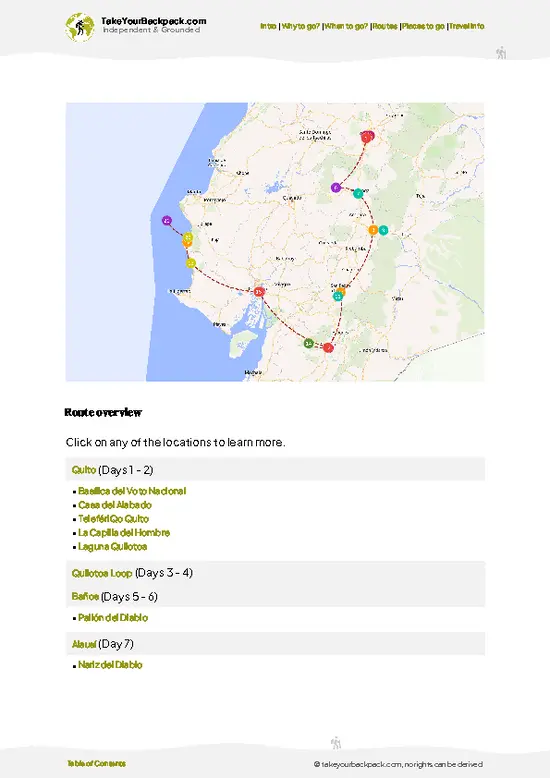
example page 2 from our offline Travel Guide for Ecuador
example page 3 from our offline Travel Guide for Ecuador
example page 4 from our offline Travel Guide for Ecuador
example page 5 from our offline Travel Guide for Ecuador
example page 6 from our offline Travel Guide for Ecuador
example page 7 from our offline Travel Guide for Ecuador
The digital guide (274 pages) contains:
✅ 87 highlights, ranked by travel appeal
✅ Optimized 5, 10 & 15-day travel routes
✅ Cities, national parks, landmarks, beaches
✅ How to get around
✅ Offline-friendly for travel without Wi-Fi
👉 Click to see all 30+ guide features

📅 Plan smarter in minutes, not weeks
✅ Month by month travel advice
✅ Festivals & national holidays
✅ Budget expectations

🗺️ Go to the right places, skip the overrated ones
✅ Honest pros & cons of destinations
✅ Top hikes, parks & viewpoints
✅ Lesser-known places most travelers miss
✅ Clear “worth it vs skip it” guidance

🛏️ Travel smoothly without rookie mistakes
✅ Best areas to stay
✅ Transport systems explained simply
✅ Common scams & safety advice
✅ SIM cards, money & practical tips

🌍 Understand the country, not just visit it
✅ Culture & traditions
✅ 52 Essential phrases & customs
✅ Festivals worth planning around
✅ Traveler-friendly historical context
✅ Insights that make places more meaningful

📱 Built for real travel conditions
✅ Fully downloadable PDF
✅ Works completely offline
✅ Optimized for phone use
✅ Useful in remote areas & buses
✅ Everything in one place
Stop searching, start planning
Get instant access to your full guide. 30‑day money-back guarantee.
+ Add another guide for just

By proceeding you agree to our terms.
Sent to your inbox immediately after payment • 100% Secure Checkout
Best Backpacking Travel Advisor 2025 tourism awardBest Backpacking
Travel Advisor
2025
What others say about Take Your Backpack Guides:
⭐⭐⭐⭐⭐
Fantastic, amazing amount of information!
⭐⭐⭐⭐⭐
My goodness this is amazing, it's what I've been looking for hats off too you!
⭐⭐⭐⭐⭐
I think this is absolutely BRILLIANT
⭐⭐⭐⭐
Very complete and informative. It's still missing places, but I gotta to commend you
⭐⭐⭐⭐⭐
This is truly amazing, thank you, can't wait to explore it with my kids!
⭐⭐⭐⭐⭐
Awesome resource, thank you!
⭐⭐⭐⭐⭐
This is amazing! Can't wait to explore the ones I haven't seen
⭐⭐⭐⭐
I love this! Well done, great idea.
⭐⭐⭐⭐⭐
Thanks for taking the time to make this gem!
⭐⭐⭐⭐⭐
This might be the best website I've ever seen.
⭐⭐⭐⭐⭐
Congratulations, and thank you so much for your work; it's incredibly valuable.
⭐⭐⭐⭐
In all seriousness I think you did a great job pointing out the important spots
⭐⭐⭐⭐⭐
10/10 very good
⭐⭐⭐⭐⭐
As someone who's only just starting to visit regularly this is awesome, thank you.
⭐⭐⭐⭐
Thank you very much! I'm going to visit my dad, it's going to be very useful!
⭐⭐⭐⭐⭐
This is really cool! We'll be travelling for the first time and this definitely come in handy.
⭐⭐⭐⭐⭐
You are now our minister of culture, congratulations 👨‍💼
⭐⭐⭐⭐⭐
Just wanted to tell you that this is a pearl! Going to follow your recommendations.
⭐⭐⭐⭐⭐
This is so cool. I'll definitely be using the resource for my travels soon.
⭐⭐⭐⭐⭐
This is very impressive! Good work.
⭐⭐⭐⭐⭐
This is an amazing and informative site. Very well done!

🛏️ Where to stay?Accommodation Highlights

Ecuador has plenty of hostels and guesthouses, with dorm beds typically running US$8 to 15 a night and private rooms from about US$20 to 35. In Quito, La Mariscal packs in the most hostels, bars and tour agencies but gets rowdy and sketchy after dark, the Centro Histórico puts you steps from the colonial churches and plazas yet empties out at night, and La Floresta trades nightlife for leafy, safer streets and good cafés. Beyond the capital, Baños clusters its cheap beds near the bus terminal and thermal baths, Cuenca has quiet, walkable options around its old center, and Montañita offers beachside dorms where the parties run until sunrise and sleep comes second.

If you enjoy meeting fellow travelers, … read more 👉
Ecuador has plenty of hostels and guesthouses, with dorm beds typically running US$8 to 15 a night and private rooms from about US$20 to 35. In Quito, La Mariscal packs in the most hostels, bars and tour agencies but gets rowdy and sketchy after dark, the Centro Histórico puts you steps from the colonial churches and plazas yet empties out at night, and La Floresta trades nightlife for leafy, safer streets and good cafés. Beyond the capital, Baños clusters its cheap beds near the bus terminal and thermal baths, Cuenca has quiet, walkable options around its old center, and Montañita offers beachside dorms where the parties run until sunrise and sleep comes second.

If you enjoy meeting fellow travelers, consider choosing hostels with high ratings for atmosphere. On the other hand, if you prefer having your own space, a hotel might be a better option.

EcuadorSee More of Ecuador

👋 Meet the founderWho’s Behind Take Your Backpack?

Johan, backpacker and founder of TakeYourBackpackHi, I’m Johan (Netherlands 🇳🇱), the creator of TakeYourBackpack. Over the past 3 decades, I’ve backpacked through 90+ countries across six continents, gaining extensive experience with independent travel, long-term trips, and overland routes.

This site is built on a combination of firsthand travel experience and carefully curated insights from other backpackers. Many guides are based on places I’ve personally visited, while others bring together tips, observations, and practical advice shared by trusted travelers I’ve met along the way.

The goal is to provide realistic, experience-driven guidance — not generic itineraries — so you can explore destinations with better context, clearer expectations, and more confidence.