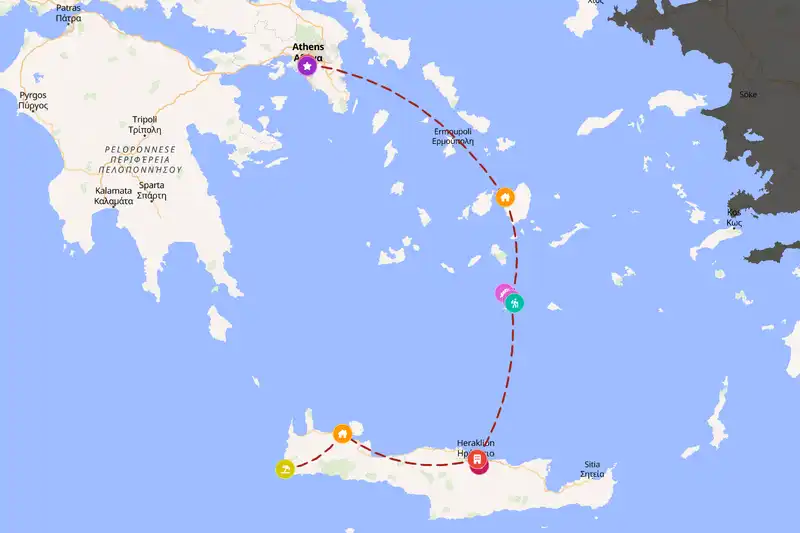
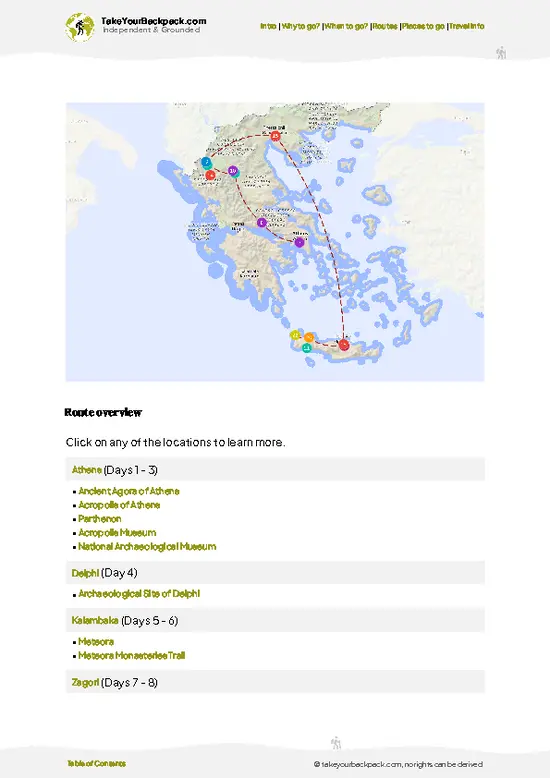
This fifteen-day route is for travelers who want the full spread of Greece: ancient sanctuaries, cliff-top monasteries, deep limestone gorges, a second city with real character, and the best of western Crete. The pace is relaxed for the distances involved, with two or three nights at most stops and only one truly long transfer. You will rely on the Athens metro, KTEL intercity buses, one taxi into the Zagori mountains, a domestic flight from Thessaloniki to Crete and Cretan buses and boats at the end.
Days 1-3: Athens
Three nights in
Athens lets you take the city in layers instead of in one exhausting sweep. Spend the first morning at the
Ancient Agora of Athens, where the Temple of Hephaestus stands almost complete and the reconstructed Stoa of Attalos holds the everyday finds of Athenian life: ballots, weights, children’s toys. The next day belongs to the
Acropolis of Athens and the
Parthenon, ideally at the 8:00 opening before tour groups arrive, followed by the
Acropolis Museum in the …
read more 👉This fifteen-day route is for travelers who want the full spread of Greece: ancient sanctuaries, cliff-top monasteries, deep limestone gorges, a second city with real character, and the best of western Crete. The pace is relaxed for the distances involved, with two or three nights at most stops and only one truly long transfer. You will rely on the Athens metro, KTEL intercity buses, one taxi into the Zagori mountains, a domestic flight from Thessaloniki to Crete and Cretan buses and boats at the end.
Days 1-3: Athens
Three nights in Athens lets you take the city in layers instead of in one exhausting sweep. Spend the first morning at the Ancient Agora of Athens, where the Temple of Hephaestus stands almost complete and the reconstructed Stoa of Attalos holds the everyday finds of Athenian life: ballots, weights, children’s toys. The next day belongs to the Acropolis of Athens and the Parthenon, ideally at the 8:00 opening before tour groups arrive, followed by the Acropolis Museum in the afternoon heat. Save day three for the National Archaeological Museum, which holds the gold Mask of Agamemnon and the corroded bronze gears of the Antikythera mechanism. That order means you hit the big sites with fresh legs and finish with context.Day 4: Delphi
A morning KTEL bus covers the 2.5 to 3 hours to Delphi, a small town strung along a mountainside above an ocean of olive trees. Sleeping here is the smart move: you can walk into the Archaeological Site of Delphi when it opens, climb past the Temple of Apollo to the stadium at the top, and then see the bronze Charioteer in the site museum before the day-trippers from Athens pull in. Evenings in Delphi are quiet, cheap and come with a view down to the Gulf of Corinth.Days 5-6: Kalambaka and Meteora
This is the long travel day of the trip, 5 to 6 hours by bus with changes, so the next day stays slow on purpose. Kalambaka sits directly under the rock pillars of Meteora and is far better value than staying in a tour hub. Walk up rather than ride: the Meteora Monasteries Trail follows old footpaths from town to the monasteries in about 1.5 to 2 hours of climbing, and you see the cliffs change scale as you rise. Six monasteries are still active and each closes on one or two weekdays, so check before you plan which ones to enter. Shoulders and knees need covering, and women may be asked to wear a wrap skirt, usually lent at the door.Days 7-8: Zagori Villages and Vikos Gorge
A bus over the Pindus via Metsovo takes 2.5 to 3 hours to Ioannina, and from there a taxi (roughly €40 to 60) is the reliable way into the Zagori Villages, a cluster of slate-roofed stone settlements linked by arched bridges and mule paths. Base in Monodendri or the Papingo villages and give a full day to the Vikos Gorge: the classic crossing from Monodendri to Vikos village runs about 12 to 13 kilometers and takes 6 to 7 hours, with a steep descent and a long, shaded walk along the riverbed. Arrange a taxi pickup at the far end the night before.Days 9-10: Ioannina to Thessaloniki
Head back down to Ioannina and give yourself a couple of hours by the lake and inside the walled old town before the 3.5 to 4 hour bus east. Thessaloniki is the counterweight to Athens: younger, more relaxed, and built for eating. Two nights is enough to walk the seafront to the White Tower of Thessaloniki, climb it for the view over the harbor, and spend a morning in the Museum of Byzantine Culture, the best place in Greece to understand the thousand years between antiquity and the Ottomans. Breakfast is bougatsa, a flaky custard or cheese pastry the city takes seriously.Day 11: Heraklion and Knossos
A direct flight of about 1 hour 15 minutes drops you in Heraklion, saving two days of ferries. Local buses reach the Palace of Knossos in 20 to 30 minutes. Go late in the afternoon when the light softens over the partly reconstructed red columns and the crowds thin out. One night is plenty; Heraklion works best as a launchpad.Days 12-14: Chania, Samaria and Balos
The bus west to Chania takes about 2 hours 45 minutes, and the Venetian harbor with its lighthouse and tangle of lanes is the most attractive place to sleep on Crete. Use one day for the Samaria Gorge (open roughly May to October, entry €10): an early bus to the Xyloskalo trailhead, about 16 kilometers downhill through the gorge to Agia Roumeli on the south coast, then a ferry and bus back. Rest the next morning, then take the bus to Kissamos for a boat to Balos Lagoon, where shallow turquoise water and white sand sit between a headland and a wild cape. Fly out of Chania on day 15.
If a friend were heading to Zagori, I’d send them to the Ovires rock pools a short walk below Mikro Papingo and tell them to pack a swimsuit, because the water is cold, clear and the best place in the region to soak tired legs after the gorge.v2.webp)

 Best Backpacking