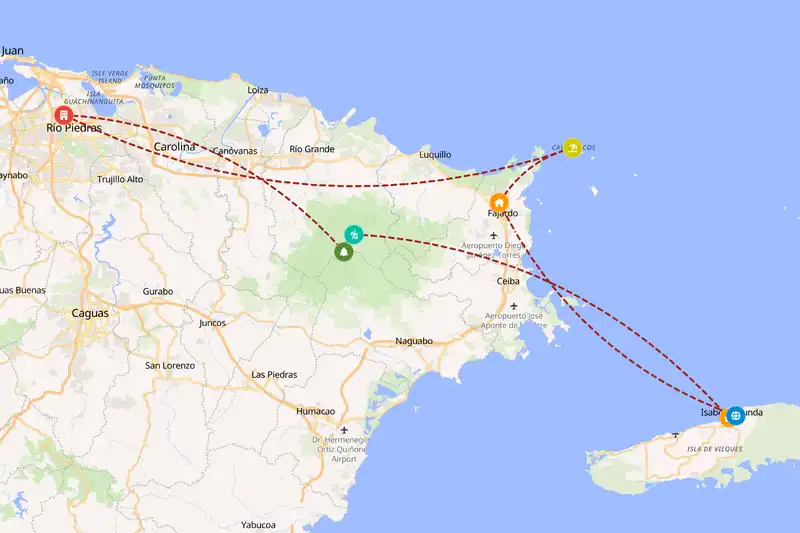
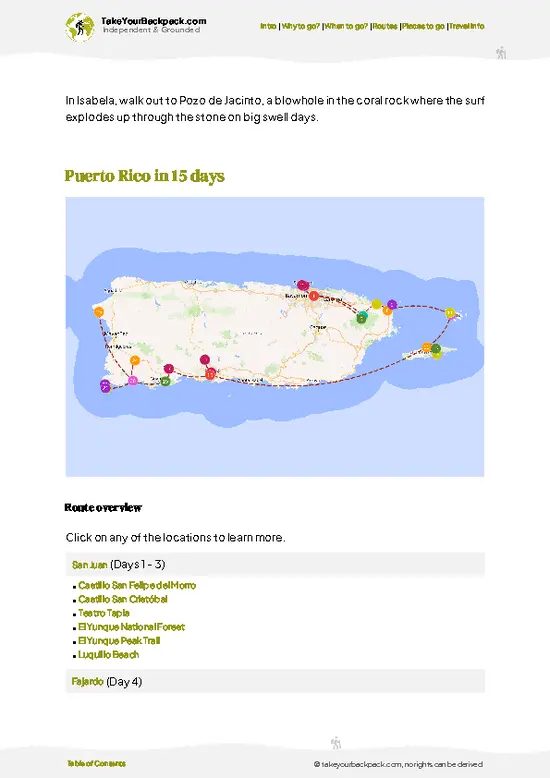
This fifteen-day loop around Puerto Rico is for travelers who want the whole picture: the colonial capital, rainforest summits, both offshore islands, the coffee and rum history of the south, and the cliffs and sunsets of the far west. The pace is relaxed, with two or three nights in most places and only one properly long travel day. You will need a rental car on the main island (split into two rentals, before and after the islands), the passenger ferry from Ceiba to Culebra and Vieques, and públicos or a locally rented jeep or golf cart on the islands themselves.
Days 1-3: San Juan, slowly
Three nights in
San Juan gives the old city the time it deserves. Spend the first morning on the grassy esplanade and six levels of
Castillo San Felipe del Morro, then walk the city wall east to
Castillo San Cristóbal, whose tunnels and sentry boxes face the Atlantic; one US$10 ticket covers both forts. Day two belongs to
Old San Juan’s hidden plazas: Plaza de Armas with its old men and pigeons, the tiny …
read more 👉This fifteen-day loop around Puerto Rico is for travelers who want the whole picture: the colonial capital, rainforest summits, both offshore islands, the coffee and rum history of the south, and the cliffs and sunsets of the far west. The pace is relaxed, with two or three nights in most places and only one properly long travel day. You will need a rental car on the main island (split into two rentals, before and after the islands), the passenger ferry from Ceiba to Culebra and Vieques, and públicos or a locally rented jeep or golf cart on the islands themselves.
Days 1-3: San Juan, slowly
Three nights in San Juan gives the old city the time it deserves. Spend the first morning on the grassy esplanade and six levels of Castillo San Felipe del Morro, then walk the city wall east to Castillo San Cristóbal, whose tunnels and sentry boxes face the Atlantic; one US$10 ticket covers both forts. Day two belongs to Old San Juan’s hidden plazas: Plaza de Armas with its old men and pigeons, the tiny Plazuela de la Rogativa above the bay, and the shaded corners off Calle del Cristo where you can sit with a coffee and listen to the blue cobblestones rattle under passing cars. In the evening, check the program at Teatro Tapia, an 1830s theater still staging plays, dance and concerts. Day three is a free day for the beach or a second look at the streets you liked.Day 4: El Yunque Peak and Fajardo
Pick up your first rental car and drive about an hour east into El Yunque National Forest. Book the vehicle reservation for road PR-191 in advance (around US$2). Skip the short waterfall walks and climb the El Yunque Peak Trail, roughly 4 kilometers each way to a summit near 1,065 meters, where cloud rolls over a stone lookout tower and the coqui frogs never stop. Wash off the mud at Luquillo Beach and grab lunch at the row of kiosks by the highway. Sleep in Fajardo, and after dark paddle into Fajardo Bioluminescent Bay through a mangrove channel; kayak tours run about US$50 to 70, and moonless nights glow brightest.Days 5-6: Culebra
Return the car and take the morning ferry from Ceiba to Culebra (about US$2, book ahead, especially on weekends). The island is small, sleepy and built for doing very little. A público runs to Flamenco Beach, a long horseshoe of pale sand where a rusting, graffiti-painted tank sits in the shallows as a leftover from the US Navy years. Two nights lets you see Flamenco empty at 8 a.m., when the water is flat and turquoise and the day-trippers are still on the ferry.Days 7-9: Vieques
Ferry back to Ceiba and cross straight over to Vieques; with the connection it is a half-day of transit, not a long one. Rent a jeep on arrival, because the best of Vieques is at the end of potholed tracks. Three nights is right here. The former Navy land in the east is now the Vieques National Wildlife Refuge, and its beaches are the reason to come: Playa La Chiva has small coves, clear water over sea grass and shade trees, and on a weekday you may share a cove with nobody. Wild horses wander the roads and the town square at Isabel II, so drive slowly at night.Days 10-11: Ponce and the coffee hills
Take the early ferry, pick up your second rental car and drive about 2 hours to Ponce. This is the one long travel day, so keep the afternoon light: the red-and-black firehouse on the main plaza and a walk along the old merchant streets. Day eleven is for the city’s history. Museo Castillo Serrallés, the Spanish Revival mansion of the family behind Don Q rum, sits on El Vigía hill with views over the whole south coast. Then drive 20 minutes into the hills to Hacienda Buena Vista, a restored 19th-century coffee and corn plantation with working water-driven machinery; tours need a reservation.Days 12-13: The dry southwest
Head west past Yauco and stop at Yaucromatic, where painted stairways and murals turn the old town into a hillside of color, a quick and fun hour. Continue to Guánica State Forest, a dry forest of cactus and twisted gumbo-limbo trees where the trails end at empty, rocky coves. Sleep two nights in La Parguera, a low-key fishing village of stilt houses and mangrove cays. On day thirteen drive to the bottom corner of the island: the 19th-century Cabo Rojo Lighthouse stands on pinkish limestone cliffs, the Cabo Rojo Salt Flats shimmer pink and white just below with birds wading in them, and Playa Sucia, a calm crescent beach, is a short walk from the lighthouse road.Days 14-15: San Germán, Rincon and the drive home
On the way north stop in San Germán, the island’s second-oldest town, for the small hilltop Porta Coeli church and its quiet plazas. Spend your last night in Rincon, a surf town on the west tip where everyone gathers at the beach bars for sunset over Mona Passage. Day fifteen is the 2.5- to 3-hour drive back to San Juan.
If you have an extra day in Ponce, take the boat from La Guancha to Isla Caja de Muertos, an uninhabited island with a hilltop lighthouse and clear snorkeling water.


 Best Backpacking