×
Uganda🇺🇬 | 15 days itinerary

Backpacking Uganda: A 15-Day Guide

By Johan Kruseman 🇳🇱 | Updated May 8, 2026
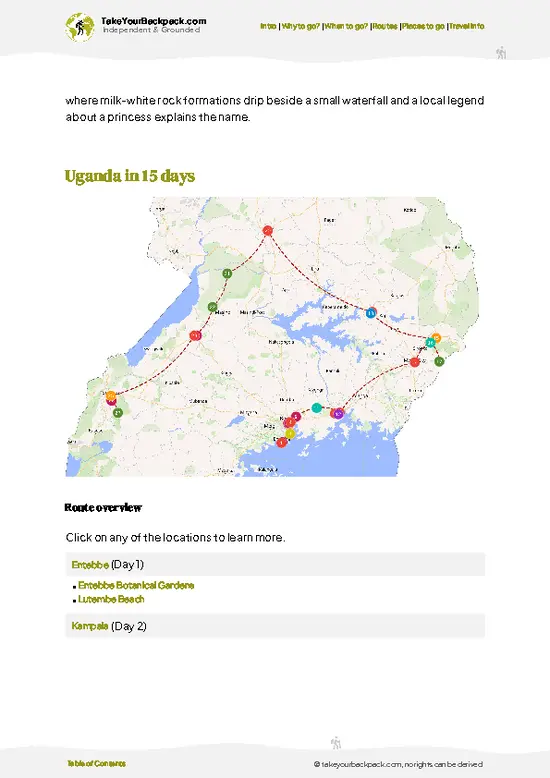
This 15-day route is for travelers who want the full Uganda arc—gorillas, classic savanna, crater lakes, and the wild northeast—without turning it into a boot camp, using a mix of long but spaced-out road journeys in private vehicles or shared taxis and short local transfers around each base. The pace is adventurous but humane: you’ll loop from Kampala through the southwest for gorillas and lakes, swing north for big waterfalls and savanna, then finish in the remote northeast around Moroto and Mount Morungole for culture and highland hiking.

Days 1-3: Kampala Deep Dive and Martyrs’ Heritage

Start with three nights in Kampala so you can move beyond first impressions and really understand the city’s layers. Spend time at the Kasubi Royal Tombs and Kabaka’s Palace and Idi Amin’s Torture Chambers to trace the arc from precolonial Buganda power through the trauma of the Amin years, then connect it all at the Uganda National Museum. Visit the Uganda National Mosque for sweeping views and a sense … read more 👉
This 15-day route is for travelers who want the full Uganda arc—gorillas, classic savanna, crater lakes, and the wild northeast—without turning it into a boot camp, using a mix of long but spaced-out road journeys in private vehicles or shared taxis and short local transfers around each base. The pace is adventurous but humane: you’ll loop from Kampala through the southwest for gorillas and lakes, swing north for big waterfalls and savanna, then finish in the remote northeast around Moroto and Mount Morungole for culture and highland hiking.

Days 1-3: Kampala Deep Dive and Martyrs’ Heritage

Start with three nights in Kampala so you can move beyond first impressions and really understand the city’s layers. Spend time at the Kasubi Royal Tombs and Kabaka’s Palace and Idi Amin’s Torture Chambers to trace the arc from precolonial Buganda power through the trauma of the Amin years, then connect it all at the Uganda National Museum. Visit the Uganda National Mosque for sweeping views and a sense of Kampala’s religious mix, then step into both Rubaga Cathedral and Namirembe Cathedral to see how Christianity shaped the city’s skyline and social life. Add an evening at the National Theatre and Cultural Centre or the Ndere Cultural Centre for live performance, and if you want a quieter afternoon, walk around Kabaka’s Lake, a man-made royal lake that feels like a neighborhood park with a royal backstory. With three days, you can also make a half-day pilgrimage out to the Namugongo Uganda Martyrs Catholic Shrine, where the story of the martyrs is told through architecture, memorials, and local devotion that still draws crowds every year.

Days 4-6: Southwest to Mbarara, Ntungamo, and Lake Mburo

Head southwest by road to Mbarara, using it as your first overnight stop and a chance to feel the shift into Ankole cattle country. Continue on to Ntungamo, a smaller town that breaks up the journey and lets you see everyday roadside life away from the main tourist hubs. From this base, spend a full day in Lake Mburo National Park, where the compact size means you can do rewarding game drives without the long internal transfers of bigger parks, spotting zebras, antelopes, and rich birdlife against a backdrop of rolling hills and lakes. The slower progression through Mbarara and Ntungamo keeps you from stacking exhausting travel days back-to-back while still nudging you steadily toward the gorilla highlands.

Days 7-9: Gorilla Country around Kabale, Kisoro, and Bwindi

Continue by road into the southwest hills, overnighting in Kabale as your first real taste of cooler, higher-altitude air and terraced slopes. Push on to Kisoro, a frontier-feeling town that serves as a gateway to both Bwindi Impenetrable National Park and Mgahinga Gorilla National Park, and base yourself here for a couple of nights. Dedicate a full day to gorilla tracking in Bwindi Impenetrable National Park, where the steep, muddy trails and dense forest make the encounter feel fully earned, then use another day to explore Mgahinga Gorilla National Park for golden monkey tracking or a volcano day hike if your legs are up for it. This three-day block is intense but focused, and by staying in Kabale and Kisoro rather than bouncing around nightly, you keep the logistics manageable while still hitting Uganda’s most iconic wildlife experience.

Days 10-11: Fort Portal, Crater Lakes, and Kibale Forest

From the southwest, make the long but scenic road journey north to Fort Portal, where tea estates and crater lakes ring the town and give you a very different feel from the gorilla highlands. Spend two nights here so you can take a day trip into Kibale Forest National Park, famous for chimpanzee tracking and dense, cathedral-like forest that contrasts sharply with Bwindi’s tangle. If you want to go deeper, add a side visit to Semuliki National Park or the Toro-Semliki Wildlife Reserve for lowland forest, hot springs, and quieter wildlife viewing, or simply wander Fort Portal’s hills and viewpoints to rest between big wildlife days. This phase is about variety—different forests, different primates, and a softer, greener landscape before you swing into the drier northeast.

Days 12-13: Moroto and the Mount Morungole Trail

Travel by road into Karamoja, basing yourself in Moroto for two nights to experience a region that feels culturally distinct from the rest of Uganda. Use one of your full days to tackle the Mount Morungole Trail, a highland hike that combines big views with insight into local communities and their relationship to the mountains, giving you a very different kind of “wild” than the forests and savannas you’ve already seen. The extra night in Moroto lets you recover from the hike, visit local markets, and absorb the slower rhythm of life here without immediately jumping back into a long transfer.

Days 14-15: Teso Region and Soft Landing

On your final leg, head into the Teso region, where the landscape opens into broad plains dotted with rock outcrops and small towns that see far fewer visitors. Spend your last full day exploring local markets and villages, using the region as a cultural counterpoint to both Buganda and Karamoja, and enjoying the feeling of being somewhere that’s still very much on its own terms. Your final day is a travel day back toward Kampala or your onward connection, and ending in Teso keeps the last chapter of your trip grounded in everyday life rather than one more big-ticket attraction.
My standout memory from this route is the contrast between the hushed, mossy trails of Bwindi and the wide, wind-swept slopes around Mount Morungole, which makes Uganda feel like three different countries stitched into one journey.
Loading the map 🌍
film
0
0
0a
Lake Mburo
film
1
1
1a
Kisoro
film
2
2
2a
Bwindi Impenetrable
Pixabay
film
3
3
3a
Semuliki
film
4
4
4a
Moroto

✈️ The backpacker research shortcutUganda Travel Guide

An offline-friendly backpacking guide with optimized travel routes, ranked highlights, transport advice, and the best areas to stay.
example page 0 from our offline Travel Guide for Ugandaexample page 1 from our offline Travel Guide for Ugandaexample page 2 from our offline Travel Guide for Ugandaexample page 3 from our offline Travel Guide for Ugandaexample page 4 from our offline Travel Guide for Ugandaexample page 5 from our offline Travel Guide for Uganda
The digital guide (362 pages) contains:
109 highlights, ranked by travel appeal
Optimized 5, 10 & 15-day travel routes
Best neighborhoods to stay
How to get around
Offline-friendly for travel without Wi-Fi
👉 See all 30+ guide features

📅 Plan smarter in minutes, not weeks
Month by month travel advice
Festivals & national holidays
Budget expectations

🗺️ Go to the right places, skip the overrated ones
Honest pros & cons of destinations
Top hikes, parks & viewpoints
Lesser-known places most travelers miss
Clear “worth it vs skip it” guidance

🛏️ Travel smoothly without rookie mistakes
Best areas to stay
Transport systems explained simply
Common scams & safety advice
SIM cards, money & practical tips

🌍 Understand the country, not just visit it
Culture & traditions
52 Essential phrases & customs
Festivals worth planning around
Traveler-friendly historical context
Insights that make places more meaningful

📱 Built for real travel conditions
Fully downloadable PDF
Works completely offline
Optimized for phone use
Useful in remote areas & buses
Everything in one place
Save weeks of stressful planning
Get instant access to the full guide directly. 30-day money-back guarantee.


Sent to your inbox immediately after payment • 100% Secure Checkout
Best Backpacking Travel Advisor 2025 tourism awardBest Backpacking
Travel Advisor
2025
What others say about Take Your Backpack Guides:
⭐⭐⭐⭐⭐
Fantastic, amazing amount of information!
⭐⭐⭐⭐⭐
My goodness this is amazing, it's what I've been looking for hats off too you!
⭐⭐⭐⭐⭐
I think this is absolutely BRILLIANT
⭐⭐⭐⭐
Very complete and informative. It's still missing places, but I gotta to commend you
⭐⭐⭐⭐⭐
This is truly amazing, thank you, can't wait to explore it with my kids!
⭐⭐⭐⭐⭐
Awesome resource, thank you!
⭐⭐⭐⭐⭐
This is amazing! Can't wait to explore the ones I haven't seen
⭐⭐⭐⭐
I love this! Well done, great idea.
⭐⭐⭐⭐⭐
Thanks for taking the time to make this gem!
⭐⭐⭐⭐⭐
This might be the best website I've ever seen.
⭐⭐⭐⭐⭐
Congratulations, and thank you so much for your work; it's incredibly valuable.
⭐⭐⭐⭐
In all seriousness I think you did a great job pointing out the important spots
⭐⭐⭐⭐⭐
10/10 very good
⭐⭐⭐⭐⭐
As someone who's only just starting to visit regularly this is awesome, thank you.
⭐⭐⭐⭐
Thank you very much! I'm going to visit my dad, it's going to be very useful!
⭐⭐⭐⭐⭐
This is really cool! We'll be travelling for the first time and this definitely come in handy.
⭐⭐⭐⭐⭐
You are now our minister of culture, congratulations 👨‍💼
⭐⭐⭐⭐⭐
Just wanted to tell you that this is a pearl! Going to follow your recommendations.
⭐⭐⭐⭐⭐
This is so cool. I'll definitely be using the resource for my travels soon.
⭐⭐⭐⭐⭐
This is very impressive! Good work.
⭐⭐⭐⭐⭐
This is an amazing and informative site. Very well done!

🧭 RouteOther Route Options

Travel Uganda your way — from a quick highlights trip to a slow-paced adventure.

🙋 FAQFAQ: Backpacking Uganda

Uganda is absolutely doable to backpack independently, as long as you’re comfortable with a bit of improvising. English is widely spoken, people are generally friendly and curious, and guesthouses are used to independent travelers. The catch is that things run on “East Africa time”: buses leave when full, road conditions can be rough, and schedules are more suggestion than promise. This is part of the charm if you’re flexible, but a headache if you expect European-style punctuality. For budget travelers, the big win is cost: local food, shared taxis, and basic guesthouses are cheap compared with neighboring safari giants. You can eat at local joints, use boda-bodas (motorbike taxis) for short hops, and stay in simple lodges or dorms near national parks instead of high-end safari camps. Safety-wise, the main issues are road traffic, petty theft in busy areas, and the usual big-city caution in Kampala. Walking at night in quiet areas, flashing your phone or cash, or riding drunk on bodas are the main things to avoid. ATMs are common in towns, SIM cards are easy to get, and mobile data is cheap, which makes navigation and communication straightforward. Independent backpacking works best if you accept that some activities, like gorilla trekking or multi-day safaris, are easier and sometimes cheaper when arranged through a local operator or your guesthouse. Think of Uganda as a place where you travel independently between hubs, then plug into short, organized trips for the big wildlife hits.
If you want a quick taste of Uganda, 7–10 days is the bare minimum, but 2–3 weeks is where it really starts to feel worth the flight. Under 10 days, you’ll have to choose between west (safaris and gorillas) or east (Sipi Falls and Jinja) plus maybe a short Kampala stop. With about 10 days, a classic budget-friendly loop is: Kampala → Jinja (Nile and adventure sports) → Sipi Falls (hiking and coffee) → back to Kampala. If you stretch to 2 weeks, you can add one major western park like Queen Elizabeth or Murchison Falls for a more affordable safari experience. With 3 weeks, you can do a full western circuit: Kampala → Murchison Falls → Fort Portal and crater lakes → Queen Elizabeth → Bwindi or Mgahinga for gorillas → Lake Bunyonyi → back via Lake Mburo. That’s the sweet spot for backpackers who want both wildlife and chill time without sprinting. More than 3 weeks lets you slow down, linger in places like Fort Portal or Bunyonyi, and keep transport costs low by using local buses instead of private transfers. The main time-eater is road travel: distances look short on the map, but a 300 km bus ride can easily take 6–9 hours. Building in buffer days for delays, rest, and laundry keeps the trip fun instead of feeling like a race between bus stations.
You can absolutely get around Uganda without renting a car, and most backpackers do. The backbone of budget travel is long-distance buses and matatus (shared minibuses) connecting major towns like Kampala, Jinja, Mbale, Gulu, Fort Portal, Mbarara, and Kasese. They’re cheap and frequent, but expect cramped seats, loud music, and variable safety standards. For shorter hops and last-mile connections, boda-bodas (motorbike taxis) are everywhere; they’re fast and affordable, but you need to be picky about drivers and insist on a helmet whenever possible. Around national parks, public transport usually gets you only as far as the nearest town or park gate. From there, you’ll often need a lodge pickup, a hired car with driver, or to join a group tour for game drives. This is where costs jump, so it pays to stay at backpacker-friendly lodges that organize shared activities. Hitchhiking in the rural west is common and often safe if you use common sense, but never rely on it as your only plan. Domestic flights exist between a few key spots, but they’re usually out of a tight backpacker budget. The key strategy is to move in a rough loop rather than backtracking, use big towns as transport hubs, and accept that some days will be “bus days” where the main activity is just getting from A to B.
For a first-time backpacker in Uganda, a few places punch way above their cost and effort. Jinja is the easy win: it’s the laid-back adventure hub on the Nile where you can raft, kayak, bungee, or just sit with a cheap beer watching the river move. It’s also one of the easiest places to meet other travelers. Sipi Falls on the edge of Mount Elgon is another budget hero: you get dramatic waterfalls, village walks, coffee tours, and cool evenings without needing a pricey safari vehicle. It’s perfect if you like hiking more than sitting in a jeep. In the west, Murchison Falls National Park is the most backpacker-friendly big-game option: you can often stay outside or near the park in cheaper lodges, do shared game drives, and take a boat trip to the base of the falls that feels like a full-value safari without luxury prices. Queen Elizabeth National Park is also strong value if you combine it with the nearby crater lakes around Fort Portal, where you can hike, swim in crater lakes, and stay in simple guesthouses with big views. If your budget can stretch, Bwindi or Mgahinga for gorilla trekking is the one true global-level experience: expensive, yes, but it’s one of those rare wildlife encounters that actually lives up to the hype. For rest days, Lake Bunyonyi is a backpacker classic: cheap lakeside camps, canoeing, and cool highland air that’s perfect for a few days of doing almost nothing.
If you’re short on time or cash, the first thing to skip is trying to cram in every national park. Doing Murchison Falls and Queen Elizabeth and Kidepo and gorillas in one short trip will drain your budget and turn your days into a blur of long drives. Pick one or two wildlife areas and do them properly instead of collecting park names. Kidepo Valley is incredible but remote and expensive to reach; on a tight schedule or budget, it’s usually the first big-ticket park to drop. Lake Mburo is pleasant but relatively modest in wildlife compared with Murchison or Queen Elizabeth, so it’s skippable unless it fits perfectly as a break on a long drive. In cities, you can keep Kampala short if big, chaotic capitals aren’t your thing; one or two nights to sort logistics, eat some street food, and move on is enough for many backpackers. You can also skip chasing every cultural performance or museum in favor of more time in villages, crater lakes, or on the Nile, where daily life is the real show. If you’re not a hardcore hiker, you can skip multi-day high-altitude treks in the Rwenzori or Mount Elgon; they’re amazing but time-consuming and not cheap once you factor in guides, porters, and gear. The smart move when time is tight is to focus on one region: either an east-and-central loop (Kampala, Jinja, Sipi) or a west-and-south loop (Fort Portal, a single major park, Lake Bunyonyi), instead of zigzagging across the whole country.

🇺🇬 UgandaExpand Your Journey

Ready to build a truly unique trip? Predefined routes are perfect for first-time visitors, but there is so much more to discover. Whether you are chasing a city trip, pristine national parks, local food scenes, or quiet beaches, pick a category to design your own path.