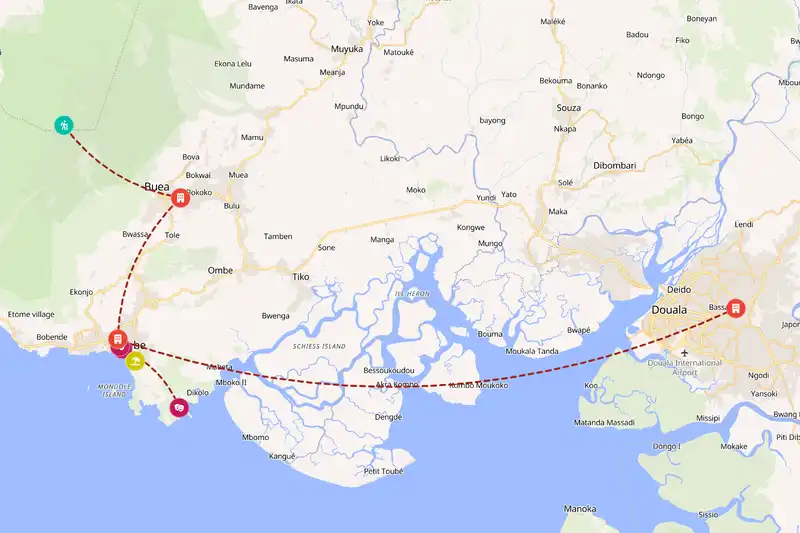
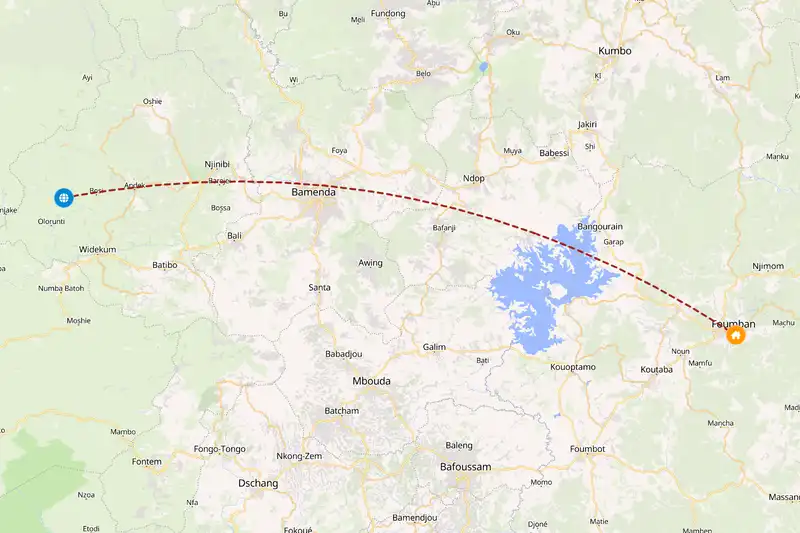
Yes, Cameroon can be backpacked independently, though it asks more patience than Ghana or Senegal: few fellow backpackers, French in most regions and transport that leaves when it is full.
The south is the workable zone.
Douala,
Limbe,
Buea,
Yaoundé,
Kribi,
Dschang and
Foumban are linked by agency buses and shared taxis, and basic rooms cost about 10,000 to 20,000 XAF (US$17 to 33). Plan on US$28 to 45 a day. English works in Limbe and Buea. Police checkpoints are routine, so carry your passport. Most governments advise against travel to the Far North and the Northwest, which takes Waza and Bamenda off a sensible plan.
Two weeks is the right length for a first trip to Cameroon; one week covers a single region well, and three weeks lets you link the coast, the highlands and the south.
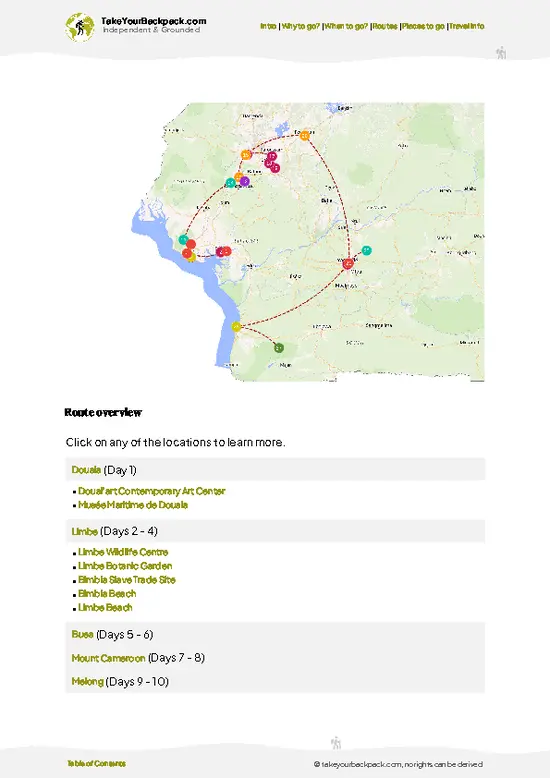
In 7 days, stay around
Douala,
Limbe and
Buea, including a 2 to 3 day Mount Cameroon trek. In 14 days, add
Yaoundé,
Foumban,
Dschang and 3 nights in
Kribi. In 21 days, combine both and add Campo Ma’an. Build in buffer time: Yaoundé to Foumban takes 5 to 6 hours by bus, and departures often wait until every seat is sold.
Yes, the southern half of Cameroon is fully doable without a car, using agency buses between cities and shared taxis or moto-taxis for short distances.
Douala to
Yaoundé takes 3.5 to 5 hours, at roughly 4,000 to 8,000 XAF (US$7 to 14) depending on standard or VIP class. Douala to
Limbe is about 90 minutes for 1,500 to 2,000 XAF, and Douala to
Kribi about 3 hours. Moto-taxis to trailheads and waterfalls cost 200 to 1,500 XAF. For the Bamiléké chiefdom museums, a chartered taxi for the day at around 30,000 to 50,000 XAF saves hours of connections. The Camrail overnight train runs from Yaoundé to Ngaoundéré in 12 to 16 hours.
The essential places in Cameroon are Mount Cameroon, the Limbe coast, the Grassfields kingdoms around Foumban and Dschang, and the beach at Kribi.
Allow 2 to 3 days for the
Mount Cameroon trek from
Buea, and 2 days in
Limbe for the Wildlife Centre, Botanic Garden and Bimbia Slave Trade Site.
Foumban, 5 to 6 hours from Yaoundé, has the Bamum Sultan’s palace and bronze casters. The Musée des Civilisations in
Dschang is the country’s best museum. The
Ekom-Nkam Waterfalls and Manengouba Twin Crater Lakes near Melong fill 2 days, and
Kribi, 3 hours from Douala, is the place for 2 to 3 beach days.
If time is short in Cameroon, skip the north and the far eastern rainforest parks, and keep Douala to a single night.
The Far North (Waza, Mora, Rhumsiki, Kousseri) faces government travel warnings, and Garoua, Benoue and Bouba Ndjida need a flight or a 12 to 16 hour train plus long road transfers.
Lobéké and
Dja are superb but take 2 days of rough driving each way via Yokadouma or Lomié, plus costly permits and guides. Bamenda and Korup sit in conflict-affected Anglophone areas. Spending those days on
Limbe,
Foumban,
Dschang and
Kribi gives far more for the hours.
Yes, our itinerary-planner does exactly that. Set your trip length in days, give your interests and travel style, optionally give start- and end location and/or some mandatory stops you would like to include and the itinerary planner creates your personalized routes for Cameroon in seconds. Try it out!
Try the itinerary plannerv2.webp)
 Best Backpacking