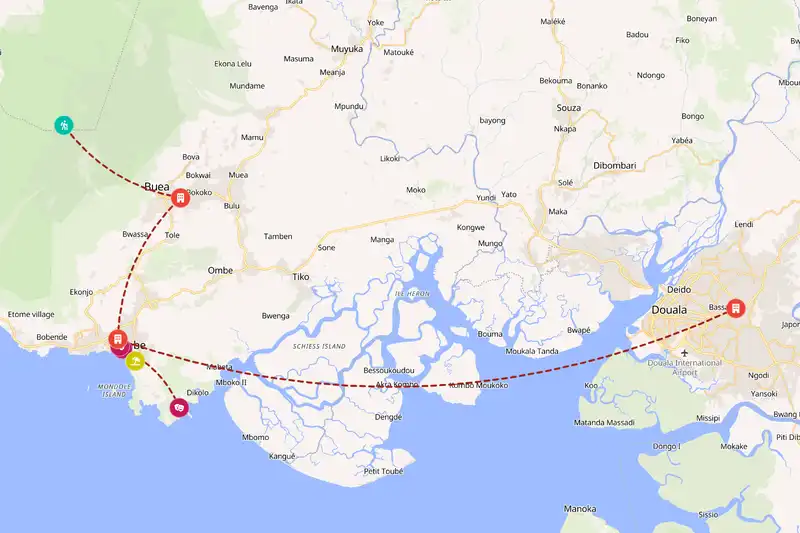
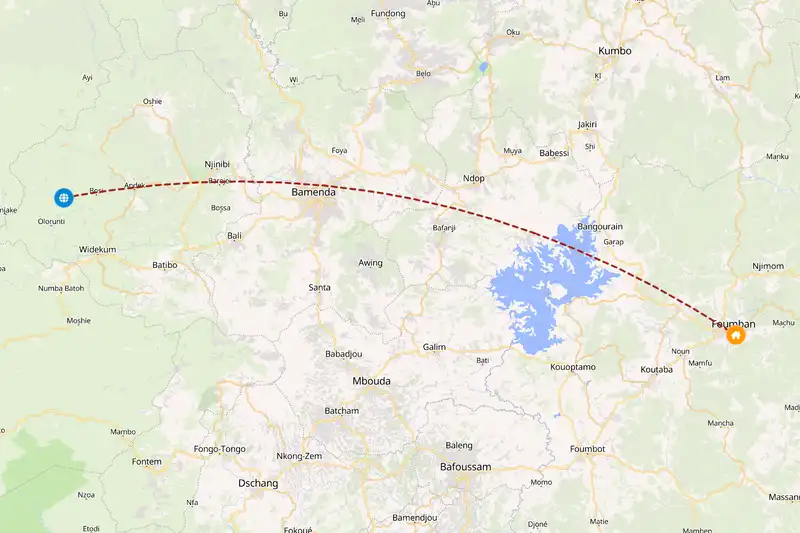
This three-week loop suits travelers who want Cameroon’s full southern spread at a pace that leaves room to linger: the volcanic coast, a summit, the crater lakes and waterfalls of the Littoral hills, the royal compounds of the Grassfields, the capital and a final stretch of rainforest-backed beach. The pace is relaxed, with long transfer days followed by slow ones. You’ll ride agency buses on the main corridors, shared taxis and minibuses on shorter hops, moto-taxis for trailheads and falls, and one chartered taxi for the chiefdom circuit.
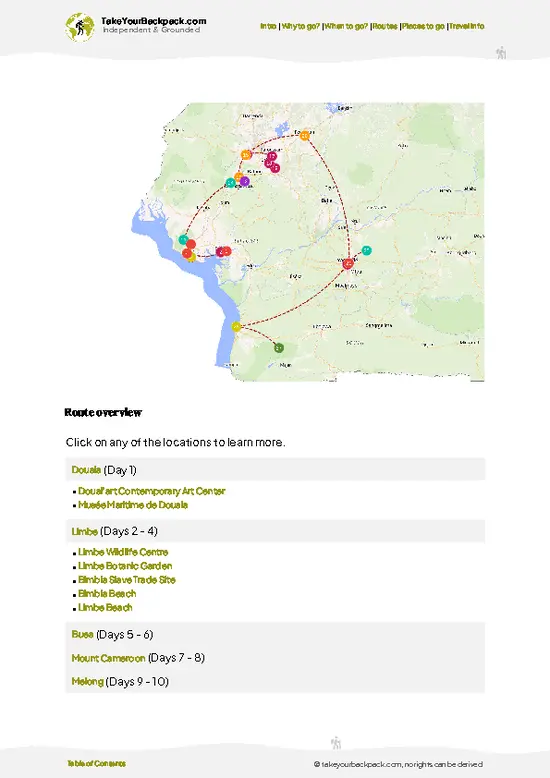
Days 1-4: Douala and Limbe
Give
Douala a proper morning this time. After an arrival night in Bonanjo, walk to
Doual’art Contemporary Art Center, which has spent decades commissioning public art for the city’s streets, then the
Musée Maritime de Douala, a compact look at the port and river trade that built the city. By afternoon you’re on a minibus from Bonabéri to
Limbe, about 90 minutes away.
Three nights here lets you split the sights sensibly. Start …
read more 👉This three-week loop suits travelers who want Cameroon’s full southern spread at a pace that leaves room to linger: the volcanic coast, a summit, the crater lakes and waterfalls of the Littoral hills, the royal compounds of the Grassfields, the capital and a final stretch of rainforest-backed beach. The pace is relaxed, with long transfer days followed by slow ones. You’ll ride agency buses on the main corridors, shared taxis and minibuses on shorter hops, moto-taxis for trailheads and falls, and one chartered taxi for the chiefdom circuit.
Days 1-4: Douala and Limbe
Give Douala a proper morning this time. After an arrival night in Bonanjo, walk to Doual’art Contemporary Art Center, which has spent decades commissioning public art for the city’s streets, then the Musée Maritime de Douala, a compact look at the port and river trade that built the city. By afternoon you’re on a minibus from Bonabéri to Limbe, about 90 minutes away.
Three nights here lets you split the sights sensibly. Start at the Limbe Wildlife Centre, where rescued gorillas, chimpanzees and drills live in large forest enclosures, and cross to the Limbe Botanic Garden, laid out by the German colonial government in 1892. A second day goes to Bimbia Slave Trade Site, 30 to 40 minutes along the coast, where community guides walk you past the ruins toward the shoreline captives were marched to. Stay on for a swim at Bimbia Beach, then spend the last afternoon on the dark volcanic sand of Limbe Beach, eating grilled fish at Down Beach while the fishing pirogues come in.Days 5-8: Buea and Mount Cameroon
Buea sits at roughly 1,000 meters on the mountain’s flank, an hour from Limbe, and was the German colonial capital; the old governor’s residence still stands. Spend the first night sorting a licensed guide and porter. The three-day Mount Cameroon trek climbs through farmland and montane forest to the huts, crosses the lava fields of recent eruptions and tops out just over 4,000 meters, the highest point in West Africa. Come down to a second night in Buea rather than rushing off. The Southwest Region has been affected by the Anglophone crisis since 2016, and Buea and Limbe have remained the standard bases for visitors on this coast.Days 9-10: Melong
The longest transfer of the trip (4 to 5 hours via Douala) brings you to Melong, a quiet crossroads town that exists on this route for two reasons. The Ekom-Nkam Waterfalls, about 80 meters of water pouring off a forested basalt ledge (they appeared in the 1984 film Greystoke), are a moto-taxi ride away. The next day, a guided climb up the grassy flanks of Mount Manengouba ends at the Manengouba Twin Crater Lakes, one blue and one green, known locally as the male and female lakes, with Fulani cattle grazing the caldera floor.Days 11-14: Dschang, the Chiefdoms and Foumban
Dschang, two hours up into cooler air, is a former colonial hill station with a lake at its center and the Musée des Civilisations on its shore, the best introduction anywhere to Cameroon’s ethnic and regional diversity. Stay two nights. Then charter a taxi for a full day across the Bamiléké plateau: Bandjoun Station Art Center, artist Barthélémy Toguo’s mural-covered studio and gallery, then the chiefdom collections at Musée Royal de Baham and Musée Royal de Batoufam, where carved posts, beaded thrones and masks stay in the royal compounds they belong to. Finish in Foumban, capital of the Bamum kingdom, where the Sultan’s palace and the bronze casters and woodcarvers on the artisans’ street fill a second day easily.Days 15-17: Yaoundé
Allow 5 to 6 hours by bus to Yaoundé, then take a slower look than most visitors do. The National Museum of Cameroon occupies the former presidential palace, and the Musée La Blackitude adds a closer look at traditional regalia and masks. When the traffic fumes get to you, the Bois Sainte Anastasie is a shady park right in the center. Give one full day to the Mefou Primate Sanctuary, roughly an hour outside the city, where forest paths pass enclosures of rescued chimpanzees and gorillas.Days 18-21: Kribi and Campo Ma’an
A 3.5 to 4.5 hour bus ride ends the trip on the sand. Kribi Beach is pale and palm-lined, a sharp contrast to Limbe’s black volcanic shore, and two nights of grilled prawns and swimming are the right reward after three weeks of road. Then push 1.5 to 2 hours south to Campo Ma’an National Park for a final night, using the coastal village of Ebodjé as your base for its sea turtle program and rainforest walks; turtles nest here roughly between November and March. On day 21, the road back to Douala takes 4 to 5 hours, so plan for an evening flight.
On the drive between Douala and Edéa, a short detour leads to Lake Ossa, a quiet lake and wildlife reserve where fishermen in dugout canoes share the water with a small population of African manatees.
 Best Backpacking