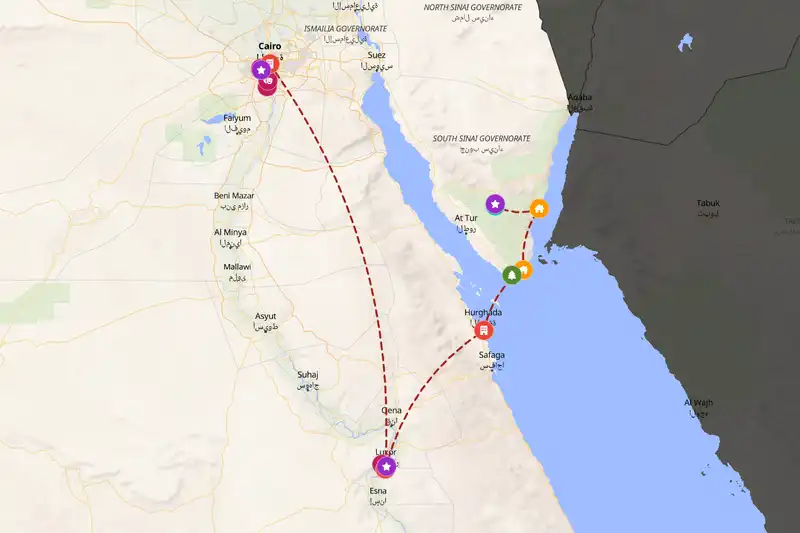
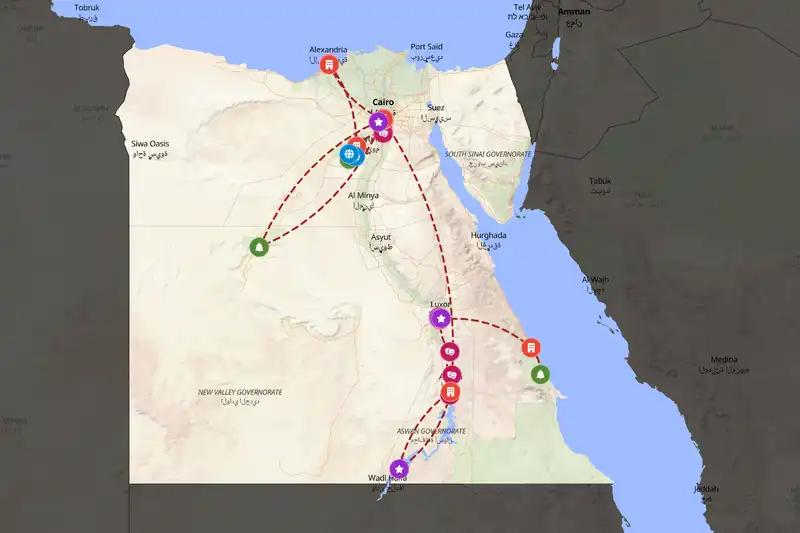
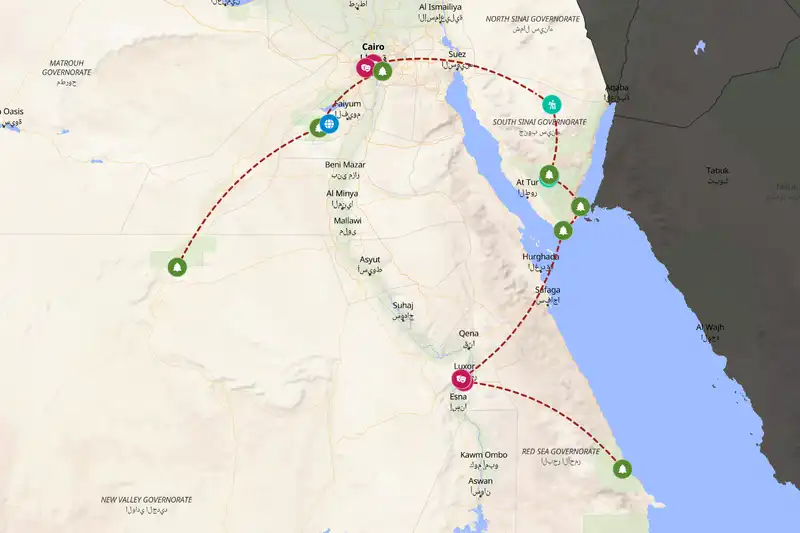
Yes, backpacking Egypt independently is very doable on the Cairo, Luxor and Aswan corridor and in Sinai, though it takes more patience with touts and haggling than most countries.
Dorm beds in
Cairo,
Luxor,
Aswan and
Dahab run about EGP 300 to 600 (US$6 to 12), and hostels book desert trips and transfers for you. Uber and Careem work in Cairo and Alexandria, which ends taxi-fare arguments. A daily budget of US$20 to 35 covers a dorm, street food such as koshary and local transport. Site tickets are the big expense, with the Giza plateau and the Valley of the Kings each around US$10 to 20. Agree every felucca, carriage and taxi price before you set off.
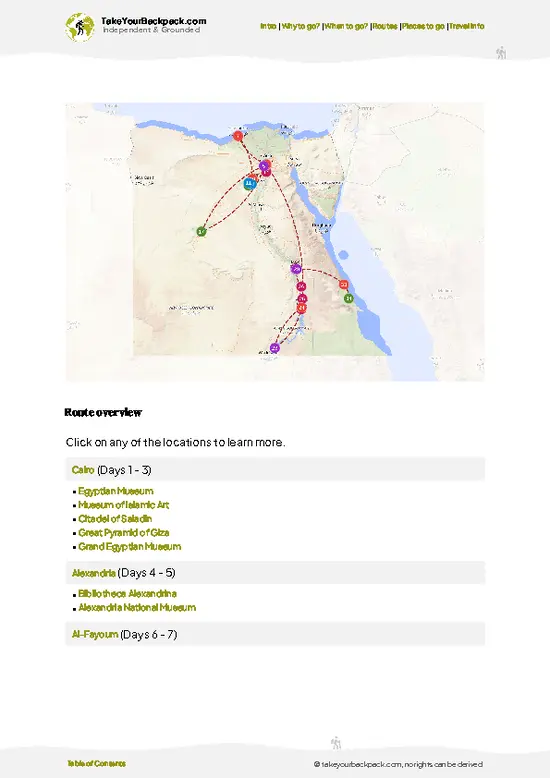
Two weeks is the right length for a first trip to Egypt, enough for the pyramids, the Nile temples and a few days on the Red Sea without rushing.
Give
Cairo 3 to 4 days for Giza, the museums and Saqqara,
Luxor 3 days and
Aswan 2 to 3 days including the Abu Simbel day trip. Add 3 to 4 days in Sinai or on the Red Sea coast. With only 7 days, stick to Luxor and Aswan, or Cairo plus Luxor linked by the 1-hour flight or the 9 to 10 hour sleeper train. Three weeks lets you add
Alexandria, the
Fayoum Oasis and a night camping in the
White Desert.
You can get around Egypt easily without a car, and driving yourself is a poor idea given the traffic and checkpoints.
Trains follow the Nile: Cairo to Alexandria takes 2.5 to 3 hours, Cairo to Luxor 9 to 10 hours, and Luxor to Aswan 3 to 4 hours. Private bus companies cover Cairo to
Hurghada in 6 to 7 hours and Cairo to
Dahab in 9 to 10 hours, usually for US$10 to 25. Domestic flights, such as Cairo to Aswan in about 1.5 hours, cost roughly US$60 to 120. For the pyramids of
Saqqara and
Dahshur or the Fayoum desert, hire a car with a driver for about US$30 to 60 a day.
The places in Egypt you shouldn’t miss are the Giza pyramids, Luxor’s temples and tombs, and Abu Simbel, with Sinai close behind.
In
Cairo, pair the
Great Pyramid of Giza with the
Grand Egyptian Museum next door over one full day.
Luxor needs 3 days for Karnak, the Valley of the Kings and the Temple of Hatshepsut. From
Aswan, the Abu Simbel temples are a 3.5 hour drive each way, leaving around 4 a.m. In Sinai, base yourself in
Dahab for reef snorkeling and the overnight climb of
Mount Sinai, about 2.5 hours away by road, for sunrise at 2,285 meters.
If you’re short on time in Egypt, skip the big resort strips, the far oases and the second-tier Delta cities, and keep your days on the Nile.
Hurghada and
Sharm El Sheikh are mostly hotel zones; unless you’re diving, a few days in
Dahab covers your beach time better.
Siwa Oasis is magical but sits 10 to 12 hours by bus from Cairo, so it only makes sense with 3 or more spare days.
Alexandria can go on trips under 10 days, since little of its ancient city survives above ground. In Cairo, the Abdeen and Manial palace museums are easy to drop.
Yes, our itinerary-planner does exactly that. Set your trip length in days, give your interests and travel style, optionally give start- and end location and/or some mandatory stops you would like to include and the itinerary planner creates your personalized routes for Egypt in seconds. Try it out!
Try the itinerary plannerv2.webp)
 Best Backpacking