×
Ghana🇬🇭 | 5 days itinerary

Ghana in 5 Days

By Johan Kruseman 🇳🇱 | Updated May 11, 2026
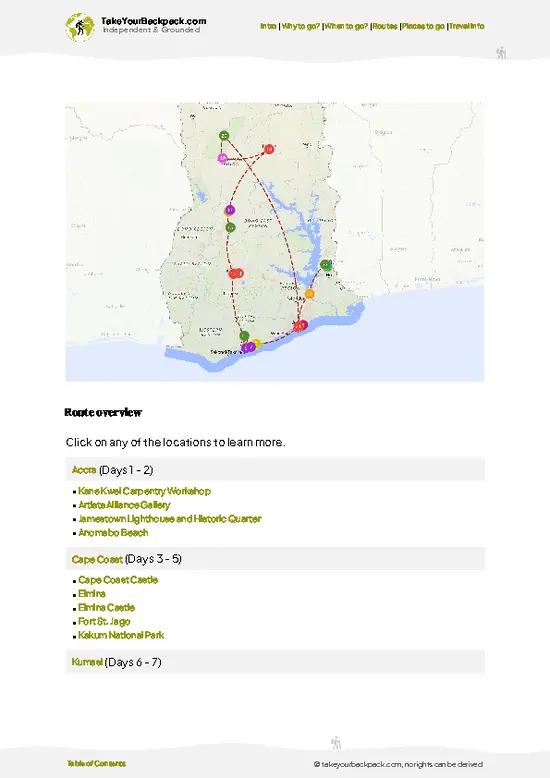
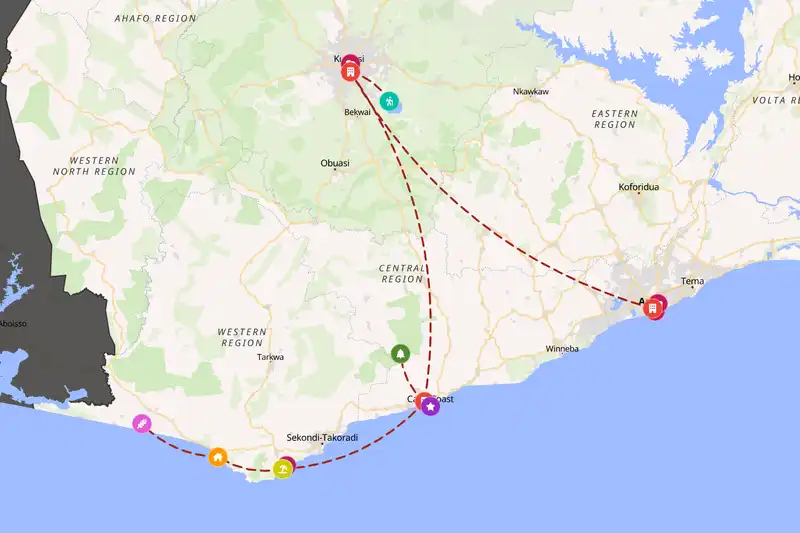
This 5-day coastal loop is for travelers who want Ghana’s history and beaches without burning out on bus rides; it’s relaxed, heavy on culture, and uses a mix of tro-tros, shared taxis, and one intercity bus hop from Accra to the Cape Coast-Elmina area. You’ll base yourself mostly in one region so you can actually feel the rhythm of the coast instead of just ticking castles off a list.

Days 1-2: Accra - First taste of Ghanaian city life and coastal culture

Roll into Accra and give yourself time to land: walkable chunks of the city, easy transport, and plenty of food stalls mean you can adjust to the heat and pace without stress. Spend your first full day diving into Ghana’s modern story at the Kwame Nkrumah Mausoleum and Memorial Park, then cross town to the W.E.B. Du Bois Memorial Centre for Pan-African Culture to connect the dots between Ghana’s independence and the wider Black diaspora. In between, swing by the National Museum of Ghana if it’s open and you’re hungry for more context, … read more 👉
This 5-day coastal loop is for travelers who want Ghana’s history and beaches without burning out on bus rides; it’s relaxed, heavy on culture, and uses a mix of tro-tros, shared taxis, and one intercity bus hop from Accra to the Cape Coast-Elmina area. You’ll base yourself mostly in one region so you can actually feel the rhythm of the coast instead of just ticking castles off a list.

Days 1-2: Accra - First taste of Ghanaian city life and coastal culture

Roll into Accra and give yourself time to land: walkable chunks of the city, easy transport, and plenty of food stalls mean you can adjust to the heat and pace without stress. Spend your first full day diving into Ghana’s modern story at the Kwame Nkrumah Mausoleum and Memorial Park, then cross town to the W.E.B. Du Bois Memorial Centre for Pan-African Culture to connect the dots between Ghana’s independence and the wider Black diaspora. In between, swing by the National Museum of Ghana if it’s open and you’re hungry for more context, and end the day with sand between your toes at Labadi Beach, where live music, football games, and grilled fish make it feel like half the city’s unofficial living room.

Days 3-4: Cape Coast & Elmina - Castles, memory, and sea breeze

Take a morning bus or shared taxi west to Cape Coast, a manageable half-day move that still leaves time to explore. Start with Cape Coast Castle, where the guided tours through the dungeons and Door of No Return are emotionally heavy but absolutely essential to understanding Ghana’s role in the transatlantic slave trade. Use the late afternoon to wander town or grab a drink overlooking the water, then the next day hop a short tro-tro to Elmina. Here, walk through Elmina Castle and, if you have the energy, climb up to Fort St. Jago for a different vantage point over the fishing harbor, watching the canoes and drying nets that show life here didn’t freeze with the history on the walls.

Day 5: Back to Accra - One more city hit before you go

Head back to Accra in the morning so you’re not gambling with traffic on departure day, then use your last hours to explore the lanes around Jamestown Lighthouse and Historic Quarter, where colonial-era buildings, street art, and boxing gyms give you a rawer, more lived-in side of the capital. If time allows, swing by Osu Castle from the outside or dip into the Artists Alliance Gallery for a fast, curated hit of contemporary Ghanaian art before you peel off to the airport or your next leg.

My strongest memory from this route is standing on the ramparts of Cape Coast Castle at sunset, feeling the sea wind on my face while the town’s drums and church choirs floated up from below.
Loading the map 🌍
film
0
0
0a
W.E.B. Du Bois Memorial Centre for Pan-African Culture
film
1
1
1a
National Museum of Ghana
film
2
2
2a
Labadi Beach
film
3
3
3a
Cape Coast
film
4
4
4a
Elmina
film
5
5
5a
Elmina Castle
film
6
6
6a
Osu Castle

🛏️ Where to stay?5 Days of Adventure

✈️ The backpacker research shortcutGhana Travel Guide

An offline-friendly backpacking guide with optimized travel routes, ranked highlights, transport advice, and the best areas to stay.
example page 0 from our offline Travel Guide for Ghanaexample page 1 from our offline Travel Guide for Ghanaexample page 2 from our offline Travel Guide for Ghanaexample page 3 from our offline Travel Guide for Ghanaexample page 4 from our offline Travel Guide for Ghanaexample page 5 from our offline Travel Guide for Ghana
The digital guide (365 pages) contains:
111 highlights, ranked by travel appeal
Optimized 5, 10 & 15-day travel routes
Best neighborhoods to stay
How to get around
Offline-friendly for travel without Wi-Fi
👉 See all 30+ guide features

📅 Plan smarter in minutes, not weeks
Month by month travel advice
Festivals & national holidays
Budget expectations

🗺️ Go to the right places, skip the overrated ones
Honest pros & cons of destinations
Top hikes, parks & viewpoints
Lesser-known places most travelers miss
Clear “worth it vs skip it” guidance

🛏️ Travel smoothly without rookie mistakes
Best areas to stay
Transport systems explained simply
Common scams & safety advice
SIM cards, money & practical tips

🌍 Understand the country, not just visit it
Culture & traditions
52 Essential phrases & customs
Festivals worth planning around
Traveler-friendly historical context
Insights that make places more meaningful

📱 Built for real travel conditions
Fully downloadable PDF
Works completely offline
Optimized for phone use
Useful in remote areas & buses
Everything in one place
Save weeks of stressful planning
Get instant access to the full guide directly. 30-day money-back guarantee.


Sent to your inbox immediately after payment • 100% Secure Checkout
Best Backpacking Travel Advisor 2025 tourism awardBest Backpacking
Travel Advisor
2025
What others say about Take Your Backpack Guides:
⭐⭐⭐⭐⭐
Fantastic, amazing amount of information!
⭐⭐⭐⭐⭐
My goodness this is amazing, it's what I've been looking for hats off too you!
⭐⭐⭐⭐⭐
I think this is absolutely BRILLIANT
⭐⭐⭐⭐
Very complete and informative. It's still missing places, but I gotta to commend you
⭐⭐⭐⭐⭐
This is truly amazing, thank you, can't wait to explore it with my kids!
⭐⭐⭐⭐⭐
Awesome resource, thank you!
⭐⭐⭐⭐⭐
This is amazing! Can't wait to explore the ones I haven't seen
⭐⭐⭐⭐
I love this! Well done, great idea.
⭐⭐⭐⭐⭐
Thanks for taking the time to make this gem!
⭐⭐⭐⭐⭐
This might be the best website I've ever seen.
⭐⭐⭐⭐⭐
Congratulations, and thank you so much for your work; it's incredibly valuable.
⭐⭐⭐⭐
In all seriousness I think you did a great job pointing out the important spots
⭐⭐⭐⭐⭐
10/10 very good
⭐⭐⭐⭐⭐
As someone who's only just starting to visit regularly this is awesome, thank you.
⭐⭐⭐⭐
Thank you very much! I'm going to visit my dad, it's going to be very useful!
⭐⭐⭐⭐⭐
This is really cool! We'll be travelling for the first time and this definitely come in handy.
⭐⭐⭐⭐⭐
You are now our minister of culture, congratulations 👨‍💼
⭐⭐⭐⭐⭐
Just wanted to tell you that this is a pearl! Going to follow your recommendations.
⭐⭐⭐⭐⭐
This is so cool. I'll definitely be using the resource for my travels soon.
⭐⭐⭐⭐⭐
This is very impressive! Good work.
⭐⭐⭐⭐⭐
This is an amazing and informative site. Very well done!

🧭 RouteMore Ways to Explore

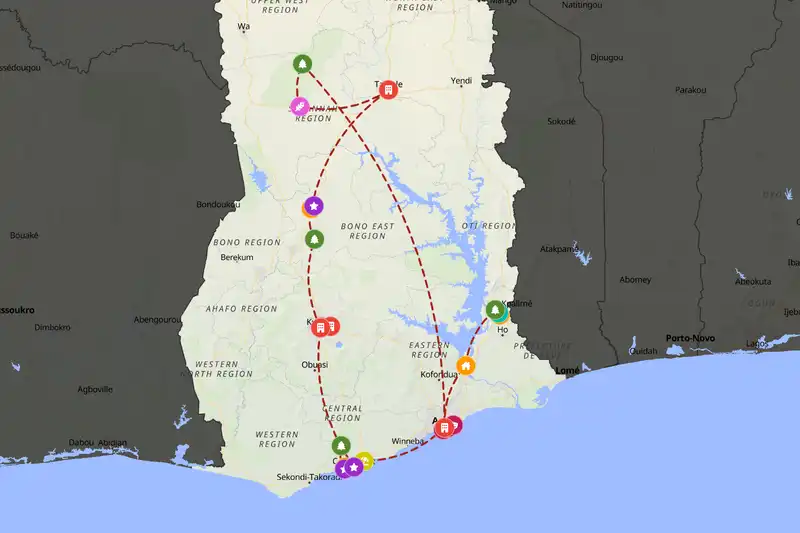
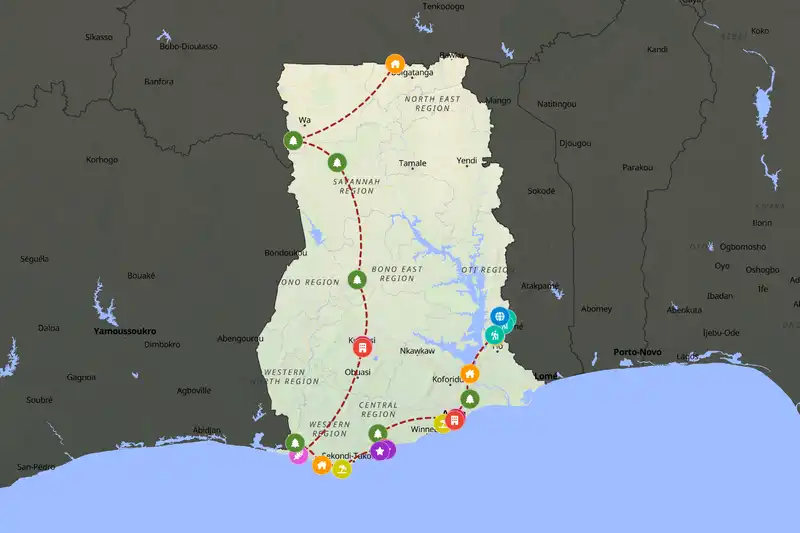
Travel Ghana your way — from a quick highlights trip to a slow-paced adventure.

🙋 FAQGood to Know

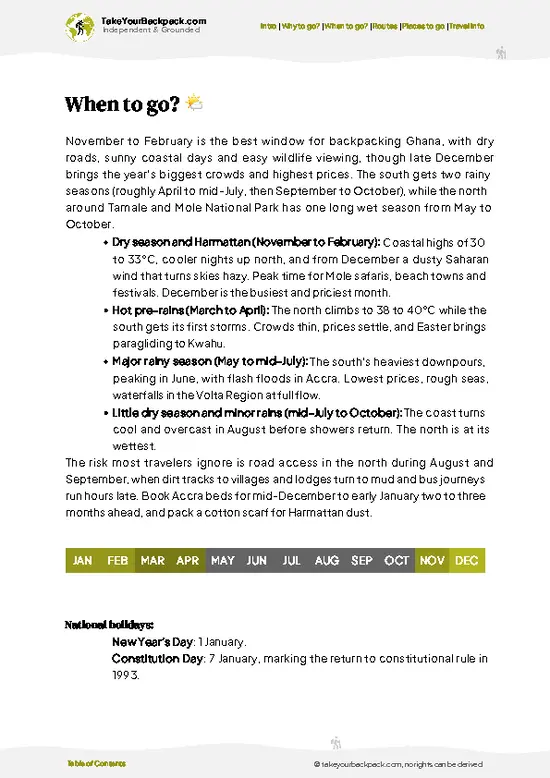
Short version: yes, Ghana is very doable to backpack independently, especially if you’ve handled any other West African country before. It’s one of the friendlier, more stable entries into the region, and English as an official language makes logistics much easier than in neighboring francophone countries. You still work for it a bit, but that’s half the fun.

For a budget traveler, the main strengths are: widespread shared transport (trotros and shared taxis), plenty of cheap guesthouses, and a strong culture of helping lost strangers. You can show up in most towns with no booking and find a room under your budget, especially outside peak holiday periods. In coastal and student areas, you’ll also find hostels and simple beach lodges that are used to backpackers.

The main challenges: things move on “Ghana time,” so buses leave late, trotros wait to fill up, and distances that look short on the map can eat a whole day. Road quality varies; you’ll bounce around a lot in the north and on some coastal stretches. ATMs are common in cities and bigger towns but can be unreliable, so you need a bit of cash buffer. Power cuts happen, so don’t expect ice-cold drinks and perfect Wi‑Fi everywhere.

Safety-wise, Ghana is one of the calmer countries in the region. Petty theft exists (especially in crowded markets and bus stations), but violent crime against travelers is rare if you use basic street sense: keep valuables close, avoid wandering around drunk at night in unfamiliar neighborhoods, and use registered taxis or ride-hailing in Accra after dark. Solo women backpacking is common; you’ll get attention but usually more curiosity than aggression.

If you’re comfortable with slightly chaotic transport, flexible with time, and okay with basic rooms and bucket showers now and then, Ghana is absolutely manageable solo and a solid first West Africa trip.
If you want more than a rushed checklist, 2–3 weeks is the sweet spot for Ghana on a backpacker budget.

Rough breakdowns that actually work on the ground:

7–10 days (fast but doable)
You can focus on the south and still feel like you’ve actually been somewhere, not just sat in buses.
- Accra: 2–3 days for markets, food, nightlife, and a day trip to Jamestown or Labadi.
- Cape Coast & Elmina: 2–3 days for the castles, history, and Kakum National Park canopy walk.
- One extra stop: 2–3 days at a beach (Busua/Butre) or in the Volta Region (Wli Falls, Mount Afadja).
This is tight but realistic if you accept some long transport days.

2 weeks (ideal starter trip)
- Accra: 2–3 days.
- Cape Coast/Elmina + Kakum: 3 days.
- Western beaches (Busua/Butre/Akwidaa): 3–4 days.
- Volta Region (Hohoe/Wli/Afadjato or Lake Volta area): 3–4 days.
You’ll have time to slow down, repeat your favorite food stalls, and not panic if a bus is late.

3–4 weeks (deeper dive)
This is where Ghana really opens up.
- All of the above, plus:
- Kumasi & Ashanti Region: 3–4 days for markets and craft villages.
- Northern Ghana (Tamale, Mole National Park, maybe Bolgatanga): 5–7 days.
The north adds a totally different feel: drier landscapes, different architecture, and a more relaxed pace.

Anything under a week is basically a city-and-coast teaser. Worth it if you’re already in the region, but if you’re flying in just for Ghana, aim for at least 10–14 days so the bus delays and slow days feel like part of the rhythm, not a disaster.
You can absolutely get around Ghana without a car; in fact, most locals do. For a backpacker, public and shared transport is the default, not a backup plan.

Main options:
- Trotros: Minibuses running fixed routes between and within towns. They’re cheap, frequent, and crowded. They leave when full, not on a strict schedule, so build in waiting time. Great for short to medium hops.
- Intercity buses: Companies like STC and VIP run larger, more comfortable buses between major cities (Accra–Kumasi, Accra–Tamale, etc.). They’re slower to get going but safer and more comfortable than trotros for long distances. Book at the station, ideally a bit in advance for popular routes.
- Shared taxis: Cars that run fixed routes and leave when full, usually a bit more expensive than trotros but faster and less cramped. Good for shorter inter-town routes or when you’re tired of being folded in half.
- Private taxis / ride-hailing: In Accra and a few other cities, you’ll find metered taxis or app-based rides. They’re still affordable by Western standards and worth it at night or with luggage.

How it feels in practice:
- You can reach all the classic backpacker stops (Accra, Cape Coast, Elmina, Kakum, Busua/Butre, Kumasi, Tamale, Mole, Volta Region) by public transport, then use local taxis or moto-taxis to reach your guesthouse or trailhead.
- The trade-off is time and comfort. A 4–5 hour drive can easily become a 7–8 hour travel day with waiting, traffic, and random stops. If you only have a week, this matters; with 2–3 weeks, it’s just part of the story.
- At night, especially in big cities, it’s smarter to use taxis or ride-hailing instead of walking long distances with your pack.

Renting a car is possible but not necessary for most backpackers and can be more stress than it’s worth: traffic in Accra is chaotic, police checkpoints are frequent, and road conditions change fast. Unless you’re traveling as a group and really want maximum flexibility, stick to the local system—it’s cheaper, safer, and more interesting.
For a budget traveler, the must-visits are the places that give you the most culture, history, and nature per bus ride and cedi spent.

1. Accra (but not just the malls)
You don’t need to love big cities to get something out of Accra. Focus on:
- Jamestown for street life, boxing gyms, and coastal views.
- Markets like Makola for fabric, food, and chaos.
- Local food joints for waakye, banku with tilapia, and kelewele.
Use it as your landing pad to get your bearings, SIM card, and cash sorted.

2. Cape Coast & Elmina
These two towns are essential for understanding Ghana’s role in the transatlantic slave trade. The castles are heavy, emotional visits, but they’re important. Stay at least one night so you’re not rushing between tours and buses. The towns themselves are walkable and atmospheric, with cheap guesthouses and street food.

3. Kakum National Park
Close to Cape Coast, Kakum is worth the detour for the canopy walkway and the chance to get into real forest. The standard canopy walk is short but memorable; if you have time and budget, ask about longer hikes or overnight stays in the park for a more immersive experience.

4. Western Coast beaches (Busua, Butre, Akwidaa)
If you want a few days of hammocks, surf, and cheap grilled fish, this stretch is your spot. Busua is more social and surf-oriented; Butre and Akwidaa are quieter. You can walk between some of them along the beach or by short boat rides. This is where a lot of backpackers end up staying longer than planned.

5. Volta Region (Hohoe, Wli Falls, Mount Afadja)
This area gives you waterfalls, hills, and cooler air without needing a 12-hour bus ride. Wli Falls is one of the most rewarding day hikes for the effort, and Mount Afadja is a short but sweaty climb with wide views. You can base yourself in Hohoe or a nearby village guesthouse.

6. Kumasi & the Ashanti Region
Kumasi’s main draw is cultural: the huge Kejetia Market, the Manhyia Palace Museum, and nearby craft villages (kente weaving, wood carving). It’s a good place to understand Ashanti history and pick up meaningful souvenirs instead of random trinkets.

7. Mole National Park (if you have time)
If you’re in Ghana for 2–3 weeks, Mole is worth the long haul north. It’s one of the more budget-friendly safari experiences in West Africa, with walking safaris and a good chance of seeing elephants, antelope, and warthogs. The view from the lodge over the waterholes is a classic Ghana moment.
If you’re short on time, skip anything that eats days of transport for an experience you can get more easily elsewhere in the country.

1. Very remote beaches beyond Busua/Butre
Going far west along the coast toward the border can be beautiful, but the extra hours of bumpy roads often don’t add much beyond what you already get in Busua or Butre: quiet sand, fishing villages, and simple lodges. With limited days, stop at one or two well-located beach towns and call it good.

2. Trying to do both the far north and everything in the south on a 1–2 week trip
Tamale and Mole are great, but they’re a serious time investment from Accra or the coast. If you only have 7–10 days, forcing Mole into the plan means you’ll spend half your trip on buses. Either commit to a north-focused itinerary (Accra–Kumasi–Tamale–Mole) or stick to the south (Accra–Cape Coast–Kakum–beaches–Volta). Doing both in a rush makes everything feel like a transit day.

3. Multiple big cities
Accra plus Kumasi is plenty of urban Ghana for a short trip. Adding extra time in second-tier cities (like Takoradi) usually doesn’t add much for a backpacker unless you have a specific reason. Use that time for nature, coast, or villages instead.

4. Overpriced, heavily packaged “cultural shows”
In touristy areas you’ll see offers for expensive staged performances or “village tours” that feel more like a bus stop than an exchange. If your budget and time are tight, skip the high-priced, over-curated experiences and look for smaller, locally run tours or just spend time in markets, trotro stations, and neighborhood bars. You’ll get more real interaction for less money.

5. Rushing every castle and fort on the coast
The history is important, but you don’t need to see every single fort. Cape Coast Castle and Elmina Castle cover the story powerfully. Smaller forts along the coast are interesting if you have time, but if you’re on a tight schedule, focus on those two and spend the rest of your hours walking the towns or relaxing at the beach.

If you’re really squeezed, the most efficient high-impact route is: Accra → Cape Coast/Elmina + Kakum → one beach town (Busua or Butre) → Volta Region (Wli Falls/Afadjato) → back to Accra. Everything else is optional once you have more days to play with.

🇬🇭 GhanaDiscover the Country

Ready to build a truly unique trip? Predefined routes are perfect for first-time visitors, but there is so much more to discover. Whether you are chasing a city trip, pristine national parks, local food scenes, or quiet beaches, pick a category to design your own path.