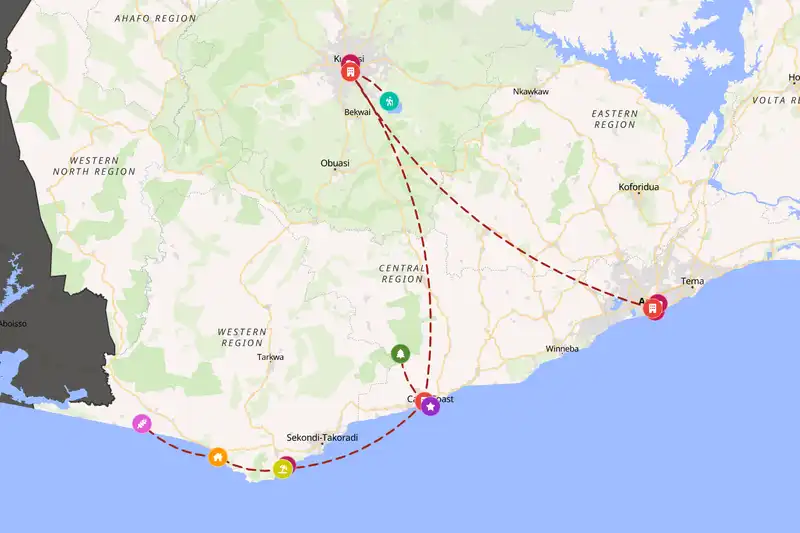
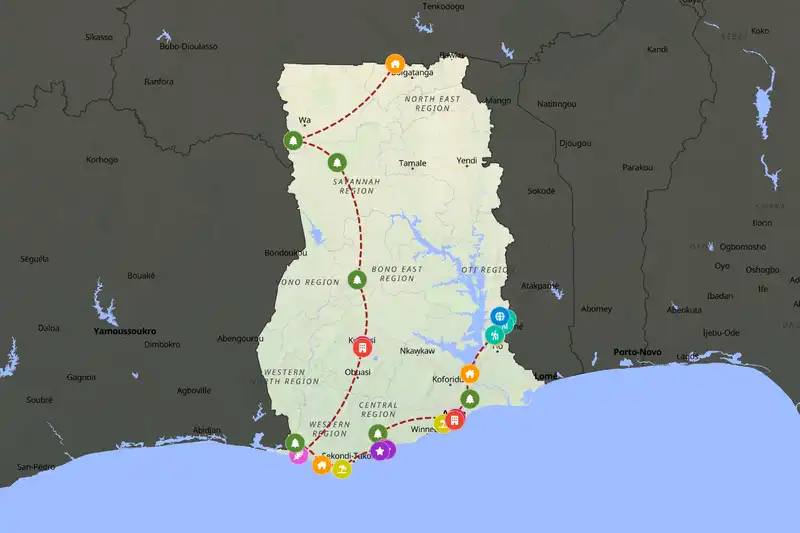
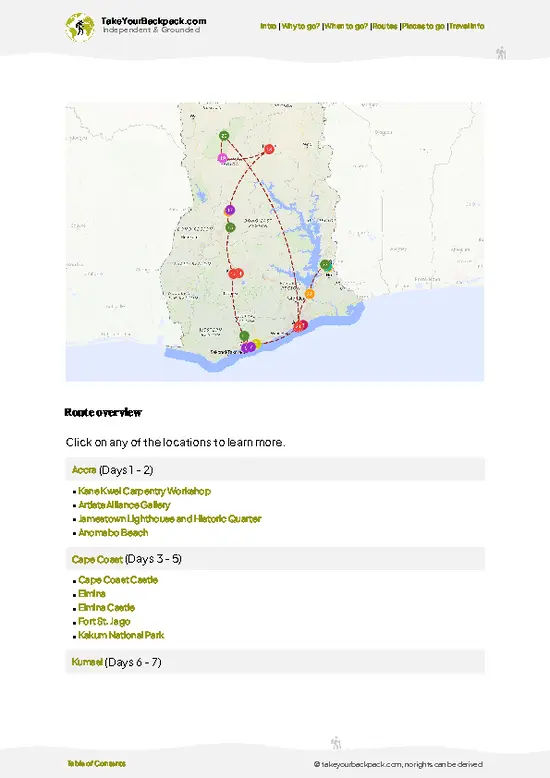
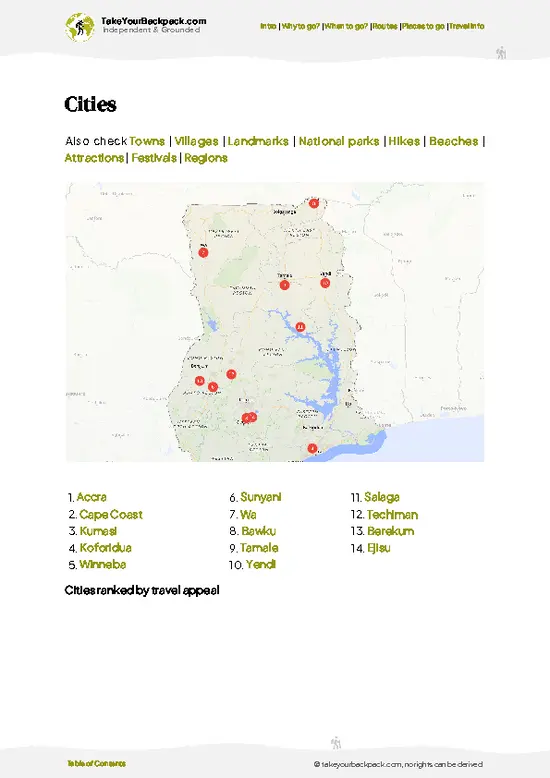
This fifteen-day route is for travelers who want the full north-to-south sweep of Ghana: Atlantic forts, the Asante kingdom, the dry northern savannah and the green hills east of Lake Volta. The pace is steady, with 1 to 3 nights per stop. It runs on intercity coaches, trotros (shared minibuses), shared taxis, an early-morning Metro Mass bus and one domestic flight from Tamale that saves a 12-hour bus ride.
Days 1-2: Accra
Use the first two days to see the creative side of
Accra. Head east to Teshie and the
Kane Kwei Carpentry Workshop, where carpenters have carved “fantasy coffins” shaped like fish, cocoa pods and Mercedes-Benzes since the 1950s. You can watch the sawdust fly and order a miniature to take home. Back in town, the
Artists Alliance Gallery on the Labadi road fills three floors with sculpture, kente and paintings, and it is a far better place to buy art than any airport shop. Finish at the
Jamestown Lighthouse and Historic Quarter as the sun drops, when the crumbling colonial …
read more 👉This fifteen-day route is for travelers who want the full north-to-south sweep of Ghana: Atlantic forts, the Asante kingdom, the dry northern savannah and the green hills east of Lake Volta. The pace is steady, with 1 to 3 nights per stop. It runs on intercity coaches, trotros (shared minibuses), shared taxis, an early-morning Metro Mass bus and one domestic flight from Tamale that saves a 12-hour bus ride.
Days 1-2: Accra
Use the first two days to see the creative side of Accra. Head east to Teshie and the Kane Kwei Carpentry Workshop, where carpenters have carved “fantasy coffins” shaped like fish, cocoa pods and Mercedes-Benzes since the 1950s. You can watch the sawdust fly and order a miniature to take home. Back in town, the Artists Alliance Gallery on the Labadi road fills three floors with sculpture, kente and paintings, and it is a far better place to buy art than any airport shop. Finish at the Jamestown Lighthouse and Historic Quarter as the sun drops, when the crumbling colonial facades turn orange and kids play football on the sand below.Days 3-5: Anomabo, Cape Coast and Elmina
Head west and break the trip at Anomabo Beach, 2.5 to 3 hours from Accra, for a swim and a long lunch before the last 20 minutes into Cape Coast. Three nights here let you take the history slowly instead of stacking tours. Give one morning to Cape Coast Castle, then decompress with a fresh coconut down at the fishing harbour. The next day belongs to Elmina. Tour Elmina Castle in the morning, then climb the hill opposite to Fort St. Jago, where the Dutch placed the cannons they used to take the castle from the Portuguese in 1637. The view over the lagoon and the canoe boatyard is the best on this stretch of coast. Keep the last day for Kakum National Park, and if the canopy walkway queue is long, ask about the guided forest trails on the ground below it.Days 6-7: Kumasi and Ejisu
The coach to Kumasi takes 4 to 5 hours through cocoa country. In the old Asante capital, the Manhyia Palace Museum tells the story of the kings through their furniture, regalia and life-size wax figures. If your visit lands on an Akwasidae festival day (held every 42 days), you may see the Asantehene receiving chiefs under huge ceremonial umbrellas. On day seven, take a trotro 30 minutes east to Ejisu, hometown of Queen Mother Yaa Asantewaa, who led the 1900 War of the Golden Stool against the British.Days 8-9: Boabeng-Fiema, Kintampo and Tamale
Day eight is the longest road day of the first week: a trotro north to Techiman (about 3 hours), then a shared taxi to the Boabeng-Fiema Monkey Sanctuary. Black-and-white colobus and Mona monkeys live right inside two villages that have protected them as sacred for generations. Continue roughly 90 minutes to Kintampo for the night. Next morning, walk the steps down to Kintampo Waterfalls before the heat builds, then ride 3 to 4 hours north to Tamale, where the land flattens into savannah and motorbikes outnumber cars.Days 10-11: Larabanga and Mole National Park
The paved road west of Tamale gets buses to Larabanga in about 3 hours. Stop at the whitewashed mud-and-timber mosque, traditionally dated to the 15th century, before the last few kilometres to Mole National Park. Two nights give you both the morning and afternoon walking safaris with an armed ranger. In the dry season (November to April) elephants gather at the waterholes below the escarpment, sometimes within 30 m of your group.Day 12: Tamale to Accra
Catch the early bus from Mole back to Tamale (3 to 4 hours), then fly to Accra in about 1 hour 10 minutes for roughly US$70 to 150. Sleep in Accra and keep the evening easy.Days 13-15: Akosombo and the Volta Highlands
Day 13 is a short hop: 2 hours by trotro to Akosombo, where the 1965 dam created Lake Volta, one of the world’s largest reservoirs by surface area. Spend the afternoon on a boat or by the river below the dam. Day 14 takes you east via Ho to the Tafi Atome Monkey Sanctuary, where Mona monkeys take bananas from your hand in the early morning, and on to Amedzofe, which at around 750 m is one of Ghana’s highest villages and pleasantly cool at night. On the final morning, hike the Amedzofe Mountain Trail up Mount Gemi to the iron cross on the summit, then ride 3.5 to 4 hours back to Accra for your flight.
If you ever stretch this trip further north, the painted compound houses of Sirigu near Bolgatanga, where women decorate mud walls with geometric patterns in black, white and red, repay every bumpy kilometre.
 Best Backpacking