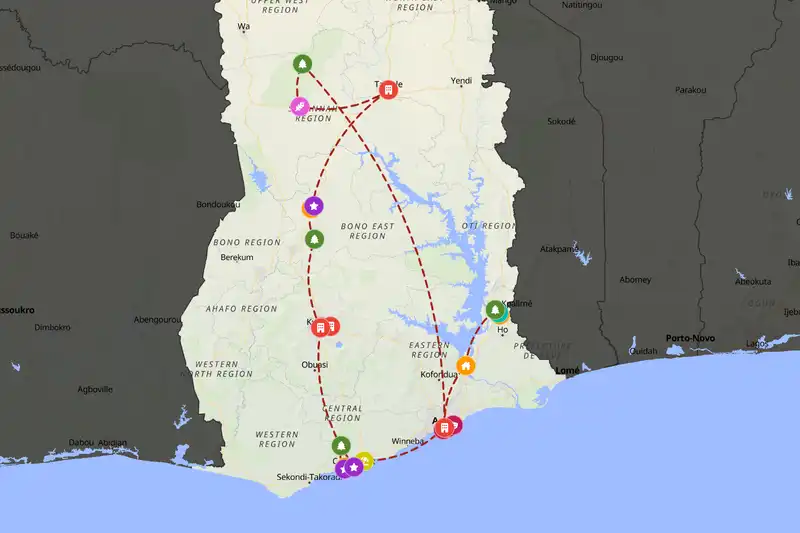
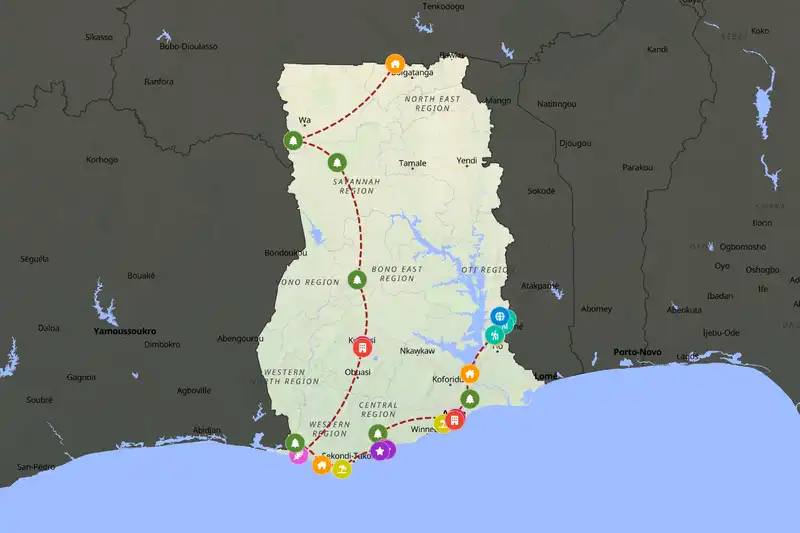
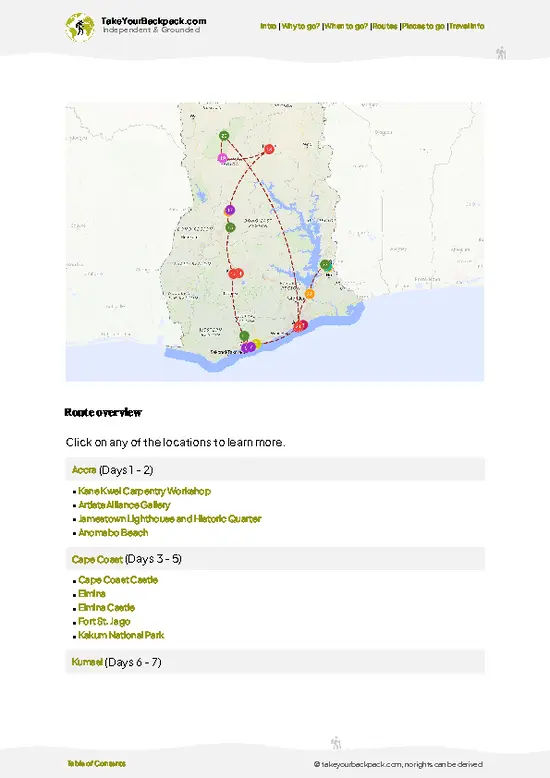
This ten-day loop suits travelers who want the Asante heartland followed by slow days on the quieter western beaches, with two-night stays almost everywhere so no day is pure transit. The pace is moderate, and everything runs on intercity coaches, trotros (shared minibuses) and shared taxis, plus a dugout canoe for the final stilt-village trip.
Days 1-2: Accra
Stay in Osu and spend your full day in
Accra on the city’s Pan-African story. The
W.E.B. Du Bois Memorial Centre for Pan-African Culture in Cantonments is the house where the American scholar lived from 1961 until his death in 1963; his library, his gown and his grave are all on site, and the garden is a calm hour away from the traffic. In the afternoon, walk to
Osu Castle, built by the Danes in the 1660s and the seat of Ghana’s government until 2013. Evenings in Osu mean plastic chairs, cold Club beer and street food sizzling under bare bulbs.
Days 3-4: Kumasi
A coach covers the 250 km to
Kumasi in 4 to 6 hours. Start at the
Manhyia …
read more 👉This ten-day loop suits travelers who want the Asante heartland followed by slow days on the quieter western beaches, with two-night stays almost everywhere so no day is pure transit. The pace is moderate, and everything runs on intercity coaches, trotros (shared minibuses) and shared taxis, plus a dugout canoe for the final stilt-village trip.
Days 1-2: Accra
Stay in Osu and spend your full day in Accra on the city’s Pan-African story. The W.E.B. Du Bois Memorial Centre for Pan-African Culture in Cantonments is the house where the American scholar lived from 1961 until his death in 1963; his library, his gown and his grave are all on site, and the garden is a calm hour away from the traffic. In the afternoon, walk to Osu Castle, built by the Danes in the 1660s and the seat of Ghana’s government until 2013. Evenings in Osu mean plastic chairs, cold Club beer and street food sizzling under bare bulbs.Days 3-4: Kumasi
A coach covers the 250 km to Kumasi in 4 to 6 hours. Start at the Manhyia Palace Museum, the Asantehene’s residence from 1925 to 1995, now filled with royal furniture and wax figures of past kings, then lose an hour in Kejetia Market, one of the largest in West Africa. Day four is for the Lake Bosomtwe Trail, about an hour southeast: a meteorite crater lake roughly 8 km across, ringed by forested hills. Walk the shore path between fishing villages, where men still paddle out on wooden planks instead of boats.Days 5-6: Cape Coast
The road south to Cape Coast takes 4 to 5 hours. This was the British headquarters of the Gold Coast for nearly two centuries, and Cape Coast Castle tells that story through its museum as well as its dungeons; give it a full morning. Spend the next morning at Kakum National Park, then stop for lunch at a roadside chop bar on the way back.Days 7-8: Busua
Head west to Busua Beach, about 3 hours via a trotro to Takoradi and a shared taxi from Agona Junction. Busua’s long, gentle beach break is one of the best places in West Africa to learn to surf, and boards can be rented on the sand. On your second day, walk the Busua to Butre trail, roughly an hour along the beach and over a jungle-covered headland, ending in Butre below Fort Batenstein, a small Dutch fort from the 1650s with a sweeping view of the bay.Days 9-10: Axim, Nzulezo and the Ride Home
Move an hour west to Axim, then take a shared taxi 1 to 1.5 hours to Beyin for the dugout canoe to Nzulezo. The ride through raffia-palm swamp on Lake Amansuri takes about an hour each way, and the village itself stands entirely on stilts above the water. On day ten, ride 6 to 7 hours back to Accra, or shorten the journey with a 40-minute flight from Takoradi.
For one extra night on this coast, Princes Town and its hilltop Fort Gross-Friedrichsburg, built by Brandenburg traders in 1683, offer a near-empty beach and some of the quietest sunsets in Ghana.
 Best Backpacking