×

Hong Kong🇭🇰 | best townsThe Must-See 10 towns in Hong Kong

Hong Kong is a city-region, so its towns are not sleepy market squares but pockets of village life wedged between harbor, hills and high-rises. Expect three flavors: New Territories market towns with rail access, outlying island villages reached by ferry, and old urban neighborhoods that behave like towns. Costs jump sharply on Hong Kong Island and drop once you cross into the New Territories or onto Lantau and Lamma. For independent travel, an Octopus card covers nearly everything. Go on weekdays, since ferries and trains fill up on Sundays, and eat before 1 pm or after 2 pm to skip the lunch queues.

By Johan Kruseman 🇳🇱 | Updated October 19, 2026
Explore the best villages in Hong Kong

Why go?Understanding Their Importance

Hong Kong suits towns because its geography forced people into tight clusters. Steep granite hills leave only narrow strips of flat land, so settlements grew in coastal pockets and valleys, and many still sit within walking distance of a trailhead or a beach. Centuries of Hakka, Cantonese and fishing community history left walled villages, temples, and market streets that survive beside modern estates, while the British colonial era added piers, tram lines and a grid of ferry routes that still work.

The real advantage is infrastructure. The MTR, buses, minibuses and ferries run on one Octopus card, so reaching a town rarely costs more than US$1 to 5 (about HK$8 to 40) one way. Nothing is far, which means you can sleep in one place and visit several.

Know before you choose: this is not a … read more 👉
Hong Kong suits towns because its geography forced people into tight clusters. Steep granite hills leave only narrow strips of flat land, so settlements grew in coastal pockets and valleys, and many still sit within walking distance of a trailhead or a beach. Centuries of Hakka, Cantonese and fishing community history left walled villages, temples, and market streets that survive beside modern estates, while the British colonial era added piers, tram lines and a grid of ferry routes that still work.

The real advantage is infrastructure. The MTR, buses, minibuses and ferries run on one Octopus card, so reaching a town rarely costs more than US$1 to 5 (about HK$8 to 40) one way. Nothing is far, which means you can sleep in one place and visit several.

Know before you choose: this is not a country of remote, slow towns. Even the quietest outlying village is under two hours from the center, and weekends bring local crowds on ferries and trails. Humidity is heavy for much of the year, and typhoon season can cancel ferries, so build in slack. Cash is still handy in village stalls, and a few small shops close on weekday afternoons. English signage is good, but a little Cantonese goes a long way.
Why These Made the Cut
The list of best towns in Hong Kong is created based on charm, local culture, atmosphere, hidden gems, and visitor appeal. If you feel a town is missing in this list, please let us know.

When to go?Seasonal Guide to Visiting

Best months: The best months for towns in Hong Kong are October to December, when humidity drops, skies are clear, and daytime highs sit around 20 to 28°C. That makes village walks, ferry decks and market wandering comfortable, and rain is scarce, often under 50 mm a month.
Shoulder seasons: January to February is cooler, 12 to 18°C, with misty days that can hide hill views but suit temple and market towns well. March to April warms up to 20 to 26°C with rising humidity and fog. Bring a light layer for evenings on the water.
Seasons to plan around: May to September is hot and humid, 28 to 33°C, and wet: June to August can see 300 to 450 mm a month, with sudden downpours. Typhoon signal 8 or higher halts ferries and many buses, so keep the next day flexible. Start walks at 7 am and be indoors … read more 👉
Best months: The best months for towns in Hong Kong are October to December, when humidity drops, skies are clear, and daytime highs sit around 20 to 28°C. That makes village walks, ferry decks and market wandering comfortable, and rain is scarce, often under 50 mm a month.
Shoulder seasons: January to February is cooler, 12 to 18°C, with misty days that can hide hill views but suit temple and market towns well. March to April warms up to 20 to 26°C with rising humidity and fog. Bring a light layer for evenings on the water.
Seasons to plan around: May to September is hot and humid, 28 to 33°C, and wet: June to August can see 300 to 450 mm a month, with sudden downpours. Typhoon signal 8 or higher halts ferries and many buses, so keep the next day flexible. Start walks at 7 am and be indoors by midday.
Crowds and prices: Lunar New Year (late January to mid February), Easter, and the first week of October (National Day) fill ferries and push guesthouse rates up 20 to 50 percent. Weekdays beat weekends all year, especially for outlying islands. Late autumn gives the best weather, so book rooms ahead then.

town hoppingOptimizing Your Multi-Stop Itinerary

How long to allow: A trip combining several towns in Hong Kong works best in 4 to 7 days, because the distances are small and the time goes on transfers and waiting for ferries.
Grouping and direction: Cluster by transport, not by map. The New Territories towns link by the East Rail and Tuen Ma lines, so do them together. The outlying islands leave from Central ferry piers, so pair them with a base on Hong Kong Island. Work outward from your hotel: islands on weekdays, New Territories rail towns in between, and the busier urban neighborhoods on weekends when the quiet places are crowded.
Time and transfers: Allow half a day (3 to 5 hours) per town, or a full day if a hike or temple climb is involved. Ferries from Central take roughly 30 to 60 minutes, with fast and slow options on some routes. … read more 👉
How long to allow: A trip combining several towns in Hong Kong works best in 4 to 7 days, because the distances are small and the time goes on transfers and waiting for ferries.
Grouping and direction: Cluster by transport, not by map. The New Territories towns link by the East Rail and Tuen Ma lines, so do them together. The outlying islands leave from Central ferry piers, so pair them with a base on Hong Kong Island. Work outward from your hotel: islands on weekdays, New Territories rail towns in between, and the busier urban neighborhoods on weekends when the quiet places are crowded.
Time and transfers: Allow half a day (3 to 5 hours) per town, or a full day if a hike or temple climb is involved. Ferries from Central take roughly 30 to 60 minutes, with fast and slow options on some routes. Rail between New Territories towns takes 20 to 50 minutes, and crossing from island to rail region can eat 1.5 to 2 hours.
Mistakes to skip: Travelers pack two ferry destinations into one day, then miss the last boat, which often leaves between 10 pm and midnight on small routes. Check the return timetable first. Others change hotels every night, though one base with an Octopus card is cheaper and calmer. Leave a buffer for typhoon days.

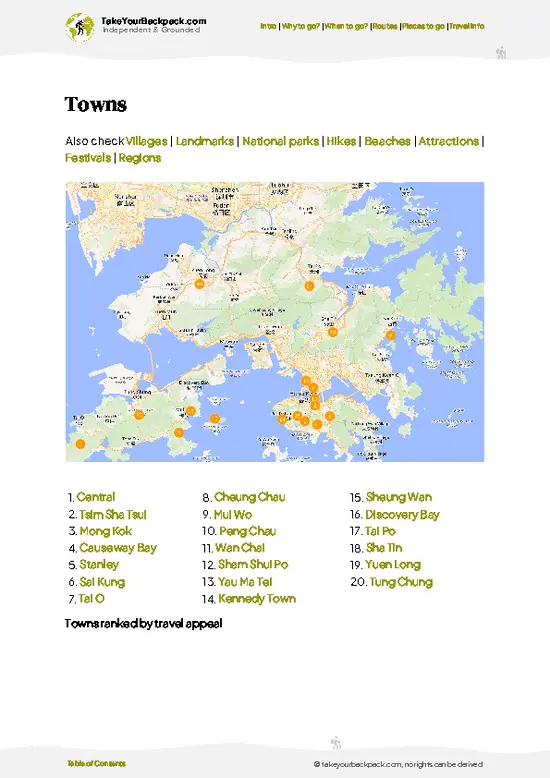
The ListTop towns of Hong Kong

1 Central

Skyscrapers, mid-levels escalator, finance hub

Ride the world’s longest outdoor escalator, explore hidden alleys, and watch the city’s business heart in motion.

hong-kong-city-central
© Google |

2 Tsim Sha Tsui

Harbor views, museums, luxury shopping

Take in skyline panoramas, visit world-class museums, and explore bustling streets lined with flagship stores and hotels.

3 Mong Kok

Sneaker Street, neon signs, market lanes

Navigate crowded sidewalks, shop for rare sneakers, and experience the city’s most intense street-level energy.

hong-kong-city-mong-kok
© Google |

4 Causeway Bay

Shopping mecca, Times Square, urban bustle

Dive into packed malls, explore side streets for local snacks, and feel the pulse of Hong Kong’s busiest retail district.

hong-kong-city-causeway-bay
© Google |

5 Stanley

Seaside market, colonial buildings, promenade

Browse market stalls, relax at waterfront cafés, and explore remnants of British-era architecture by the South China Sea.

6 Sai Kung

Seafood piers, hiking trails, island ferries

Set out for coastal hikes, kayak to quiet coves, and dine at open-air seafood restaurants overlooking the harbor.

7 Tai O

Stilt houses, fishing traditions, pink dolphins

Wander wooden walkways above tidal flats, sample shrimp paste, and join boat trips searching for rare dolphins.

8 Cheung Chau

Fishing village, bun festival, car-free lanes

Walk narrow alleys lined with seafood stalls, rent a bike, and catch local festivals unique to this compact island.

9 Mui Wo

Silvermine Bay, ferry pier, rural trails

Arrive by ferry, rent a bike, and explore waterfalls, beaches, and small villages scattered across Lantau’s eastern shore.

10 Peng Chau

Tiny island, old temples, quiet beaches

Walk peaceful lanes, visit incense-filled temples, and enjoy a slow afternoon on uncrowded sands.

11 Wan Chai

Nightlife strip, convention center, old-meets-new

Find late-night bars, spot colonial-era buildings, and see how tradition and modernity coexist along busy thoroughfares.

hong-kong-city-wan-chai
© Google |

12 Sham Shui Po

Electronics markets, textile alleys, street food

Browse gadget stalls, hunt for fabric bargains, and sample some of the city’s best cheap eats in a dense urban grid.

13 Yau Ma Tei

Temple Street, fruit market, vintage cinema

Catch a street opera, browse night market stalls, and see a slice of old Kowloon in action.

14 Kennedy Town

Harborfront bars, swimming pier, quiet streets

Unwind at waterfront spots, swim off the public pier, and explore a neighborhood that feels removed from city rush.

15 Sheung Wan

Antique shops, dried seafood, indie cafés

Browse for curios, sip coffee in quiet corners, and walk streets where old trades still shape daily life.

hong-kong-city-sheung-wan
© Google |

16 Discovery Bay

Car-free zone, marina, expat community

Relax on sandy beaches, dine at waterfront restaurants, and experience a quieter, family-oriented enclave away from city crowds.

17 Tai Po

Seafood market, cycling hub, waterfront promenade

Sample fresh catch at the pier, pedal scenic bike routes, and enjoy a slower pace along the Tolo Harbour.

18 Sha Tin

New Town Plaza, cycling paths, riverfront

Cycle along the Shing Mun River, browse sprawling malls, and find quiet temples tucked among residential towers.

19 Yuen Long

Wetlands, village lanes, open-air markets

Stroll rural backroads, visit traditional walled villages, and spot migratory birds in protected marshland.

20 Tung Chung

Cable car, outlet shopping, airport access

Ride the Ngong Ping 360 for mountain views, shop international brands, and stay close to Hong Kong’s main airport.

21 Tsuen Wan

Riverside parks, textile heritage, suburban malls

Discover a district where industrial roots meet green spaces, with easy access to hiking trails and modern shopping complexes.

22 Fanling

Walled villages, ancestral halls, rural outskirts

Visit centuries-old clan houses, explore quiet farmland, and see the contrast between old villages and new developments.

23 Sheung Shui

Border town, local markets, suburban estates

Shop at bustling street markets, observe cross-border trade, and find green spaces on the city’s northern edge.

24 Ma On Shan

Mountain backdrop, waterfront park, new town estates

Walk along the Ma On Shan promenade, enjoy mountain views, and explore a residential area with easy rail connections.

25 Tuen Mun

Harborfront, local markets, beachside parks

Experience a quieter side of the city with seaside promenades, neighborhood food stalls, and easy ferry links to outlying islands.

26 Kowloon City

Thai eateries, old airport relics, low-rise streets

Wander through neighborhoods where diverse cuisines, aviation history, and a patchwork of local shops create a distinctive urban landscape.

27 Wong Tai Sin

Famous temple, public housing, hillside parks

Visit a major Taoist temple, walk through sprawling estates, and find green escapes on the slopes above the city.

Think you know Hong Kong?

Prove you’re a true local — uncover 17 lesser-known towns in Hong Kong that locals tend to keep to themselves.
Loading the map 🌍

Expert viewPro Tips for Exploring the Best

How many towns: Visit three to five towns in a week. Each needs half a day or more once you add transfers, food stops and the walk in, and a fifth is usually the point where you start skimming. Fewer, slower visits beat a checklist, especially in summer heat.
Which kind for which style: For culture and history, pick a New Territories walled-village or market town. For hiking and beaches, choose an outlying island. For food and nightlife, stay with the old urban neighborhoods. If you have only one day and little energy, a rail-linked market town is easiest. On a longer trip, add one island for contrast.
Budget: Plan US$55 to 110 a day (about HK$430 to 860) for independent travel. A dorm bed costs US$20 to 40 and a basic private room US$50 to 90 (HK$390 to 700), and rates climb at weekends and … read more 👉
How many towns: Visit three to five towns in a week. Each needs half a day or more once you add transfers, food stops and the walk in, and a fifth is usually the point where you start skimming. Fewer, slower visits beat a checklist, especially in summer heat.
Which kind for which style: For culture and history, pick a New Territories walled-village or market town. For hiking and beaches, choose an outlying island. For food and nightlife, stay with the old urban neighborhoods. If you have only one day and little energy, a rail-linked market town is easiest. On a longer trip, add one island for contrast.
Budget: Plan US$55 to 110 a day (about HK$430 to 860) for independent travel. A dorm bed costs US$20 to 40 and a basic private room US$50 to 90 (HK$390 to 700), and rates climb at weekends and holidays. Street and cha chaan teng meals run US$3 to 8 (HK$25 to 60), while a seafood dinner on an island can reach US$25 to 45. Transport per day is typically US$3 to 10 (HK$25 to 80) on an Octopus card, with island ferries from about US$2 to 4 on ordinary decks and a bit more for fast boats. Temples are often free or take small donations, and museums and heritage sites in towns run from free to about US$2 to 5 (HK$15 to 40). Guided village or heritage walks cost US$25 to 60 (HK$200 to 470) per person. Hike snacks and water from a 7-Eleven or supermarket save money, since island cafes charge more.
Safety: Hong Kong has low violent crime and towns are safe at night, but pickpockets work crowded ferries and market lanes, so keep your phone in a front pocket. The real risks are environmental: heat stroke on summer hikes, slippery trails after rain, and wild boar or cattle near some villages. Never feed them. Carry 1.5 liters of water per person and start early. Stay off beaches when shark or red-tide flags are flying. Typhoon warnings are issued through the Hong Kong Observatory, and trails and ferries close at signal 8.
Cultural notes: Villages are living communities, not theme parks, so ask before photographing residents and keep voices down near ancestral halls. At temples, do not step on thresholds, and take incense only if you plan to offer it. Walk on the left on narrow lanes, give seats to older passengers, and queue for ferries. Tipping is not expected at local eateries, though a 10 percent service charge often appears at sit-down restaurants. Carry some cash, since village shops and stalls often skip cards.

✈️ The backpacker research shortcutHong Kong Travel Guide

An offline-friendly backpacking guide with optimized travel routes, ranked highlights, transport advice, and the best areas to stay.
example page 0 from our offline Travel Guide for Hong Kong
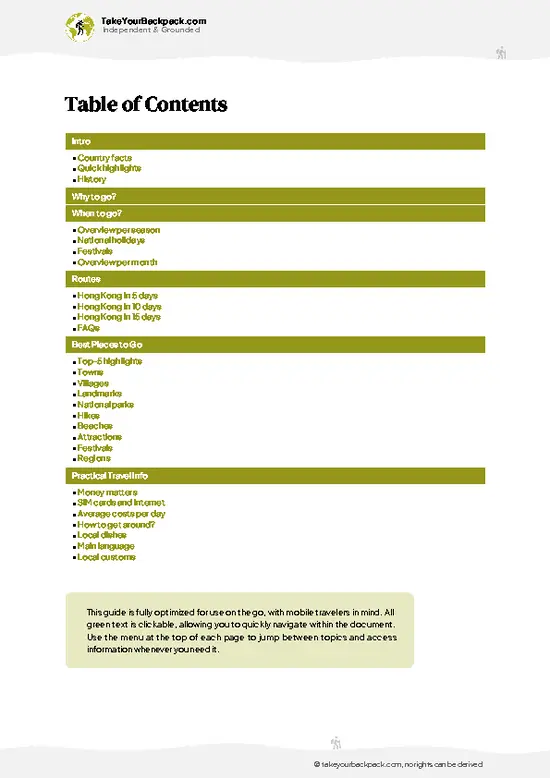
example page 1 from our offline Travel Guide for Hong Kong
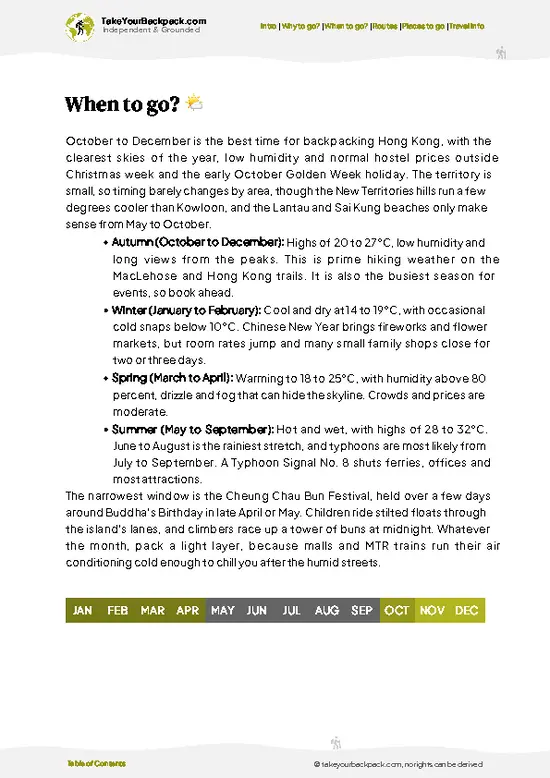
example page 2 from our offline Travel Guide for Hong Kong
example page 3 from our offline Travel Guide for Hong Kong
example page 4 from our offline Travel Guide for Hong Kong
example page 5 from our offline Travel Guide for Hong Kong
example page 6 from our offline Travel Guide for Hong Kong
example page 7 from our offline Travel Guide for Hong Kong
The digital guide (359 pages) contains:
✅ 97 highlights, ranked by travel appeal
✅ Optimized 5, 10 & 15-day travel routes
✅ Cities, national parks, landmarks, beaches
✅ How to get around
✅ Offline-friendly for travel without Wi-Fi
👉 Click to see all 30+ guide features

📅 Plan smarter in minutes, not weeks
✅ Month by month travel advice
✅ Festivals & national holidays
✅ Budget expectations

🗺️ Go to the right places, skip the overrated ones
✅ Honest pros & cons of destinations
✅ Top hikes, parks & viewpoints
✅ Lesser-known places most travelers miss
✅ Clear “worth it vs skip it” guidance

🛏️ Travel smoothly without rookie mistakes
✅ Best areas to stay
✅ Transport systems explained simply
✅ Common scams & safety advice
✅ SIM cards, money & practical tips

🌍 Understand the country, not just visit it
✅ Culture & traditions
✅ 52 Essential phrases & customs
✅ Festivals worth planning around
✅ Traveler-friendly historical context
✅ Insights that make places more meaningful

📱 Built for real travel conditions
✅ Fully downloadable PDF
✅ Works completely offline
✅ Optimized for phone use
✅ Useful in remote areas & buses
✅ Everything in one place
Stop searching, start planning
Get instant access to your full guide. 30‑day money-back guarantee.
+ Add another guide for just

By proceeding you agree to our terms.
Sent to your inbox immediately after payment • 100% Secure Checkout
Best Backpacking Travel Advisor 2025 tourism awardBest Backpacking
Travel Advisor
2025
What others say about Take Your Backpack Guides:
⭐⭐⭐⭐⭐
Fantastic, amazing amount of information!
⭐⭐⭐⭐⭐
My goodness this is amazing, it's what I've been looking for hats off too you!
⭐⭐⭐⭐⭐
I think this is absolutely BRILLIANT
⭐⭐⭐⭐
Very complete and informative. It's still missing places, but I gotta to commend you
⭐⭐⭐⭐⭐
This is truly amazing, thank you, can't wait to explore it with my kids!
⭐⭐⭐⭐⭐
Awesome resource, thank you!
⭐⭐⭐⭐⭐
This is amazing! Can't wait to explore the ones I haven't seen
⭐⭐⭐⭐
I love this! Well done, great idea.
⭐⭐⭐⭐⭐
Thanks for taking the time to make this gem!
⭐⭐⭐⭐⭐
This might be the best website I've ever seen.
⭐⭐⭐⭐⭐
Congratulations, and thank you so much for your work; it's incredibly valuable.
⭐⭐⭐⭐
In all seriousness I think you did a great job pointing out the important spots
⭐⭐⭐⭐⭐
10/10 very good
⭐⭐⭐⭐⭐
As someone who's only just starting to visit regularly this is awesome, thank you.
⭐⭐⭐⭐
Thank you very much! I'm going to visit my dad, it's going to be very useful!
⭐⭐⭐⭐⭐
This is really cool! We'll be travelling for the first time and this definitely come in handy.
⭐⭐⭐⭐⭐
You are now our minister of culture, congratulations 👨‍💼
⭐⭐⭐⭐⭐
Just wanted to tell you that this is a pearl! Going to follow your recommendations.
⭐⭐⭐⭐⭐
This is so cool. I'll definitely be using the resource for my travels soon.
⭐⭐⭐⭐⭐
This is very impressive! Good work.
⭐⭐⭐⭐⭐
This is an amazing and informative site. Very well done!

🛏️ Where to stay?Where to Stay in Hong Kong

Hong Kong has plenty of hostels and guesthouses, with dorm beds typically running HK$150 to 350 (US$20 to 45) a night and private rooms often the size of a closet. Tsim Sha Tsui puts you on the harbor promenade with the densest cluster of cheap guesthouses, though the older blocks can feel cramped and hectic, while Mong Kok and Yau Ma Tei are a bit cheaper, close to the night markets and street food, and very loud until late. On Hong Kong Island, Causeway Bay and Wan Chai keep you near shopping and the bar scene, and Sheung Wan is quieter and more local but pricier per bed, and the whole city stays very safe after dark.

If you enjoy meeting fellow travelers, consider choosing hostels with high … read more 👉
Hong Kong has plenty of hostels and guesthouses, with dorm beds typically running HK$150 to 350 (US$20 to 45) a night and private rooms often the size of a closet. Tsim Sha Tsui puts you on the harbor promenade with the densest cluster of cheap guesthouses, though the older blocks can feel cramped and hectic, while Mong Kok and Yau Ma Tei are a bit cheaper, close to the night markets and street food, and very loud until late. On Hong Kong Island, Causeway Bay and Wan Chai keep you near shopping and the bar scene, and Sheung Wan is quieter and more local but pricier per bed, and the whole city stays very safe after dark.

If you enjoy meeting fellow travelers, consider choosing hostels with high ratings for atmosphere. On the other hand, if you prefer having your own space, a hotel might be a better option.

Hong KongMore of Hong Kong

👋 Meet the founderWho’s Behind Take Your Backpack?

Johan, backpacker and founder of TakeYourBackpackHi, I’m Johan (Netherlands 🇳🇱), the creator of TakeYourBackpack. Over the past 3 decades, I’ve backpacked through 90+ countries across six continents, gaining extensive experience with independent travel, long-term trips, and overland routes.

This site is built on a combination of firsthand travel experience and carefully curated insights from other backpackers. Many guides are based on places I’ve personally visited, while others bring together tips, observations, and practical advice shared by trusted travelers I’ve met along the way.

The goal is to provide realistic, experience-driven guidance — not generic itineraries — so you can explore destinations with better context, clearer expectations, and more confidence.