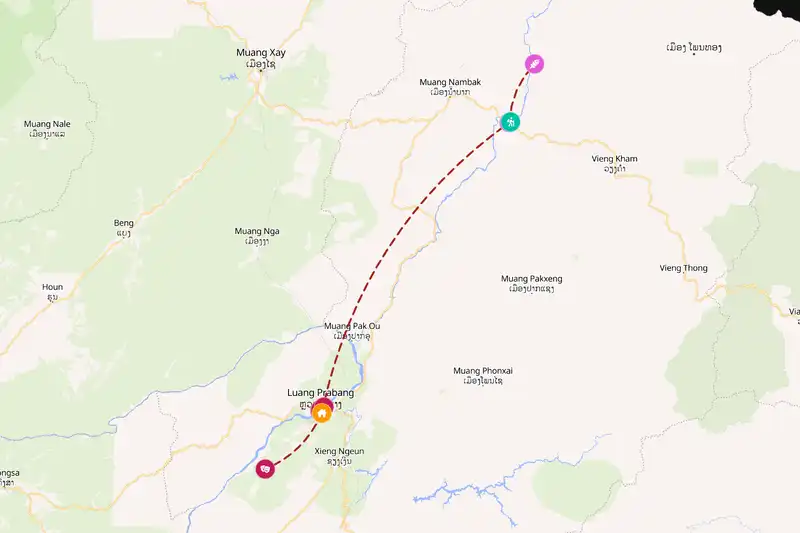
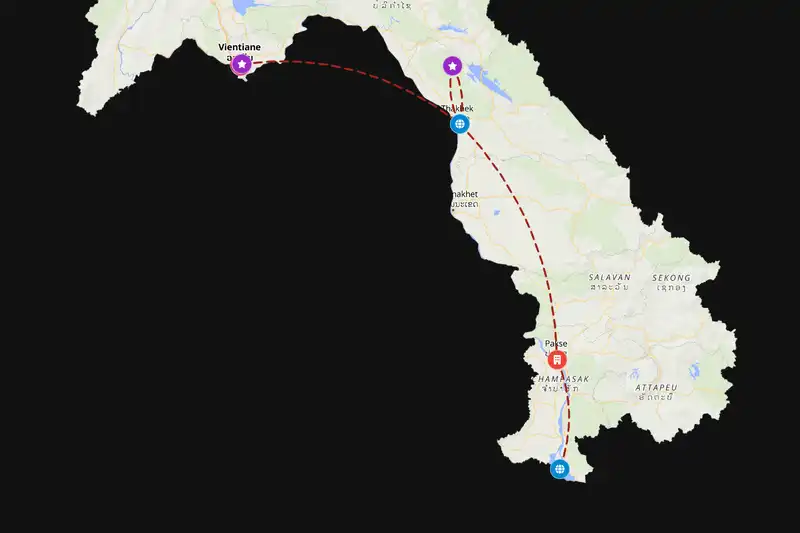
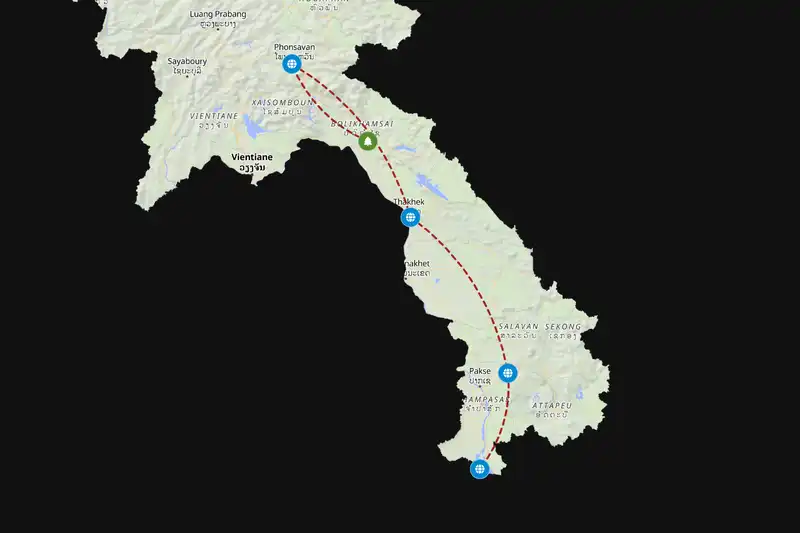
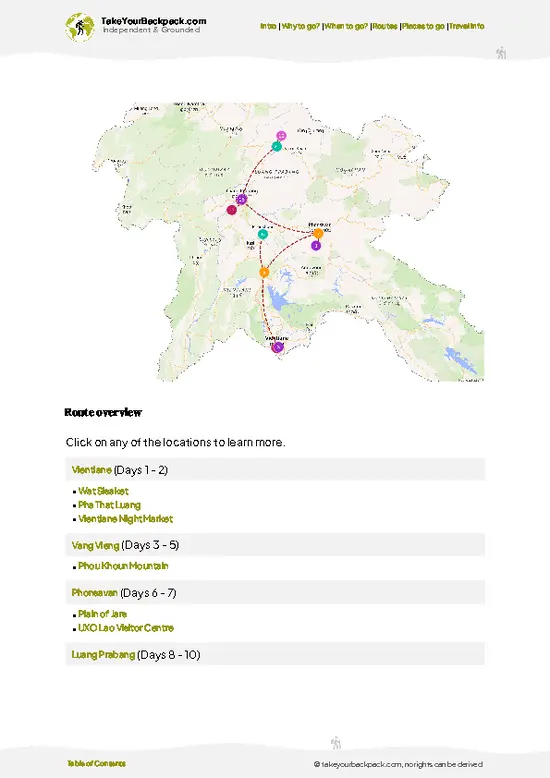
This 15-day Laos itinerary is for travelers who would rather know the north and center properly than tick off the whole map. It suits a first long trip in Southeast Asia as well as a return visit, and the pace is relaxed, with two or three nights at most stops and only one tiring overland day. You will use the Laos-China Railway, long-distance buses, minivans, tuk-tuks and a longtail boat on the Nam Ou.
Days 1-2: Vientiane
Start in the capital because it is the easiest place to land, change money and adjust to the heat. Give the first morning to
Wat Sisaket, built in 1818 and the only major temple to survive the Siamese sacking of the city in 1828. Its cloister walls hold thousands of small Buddha images tucked into niches, and the place is quiet enough to hear the fans turning. Later, ride a tuk-tuk out to
Pha That Luang, whose gilded spire looks best in late-afternoon light when the tour groups have left. On the second evening, walk the riverfront
Vientiane Night Market, which is more …
read more 👉This 15-day Laos itinerary is for travelers who would rather know the north and center properly than tick off the whole map. It suits a first long trip in Southeast Asia as well as a return visit, and the pace is relaxed, with two or three nights at most stops and only one tiring overland day. You will use the Laos-China Railway, long-distance buses, minivans, tuk-tuks and a longtail boat on the Nam Ou.
Days 1-2: Vientiane
Start in the capital because it is the easiest place to land, change money and adjust to the heat. Give the first morning to Wat Sisaket, built in 1818 and the only major temple to survive the Siamese sacking of the city in 1828. Its cloister walls hold thousands of small Buddha images tucked into niches, and the place is quiet enough to hear the fans turning. Later, ride a tuk-tuk out to Pha That Luang, whose gilded spire looks best in late-afternoon light when the tour groups have left. On the second evening, walk the riverfront Vientiane Night Market, which is more about cheap clothes and phone cases than crafts, then eat grilled fish on the Mekong promenade as the lights of Thailand come on across the water.Days 3-5: Vang Vieng
The train to Vang Vieng takes about an hour, which makes this the gentlest transfer of the trip. The town’s party reputation has faded since the riverside bars were shut in 2012, and what remains is the reason people came in the first place: limestone towers rising straight out of rice fields along the Nam Song. Three nights lets you kayak or tube one day, rent a scooter and explore caves and swimming holes west of the river the next, and still have a lazy morning watching the hot-air balloons drift over the karst.Days 6-7: Plain of Jars
Day 6 is the long one: a 6 to 7 hour bus north on Route 13, then east on Route 7 after the junction at Phou Khoun Mountain, where the road crests a high ridge with views across rows of forested peaks. You end up in Phonsavan, on a plateau at roughly 1,100 meters with cool nights that feel strange after the lowlands. Day 7 is for the Plain of Jars, a UNESCO World Heritage Site since 2019, where hundreds of carved stone jars up to about 3 meters tall sit in grassy fields. Hire a tuk-tuk or scooter to cover Sites 1, 2 and 3, and stay inside the marked paths, because this province was heavily bombed during the Indochina War. Before you leave, stop by the UXO Lao Visitor Centre in town, which explains what that bombing left behind in plain, sobering terms.Days 8-10: Luang Prabang
The road from Phonsavan to Luang Prabang winds for 8 to 10 hours, so plan nothing on Day 8 beyond a riverside dinner. Over the next two days, go deeper than the usual temple loop. The Traditional Arts and Ethnology Centre is the best primer in the country on the Hmong, Akha and other upland groups whose villages you will pass later. A half-day weaving or dyeing class at Ock Pop Tok, on a quiet stretch of the Mekong, is worth the fee. See Wat Xieng Thong and the Royal Palace Museum in the cooler morning, climb the roughly 330 steps of Phou Si Mountain for sunset, and browse the Luang Prabang Night Market afterward. Give one morning to Kuang Si Falls Bear Rescue Centre, where rescued moon bears doze in hammocks a short walk from the turquoise pools. Arrive before 10 a.m. to swim before the minivans roll in.Days 11-15: Nong Khiaw and Muang Ngoi Neua
Finish where the scenery is most dramatic and the pace is slowest. A 3 to 4 hour minivan takes you up the Nam Ou valley to Nong Khiaw, where cliffs rise straight above the bridge. On Day 12, the boat upstream to Muang Ngoi Neua takes about an hour, and with two nights in the village you can walk the Nong Khiaw to Muang Ngoi Trek trails out past caves and rice paddies to villages such as Ban Na and Huay Bo, eating sticky rice with families along the way. Ride the boat back on Day 14, climb the Nong Khiaw viewpoint for a last sunset, and take the minivan back to Luang Prabang on Day 15 for your flight or the train south.
If you have an extra half day in Luang Prabang, take a boat from Ban En to Tad Sae, a series of shallow tiered falls that see a fraction of the visitors Kuang Si gets.v2.webp)



 Best Backpacking