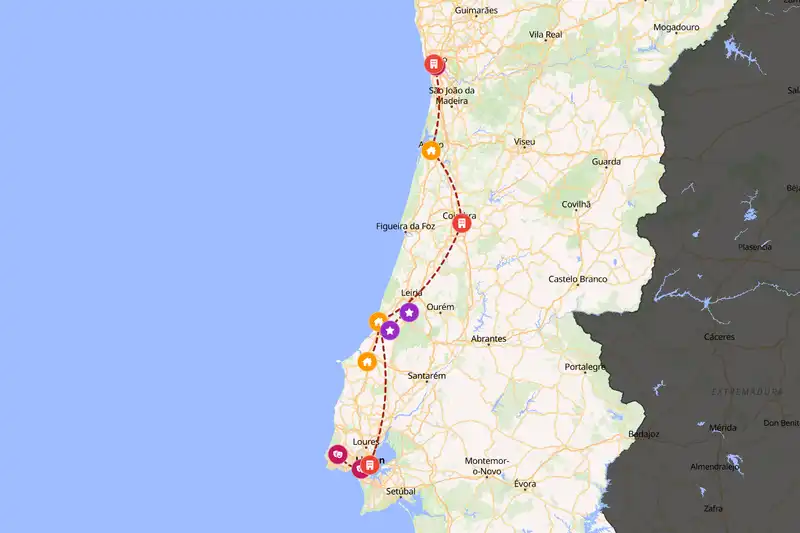
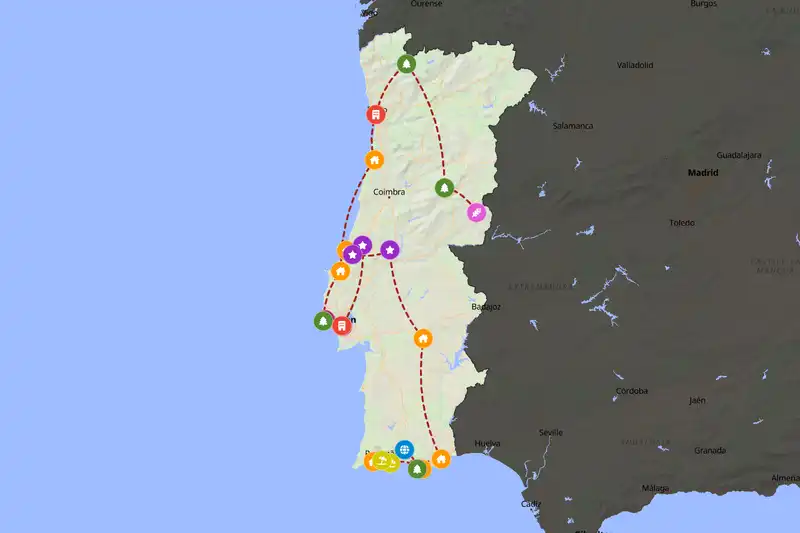
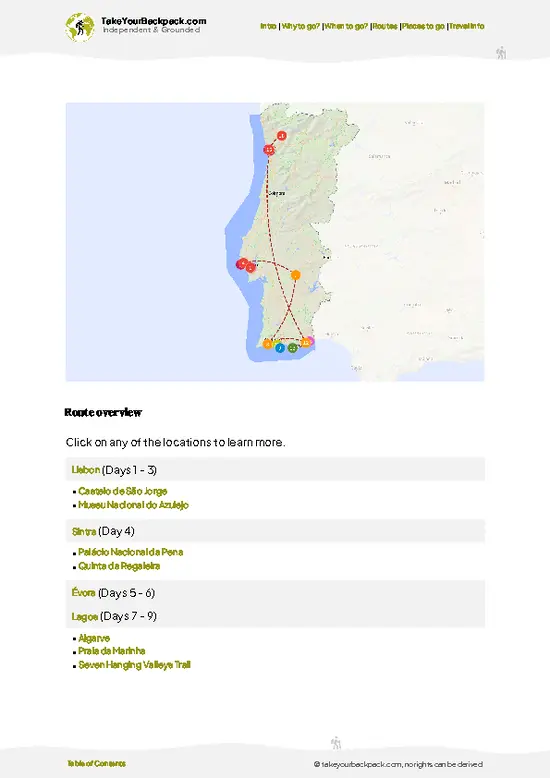
This 15-day loop suits travelers who want the whole mainland of Portugal in one trip: big-city neighborhoods, palace country, the Alentejo plains, two very different stretches of the Algarve and the granite north. The pace is steady but unhurried, with two or three nights in most bases and only one genuinely long travel day. You can do all of it with CP trains (suburban, regional and Alfa Pendular), Rede Expressos intercity buses, Lisbon’s metro and trams, one short ferry and a single taxi hop on the Algarve coast.
Days 1-3: Lisbon
Start in
Lisbon and give it three full days, because the city is built on steep hills and you will move slower than you expect. Climb to
Castelo de São Jorge at opening (around €15) for the view across the Tagus, then drift down through Alfama and Mouraria on foot, where laundry hangs over lanes too narrow for tram 28. Spend a morning at the
Museu Nacional do Azulejo, set in a former convent east of the center, where a 23-meter tile panorama shows Lisbon before …
read more 👉This 15-day loop suits travelers who want the whole mainland of Portugal in one trip: big-city neighborhoods, palace country, the Alentejo plains, two very different stretches of the Algarve and the granite north. The pace is steady but unhurried, with two or three nights in most bases and only one genuinely long travel day. You can do all of it with CP trains (suburban, regional and Alfa Pendular), Rede Expressos intercity buses, Lisbon’s metro and trams, one short ferry and a single taxi hop on the Algarve coast.
Days 1-3: Lisbon
Start in Lisbon and give it three full days, because the city is built on steep hills and you will move slower than you expect. Climb to Castelo de São Jorge at opening (around €15) for the view across the Tagus, then drift down through Alfama and Mouraria on foot, where laundry hangs over lanes too narrow for tram 28. Spend a morning at the Museu Nacional do Azulejo, set in a former convent east of the center, where a 23-meter tile panorama shows Lisbon before the 1755 earthquake. It explains every tiled facade you will pass for the next two weeks. Evenings belong to the miradouros (Senhora do Monte and Graça face the sunset) and a cheap plate of grilled sardines in summer.
Day 4: Sintra
Take the suburban train from Rossio (about 40 minutes, under €3) and sleep in Sintra rather than day-tripping. That one night lets you reach Palácio Nacional da Pena when the gates open, before the tour buses arrive and the ramp up to the yellow and red terraces turns into a queue. In the afternoon, walk downhill to Quinta da Regaleira and descend the spiral initiation well, nine landings of mossy stone that end in a tunnel. Sintra’s hills hold mist, so pack a layer even in July.
Days 5-6: Évora
Head back through Lisbon and catch a train or bus to Évora, roughly 1.5 hours east. The pace drops immediately. The walled center has a Roman temple standing in a plaza, a bone chapel lined with an estimated 5,000 skeletons, and whitewashed streets trimmed in mustard yellow. Two nights give you time for a slow lunch of black pork and Alentejo wine and an evening walk on the old aqueduct line, when the stone gives back the day’s heat.
Days 7-9: Lagos and the Algarve Coast
Day 7 is a 4 to 5 hour bus south to Lagos, the Algarve’s most backpacker-friendly town, with a walkable old center and a lively hostel scene. Walk out to Ponta da Piedade for the sea arches, then spend a full day east along the Algarve Coast: take a bus to Lagoa and a short taxi (€12 to 18) to Praia da Marinha, swim beneath the ochre cliffs, and follow the Seven Hanging Valleys Trail roughly 6 kilometers one way along the clifftops toward Vale Centeanes, 2 to 3 hours with photo stops. Go early in summer; there is almost no shade.
Days 10-11: Tavira and the Ria Formosa
The regional train runs the length of the coast, so reach Tavira in 2.5 to 3 hours with a change in Faro. The eastern Algarve has a lower skyline and a calmer rhythm: a Roman-style bridge, rooftops with four-sided tiled pyramids, and salt pans full of flamingos. Spend one day in the Ria Formosa lagoon by taking the small ferry to Ilha de Tavira’s long sand beach, and the other on an easy trip to Cacela Velha, a tiny whitewashed hamlet on a bluff above the lagoon where oysters cost a fraction of Lisbon prices.
Days 12-15: Porto and Guimarães
Day 12 is the long haul: train to Faro, then the direct Alfa Pendular to Porto, about 6.5 to 7 hours door to door, booked ahead for the best fares. You earn three nights in the north. Tour the Palácio da Bolsa for its gilded Arab Room, then cross town to the Serralves Museum & Villa, where a pink Art Deco house and contemporary galleries sit in 18 hectares of gardens. On day 14, ride the train about 1 hour 15 minutes to Guimarães, where the castle and the cobbled Largo da Oliveira make a relaxed day that ends back in Porto with a francesinha and a port tasting across the river in Gaia. Fly home from Porto on day 15.
From Tavira, I would send a friend on the ferry from Olhão to Culatra, a car-free sand island in the Ria Formosa; bring cash for grilled fish at the harbor shacks and check the time of the last boat back before you settle in.v2.webp)
 Best Backpacking